Gender Fluidity Now & Then: fairy tale, myth and icon

Gender Fluidity Now

The Sleeping Beauty now

When the curtains rises on Marius Petipa’s 1890 The Sleeping Beauty, we are left in no doubt that we are entering a world of rigid codes in terms of clothing, etiquette, and hierarchy.  And as the ballet progresses, we quickly become aware of its binary nature, with clear-cut distinctions between good and evil, beauty and ugliness, youth and age, male and female.

Based on Charles Perrault’s “old fairy”, the Evil Fairy Carabosse is indisputably female.  Nonetheless, following perhaps the example of Old Madge in August Bournonville’s La Sylphide (1836), Carabosse was originally performed by the renowned virtuoso and mime artist Enrico Cecchetti, and is still frequently performed by a male dancer.  Another contributory factor to this decision may have been the nature of Baba Yaga, the “supreme scare figure of the Russian nursery”, who in mythographer Marina Warner’s words “breaks the laws of nature.  Baba Yaga isn’t quite a woman, and certainly not feminine; there’s something of Tiresias about her, double-sexed and knowing” (more about Tiresias in the Then section of this post).  

Writing in 1998, American historian Sally Banes describes Carabosse as “old, ugly, wicked, hunchbacked” (54).  Clearly Carabosse is guilty of wickedness (although we are not given any explanation why), and her other attributes are implied through her name: bosse meaning hump or swelling, and cara meaning face.  This is indisputably the archetypal figure of the ugly old crone (Warner; Watson; Windling).

Banes analyses the ways in which Carabosse flaunts all the codes integral to Sleeping Beauty’s court life:

She breaks the polite bodily codes of the courtiers.  She takes up too much space; her movements are angular, spasmodic, and grotesque.  She transgresses the boundary between female power seen as beautiful and good (as in the Lilac Fairy’s commanding presence) and female power seen as ugly and evil … Usually played by a man (like Madge in La Sylphide, symbolizing her distinctly unfeminine traits and behavior), Carabosse has all the wrong proportions, above all gigantic hands.  She is a monster precisely because she is a category error, seemingly violating gender boundaries by combining aspects of male and female.

In this world a woman can be either powerful, good and beautiful or powerful, evil and ugly.   However, not only is Carabosse ugly and evil, and old, but like Baba Yaga she simultaneously embodies an archetypal female stereotype and fails to adhere to ideals of femininity.  And in this world of classical ballet, she is incapable of executing la danse d’école: “Unlike the good fairies, who balance confidently on one leg while dancing, she cannot even balance on two legs, for she walks with a cane” (Banes 54).

Kristen McNally as Carabosse, 2023 © ROH/Johan Persson

The Royal Ballet’s last run of Sleeping Beauty showcased a variety of female dancers in the role, including Kristen McNally, who has been performing Carabosse since 2009.  Reviews of McNally demonstrate that in her interpretation, while the Evil Fairy may indeed be a monster by nature, she strays far from Banes’ description of Carabosse:  Gerald Dowler describes her as “icily beautiful” with “an evil heart”, while Jann Parry sees her as similarly “glamorous and spiteful”.  One of McNally’s predecessors Genesia Rosato, who performed the role in the first decade of this century, and is our favourite Carabosse, was perceived by reviewers not as “a grotesque old hag …, but a rather sexy and dangerous woman” (Titherington), a “beautiful fairy turned spiteful and gothic” (Liber).
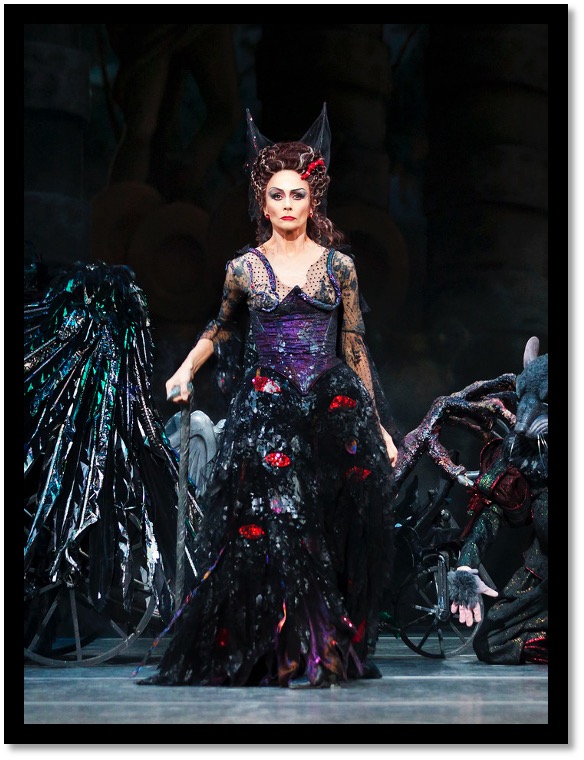
Genesia Rosato as Carabosse with artists of The Royal Ballet, 2011 © ROH/Johan Persson

Fortunately for us, both of these compelling performances are available commercially, so we were able to analyse the dancers’ movements closely in relation to Banes’ words and our knowledge of non-verbal communication and gender representation.  As is characteristic of women, both Rosato and McNally walk with a narrower gait and keep their gestures rather closer to the body than do their male predecessors, such as Anthony Dowell and Frederick Ashton, and they use their canes to poke rather than beat the offending Catalabutte, who forgot to invite Carabosse to the Christening. Unlike the figure of the “ugly old crone” they walk upright, their skin is smooth, and their lips red; and there are no “gigantic hands”.  Nonetheless we still see some “violation of gender boundaries” in their behaviour: they command the space around them; their gestures are strong, broad and intrusive, their eye contact ferocious.  In fact their behaviour in general exhibits the kind of dominance more typical of men (Argyle 284; Burgoon et al. 381; Carli et al. 1031; Mast and Sczesny 414). 

It seems clear that these renditions of Carabosse as glamorous and beautiful do not transgress the gender binary in the way that Banes has in mind, even though some masculine traits are visible.  However, for us, the critical point about gender here is that in this particular world of Sleeping Beauty, a woman can be powerful and evil … and yes, beautiful.  

Over at English National Ballet, who last performed The Sleeping Beauty in 2018, Kenneth MacMillan’s 1986 production provides a different, but equally fascinating, lens through which to view Carabosse, thanks to the costuming of Nicholas Georgiadis.  Luke Jennings’ colourful description of Carabosse with her “sallow features and madly crimped [red] hair” is an unmistakable reference to Queen Elizabeth I, so renowned for her combination of masculine and feminine traits. 

In 2018 casts included both male and female performers.  Clearly, from critic Vera Liber’s point of view, there was a noticeable distinction between the interpretations of the first and second casts, one male, one female:

On first night, James Streeter revels in playing up the panto villain, giving it plenty of gothic largesse, whereas second cast Stina Quagebeur is a deliciously spiteful Nicole Kidman lookalike, a vengeful woman wronged.

James Streeter as Carabosse in English National Ballet’s The Sleeping Beauty, 2018 © Laurent Liotardo

Even though not explicit, the comparison with a female actor and choice of words “deliciously spiteful” and “vengeful woman” do strongly imply that, to Liber, Stina Quagebeur appears markedly more feminine than James Streeter.  And her depiction of Quagebeur’s Carabosse is very much in line with the descriptions of Genesia Rosato and Kristen McNally in the role, combining evil, beauty and power.  

What Carabosse and Elizabeth I have in common is that they both have the power to wreck the dynasty: Elizabeth through her choice not to bear children, and Carabosse by scheming to prevent Aurora from producing an heir.  And this parallel with Elizabeth informs our understanding of Carabosse as a character that does not fit comfortably within a single gender category.  

The Scottish preacher and author John Knox (1514-1572) declared that “God hath revealed to some in this our age that it is more than a monster in nature that a woman should reign and bear empire above man” (2).  So whether performed by a male or female dancer, this Elizabeth-Carabosse can been seen as “a monster … seemingly violating gender boundaries”.  And on a personal note, we would have to say that Stina Quagebeur is without a doubt the most terrifying Carabosse we have ever encountered.

Cinderella now

Last season Scottish Ballet explored gender fluidity, again in the context of a familiar, well-loved fairy-tale ballet, but in an unusual and innovative way.  

Bruno Micchiardi as Cinders in Scottish Ballet’s Cinders. Credit Andy Ross

Renamed Cinders! the narrative of Cinderella on some nights featured the usual female Cinders, who falls in love with the Prince, while on others, romance blossomed between a male Cinders and the Princess.  

The cast was deliberately not released in advance, so each audience remained uncertain of Cinders’ gender until their appearance on the stage.  Consequently, when purchasing tickets, audiences had at least to be open to the challenge of a new way of viewing the work.

Scottish Ballet describes Cinders! as “an evolution and adaptation of Christopher Hampson’s [2015] Cinderella”.  Given ballet’s rigid gender codes in terms of roles, behaviours, technique and vocabulary, you may, like us, be wondering how such a gender swap could ever be achieved. Critic Kathy Elgin asks with apparent consternation, “Would a man have to cope with girly bourrée-ing?”.  Evidently, however, the adaptations were far more subtle than these musings suggest, as Elgin asserts that “the choreography is much the same irrespective of who’s playing what, except for some obvious variation in solos to accommodate male / female specialities. That is, in pas de deux, each is dancing the steps they would have danced in any pairing”.  Yet despite the subtlety of the changes, it is clear that for both dancers and viewers the approach to characterisation made a substantial difference, resulting in fresh insights into of the nature of the protagonists.
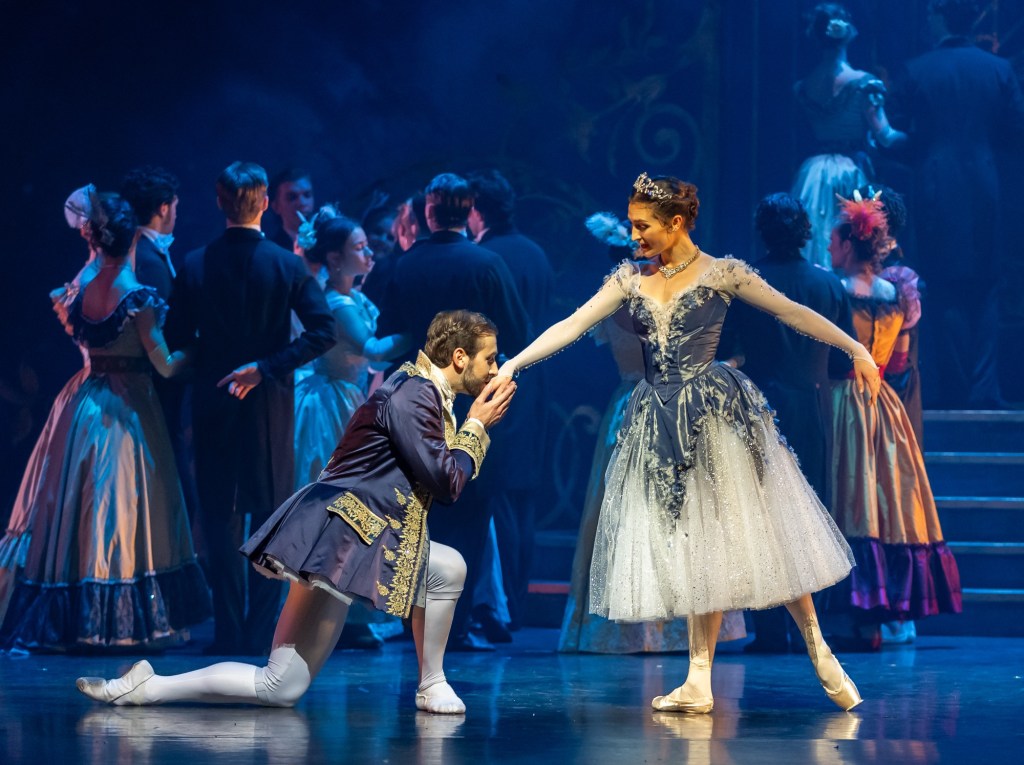
Bruno Micchiardi as Cinders and Jessica Fyfe as Princess Louise in Scottish Ballet’s Cinders. Credit Andy Ross

Principal Dancer Bruno Michiardi reflected on the rehearsal process:

What I’ve found most interesting about the fluidity of the roles of the Cinders leads is just how different and new it’s made the ballet feel. We all know and love the classic story of Cinderella, but this new version means we’re suddenly working in this amazing upside-down realm, where the male part (previously a more traditionally stoic character) is a complex mixture of vulnerability and resilience, and the female role (usually quite timid and downtrodden for most of the original ballet) is empowered and full of charisma… I’m excited at the prospect of exploring this further and sharing that with the audience! (“Introducing Cinders”)

Reviewer Tom King sees this exchange of gender as a “re-written … dialogue of the dance between the Princess and Cinders … so the gender prominence of this work now changes completely too as it is the male lead who now dominates and performs so much of this ballet”.  In contrast Elgin notes that “the commanding style of a princess in her own right reminds us how rarely women get the chance to make that kind of confident statement”.  
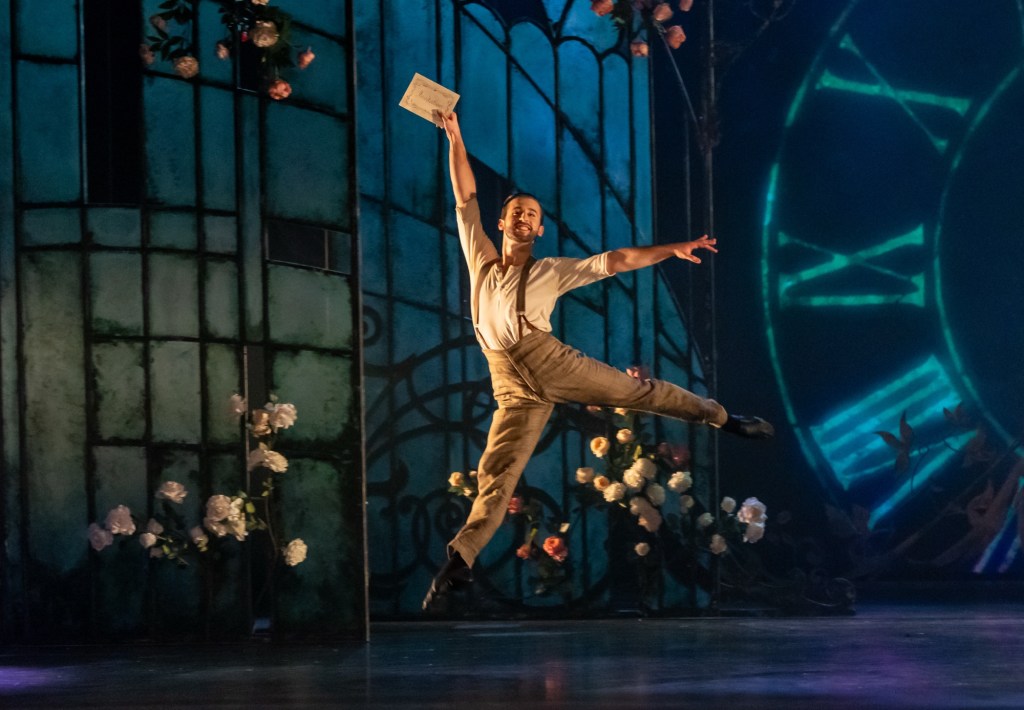
Bruno Micchiardi as Cinders in Scottish Ballet’s Cinders. Credit Andy Ross

These different perspectives highlight what is most important to us about the Cinders! gender swap—that is, the opportunity for both dancers and audience to reappraise how they perceive gender roles within the context of a traditional ballet narrative.

Broken Wings and the Male Fridas

In 2016 choreographer Annabelle Lopez Ochoa created a very different world to that of The Sleeping Beauty and Cinderella for English National Ballet.   Based on the life of artist Frida Kahlo, this ballet presents gender fluidity in a unique way—unique, but completely in line with Kahlo’s life and art.

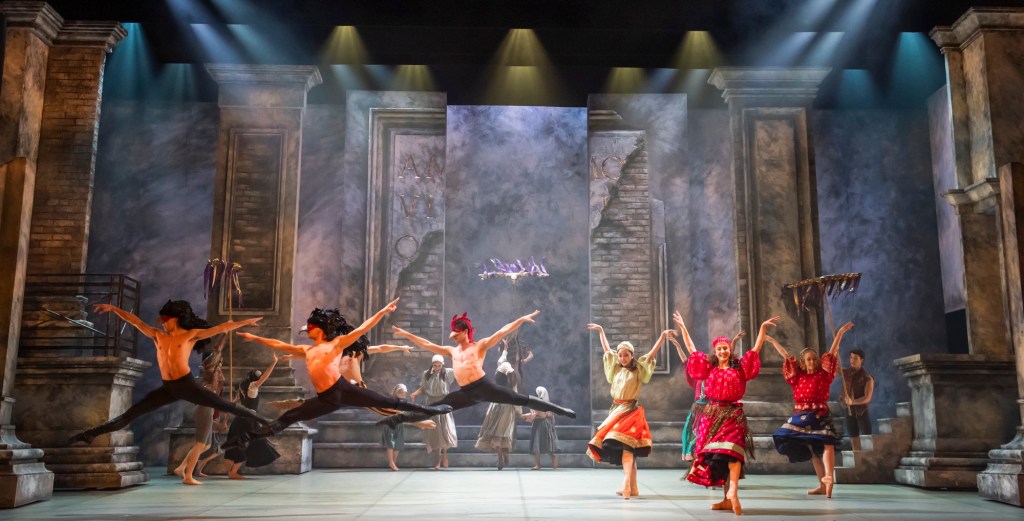
Like Queen Elizabeth I, Kahlo was known for her own peculiar union of masculinity and femininity.  In the ballet this is perhaps most notable through the presence of eleven “Male Fridas” who bring Kahlo’s paintings into three-dimensional life. 

Performed by male members of the company, these Fridas, described by designer Dieuweke van Reij as an “extension of Frida herself”, sport billowing full-length ruffled skirts, in bright, contrasting colours, inspired by traditional Tehuana dress. Their headdresses include flowers, butterflies, antlers, and the ceremonial resplandor, referencing specific self-portraits by Kahlo, including Self-Portrait with a Necklace of Thorns (1940), Self-Portrait as a Tehuana (1943), and Self-Portrait with a Monkey (1948).  Their torsos are painted to match their skirts.  
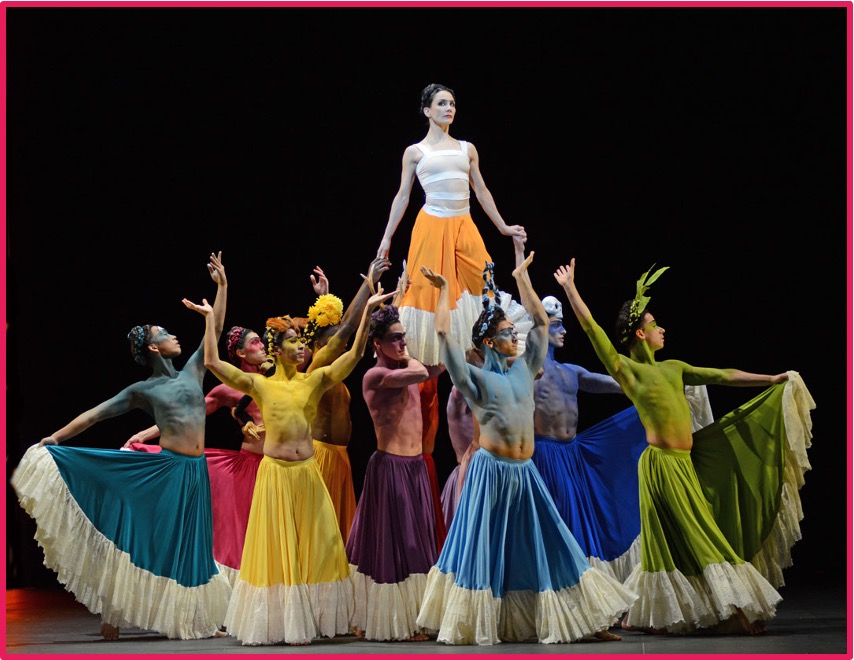
Tamara Rojo & Artists of English National Ballet, 2016 © Dave Morgan

The costumes are inspired by Kahlo’s iconic dress style, which is undeniably feminine, with the soft folds of the material and decorative headdresses.  But Kahlo was also known for a more androgynous style of dressing: even as a teenager she was known to wear a man’s suit with waistcoat and tie, and in her 1940 Self-Portrait with Cropped Hair she has cut her hair short and wears a man’s dark suit.  Her monobrow, moustache and strong features were also celebrated, even exaggerated, in her paintings.  And neither in terms of her behaviour did Kahlo conform to stereotypical femininity, with her forthrightness, her revolutionary politics, and her sexual appetite for both female and male lovers.  But despite the evident femininity of the Broken Wings costumes, they also connote power.  This is because the Tehuana dress is the traditional dress of the Zapotec women from the Isthmus of Tehuantepec, who are unconventional in being considered, to some extent at least, a matriarchal society, and from which, significantly, Kahlo’s mother hailed.

As the Male Fridas swirl and sway with bold lunges and leaps, and expansive leg gestures, they make full use of their skirts, creating a riot of colour and energy.  And Frida joins them, dressed in an orange Tehuana skirt, dancing in the same bold but non-gendered style, sometimes in unison.  Her dominance is writ large as the Male Fridas hold her aloft, and she boldly leads and directs their movements, displaying Kahlo’s own peculiar fusion of masculinity and femininity.
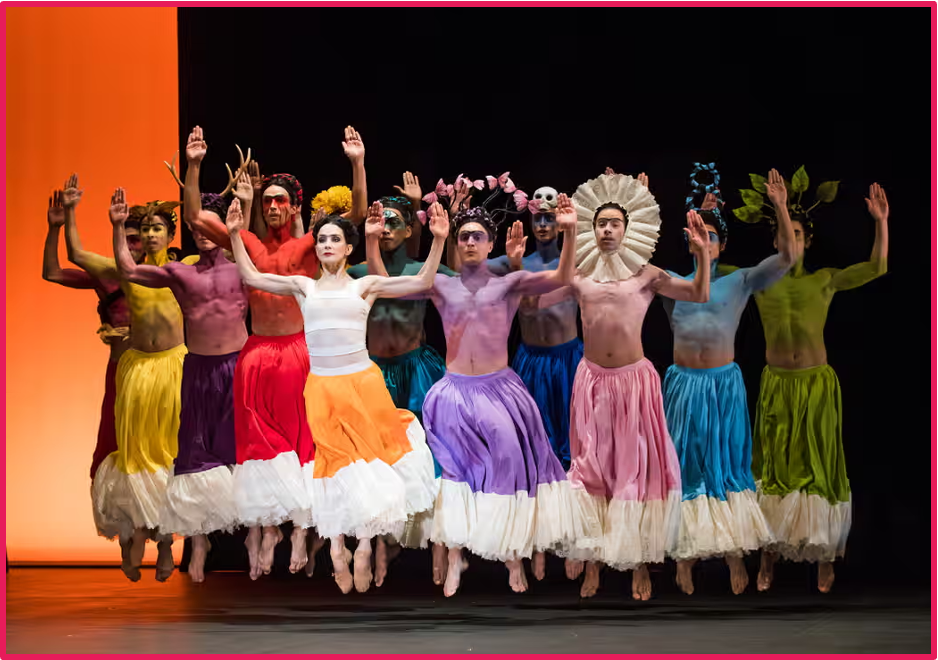
Tamara Rojo & Artists of English National Ballet, 2016
© Tristram Kenton

Further, the non-binary nature of the “Male Fridas” is accentuated by their strong resemblance to the “muxes” of Zapotec culture.  The muxes are considered neither female nor male, but instead are a recognised third gender.  While they are assigned male at birth, as adults they exhibit more stereotypically female attributes in their behaviours, and economic and societal roles.  This can be seen, for example, in the way they dress, their skill at embroidering and weaving, and their caregiving to elderly relatives (Balderas; Plata).

And now we return to The Sleeping Beauty and Cinderella to discover how gender fluidity manifested itself in British ballet in the past, before exploring a less conventional work …

Gender Fluidity Then

The Sleeping Beauty then

As we said in the Now section of this post, in 1890 Marius Petipa created the character of Carabosse for Enrico Cecchetti.  However, it’s interesting that when Sergei Diaghilev mounted his production of The Sleeping Beauty in London in 1921, Carabosse was performed by Carlotta Brianza, the originator of the role of Princess Aurora.  Over the last century there have been phases of male and female Carabosses, and following the lead of Petipa and Diaghilev, the calibre of dancers has sometimes been extraordinary, including Frederick Ashton, Robert Helpmann, Monica Mason, Lynn Seymour, Anthony Dowell, Edward Watson and Zenaida Yanowsky.  
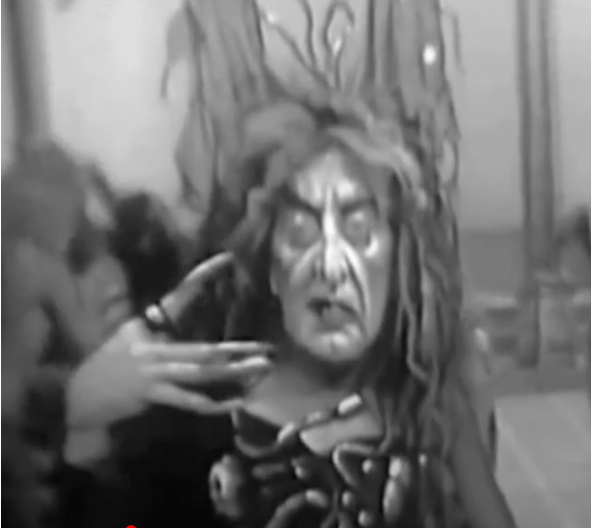
  Frederick Ashton, 1955 © Showcase Productions

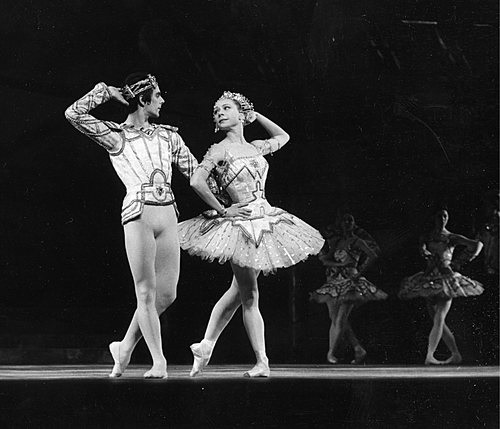
While it’s of interest that Brianza performed Carabosse for Diaghilev, it’s even more fascinating that it was not the role of Carabosse that the Impresario originally had in mind for Brianza; rather, it was her original role of Princess Aurora (Christoudia 201).  By 1921 Brianza was in her mid-50s.  According to the drama The Ballerinas, it was Brianza herself who suggested that she perform the part of the Evil Fairy.  It would be understandable if Brianza had considered herself unsuitable for Aurora at this point in her career (Tamara Rojo famously stated that she believed ballerinas should not be performing Aurora beyond the age of forty, and the first night went to the 26-year-old Olga Spessivtseva).  Ironically though, Carla Fracci, who performs sections of Aurora’s choreography as both Brianza and Spessivtseva in the programme, was herself just shy of fifty when it was recorded, and we would defy anyone to say she looks anything but youthful in both her appearance and her dancing.  At the 1890 premiere designer Alexander Benois described Brianza as “very pretty”, while reviews highlighted her grace and elegance (qtd. in Wiley 189).  Perhaps the most celebrated photograph of Brianza as Aurora shows her balancing sur pointe in cou de pied, her hands placed demurely by her neck, so that her forearms partially hide her décolleté, and attired in a tutu that gives her the perfect wasp-like waist.  The picture of femininity.  There seems no logical reason then that in her 50s Brianza would have lost all of her beauty, grace and elegance.  

It is difficult to know what Brianza was like as Carabosse, but we were able to find a small number of photos of her in the role, which make it crystal clear that Carabosse in this production was bereft of beauty, grace and elegance.  One photo shows her surrounded by her entourage of rats that seem to tower over her, making her appear a rather petite figure, her stature diminished by her hunched back and lankness of her hair (“Carlotta Brianza as Carabosse”). Feminine, but hardly the ideal of femininity.  In another she is seems to be mistress of all she surveys.  The stoop and the lank hair are still in evidence, but her silhouetted profile brings a baleful mystery to her lone, and in this image androgynous, figure (MacDonald 280).

Luckily, however, we have a very good idea of how Carabosse was portrayed in the 1950s by the Royal Ballet in the celebrated 1946 production by Nicholas Sergeyev and Ninette de Valois, thanks to two recordings of the work, made in 1955 and 1959.  On opening night Robert Helpmann accomplished the astonishing feat of performing both Carabosse and the Prince. However, it is Ashton who appears in the 1955 recording, while the 1959 film features Yvonne Cartier, who by this time was focussing on mime due to an inoperable ankle injury. 

Yvonne Cartier, 1959
© Royal Academy of Dance / ArenaPAL

Even though these two performances feature a male and a female dancer, they both exhibit a remarkable likeness to the image of Carabosse that we outlined in the Now section of this post.  With their blemished skin and stooping gait both Ashton and Cartier display the attributes of the archetypal “ugly old crone” or “grotesque old hag”.  More particularly, the words of Sally Banes could have been written specifically for these renditions of the Evil Fairy: Ashton’s movement are indisputably “angular, spasmodic, and grotesque”, while Cartier spreads her arms wide like enormous wings, and as a result “takes up too much space”.  And they have “the wrong proportions”.  Ashton has an exaggerated prosthetic nose, and they both have “gigantic hands” due to their long fake nails, threatening gestures, and in the case of Cartier, the spreading of her fingers like a raptor’s talons.

Yvonne Cartier, 1959
© Royal Academy of Dance / ArenaPAL

It seems that not even Brianza, the hyperfeminine Aurora of 1890, could escape the curse of being transformed from benign and pulchritudinous to malevolent and unsightly.  But as we have seen, the figure of Carabosse has evolved quite drastically over the last decades of the 20th century and into the current century, challenging the binaries of female vs. male, ugliness vs. beauty, good vs. evil.  How will that evolution continue, we wonder?

Cinderella then

The Royal Ballet’s decision to cast female Stepsisters as well as the traditional male Stepsisters in their 2023 production of Ashton’s Cinderella caused quite a stir (“Ashton’s Cinderella”; Pritchard), and we were excited about this “new” development.  However, we soon discovered that it had been Ashton’s original intention to create his choreography on female dancers, more specifically on Margaret Dale (the pioneer ballet filmmaker) and Moyra Fraser.  It was in fact Fraser’s unavailability that caused the change in plan, resulting in the celebrated Ashton-Helpmann Stepsister twosome.
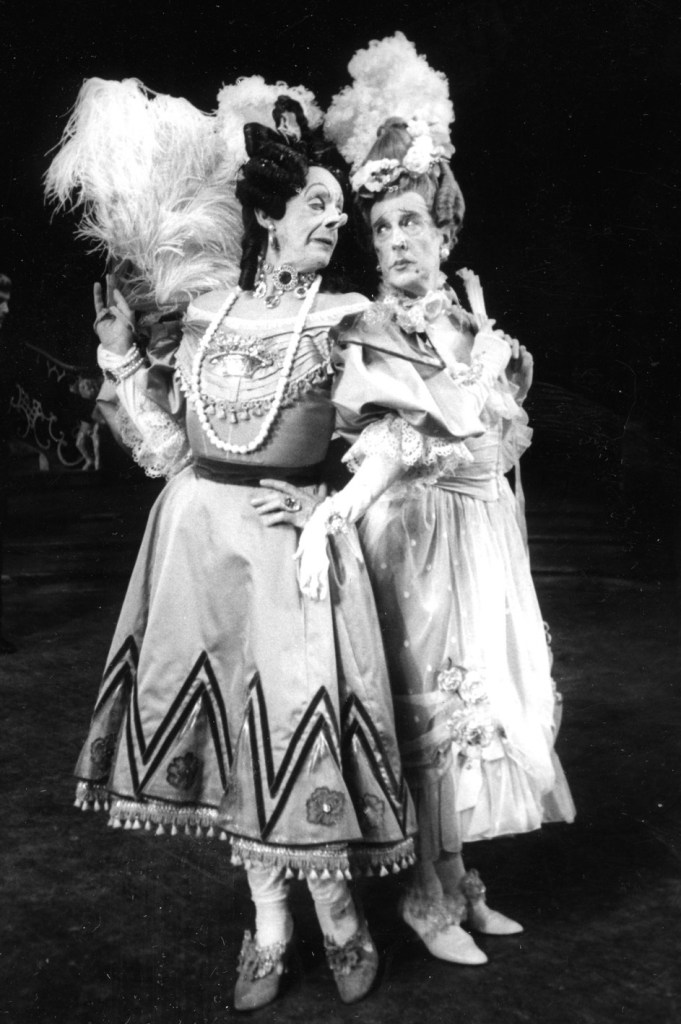
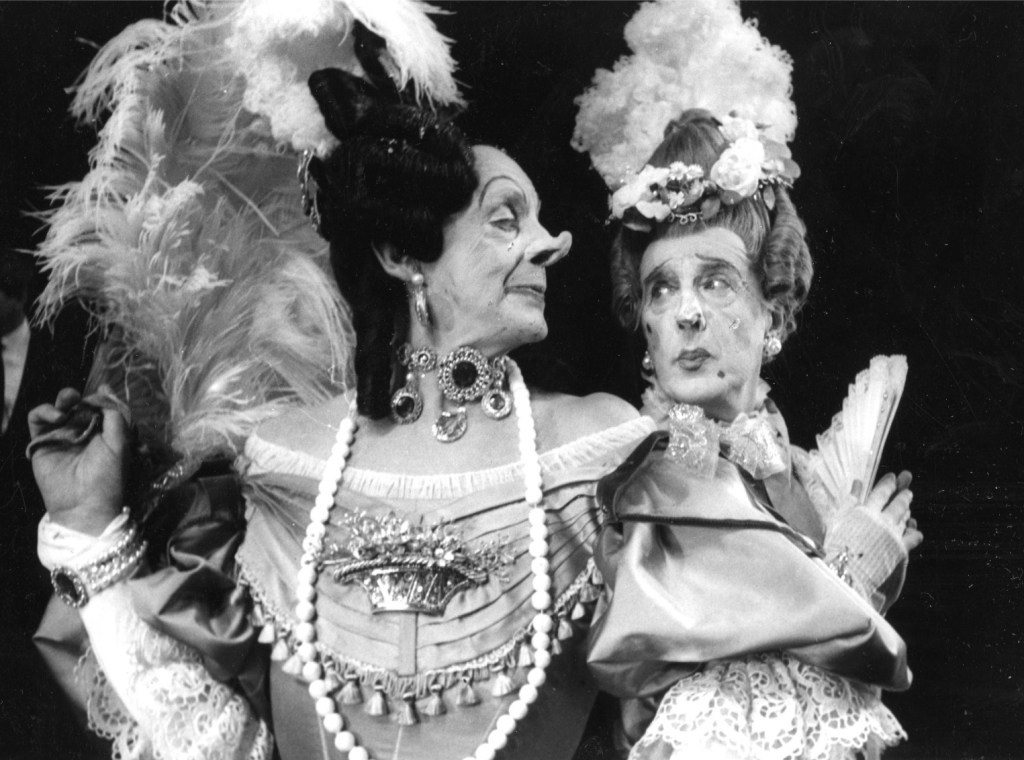
Although critic Judith Mackrell has referred to the Stepsisters as “monsters”, in stark contrast to Carabosse, they are “monsters of delusional vanity” (“Girls Aloud”) rather than monsters of evil.  Their behaviour and movements are noticeably “feminine”: they preen in front of the mirror, fuss about their clothes, bicker, walk in a flouncing manner and perform “female” variations at the Ball.  These variations overtly reference typical vocabulary from classical pas for ballerinas: small sissonnes piqué arabesque into retiré, a series of pas de chatdéveloppé à la secondeemboîtés en tournant; they even include lifts and fish dives supported by their male partners.  In fact the solo for the timid Stepsister, performed by Ashton, draws on the Sugar Plum Fairy variation, and perhaps also on Walt Disney’s hippo ballerina Hyacinth (Fantasia, 1940), inspired by the Baby Ballerina Tatiana Riabouchinska.

Further, there are additional layers of femininity to these characters.  Firstly, with their exaggerated costumes and comedic manners, they recognisably reference the tradition of the Pantomime Dame, so familiar to audiences in this country.  Secondly, Ashton had performed the Prince in Andrée Howard’s 1935 Cinderella, and according to David Vaughan (234) was influenced by some aspects of the characterisation, costumes and wig of the sister which Howard choreographed, designed and performed herself.  And thirdly, both Ashton and Helpmann were known for their mimicry, notably of women, and both were said to have been influenced by specific “female eccentrics” (Kavanagh 365): Helpmann by Jane Clark (renowned for her feistiness) and comedienne Beatrice Lillie (Vaughan 234), and Ashton himself by Edith Sitwell (Kavanagh 365). 

According to dance critic and historian David Vaughan, a female cast was unsuccessful, because “the kind of observation of the female character that lay beneath these performances could be achieved only by men” (234).  However, we would argue that, as in the case of the Pantomime Dame, performers and audience share an understanding that the performers are male, and much of the humour resides in this shared understanding, despite the overt performative femininity: “The audience and the character comically share the knowledge that the Dame is not really a woman” (“‘It’s behind you!’”).  And there must have been a delicious additional irony attached to the first cast at the premiere in 1948, given the status of both Ashton and Helpmann as key figures in the development of British ballet. 

While the Sisters each perform a ballerina solo, their dancing is very poor in classical terms, with turned-in feet, shaky balance, poor coordination and spatial confusion.  This of course adds to the humour of the work, a humour that perhaps loses some of its edge when these Pantomime Dames are performed by women. However, it also suggests that female characters who are not fully female, as it were, are in some way lacking, incapable as they are of performing female danse d’école, even when they are female dancers pretending to be male dancers pretending to be female.  

Moyra Fraser and Margaret Hill, 1958
© Royal Academy of Dance / ArenaPAL

Although Ashton and Helpmann were the most fêted “twin monsters” (Mackrell, “Girls Aloud”), the 1957 recording of the work featured Kenneth MacMillan instead of Helpmann.  Writing about MacMillan’s performance, Peter Wright spotlights the humour that arises from the play on gender in this context:

Kenneth’s performance is remarkably considered, recognisably feminine but still decidedly masculine in the best tradition of pantomime dame … He was very funny. (149)

Tiresias

Happily, undertaking research for this post gave us the opportunity to discover  more about a lesser known ballet by Frederick Ashton which, according to the Royal Opera House performance database, was performed only fourteen times over a period of four years after the premiere in 1951.  Based on the titular figure from Greek mythology, Tiresias was a tale of sexual identity and pleasure, following the life of Tiresias, who was transformed from man into woman and then back to manhood as the result of his reaction to witnessing a pair of copulating snakes.  Having experienced life as both man and woman, he is asked to decide the quarrel between Zeus and Hera as to whether males or females gain more enjoyment from the sexual act.  

As we might expect from a ballet of this era, the eponymous Tiresias was not gender fluid in the way that Frida and her corps de ballet are in Broken Wings.  Instead, Tiresias was performed by two dancers: Michael Somes as the male Tiresias, and Margot Fonteyn as his female counterpart.  Nonetheless, David Raher, writing in The Dancing Times (15) after the premiere, made some comments about Fonteyn’s performance that are pertinent to our discussion: 

Instead of contrasting femininity, she conveyed a masculinity in the attack and brio of her dancing.  Incontestable evidence of her gender, however, lay in the soft yet firm arm placements and in the unsurpassed magic of controlled développés …

While we ourselves may not make the same gender associations as Raher, the critic’s commentary clearly demonstrates that he perceived aspects of male and female in Fonteyn’s performance.  

David Vaughan, who also wrote Ashton’s biography, refers to the “wonderfully ambiguous eroticism” of the pas de deux (254), perhaps implying that the representation of gender is not as straightforward as is generally the case in ballet.  Although there seems to be no publicly available video footage of the ballet, we have found some sources that suggest the sensual nature of the choreography:  Julie Kavanagh’s description of the pas de deux as “fizz[ing] up into a kind of orgasm” (391), and John Wood’s photograph of Tiresias and her Lover (danced by John Field) showing them in a stylised pose of post-coital bliss, splayed across one another on the floor in a mirror image as they gaze into one other’s eyes.  

Judging from the reviews, the number of performances, and the literature on Tiresias, the ballet was neither a critical nor a commercial success.  Perhaps the sexually charged choreography and risqué subject matter (glossed over in the programme notes) were too ahead of their time.  After Fonteyn’s fiancé forbad her from performing the role again, her replacement Violetta Elvin took on the role, and when her she remarried, the same thing happened: her new husband banned her from dancing in further performances (Macaulay).  

Clearly the erotic nature of the choreography was challenging in 1951.  And this seems to have been the sticking point   However, the iconoclastic choice of gender fluidity and sexual identity as subject matter, in addition to sexual pleasure, should in our opinion not be forgotten, as it is a testament to the daring nature of a choreographer who is perhaps too often associated with conventionality. 

Concluding Thoughts

From this exploration of a small number of British ballets based on fairy tales and myth, it is clear that ballet is not entirely new to the concept of gender fluidity, and the more we dig into the characters, the more complex they become.  Nonetheless, while attitudes towards gender, and the stereotypes associated with two strictly defined genders, are becoming more open in everyday life, ballet is only very slowly reflecting this cultural shift.  Happily, this autumn two British companies have announced upcoming productions that will clearly feature gender-fluid characters: Northern Ballet’s Gentleman Jack, choreographed by Annabelle Lopez Ochoa, and Scottish Ballet’s Mary Queen of Scots in choreography by Sophie Laplane.

As long ago as 2012 Gretchen Alterowitz urged her readers to “contemplate the possibility of multiple or varied genders having a place in the ballet world” (21).  We would suggest that the example of Annabelle Lopez Ochoa’s Broken Wings based on the icon Frida Kahlo shows us that ballet does in fact have the capacity to create worlds where a greater diversity of gender representation can be explored—a diversity more suited to our current world and more relevant to the global art form that ballet has become.   

Next time on British Ballet Now and Then 
Autumn 2024 saw Noel Streatfeild’s 1936 novel Ballet Shoes adapted for the National Theatre.  We investigate this new stage production, television adaptations, and the original book itself.   

© British Ballet Now & Then

References

Alterowitz, Gretchen. “Contemporary Ballet: inhabiting the past while engaging the future”. Conversations Across the Field of Dance Studies, no. 35, 2015, pp. 20-23.

Argyle, Michael. Bodily Communication. 2nd ed., Routledge, 1988.

“Ashton’s Cinderella – new Royal Ballet production”. BalletcoForum,https://www.balletcoforum.com/topic/26439-ashtons-cinderella-new-royal-ballet-production/. Accessed 1 Sept. 2024.

Balderas, Jessica Rodriguez. “Muxes, the third gender that challenges heteronormativity”. Institute of Development Studies, 3 Feb. 2020, https://alumni.ids.ac.uk/news/blogs-perspectives-provocations-initiatives/513/513-Muxes-the-third-gender-that-challenges-heteronormativity

“The Ballerinas”.  YouTube, uploaded by markie polo, 24 May 2020, https://www.youtube.com/watch?v=Sx2D40Wavwg&t=10586s.

Banes, Sally. Dancing Women: female bodies on the stage. Routledge, 1998.

Burgoon et al. Nonverbal communication. 2nd ed., Routledge, 2022.

Carli, Linda L. et al. “Nonverbal Behavior, Gender, and Influence”. Journal of Personality and Social Psychology, vol. 68, no. 6, 1995, pp. 1030–1041, https://doi.org/10.1037/0022-3514.68.6.1030.

“Carlotta Brianza as Carabosse with her entourage of rats in the opening scene of The Sleeping Princess 1921”. Victoria and Albert Museumhttps://www.vam.ac.uk/blog/diaghilev-and-ballets-russes/more-diaghilev-and-film-industry

“Cinders! 2023”. Scottish Ballethttps://scottishballet.co.uk/discover/our-repertoire/cinders/. Accessed 16 May 2024.

Christoudia, Melanie Trifona. “Carlotta Brianza”. International Dictionary of Ballet, edited by Martha Bremser, pp. 200-01

Dowler, Gerald. “The Royal Ballet – The Sleeping Beauty”. Classical Source, 3 Jan. 2017, www.classicalsource.com/concert/the-royal-ballet-the-sleeping-beauty-3/

Elgin, Kathy. “Scottish Ballet’s Cinders! confirms Hampson is a savvy theatre-maker”. Bachtrack, 9 Jan. 2024   https://bachtrack.com/review-cinders-scottish-ballet-hampson-glasgow-edinburgh-december-january-2023-24

Fracci, Carla. “The Ballerinas”. YouTube, uploaded by Markie polo, 24 May 2020,  https://www.youtube.com/watch?v=Sx2D40Wavwg

“Introducing Cinders with a Charming Twist to the Tale”. Scottish Ballet, 2013, scottishballet.co.uk/discover/news-and-articles/introducing-cinders/

“‘It’s behind you! A look into the history of pantomime’”. University of York, 2010, www.york.ac.uk/news-and-events/features/pantomime/.

Jennings, Luke. “The Sleeping Beauty/English National Ballet – review”. The Guardian, 9 Dec. 2012, www.theguardian.com/stage/2012/dec/09/sleeping-beauty-english-national-ballet

Kavanagh, Julie. Secret Muses: the life of Frederick Ashton. Faber & Faber, 1996.

Knox, John. 1558. The First Blast of the Trumpet against the Monstrous Regiment of WomenBlackmask Online, 2022, http://public-library.uk/ebooks/35/36.pdf

Liber, Vera. “The Sleeping Beauty”. British Theatre Guide, 2009, www.britishtheatreguide.info/reviews/RBsleepingbeauty-rev

Macdonald, Nesta. Diaghilev Observed. Dance Horizons, 1975

Macaulay, Alastair. “Ashton and Balanchine: parallel lines”. NYU The Center for Ballet and the Arts, 2018, https://balletcenter.nyu.edu/lkl2018-script/

Mackrell, Judith. “Chase Johnsey’s unlikely success is a bold and beautiful victory for ballet”. The Guardian, 6 Feb. 2017, www.theguardian.com/stage/2017/feb/06/chase-johnsey-success-national-dance-awards

—. “Girls Aloud”. The Guardian, 1 Dec. 2003, www.theguardian.com/stage/2003/dec/01/dance

Mast, Marianne Schmid, and Sabine Sczesny. “Gender, Power, and Nonverbal Behavior”. Handbook of Gender Research in Psychology, vol. 1, Jan. 2010, pp. 411-25, SpringerLinkhttps://doi.org/10.1007/978-1-4419-1465-1_20

Plata, Gabriel. “Celebrating diversity: Meet Mexico’s Third Gender”. Inter-American Development Bank, 19 May 2019, https://www.iadb.org/en/story/celebrating-diversity-meet-mexicos-third-gender

Parry, Jann. “Royal Ballet – The Sleeping Beauty – London”. DanceTabs, 14 Nov. 2019, https://dancetabs.com/2019/11/royal-ballet-the-sleeping-beauty-london-2/

Pritchard, Jim. “The Royal Ballet exhibits Ashton’s Cinderella choreography in their Disneyfied new staging”. Seen and Heard International, 14 Apr. 2023, https://seenandheard-international.com/2023/04/the-royal-ballet-exhibits-ashtons-cinderella-choreography-in-their-disneyfied-new-staging/

Reij, Dieuweke van. “Broken Wings: interview with designer Dieuweke van Reij”. English National Ballet, 20 Jan. 2019,  www.ballet.org.uk/blog-detail/broken-wings-interview-designer-dieuweke-van-reij/

Rojo, Tamara. “Tamara Rojo South bank show 3”. YouTube, uploaded by Kabaiivansko2, 23 Apr. 2014, https://www.youtube.com/watch?v=hfOoX16RLFM

Titherington, Alan. “Tchaikovsky: The Sleeping Beauty (Royal Ballet – 2006)”. Myreviewer.com, 29 Sept. 2008, www.myreviewer.com/DVD/108291/Tchaikovsky-The-Sleeping-Beauty-Royal-Ballet-2006/108400/Review-by-Alan-Titherington

Vaughan, David. Frederick Ashton and his Ballets. Rev. ed., Dance Books, 1999.

Wright, Peter. Wrights and Wrongs: my life in dance. Oberon, 2016.

Warner, Marina. “Witchiness”. London Review of Books, vol. 31, no. 16, 2009, https://www.lrb.co.uk/the-paper/v31/n16/marina-warner/witchiness

Watson, Paul. “On Fairy Tales and Witches”. The Lazarus Corporation, 6 Jan. 2015, https://www.lazaruscorporation.co.uk/blogs/artists-notebook/posts/on-fairy-tales-and-witches

Windling, Terri. “Into the Wood, 9: Wild Men & Women”. Myth and Moor, 31 May 2013, https://windling.typepad.com/blog/2013/05/into-the-wood-8-wild-men-and-women.html

WATCHING WITH BRITISH BALLET NOW & THEN

Akram Khan’s Giselle Revisited

If Tamara Rojo’s sole achievement during her years as Artistic Director of English National Ballet (2012-2022) had been the commissioning of Akram Khan’s Giselle, she would have made a tremendous contribution to the ballet repertoire.  Such are our thoughts both before and after the Sadler’s Wells opening night of the production in September 2024.

English National Ballet dancers © Camilla Greenwell

Of course we have been watching the ballet since its first London run in 2016 and seen most of the casts.  Treasured memories include multiple viewings of Tamara Rojo herself with the wonderfully human James Streeter; a particularly intense performance by Alina Cojocaru and Isaac Hernández, where they both seemed to take flight into another dimension; Crystal Costa’s final ENB performance, with the sensitive and expressive Aitor Arietta, and our first viewing of James and his wife Erina Takahashi performing together (last year in Bristol).  

Erina Takahashi as Giselle and Ken Saruhashi as Hilarion © Camilla Greenwell

Revisiting the work after a period means seeing it afresh.  We know that.  But as the now-familiar stage action unfolds, we are surprised when a veil seems to lift from our eyes and we start to notice more clearly underlying patterns that bring an additional layer of emotional resonance to the piece for us.   

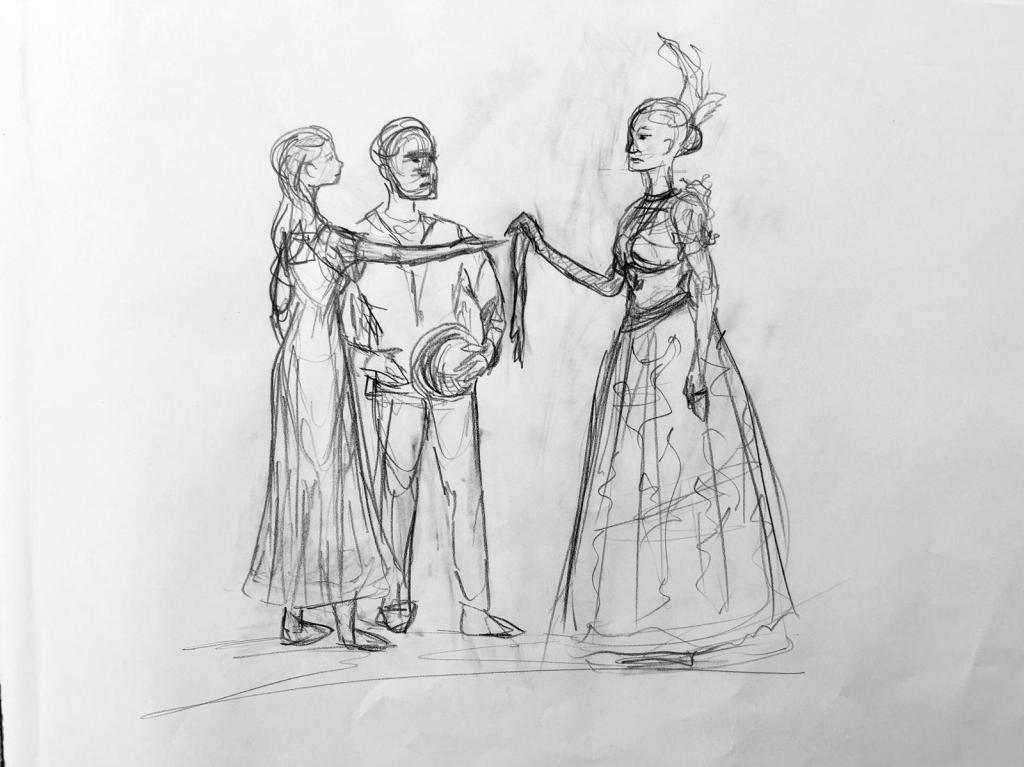
From the gloom emerges the crowd of refugee Outcasts pressing against the Wall.  From the crowd emerges a triangle of outliers: Giselle, a model of defiance and strength of will in the face of the Landlords; Albrecht, her lover, himself a Landlord, but one who spends time with the refugees to see Giselle; and the angry, arrogant, but fearful Hilarion, desirous of Giselle but desperate to improve his lot in life by bargaining with the Landlords.  We start to realise that triangles in this work act as an omen.  Conveyed through the most potent economy of means—space, eye contact and stillness—this is just the first of several dangerous triangles that mark key points in Khan’s staging.  

Once seen and surely never forgotten is the Glove Scene.  Bathilde, Albrecht’s fiancée, removes one of her gloves with deliberation and drops it on the floor for Giselle to pick up.  Her cruel power game plays out in stillness: Giselle holds her rival’s gaze with confidence and defiance as she calmly returns the glove.  But it is not Giselle who has retrieved the glove.  No.  The other character in this triangle is Hilarion.  It is he who has stooped down to pick the glove up from the ground and has attempted in vain to make Giselle bow her head before Bathilde.  He has managed to force the other Outcasts to bow down before the Landlords, but Giselle he cannot control.

Victoria Trentacoste

As Albrecht and Hilarion fight—a fight so palpable in its aggression, even though physical contact is limited—the chief Landlord circles slowly around them until his gaze reaches Hilarion’s eyes, a gaze of such force that it brings the confrontation to an abrupt end.  Squeezing Albrecht’s jaw in the vice of his grip, the Landlord seals Albrecht’s fate with an angry kiss.

The fates of Giselle herself and Hilarion are sealed at the moment when triangular relationships collide into a deadlock. Giselle has dared to insert herself and her unborn baby into the “neat” triangle of the Landlord, Bathilde and Albrecht, that is, the triangle that will keep power in the hands of the powerful and keep it removed from the powerless.  Giselle pulls Albrecht’s hand to her belly, holding it there so he can feel their bond.  But feeling instead the glare of the Landlord and Bathilde’s penetrating eyes upon him, Albrecht wrenches his hand away, throwing Giselle to the ground.  Then he literally turns his back on Giselle to walk off stage with Bathilde.

Erina Takahashi as Giselle & James Streeter Albrecht © Camilla Greenwell

For us the words of First Soloist Katja Khaniukova, who has been involved in the ballet since its premiere, shine a light on this climax:

I believe that she’s dead from the moment when Albrecht left her, when he decided … when he just turned away … That’s the moment when she died inside.  

Erina Takahashi as Giselle © Camilla Greenwell

The ensuing mad scene is the final straw for the Landlords, as it were.  Giselle must be got rid of.  And it is Hilarion who is tasked with the dirty work.

Our impressions of Act I lead us to conclude that the narrative of Khan’s Giselle can be traced through this series of triangular relationships, based on love, desire, power and control, that escalate to the crisis point of Giselle’s destiny.

Victoria Trentacoste

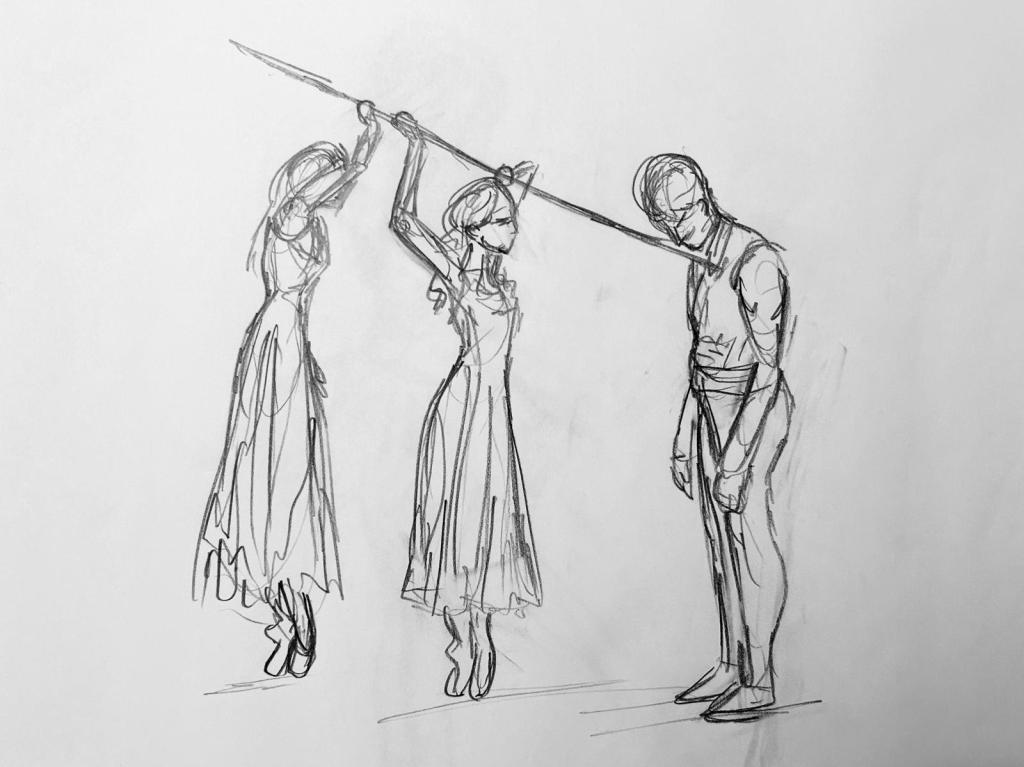
In the final triangle of the ballet Giselle seems to regain some of her agency.  It is she who cannot or will not pierce Albrecht through the heart with the cane, despite Myrtha’s urgent exhortations to do so.  It is she who demands some grace time to relive moments of love with Albrecht.  And it is she who pulls the cane from Myrtha’s grasp, thrusts it into herself and then Myrtha to connect them as they disappear back into the gloom.  Giselle then holds Albrecht’s gaze for as long as she is able.  Erina Takahashi, who has been dancing Giselle since 2016, gives us a sense of Giselle’s state of mind.

So one of the scenes that has a strong impact on me … is at the end of the ballet … the last pas de deux with Albrecht.  At the end we are feeling each another and Myrtha takes us separate, but I decide to say to Myrtha “It’s ok, I’m coming with you”. … You have a last look to Albrecht to say goodbye to him, and then go away with Myrtha.  That’s a very strong impact for me.

Emma Hawes as Myrtha © Camilla Greenwell

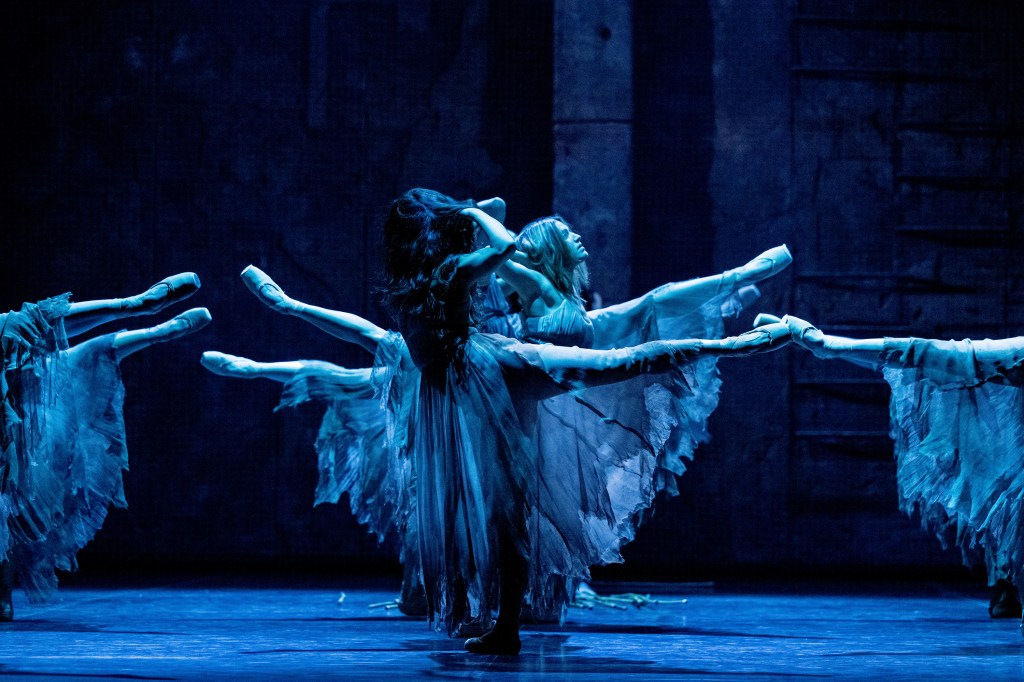
Days after the performance the magnificent score by Vincenzo Lamangna still haunts us.  Lamagna’s reworking of the familiar love themes from Adolphe Adam’s original 1841 music have now taken on a life or their own: like a phantom they hover and linger, circle and circle without resolution.  At a climactic moment the melody spirals into a dark wailing abyss as the Wilis perform their famous arabesques voyagés.  With another woman dead at the hands of the Landlords, the vicious cycle of oppression continues without respite.  

English National Ballet dancers © Camilla Greenwell

Ironically, in order to create such “bewitching” (Mackrell) performances of Outcasts, outliers and misfits, of divisive abuse of power, the Company must work together to produce cohesion in their dancing and storytelling.  And in truth, we have never experienced a performance of this ballet where the effort and energy of such cohesion was not pouring from the stage. 

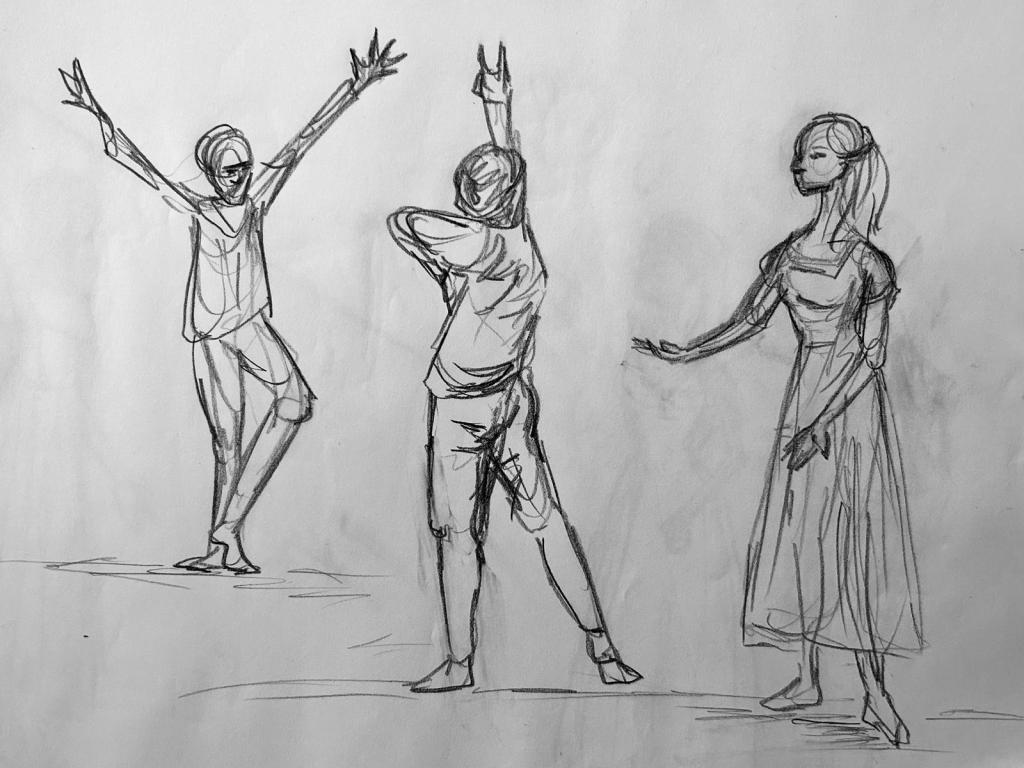
We would like to thank our lovely friend Victoria Trentacoste for the beautiful hand-drawn illustrations 🙏

thinkcreatewrite.com

Victoria Trentacoste

https://www.instagram.com/thinkcreatewrite/

© British Ballet Now & Then

References

Khaniukova, Katja. “Akram Khan’s Giselle: Katja Khaniukova’s favourite moments | English National Ballet”. YouTube, uploaded by English National Ballet, 23 Oct. 2016, https://www.youtube.com/watch?v=5cM8nK0WYxs

Mackrell, Judith. “Giselle review – Akram Khan’s bewitching ballet is magnificently danced”. The Guardian, 28 Sept. 2016, https://www.theguardian.com/stage/2016/sep/28/giselle-review-akram-khan-english-national-ballet

Takahashi, Erina. “Erina Takahashi on the ending of Akram Khan’s Giselle”.  X, uploaded by English National Ballet, 18 Sept. 2024, https://x.com/ENBallet/status/1836358770542190633

Watching with British Ballet Now and Then: Northern Ballet’s Romeo & Juliet

We are a tad nervous.  Northern Ballet is one of our favourite companies: we’ve travelled out of London to watch them perform Cathy Marston’s Jane Eyre and Victoria, as well as David Nixon’s Cinderella and The Great Gatsby.  But this is Romeo and Juliet, and over the years there has been such a plethora of productions to see in this country, and even a cluster of celebrated versions created for, or at least staged by, British companies: English National Ballet have staged both Rudolf Nureyev’s and Frederick Ashton’s choreographies, Scottish Ballet John Cranko’s, and of course both Royal Ballet companies the iconic adaptation of Shakespeare’s play by Kenneth MacMillan, often described as the “definitive” Romeo and Juliet ballet (Byrne; Watts).  Having been watching it since our teens, it is the Romeo with we are most familiar, the one that is indelibly seared on our memory.

How is it possible to compete with these celebrated works? We did in fact once see Northern Ballet’s production, which was choreographed by Massimo Moricone, and directed and devised by the dancer and actor Christopher Gable, who famously created MacMillan’s Romeo in 1965.  But that was long ago, in the 1990s, when it was new, and our understanding of adaptation not as developed as it is now.  We have read positive reviews, and we enjoy the conducting of Daniel Parkinson (Associate Conductor), as well as the dancing of members of the cast we are about to see: Dominique Larose (Juliet), Joseph Taylor (Romeo), and Rachael Gillespie (one of Juliet’s Friends).  So, tentative as we are, let’s see what happens …

At first the scale of the work bothers us slightly: the market scenes are not teeming with people, and surely the ball is a rather slight gathering for a family as proud and powerful as the Capulets.  But let’s shift our watching a bit and think of the stage action more as symbolic than realistic …  There are other ingredients that bring the work to life. There are children in the marketplace (not all choreographers have followed August Bournonville’s enthusiasm for including children in the villages and towns that provide the setting of their narratives); there are great swaying, streaming carnival pennants that fill the space and add energy to the movement.  

But what is most noticeable about the first fight scene is its humour.  Montagues and Capulets jump on each other’s backs.  There are fisticuffs. Lord Capulet tries to throttle his rival Montague. It’s all a bit uncouth.  And there seems to be more flag waving and stick wielding than real intention to kill, despite the menacing posturing of the Capulets.  Lethal weapons are scant.

Northern Ballet dancers in Romeo and Juliet ©Tristram Kenton

Nonetheless, this first fight ends on a note of strange tragedy.  A child dies and is held up by Prince Escalus for all to see.  It seems a bit out of place amidst all the raucous behaviour.  But again, thinking of it on a symbolic level, it functions as a forewarning of events to come.

Similarly, the Ballroom Scene, while relatively small in scale, is rich in action—so much so that it is quite a challenge (albeit a pleasurable one) to pick up on all the narrative detail.  Our eyes roam around the stage to follow all the activity … Once he has spotted Juliet, Romeo moves around and across the space, as if drawn to her by an invisible thread.  There are some shenanigans going on between Lady Capulet and her Nephew Tybalt in the background, which seems to cause some tension with Lord Capulet.  And joy of joys, Juliet’s friends have personality—their function is definitely not simply to frame Juliet as the ballerina, but to convey something of the excitement and sheer pleasure of youth. They flit around the stage, eagerly watching the dancing, animatedly “chatting” amongst themselves, with Juliet’s Nurse, and with the Guests; they are prominent in the dancing with the Guests and with Juliet.  And their thrill at being at the ball ratchets up a notch when they notice, all aflutter, the instant and magnetic attraction between Juliet and Romeo.  

The hustle and bustle of the ballroom dissolves into dark stillness as a pool of soft light creates Romeo and Juliet’s new world of radiant and tender love, a love that is also pitted against the escalating friction between the aggressive Tybalt and mapcap Mercutio. 

And now to the climax of Act I … The sets that separate the protagonists as the curtain opens on the first scene is now used to explore their desire for one another before they come together in their duet.  At the start of the scene their breathless anticipation is palpable.  Juliet above and Romeo below, they lean their bodies against the balcony, feeling its surfaces with sensuous touch, like a surrogate lover.  Now moving around the stage together, their touch is reciprocated: they stroke one another’s hair, embrace, lean on one another and eventually kiss.  Although the heady sweep of MacMillan’s choreography is still so alive in our minds, there are moments in the choreography before us where we see the movement follow Sergei Prokofiev’s score in a different way, as their bodies open and close, rise and fall with the melody. 

Dominique Larose and Joseph Taylor in Romeo and Juliet ©Tristram Kenton

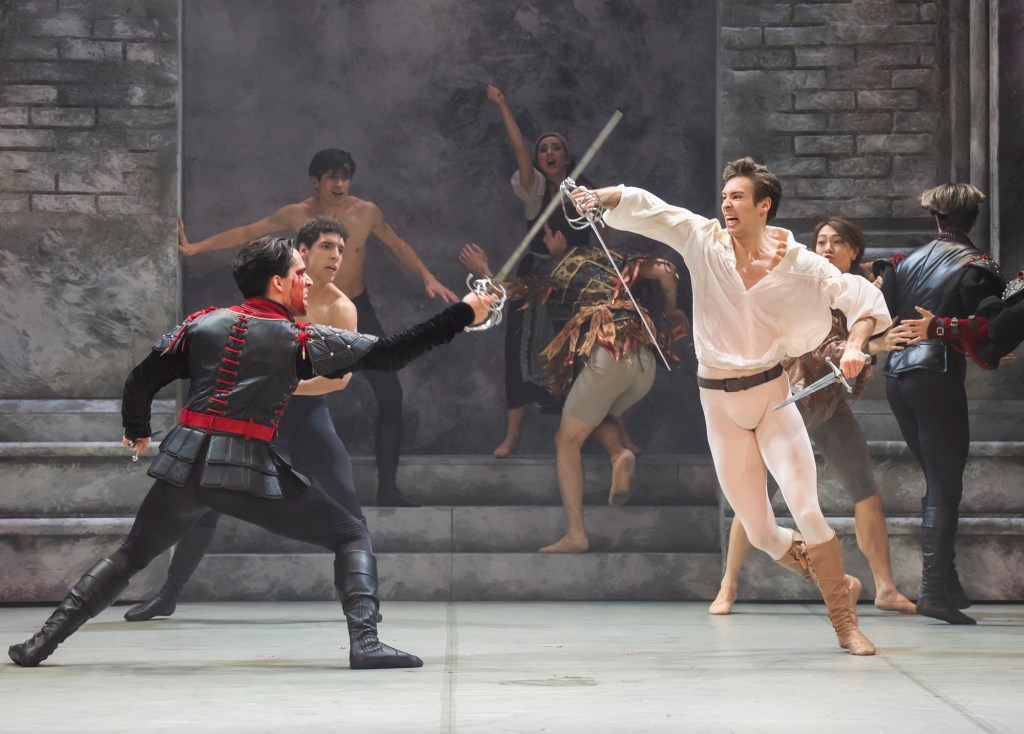
And so to Act II … The light-hearted, comedic tone resumes, with jocund carnival dancing, while Romeo sets himself up for a good ribbing as he wanders the town square in a state of swooning reverie, followed by bawdy fun with Juliet’s Nurse when she brings Romeo his letter from Juliet.  Even the fight between Tybalt and Mercutio begins more as derring-do than any serious intention to wound, let alone cause a mortal wound.  Mercutio goads his opponent by waving Tybalt’s own gloves in his face, spinning, leaping and cartwheeling around him, like an acrobat.  This ridiculing is too much for the vain and vicious Tybalt, who avails himself of a metal claw to strike out at Mercutio.  And suddenly there is Mercutio impaled on the wall stabbed by his own dagger.

Harry Skoupas and Joseph Taylor in Romeo and Juliet ©Tristram Kenton

The duel between Romeo and Tybalt is of an utterly different order to all the fighting that precedes it.  Right from the start both parties wield their lethal swords, one in each hand, fighting to the death.  The clash of metal and the speed of movement expose the emotional intensity of this fight.  But the violence culminates not only in the anticipated thrust of Romeo’s sword: the two men seize one another’s throats, with the result that Romeo kills Tybalt with his bare hands around Tybalt’s neck.  The murder of Mercutio has flipped comedy to tragedy, play fighting to murderous violence.  Sheets of rain cascade down from the heavens, with thunder and lightning, closing the act like an echo of Mercutio’s curse “A plague a’both your houses!” (3.1.106).

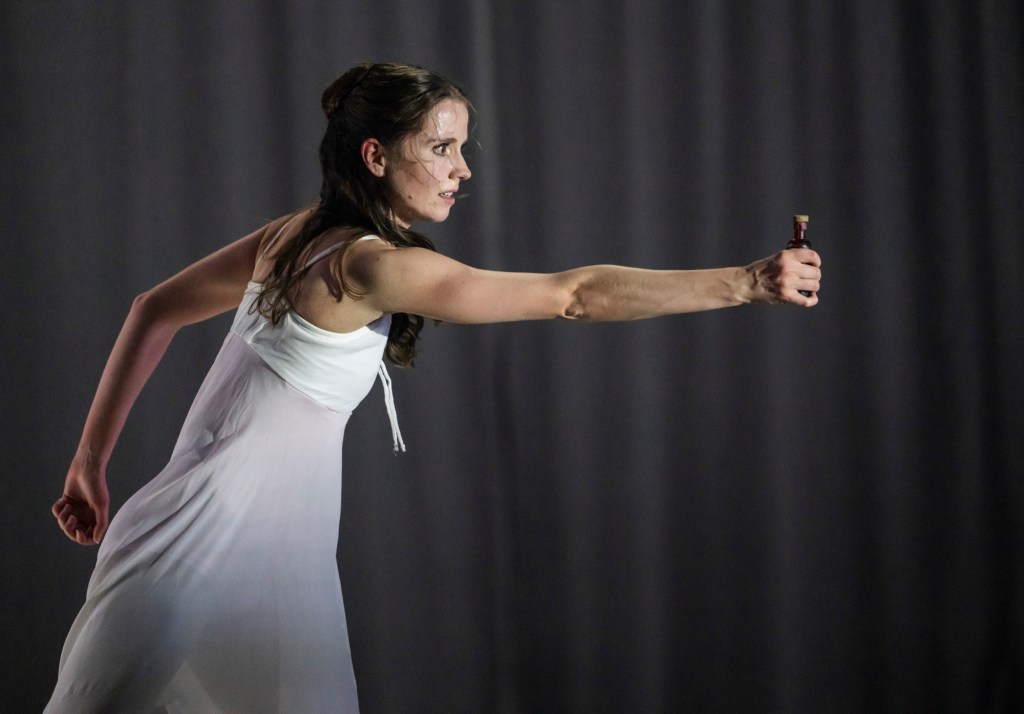
In the final act, the gawky child whose feet dangle from the bed is jolted into womanhood.  We watch this transition with awe.  The ferocity with which Juliet rips off the signature Capulet red and black apparel establishes her independence.  Completely alone on the stage and in life, betrayed by her Nurse, in conflict with her Parents, her Cousin killed by her exiled Husband, Juliet has to make the decision that will determine the rest of her life.  Shakespeare leaves us in no doubt about Juliet’s fears of what may transpire if she decides to take the potion.  She imagines the “foul mouth” of the tomb, Tybalt “festering in his shroud”, “loathsome smells”, and “madly play[ing] with my forefathers’ joints” (4.3.34-51).  

We watch Juliet dance a pas de deux in this scene, with the vial of sleeping potion replacing her partner.  Dancing a pas de deux, her aloneness is all the more poignant: by rights she should be dancing with her husband on the first joyful morning of their marriage.   She holds the vial close to her body, away from her body, moves it in circular motions around her—in front, above, behind her—turning, bending, swaying, twisting as she explores the space around her. She may be making a decision, but the vial seems welded to her very being, as if fate has decided for her.

Dominique Larose in Romeo and Juliet ©Tristram Kenton

Lady Capulet instructs the Nurse to see to Juliet’s body.  After the warm, playful exchanges between Juliet and her Nurse, after the sharing of confidences and the Nurse’s fierce defence of Juliet in the face of Lord Capulet’s rage at his Daughter’s flagrant disobedience (more striking in this version than others, we feel), the Nurse’s deft, uncompromising, seemingly detached, stripping of the bed and rearranging of Juliet’s body conveys its own peculiar sense of brutality.  

The violence of this work strikes us again in the Tomb Scene when Romeo’s response to Paris’ assault on him with a dagger is to smash Paris’ head against the wall—the nearest, most immediate weapon to hand.  Romeo’s grief again manifests itself in raw physical brutality before he lovingly and tenderly dances with Juliet’s comatose body, wrapping her limbs around him, wrapping his body around hers, stroking her soft skin, feeling her still-warm body against his own to relive their brief time together.  Juliet’s joy at waking to find herself in Romeo’s arms is palpable but of course short lived.

Dominique Larose and Joseph Taylor in Romeo and Juliet ©Tristram Kenton

As Lord Capulet and Montague become reconciled in their grief we sense Mercutio’s curse lifting.  But the scene is not so long as to detract from the loss of young lives that has precipitated this long overdue reconciliation.  

We leave the theatre, our minds astir with images that bring to mind Linda Hutcheon’s concept of adaptation as a “creative act” (8), and our nervousness assuaged. We are great admirers of MacMillan’s Romeo and Juliet, but we don’t feel comfortable with the notion of a “definitive” adaptation of anything really—it just seems too limiting to us.  This adaptation of Shakespeare’s play has emphasised humour and sexual awakening on the one hand, and the pragmatism, grief and violence associated with death on the other. And we’re fine with that.

©British Ballet Now & Then


References

Byrne, Emma. “Romeo and Juliet review: an inspired choice for the Royal Ballet’s return”. The Standard, 6 Oct. 2021, https://www.standard.co.uk/culture/dance/romeo-and-juliet-review-royal-opera-house-b959020.html

Hutcheon, Linda and Siobhan O’Flynn. A Theory of Adaptation. 2nd ed. Routledge, 2013.

Shakespeare, William. Romeo and Juliet. Penguin Books, 1967.

Watts, Graham. “Northern Ballet’s Romeo & Juliet: a plethora of outstanding dancers”. Bachtrack, 29 May 2024, https://bachtrack.com/review-romeo-and-juliet-northern-ballet-sadlers-wells-may-2024


The 19th Century Canon Now & Then

The 19th Century Canon Now

Last summer Birmingham Royal Ballet (BRB) brought their new production of Marius Petipa’s 1869 Don Quixote to London, after it had premiered four months earlier at the Birmingham Hippodrome.  With the exception of The Nutcracker, which is pretty much obligatory fare for any major ballet company (as discussed in our very first British Ballet Now & Then post, this was the first work from the 19th century ballet canon to have been performed by BRB since Carlos Acosta took over as Artistic Director in January 2020.  The premiere had originally been planned for the start of Acosta’s inaugural season, but like so many productions had to be postponed due to the Covid pandemic.

Matador Scene featuring Brandon Lawrence as Espada Photo with Artists of Birmingham Royal Ballet; photo: Emma Kauldhar

The choice of Don Quixote in favour of any other work from the 19th century canon was hardly surprising: Acosta himself has been long associated with the role of Basilio.  At the age of 17 he won the Prix de Lausanne after dancing Basilio’s Act III variation; he performed the role with the Royal Ballet (RB) in Rudolf Nureyev’s staging mounted by Ross Stretton and then created his own production of the ballet for the Company, now adapted for his own Company.

Like the other 19th century classics, Don Quixote provides technical challenges for dancers of different ranking, and opportunities for a large cast of performers to engage in different styles: classical, character and mime.  Other works in the British ballet repertoire that offer similar opportunities are La Sylphide (Bournonville, 1836), Giselle (Coralli/Perrot, 1841), Coppélia (Saint-Léon, 1870; Petipa, 1884) La Bayadère (Petipa, 1877), The Sleeping Beauty (Petipa, 1890), Swan Lake (Petipa/Ivanov, 1895) Raymonda (Petipa, 1898) and Le Corsaire (Petipa, 1899).

Artists of English National Ballet in La Sylphide, photo: Laurent-Liotardo
Jurgita Dronina and Isaac Hernandez in La Sylphide, photo: Laurent Liotardo

Apart from the fact that these works were all created during the 1800s, when ballet as an art form became more recognisably what we understand as ballet today, with its focus on the female dancer, themes inspired by Romanticism, and development of pointe work and ballets blancs, they are all connected by the fact that they were originally choreographed in France or Russia and “travelled” to this country via various routes (as we will discuss further in the Then section of this post).  Although we are sure that you are all familiar with Don Quixote, La Bayadère, Raymonda and Le Corsaire, these works took a number of decades to become established within the British repertoire, being produced in the UK at different times by different companies from 1962 to 2022, and not always in their entirety.

If you follow this blog, you will already know the history of Raymonda in the UK prior to English National Ballet’s evening-length production, which premiered in January last year.  Important details for this particular post is the fact that it was Nureyev, just three years after his defection from the Soviet Union, who first staged Raymonda in this country, initially in a complete production for the Royal Ballet (1964), and then as a one-act ballet based on the final act of the work, in 1966.  In this form Raymonda can stand on its own as a divertissement within a mixed bill, and between 1993 and 2014 English National Ballet also performed a single-act Raymonda, firstly in a production by Frederick Franklin (the British-American dancer, teacher, choreographer and director), and then, in 1993 in Nureyev’s staging, as part of the Nureyev Celebration, marking 75 years since Nureyev’s birth and 20 years since his death.

Momoko Hirata as Kitri and Mathias Dingman as Basilio, with Artists of Birmingham Royal Ballet in Don Quixote; photo: Johan Persson

Similarly, it was Nureyev who first staged La Bayadère in the UK—not in its entirety, but in that superb example of high classicism, the “Kingdom of the Shades”—and who introduced the Le Corsaire grand pas de deux to the British repertory.  In 1985 the “Kingdom of the Shades” entered the repertory of English National Ballet in a production by Natalia Makarova, and in 2013 the same company became the only British ballet company to perform the complete Corsaire.

The three most celebrated ballet defectors from the Soviet Union all had a tremendous impact on dancing in the West, but like Nureyev, Makarova and Mikhail Baryshnikov also had a substantial influence on the expansion of the 19th century repertoire, by staging major full-length productions for American Ballet Theatre: La Bayadère (Makarova, 1980) and Don Quixote (Baryshnikov, 1978).  Relevant for the development of British ballet is the fact that both of these productions were also mounted on the Royal Ballet.  While La Bayadère was the first complete version of the work to be performed in Britain (and remains the only full-length production in the UK), Don Quixote has had a far more varied history in this country, including stagings by Ballet Rambert (1962) and by London Festival (now English National) Ballet (1970), both mounted by Polish ballet master Witold Borkowski, in addition to the two more recent RB productions.  It seems that it is only since the RB’s staging of Baryshnikov’s version in 1993 that the work has become more firmly established within the British ballet repertoire. 

Although these star dancers from the Soviet Union also mounted new productions of 19th century works already established within the British ballet repertoire (including Nureyev’s Nutcracker for the Royal Ballet in 1968, and Makarova’s 1988 production of Swan Lake for London Festival Ballet), it is noticeable that they focused their efforts primarily on the 19th century works that they knew from their experiences at the Vaganova Academy and Mariinsky Ballet but were absent from North American and Western European companies.  And the newer 19th century additions to the British ballet repertoire have indubitably enriched our understanding of ballet as an art form, given dancers new challenges and offered audiences both entertainment and food for thought.  Don Quixote belongs to a very small number of comedic ballets, and provides a great variety of character and demi-character roles.  Le Corsaire is teeming with opportunities for virtuoso male dancers.   And can any scene in the ballet repertoire surpass the transcendence of the “Kingdom of the Shades”?

Artists of English National Ballet in Le Corsaire photo: Laurent-Liotardo

Yet even ballet, with its highly stylised technique, and its penchant for magic and fantasy and reputation for escapism, is not immune from the changing attitudes of our Zeitgest.  Although ENB’s production of Le Corsaire is little over a decade old, the last time it was performed (at the start of 2020), it came with a caveat from the Artistic Director, Tamara Rojo:

When English National Ballet commissioned its new production of Le Corsaire, we worked to challenge some of the traditions of this work, and therefore made adaptations to tone [down] the characters.  We know that still some elements, such as the attitude towards women and other cultures, now seem unacceptable to our values.  However, we present this traditional work with the strength of the assumption that the audience has the knowledge and the critical frame of judgement to view them in the context in which they were created.

As explored in our Raymonda post, in her own 2022 production of Raymonda, Rojo was at pains to address conflicts between current attitudes and those prevalent in Petipa’s original production, by offering a heroine with greater agency over her own life, and a reconceptualisation of Abderakhman the Muslim Saracen to address the traditional othering of this character.

The Royal Ballet last staged La Bayadère in 2018.  For the most part, as is usual for works that are already established in the repertoire, reviews highlighted the performances of the principals, and as is usual for works which feature major ballets blancs, commented on the unison of the corps de ballet (Desvignes; Hugill; Jennings; Parry).  However, both Robert Hugill and Luke Jennings raised concerns regarding Bayadère‘s promotion of orientalist attitudes manifest in “its inanely capering fakirs, lustful priests and blithe appropriation of Hindu, Islamic and Buddhist religious and cultural motifs” (Jennings). 

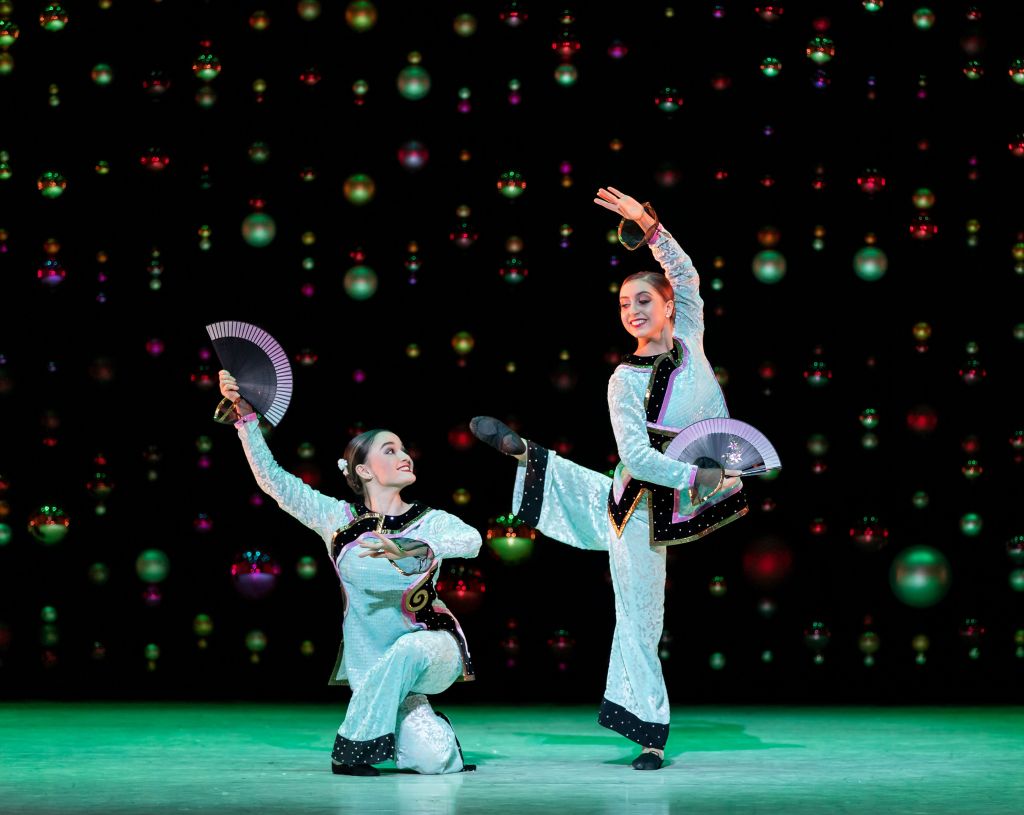
In recent years BRB, ENB, RB, and Scottish Ballet have all made revisions to the choreography, costumes and/or make-up of the Arabian and Chinese Dances from the Nutcracker productions in order to start confronting such offensive stereotypes.  But how does a company approach revising a whole full-evening work?

Scottish Ballet Artist Alice Kawalek and First Artist Kayla-Maree Tarantolo in Chinese Tea Dance. Photo credit: Andy Ross

In the United States, Arts Educator and Co-founder of Final Bow for Yellow Face Phil Chan is producing his own versions of Le Corsaire and La Bayadère to make them more suitable and relevant for American 21st century audiences by addressing what he perceives to be their inherent racism and misogyny.  In his plans, Le Corsaire takes place at a beauty pageant complete with “scheming showgirls, gunslinging beauty queens” (Chan), while La Bayadère will feature Hollywood cow girls and references to Busby Berkeley’ oeuvre, as well as a plot line similar to Singin’ in the Rain (Donen/Kelly, 1952).  These ideas may avoid racial stereotyping, but on paper at least they seem to raise other problematic issues.  Neither do we understand how the tragic nature of La Bayadère will translate into this new context.  Perhaps the productions themselves will transcend their description on paper …

The 19th Century Canon Then

In the 1920s and early 1930s, when Marie Rambert and Ninette de Valois were taking their first steps to establish ballet as a British art form, there was no canon of 19th century “classics” as we know it today. 

So what exactly was the tradition of ballet in 19th century Britain?

Well, in the 1840s, during the flourishing era of ballet Romanticism, Her Majesty’s Theatre Haymarket became a centre for the art form, with important works being created there by the pre-eminent French choreographers of the day Jules Perrot (co-creator of Giselle in 1841, with Jean Coralli) and Arthur Saint-Léon (choreographer of Coppélia, 1870).  These included Ondine, La Esmeralda and Pas de quatre by Perrot, and La Vivandière by Saint-Léon.  However, the situation changed radically in the later decades of the century, when music halls and variety theatres, such as the Empire and the Alhambra on Leicester Square, became regular venues for ballet performances, a situation that continued into the 20th century.  Despite the frequency of performances and popularity of ballet in these theatres, the works created specifically for the music halls were short lived, and even the names of the choreographers, such as Carlo Coppi and Katti Lanner, are not generally well known to today’s ballet-going public.  Further, these connections to popular theatre meant that the status of ballet as a serious art form was on thin ice, even though versions of Giselle and Coppélia, now generally considered as works of the highest calibre, were staged at the Empire in the 1880s.  And when in 1921 Serge Diaghilev mounted his sumptuous production of Tchaikovsky’s The Sleeping Beauty, based on Marius Petipa’s 1890 choreography but titled The Sleeping Princess, it was also produced in a music hall setting: at the Alhambra.

SLEEPING BEAUTY, Deanne Bergsma ( as The Lilac Fairy ) ; The Royal Ballet at the Royal Opera House, London, UK ; January 1969 ; Credit: G.B.L. Wilson / Royal Academy of Dance / ArenaPAL

When de Valois set up the Vic-Wells Ballet (later to become the UK’s flagship company the Royal Ballet) in 1931, she had a clear vision of the kind of repertoire she considered necessary for a national British company.  It consisted of four categories:

  1. Traditional-classical and romantic works
  2. Modern works of future classic importance
  3. Current works of more topical interest
  4. Works encouraging a strictly national identity in their creation generally

(Bland 57)

With both Ashton and herself at the helm creating new choreographies, it is clear how her last three aims might be fulfilled.  But of course, what interests us in this post is the way de Valois obtained the “Traditional-classical and romantic works”.

SWAN LAKE ; Nadia Nerina , Shirley Grahame and Doreen Wells ; Choreographed by Ashton and de Valois ; Designed by Hurry ; Music by Tchaikovsky ; the Royal Ballet New Group, at the Royal Opera House, London, UK ; May 1965 ; Credit : G.B.L. Wilson / Royal Academy of Dance / ArenaPAL

What we find fascinating is that political events came to de Valois’ aid: like many other figures from the Russian ballet world, the Mariinsky régisseur Nikolai Sergeyev had fled his home after the 1917 Revolution.  With him he took scores of 19th century works in a dance notation system devised by Vladimir Stepanov.  These included The Sleeping Beauty, The Nutcracker and Swan Lake, as well as Giselle and Coppélia; ballets of which de Valois had some, but limited, knowledge (Walker 129).  The distinct advantage of mounting the works from the notation scores was of course that it must have given a sense of gravitas to the productions through an authenticity that most music hall productions were unlikely to match, even if that was indeed an aim.  Before Sergeyev started to work for de Valois, he had already staged two works in London: Diaghilev’s The Sleeping Princess, and The Camargo Society’s Giselle.  However, the work of staging these ballets for de Valois’ fledgling company created a cornerstone of the British ballet repertoire.  Further, this process was solidified by Mona Inglesby, founder of International Ballet in 1941, another highly significant figure who promoted 19th century works in Britain, and for whom Sergeyev worked from 1946 until his death in 1951.  Crucially, the company toured these works the length and breadth of the British Isles: from the suburbs of London through the Midlands to Liverpool and Manchester, up to Newcastle, Glasgow and Edinburgh, and over to Belfast and Dublin.  In fact, although the Company folded in 1953, International Ballet was of such significance in its day that it was chosen to appear at the opening of the Royal Festival Hall in 1951.

LA BAYADERE – Dress rehearsal Royal Opera House – Covent Garden November 1963 SIR FREDERICK ASHTON / RUDOLPH NUREYEV and THE CORPS DE BALLETS Credit: Royal Academy of Dance / ArenaPAL

De Valois’ and Inglesby’s selection of works seems highly interesting to us, because the ballets they produced constituted only approximately one quarter of the works that could have been staged.  La Bayadère, Le Corsaire and Raymonda could have entered the British ballet repertoire decades sooner; we might have enjoyed The Pharaoh’s Daughter (Petipa, 1862) and La Esmeralda (Petipa after Perrot, 1886) or the Petipa and Ivanov version of La Fille mal gardée (1885).  Both Inglesby and Pavlova before her had made plans to produce La Bayadère, but had reached the conclusion that it was “too old fashioned” (Inglesby 97; Pritchard “Bits” 1121).  While Pavlova did mount a version of Don Quixote, according to historian and expert in British ballet history, Jane Pritchard, this also struck audiences as rather dated after Leonid Massine’s Le Tricorne (1919) (Anna Pavlova 112).  La Esmeralda also proved enticing to Inglesby, but was rejected as a project by the Royal Opera House (Inglesby 106-107).  On other hand, Giselle, Coppélia, The Sleeping Beauty and Swan Lake all had two distinct advantages: they had already been introduced to the British public, and they all had superb scores (Tchaikovsky was known to have admired the compositions of both Adolf Adam and Leo Delibes) (Pullinger).

RAYMONDA ( Act III ) ; Donald MacLeary and Svetlana Beriosova ( as Jean de Brienne and Raymonda ) ; The Royal Ballet at The Royal Opera House, London, UK ; March 1969 ; Credit: G.B.L. Wilson / Royal Academy of Dance / ArenaPAL

In addition to music hall performances of Coppélia at the Empire Leicester Square from the 1880s into the early 1900s, we were also intrigued to discover that in 1890, the same year that Petipa had choreographed the ballet for the Mariinsky Theatre with Carlotta Brianza as Aurora, one of the other Italian ballerinas who starred with the Russian Imperial Ballet, Pierinna Legnani, had danced the same role in a full production at the Alhambra, but to the choreography of Leon Espinoza with music by Georges Jacobi.  Further, in the years immediately leading up to the first London season of the Ballets Russes in 1911, the West End evidently became a veritable hive of ballet activity, with appearances from Lydia Kyasht, Tamara Karsavina, Olga Preobrazhenska, Alexandra Baldina, Ekaterina Geltzer, and of course Anna Pavlova.  Included in these performances were shortened versions of works that were to become “the classics”: in 1910 Preobrazhenska staged Swan Lake at the Hippodrome, while Karsavina mounted a truncated production of Giselle at the Coliseum.  The following year saw the complete Giselle, The Sleeping Beauty Grand pas de deux and a two-act condensed Swan Lake at the Royal Opera House performed by the Ballets Russes.

And what of the ubiquitous Nutcracker? Well, if you have been following British Ballet Now & Then since the start, you will know that the notion of The Nutcracker as a quasi-obligatory Christmas treat is a phenomenon of the later 20th century. In fact this ballet was not well known in this country before de Valois’ Vic-Wells Ballet staged it in 1934.  However, the Nutcracker Suite, which was in fact presented in concert halls before the ballet premiered at the Mariinsky Theatre, was performed in London as early as 1896. 

SADLER’S WELLS BALLET – THE NUTCRACKER 1943 ROBERT HELPMANN / MARGOT FONTEYN Credit: Royal Academy of Dance / ArenaPAL

Ballets Russes audiences would also have known some excerpts, because Diaghilev himself was a great admirer of the score and interpolated some of the numbers into his productions of The Sleeping Beauty and Swan Lake (Newman 20-21).

But you may be asking yourself how La Sylphide became integral to the 19th century canon. The original work by Filippo Taglioni, created for his daughter Marie Taglioni, the most celebrated of Romantic ballerinas, was hugely popular in its day and was performed at Covent Garden only a few months after the March premiere in Paris, 1832.  Marie Taglioni also performed it in Russia, where it continued to be included in the repertoire, and was revived by Petipa in 1892.  However, it does not seem to have been amongst the works that were recorded in the Stepanov notation, and sometime during the first half of the last century Filippo Taglioni’s choreography was lost, although the Romantic ballet expert Pierre Lacotte did produce a reconstruction of it for the Paris Opera Ballet in 1972.  As you probably are aware, the choreography that has been passed down through the generations is the version by August Bournonville, who saw the original production in Paris, but then created his own in 1836.  According to Pritchard (who also happens to be one of our favourite dance historians), Marie Rambert, who established the first ballet company in the UK, loved Romantic ballet (“Marie Rambert” 1177).  She had become familiar with Giselle during her time with the Ballets Russes, and in 1946 Giselle became the first long work to enter the repertoire of Ballet Rambert (now Rambert).  This production was staged with the help of historian Cyril Beaumont, author of The Ballet Called Giselle, first published in 1944, and still available to purchase today.  Beaumont devotes a substantial section of his book to La Sylphide, exploring its influence on Giselle in terms of themes, style, technique and structure.  The work he discusses is the original Taglioni La Sylphide, which was of course not available for Rambert to stage.  Instead, the Bournonville version was staged in 1960, by Bournonville expert Elsa Marianne von Rosen.  In contrast to the full-length Giselle and La Sylphide, only extracts from The Sleeping Beauty, The Nutcracker and Swan Lake were performed by Rambert.  However, Rambert seems to have produced an appetite for Bournonville’s ballet in Britain: Danish ballet master Hans Brenaa was invited to stage a production for Scottish Ballet in 1973; in 1979 the Danish dancer Peter Schaufuss (later to become Artistic Director) mounted his production for English National Ballet; and eventually the Royal Ballet acquired the work in Johan Kobborg’s 2005 staging.  Perhaps one factor that contributed to the growing familiarity with La Sylphide of the British ballet audience was the BBC broadcast of the Act II Pas de deux in 1960 with von Rosen herself, followed by a broadcast of the complete work with Ballet Rambert less than a year later.  Another factor was undoubtedly Rudolf Nureyev’s performances with Scottish Ballet at the London Coliseum in 1976, in which he danced James at every performance over the course of two weeks.

Concluding thoughts

A brief glance through Instagram leaves us in no doubt about the popularity of the 19th century canon across the globe.  And the importance of the works to the British ballet repertoire cannot be denied: in the 2022-2023 season, in addition to the The Nutcracker, Birmingham Royal Ballet have performed Swan Lake, English National Ballet both Raymonda and Swan Lake, and the Royal Ballet The Sleeping Beauty.

We perhaps think of the classics as being exempt from politics, but this is a fallacy: neither their content nor their arrival to these shores can be said to be divorced from politics.  The word “timeless” is also often associated with the term “classics”, but of course the style of performance varies over space and time and our perception of and relationship with the works changes with the Zeitgeist.

Ballet has traditionally been perceived as an ephemeral art form, being handed down by dancers from generation to generation, with limited means for recording the choreography.  But today, with the regular use of Benesh Movement Notation and video to record works in their different productions, perhaps we can feel more secure about the preservation of the 19th century repertoire. 

How would you like to see these works preserved? Would you like to see them performed in a style more compatible with the original style, with original choreography restored, as Alexei Ratmansky has done with his productions of The Sleeping Beauty and Swan Lake? Or would you prefer a more experimental approach, in response to a more contemporary world view, such as that proposed by Phil Chan?  We would love to hear your thoughts!   

© British Ballet Now & Then

We would like to thank our dear friend and colleague Paul Doyle for his help with this post.

Next time on British Ballet Now and Then … Ballet has a reputation for being very gender specific.  However, there is a tradition of subverting gender norms in certain circumstances.  The Royal Ballet’s recent run of Cinderella has seen both female and male identifying dancers perform the Step-Sisters, while the last time English National Ballet staged The Sleeping Beauty, the cast included a gender-fluid dancer, as well as both male and female performers in the role of Carabosse.  So this will be the focus of our next Now and Then post …     

References

Beaumont, Cyril W. The Ballet Called Giselle. Dance Books, 2011.

Bland, Alexander. The Royal Ballet: the first fifty years. Threshold Books, 1981.

Chan, Phil. “On Yellowface and a way forward for Diverse Audiences”. One Dance UK, 2020, https://www.onedanceuk.org/resource/on-yellowface-and-a-way-forward-for-diverse-audiences/.

Desvignes, Alexandra. “Marianela Nuñez shines in a star-studded, polished Bayadère at The Royal Ballet”. Bachtrack, 3 Nov. 2018, https://bachtrack.com/review-bayadere-royal-ballet-nunez-muntagirov-osipova-opera-house-london-november-2018.

Hugill, Robert. “Iconic but flawed: La Bayadère the Royal Ballet”. Planet Hugill, 12 Nov. 2018, https://www.planethugill.com/2018/11/iconic-but-flawed-la-bayadere-royal.html.
Inglesby, Mona, with Kay Hunter. Ballet in the Blitz: the story of a ballet company. Groundnut Publishing, 2008.

Jennings, Luke. “La Bayadère review – moonlit heights from Nuñez and co”. The Guardian, 11 Nov. 2018, https://www.theguardian.com/stage/2018/nov/11/la-bayadere-royal-ballet-review-marianela-nunez-natalia-osipova.

Newman, Barbara. The Nutcracker. Aurum Press, 1985.

Parry, Jann. “Royal Ballet – La Bayadère – London”. DanceTabs, 6 Nov. 2018, https://dancetabs.com/2018/11/royal-ballet-la-bayadere-london-2/.

Pritchard, Jane. Anna Pavlova Twentieth Century Ballerina,

—. “Bits of Bayadère in Britain”. Dancing Times, vol. no. , 1989.

—. “Marie Rambert”. International Dictionary of Ballet, edited by Martha Bremser, St. James Press, 1993, pp. 1175-77.

Pullinger, Mark. “A step into the world of Tchaikovsky’s ballets: Swan Lake”. Bachtrack, 23 July 2017, https://bachtrack.com/ballet-focus-tchaikovsky-swan-lake-petipa-july-2017.

Rojo, Tamara. “A Word from Tamara Rojo, Artistic Director”. Le Corsaire programme Jan. 2020, English National Ballet, London.

Walker, Katherine Sorely. Ninette de Valois: idealist without illusions. Dance Books, 1987.


Watching with British Ballet Now and Then: English National Ballet’s New Dance Films

We are excited.  This year has seen so many performances cancelled, new productions put on hold, new choreographies postponed. And now, over the weeks leading up to Christmas, English National Ballet are releasing five brand new dance films …

Take Five Blues

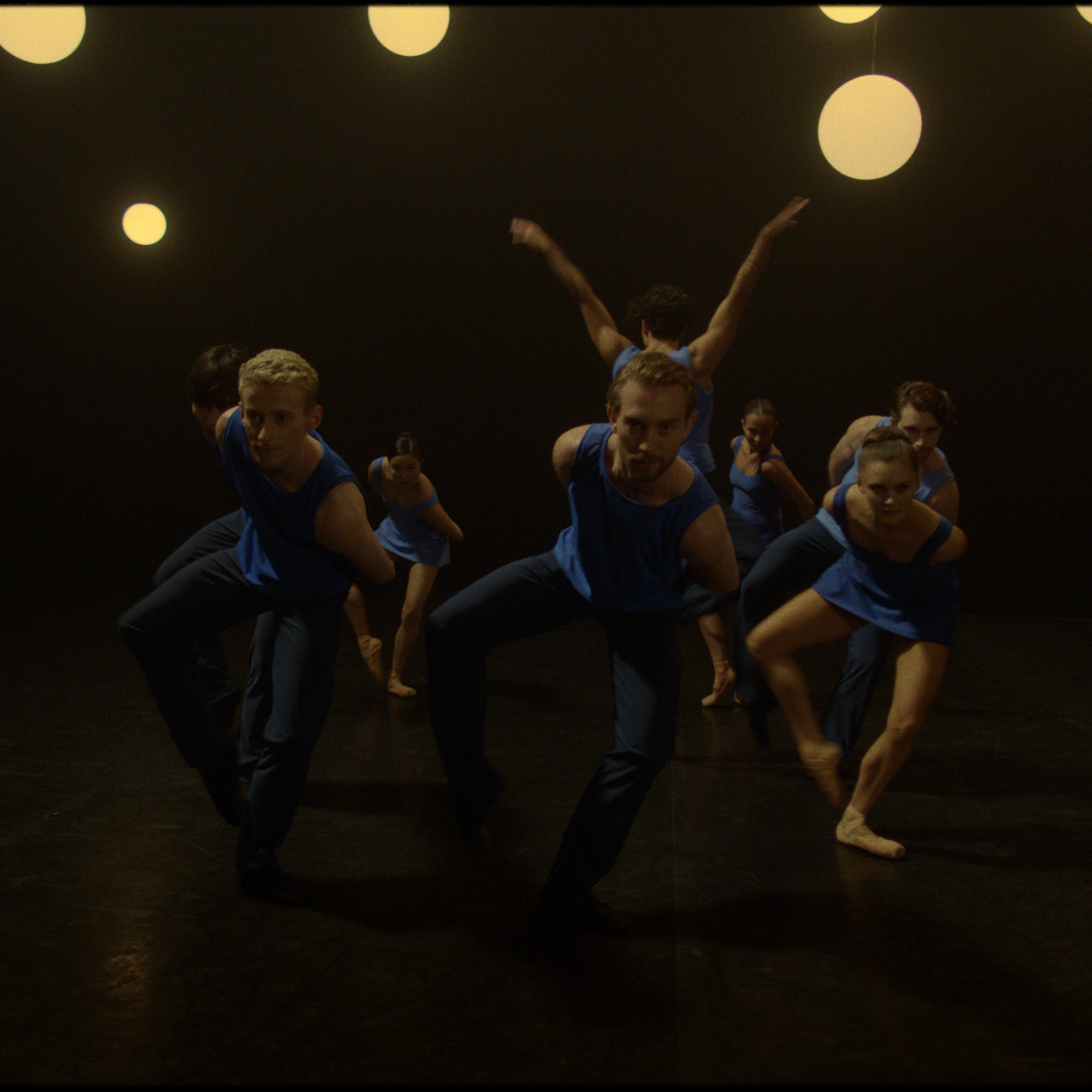
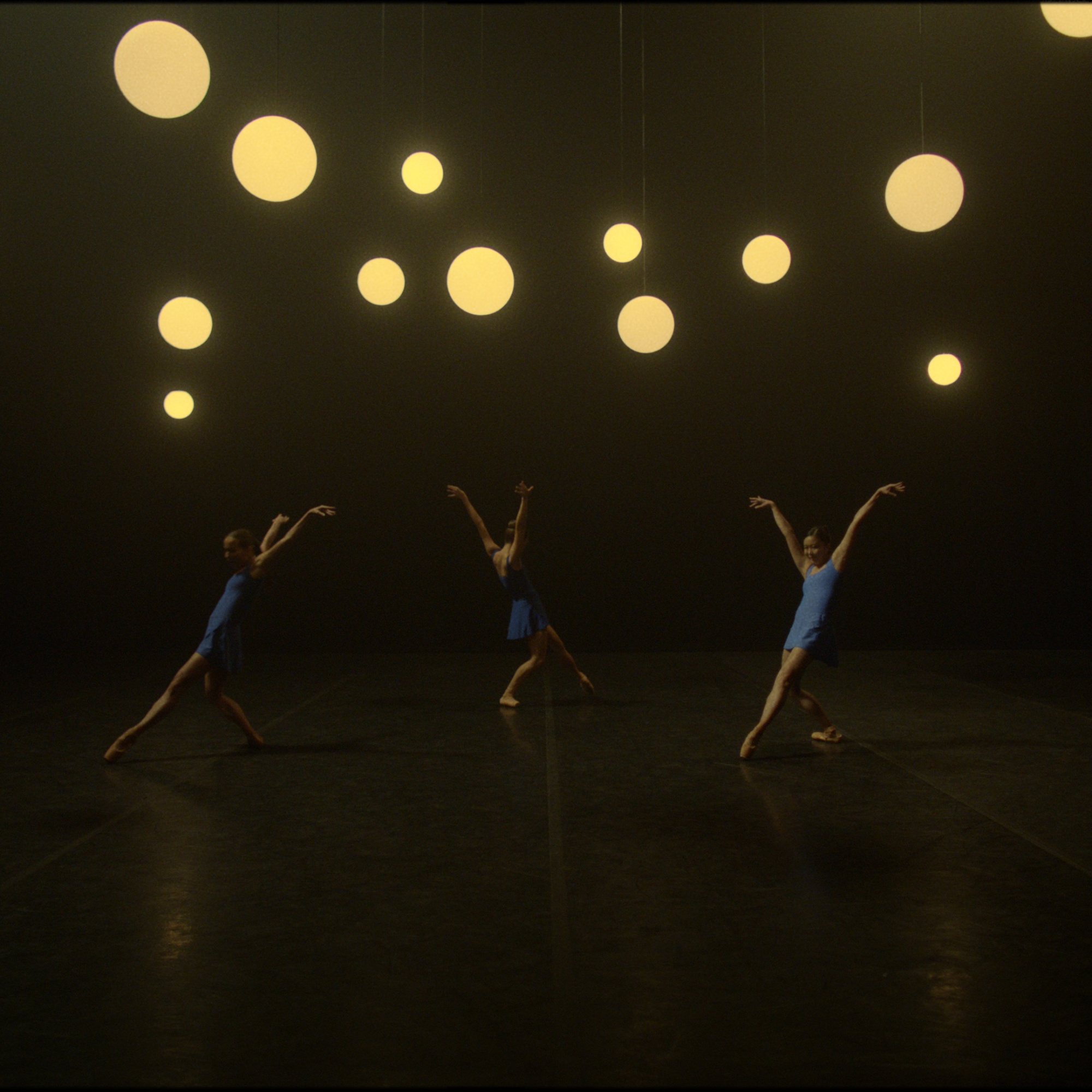
Photos: English National Ballet in Take Five Blues, a film by Shaun James Grant, choreographed by Stina Quagebeur © English National Ballet

Choreography: Stina Quagebeur

Filmmaker: Shaun James Grant

On a gloomy, overhung Thursday afternoon we are eager to see some positive signs of hope, even if only on our screens.

Take Five Blues begins with some of our favourite dancers entering the space … casually, as if in anticipation of the energy to come: Aitor Arietta, a long-time favourite; Fernando Carratalà Coloma, whom we admired so much as the Messenger of Death in Song of the Earth; Rentaro Nakaaki, who impressed us so much last year in Emerging Dancer; Katya Kaniukova, sassy as ever, and Shiori Kase with her joyous turns and luminous presence.

Choreographer Stina Quagebeur wants it to feel like we’re in the room with the dancers, and in fact we are reminded of watching class.  The visible energy.  The audible energy.  Moments of relaxation to take breath.  The spurring on of colleagues.  Personalities gleaming through the movement.  But the globes of soft light hanging over the dark stage space evoke an ambiance of a different ilk.

There is a serendipitous moment when Fernando Carratalà Coloma and Henry Dowden reach the height of a jump in complete synchrony.

Unwittingly our lecturer hats are donned and we start to admire the structure of the work: individual dancers merge into clumps of synchronous movement – they scoop down and reach forward, scoop and reach in an easy rhythm – and then peel off one by one.  Breathtaking virtuosic display is juxtaposed with movements in slow motion.  Roaming camera angles lend added texture to the patterns and rhythms of the choreography.  

But ultimately we are captivated by the buoyant sway of the dancing to the familiar tones and rhythms of Paul Desmond’s Take Five and Bach’s Vivace in Nigel Kennedy’s ebullient arrangement. We laugh as all the male dancers collapse to the floor at the end.

The gloom of the Thursday afternoon is gone.  

Senseless Kindness 

Photos: Isaac Hernandez, Francesco Gabriele Frola and Alison McWhinney in Senseless Kindness a film by Thomas James with choreography by Yuri Possokhov © English National Ballet & Emma Hawes and Francesco Gabriele Frola in Senseless Kindness a film by Thomas James with choreography by Yuri Possokhov © English National Ballet

Choreography: Yuri Possokhov

Filmmaker: Thomas James

From the trailer of Senseless Kindness we know that the tone is quite different from Take Five Blues.  Here darkness reflects a more melancholy and sombre mood.  While the whirling turns in Take Five Blues were exuberant in spirit, here Isaac Hernández spins himself into a vortex of frantic energy.

Monochrome hues, shafts of light steaming through the darkness create atmospheric spaces evoking sites of conflict and flight, fear and anxiety; and sites of momentary peace and joy.

The two couples, perfectly matched, conveying the sense of being connected by family, move fluidly together from shape to shape like kinetic sculpture.  Unison intensifies the sense of togetherness, but then the couples find their own spaces to express their own identities.

Shostakovich’s Piano Trio No. 1 catches at us with the tension of its edgy strings and percussive keyboard, giving rise to angular, staccato movement for the male dancers, performed with urgent attack and dramatic intensity.  Lyrical passages bring forth movements that melt into slow motion and blurred lines, like memories passing across the mind.  From time to time the dappled faces emerge and the camera hovers over tenderness, longing, sadness.  But then a smile crosses our lips at the warm playfulness of a pas de bourrée.

Speaking of the meaning of his work as a reflection of life, choreographer Yuri Possokhov muses: “so many negative things and so many positive things at the same time” (documentary 5:10-5:14).

Isaac Hernández’ vortical spins swiftly unravel into an ecstatic attitude reaching for the sky.

In Senseless Kindness everything is shadows and light.                  

Laid in Earth

Photos: James Streeter and Jeffrey Cirio in Laid in Earth, a film by Thomas James, choreographed by Sidi Larbi Cherkaoui © English National Ballet

Choreography: Sidi Larbi Cherkaoui

Filmmaker: Thomas James

Twenty-four hours on and we are still haunted by Laid in Earth.  Images of a Stygian forest and lake flit through our heads.  The underworld has been recreated for us, inhabited by four beings who twist and curl like the gnarled branches surrounding them.  Sometimes their limbs mutate into branches.  Sometimes they fuse spookily with the forest itself, their bodies becoming sites for forest growth.  Jeffrey Cirio’s character rarely moves far from the ground: he slides and spins seamlessly over it, sinks softly into it, allowing gravity to release him down.  Mesmerizing costumes and make-up seal the oneness of dancers and their environment.  

Erina Takahashi’s distilled energy gives an eerie glow to her being, drawing us to her as the central figure. She almost takes the hand of her shadow Precious Adams, but they seem wary.  They reflect one another in the dark waters. James Streeter and Jeffrey Cirio mirror one another on the dark ground.  In the duet Erina Takahashi and James Streeter coil around one another in a dance of sorrow. 

Laid in Earth brings Giselle to mind – the Wilis inhabiting the shadowy forest, their hems damp from the water of the lake above which they hover, and maybe from the early morning dew as they dissolve into the morning’s mist.  Hearing Dido’s plangent tones “Remember me”, we recall the rosemary branch that transforms Giselle into a Wili

If everything in Senseless Kindness is shadows and light, then everything in Laid to Earth is shadows and darkness.

Echoes

Photo: Fernanda Oliveira and Fabian Reimair in Russell Maliphant’s Echoes a film by Michael Nunn & William Trevitt © English National-Ballet

Choreography: Russell Maliphant

Filmmakers: Michael Nunn & William Trevitt

Over the weeks we have noticed that all the new choreographies have different casts, so every week we are seeing different dancers.  For us it feels like a big bonus to see a range of dancers from the Company (not to mention its egalitarian spirit).  But it’s also exhilarating to watch the dancers being challenged by movement styles that are unfamiliar to them.  This is noticeable to us this week in Russell Maliphant’s Echoes.  In the documentary we particularly enjoy Fabian Reimar and Fernanda Oliviera talk about both the challenges and the satisfaction of working with Maliphant in the studio with his task-based approach to the creative process, the groundedness of his choreography, the liquid dynamic of his movement – “like the ocean”, as Fernanda says (1:00-1:02).

Fernanda and Fabian dancing together is like a pas de deux of the ocean waves.  Moving seamlessly together as one, waves of motion repeatedly merge into one another.

Along with Fabian Reimar, Isabelle Brouwers is a dancer whom we admire greatly.  Both can bring vibrant drama to the simplest of movements.  This we have witnessed in Akram Khan’s Giselle when they perform the Landlord and Bathilde respectively.  In Echoes we witness it once again as Fabian looms on the screen with his rich and resonant presence.  

When Isabelle dances in classical pas she radiates an incandescent glow.  In Echoes her glow is hushed, softly diffused, though ever present, subsumed in the hypnotic swirling of the group.

Again and again we note the soft passive weight of the dancers.  Then the movement accelerates, becoming electrifying as the dancers swiftly free flow between heavier passive weight and strong active weight.  The dance reaches its whirling crescendo.

As the piece moves to a close, alone on the stage, Junor Souza spirals continuously, an echo of what has passed that reverberates into the future as the image hovers in our minds …

And once again we leave our screen with optimism, not only about the survival of ballet, but even about its potential revival. 

Jolly Folly

Photos: English National Ballet in Jolly Folly, a film by Amy Becker-Burnett, choreographed by Arielle Smith © English National Ballet & Francesca Velicu, Ken Saruhashi and Julia Conway in Arielle Smith’s Jolly Folly a film by Amy Becker-Burnett © English National Ballet

Choreography: Arielle Smith

Filmmakers: Amy Becker-Burnett

Boxing Day.  Jolly Folly was released almost a week ago, but anything with the name Jolly Folly just seems to be made for Boxing Day.  And we’re told that this piece is reminiscent of “Old Hollywood”, and what else is Boxing Day for but whiling away the hours, spinning out the nostalgia over well loved classic movies?  The trailer has already revealed fantasy locations, and a single row of dancers scooting away from the line, one by one, in precise canon.  Busby Berkeley comes to mind …

We chuckle at the of irony in this 16-minute dance film being divided into three acts – that iconic structure that we tend to associate with the grandeur and scale of the late 19th century classics and the “full-length” dramas of Kenneth MacMillan.   Each act is announced by the flickering sound of a film projector … 

Quizzical looks and quirky walks on the black-and-white screen remind us of Charlie Chaplin.  We’re not well versed in Chaplin’s films, but the dim street lighting of Act I makes us think of the waterfront in his 1931 City Lights, while the boxing ring shenanigans are an unmistakable reference to the prize fight from the same film.  Dinner jackets, white tie and tails worn by the dancers are all part of the “Gentleman Tramp’s” wardrobe.  

From gentle-smile to laugh-out-loud, the humour is enhanced by Arielle Smith’s use of the score – the Klazz Brothers’ Classic Meets Cuba.  Joseph Caley and Ken Saruhashi sashay and pirouette to “Cuba Danube”. All nonchalance, they press up and sway from side to side in a backbend bridge, then leap and cartwheel over one another to the reworking of Johann Strauss II’s “The Blue Danube”.  

Act II brings us an exquisite fulfilment of our Boxing Day thinking, as the chimes of the Sugar Plum Fairy morph into a paradoxically unsettling accompaniment to a world of grey clouds and craggy rocks, where the dancers strut across the space, hands in pockets, in a slightly menacing way, almost as if we’ve strayed into film noir territory. 

But with ever-changing vistas, coat-tails flying in elegant chaînés and suspended arabesques, Act III takes us back to the safe shores of Busby Berkeley and Fred Astaire.  Dancers skitter lightly across the space to the whimsical rendition of Mozart’s speedy “Rondo à la Turque”.  Jolly Folly ends in a gleeful final pose.

Epilogue

We were sorely disappointed.  Having booked our tickets to see these new choreographies onstage, we were “only” able to watch them on our screens.  But we were wrong … or at least half wrong …

In the end we discover that it’s not “only” on our screens.  These films are something to be treasured as a development in ballet making and ballet performance – they are not simply something to fill the gap left by the lack of live performances.  

Nonetheless, we can’t wait to see them live on the theatre stage. That moment can’t come too soon.