In Conversation: NORTHERN BALLET’S GENTLEMAN JACK

World Premiere 7 March 2026
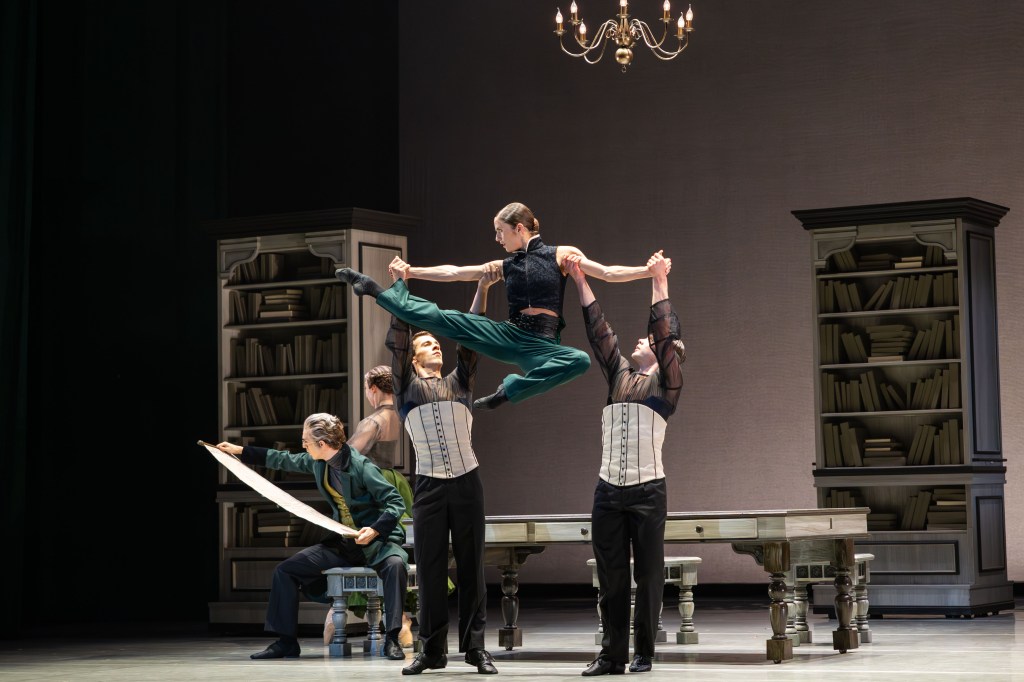
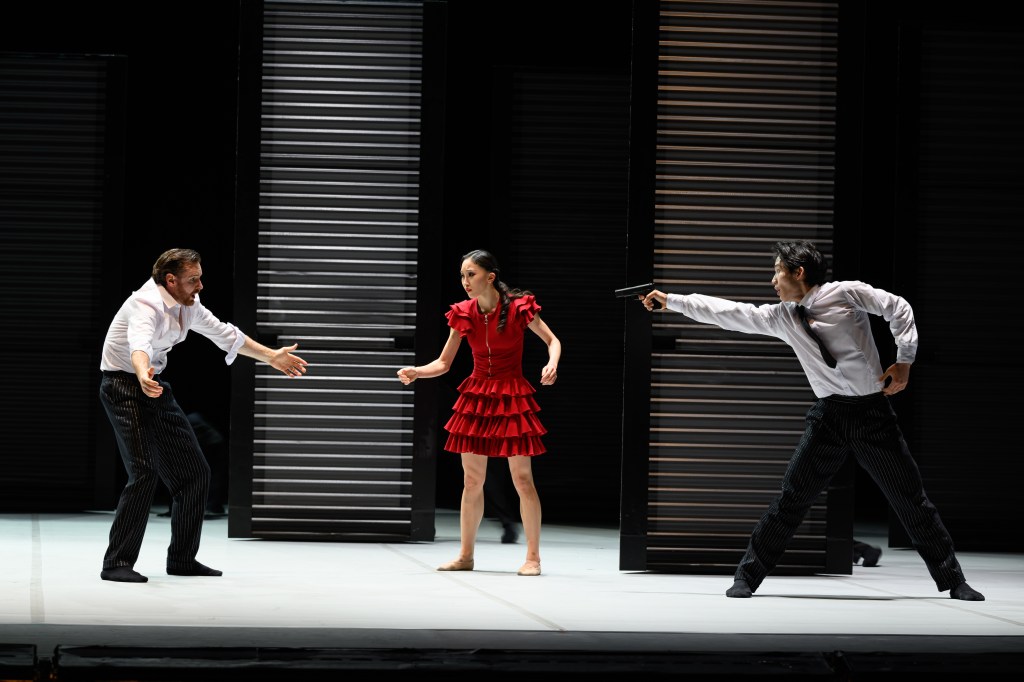
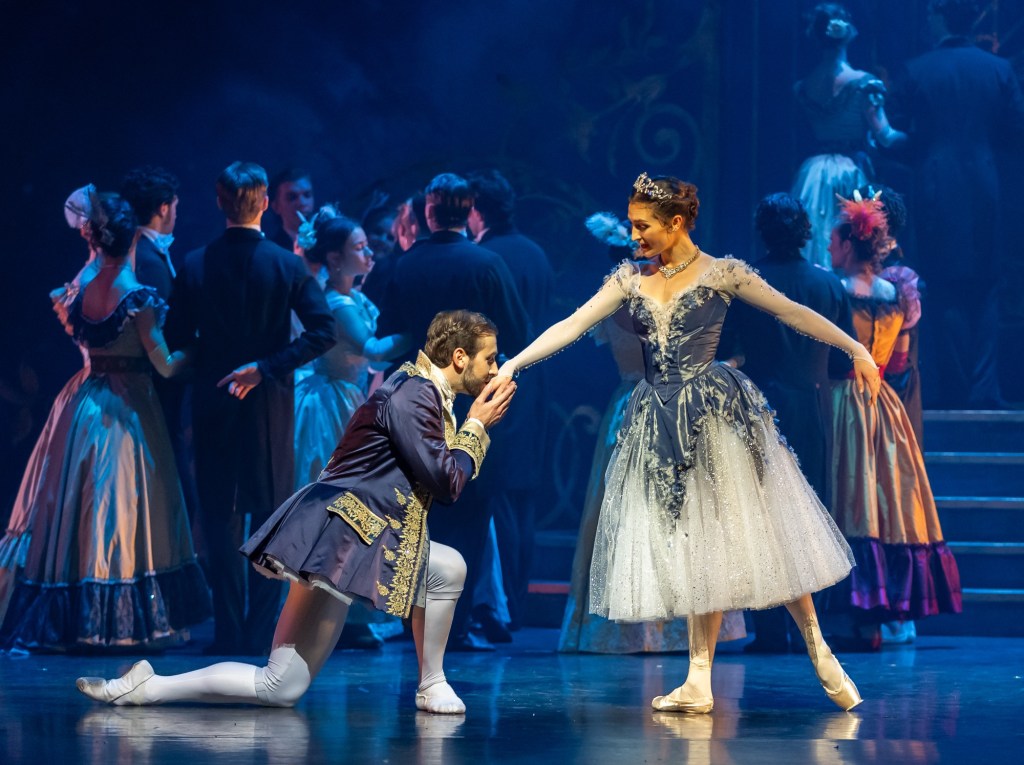
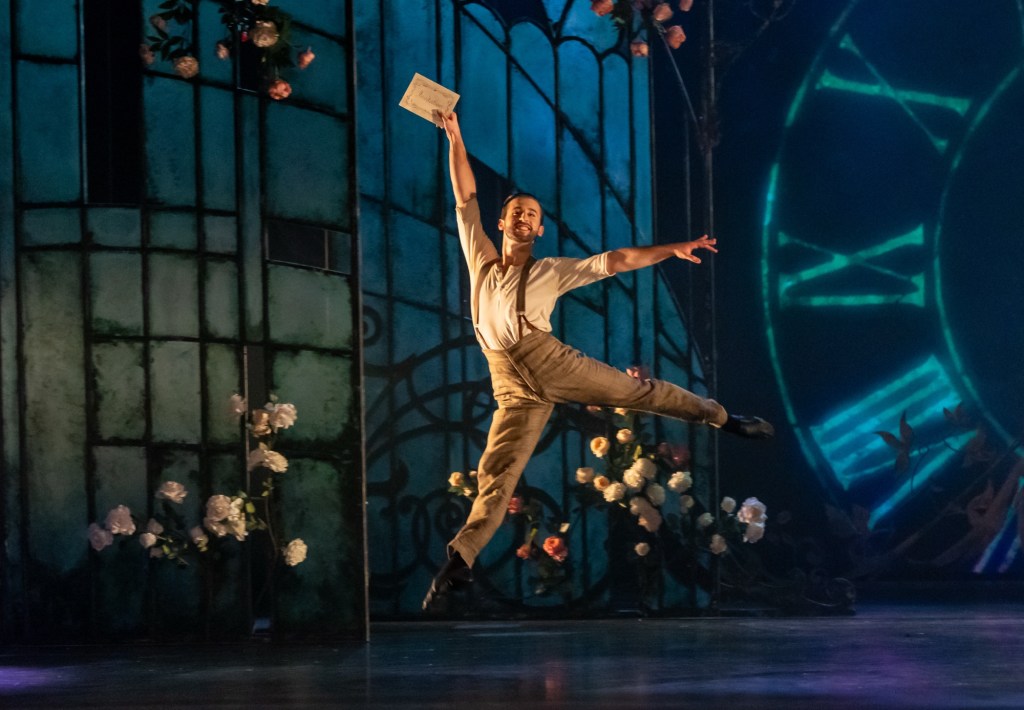
Gemma Coutts in Gentleman Jack – Photo: Colleen Mair

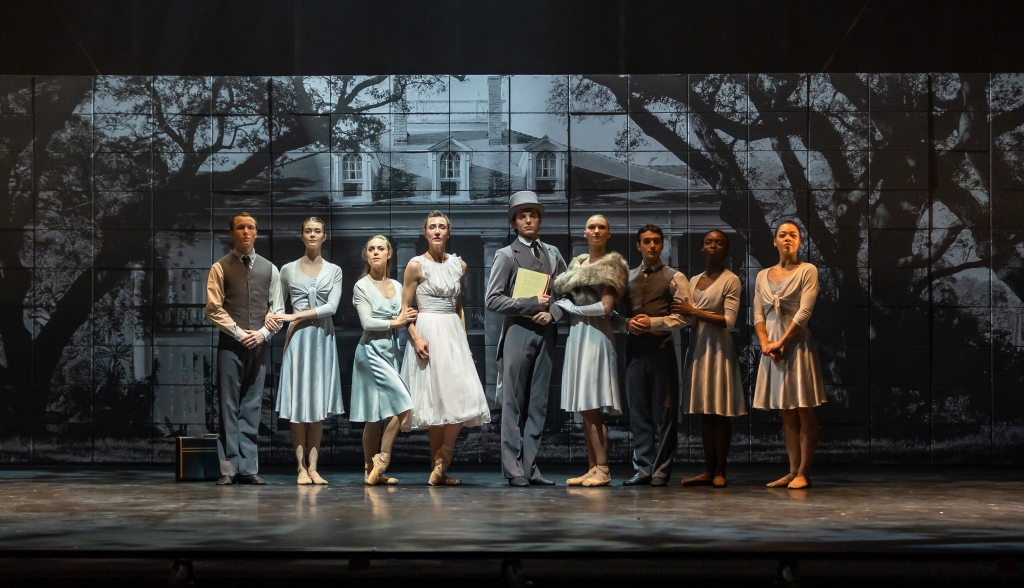
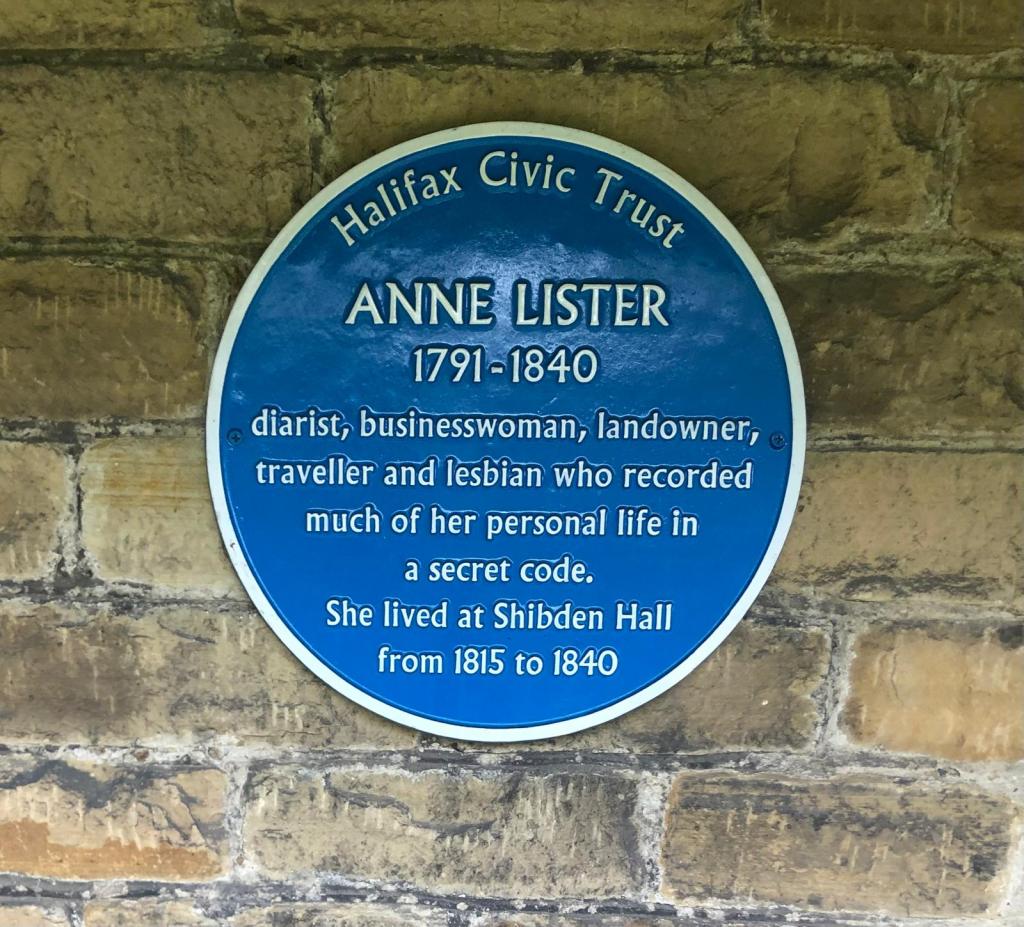
In March of this year Rosie and her ballet-loving friend Philippa spent a weekend in Yorkshire.  The purpose of the visit was to attend the world premiere of Northern Ballet’s Gentleman Jack at Leeds Grand Theatre.  Choreographed by Annabelle Lopez Ochoa, the ballet is based on the life of Anne Lister (1791-1840) “diarist, businesswoman, landowner, traveller and lesbian” (“Anne Lister”), so the trip also included a visit to Shibden Hall, the home of Anne Lister, in Halifax.  Here they talk about a weekend to remember.
Rosie: Ever since I first heard about this project (in the autumn of 2024, I think it was), I have been bursting with anticipation.  I could hardly believe that someone was creating a ballet about Anne Lister.  Which is odd, to be honest, given that Northern Ballet are known for taking inspiration from British literature and history.  I’m thinking in particular about Massimo Moricone’s A Christmas Carol (1993), David Nixon’s Wuthering Heights (2002), and Cathy Marston’s Jane Eyre (2016) and Victoria (2019).  And of course Anne Lister was from Yorkshire.  But I’m also well aware that Annabelle (Lopez Ochoa) has choreographed works focussed on iconic women, like Frida Kahlo (Broken Wings, 2016), Eva Peron (Donã Peron, 2020), and Coco Chanel (Coco Chanel, 2024).  But maybe I was so surprised because I must admit I had never heard of Anne Lister prior to the 2019 BBC drama Gentleman Jack with Suranne Jones.

Philippa: No, neither had I.  And once I started reading Anne Choma’s book Gentleman Jack: the real Anne Lister I couldn’t believe what a fascinating character she was, and one who was almost lost to history! I think it was only after the publication of Helena Whitbread’s I Know My Own Heart: The Diaries of Anne Lister in the late 1980s that her name started to be better known. 

Rosie: Even though the diaries had been discovered in the earlier part of the century.  But once the coded passages about her sex life were deciphered some people were worried about the explicitness of Anne’s descriptions of her lesbian relationships.  Thank goodness that times have changed, right?
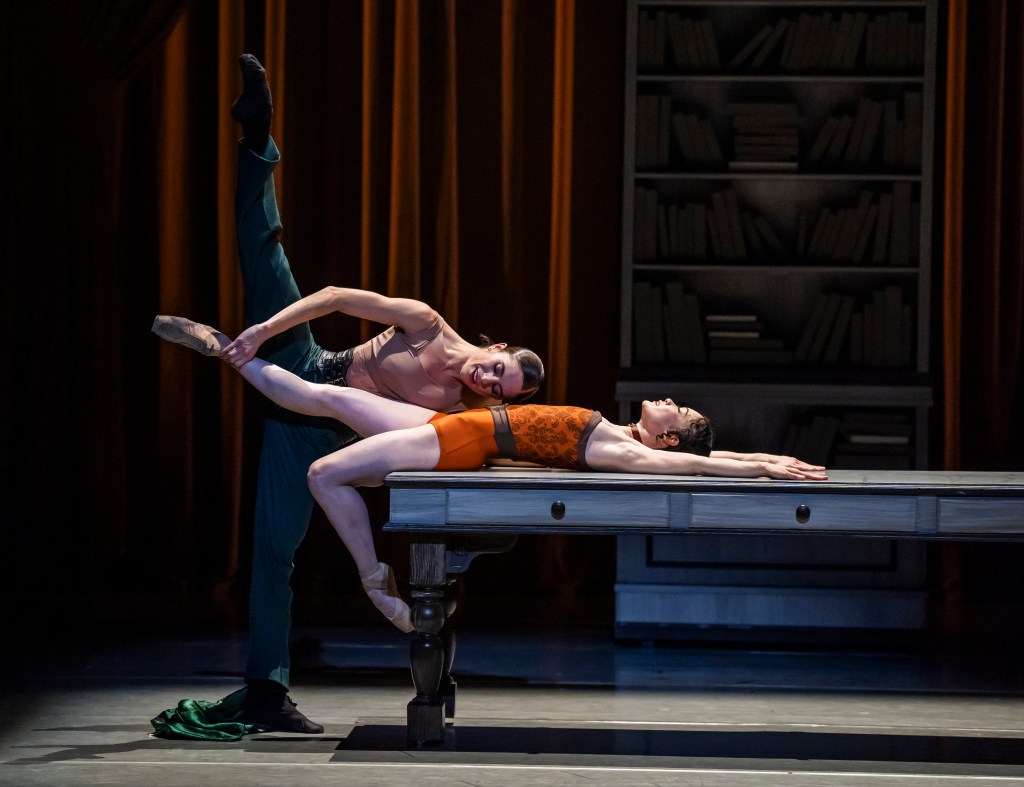
Gemma Coutts and Saeka Shirai in Gentleman Jack – Photo Tristram Kenton

Philippa: Yes, absolutely, because Anne was an extraordinary woman, living a life years ahead of her time in the shrewd way she ran the estate, her business acumen, her love of travelling, her curiosity and determination to be educated, her study of anatomy, her mountaineering … It’s so important that a woman of such accomplishment and drive is celebrated.

Rosie: I loved the story that Helena Whitbread told in the video we watched at Shibden about Anne’s ascent of the Vignemale in her silk stockings, sturdy walking shoes and rolled up skirts. Hilarious.

Philippa: And some male member of the aristocracy typically had the gall to claim he got there before her, didn’t he? But Anne wasn’t having any of it and set the story straight (“The Anne Lister Story”).

Rosie: Ha! Quite right too! One aspect that I loved about the ballet was that the prologue focussed on Anne showing her prowess in a man’s world, because obviously men were always trying to get the better of her.  Ballet so often focuses on romance, and although the work does explore Anne’s romantic life, it was quite exhilarating to see it start with Anne Lister the entrepreneur rather than Anne Lister the lover. The programme reads

Anne Lister controls the stage.  Surrounded by men, she directs every action, setting the scene for complex games of business and love.  She is grounded and decisive, clear and proud, even as the men encircle her.  She is the one who initiates action, who lives on her own terms. (“The Story” 4)
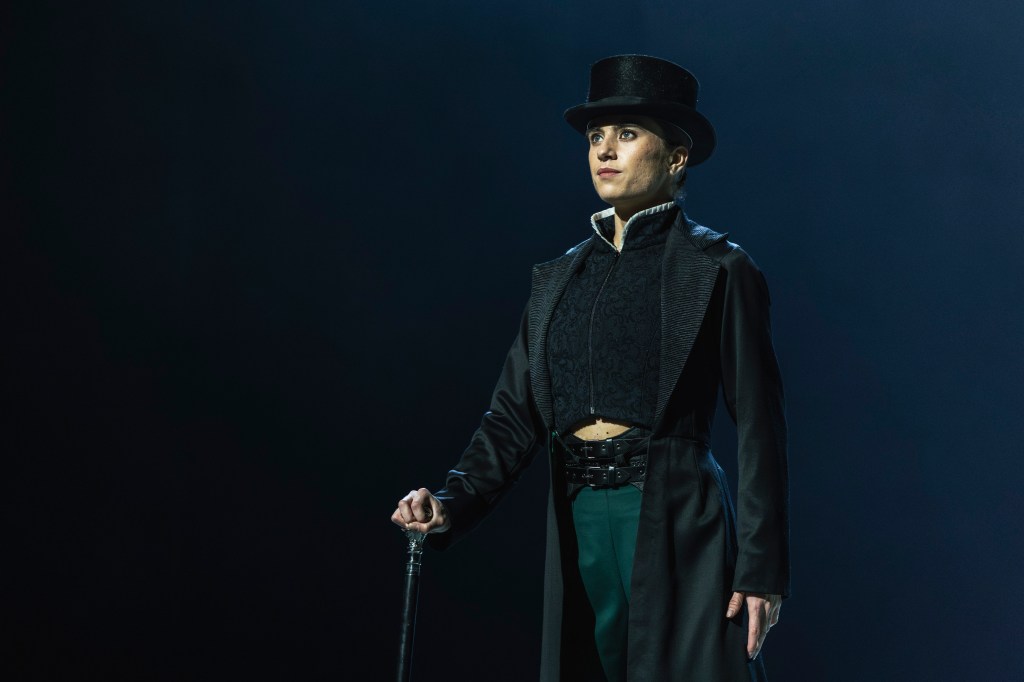
Gemma Coutts in Gentleman Jack – Photo Scott Salt

I think this description gives a clear sense of the stage action.

Philippa: And her groundedness definitely comes through from the fact that she doesn’t perform in pointe shoes until the wedding scene with Ann Walker towards the end of the ballet. 

Rosie: There are motifs connected to her character too that recur throughout the ballet.  My favourite is the way she moves into attitude derrière on a fondu. It’s so simple, but it makes her look really 3-dimensional and gives her gravitas too.  Very different from Aurora’s attitude motif. 

Philippa: Totally.  For me it also gives a sense of her striding forward.  Laura Capelle’s article said that the dancers watched how Suranne Jones walks in the drama series, and I think I could see that. 

Rosie: Yes, really purposeful and energetic.  Judging from the climb up to Shibden, Anne Lister must have been super fit.  And her energy is partly conveyed simply through the size of her movements (again, à la Suranne Jones).  Annabelle said she chose dancers to perform Anne who “dared to take up the space” (qtd. in Winship). 

Philippa: I found that the contrast between the size of Anne’s movements and those of her family also contributed to some of the humour in the choreography.  Some of my favourite scenes were the afternoon tea scenes, with the “teaography”, as the critic Jennie Eyres describes it. The way that Anne’s Uncle, Aunt and Sister move their teacups, saucers and spoons around gives a sense of the repetitive and mundane nature of their lives.  And then Anne comes bursting in on the scene with all her blazing energy, completely disrupting the calm.    

Rosie: I loved the way she dramatically launches herself at the table in a huge cabriole derrière, and even literally dances on the table (“Gentleman Jack | First Look”; “Gentleman Jack | Trailer”).  To the consternation of her family, of course, who look quite put out.     

Philippa: There were laugh-out-loud scenes too, like Anne’s business rival Christopher Rawson physically trying (and failing) to separate his niece Ann Walker from Anne Lister because of Anne’s reputation vis-à-vis women. It almost felt like a game of musical chairs.  Of course the TV drama contains plenty of humour too, because Anne is always defying expectations.  But she’s also quite snobbish, and sometimes that can also be quite comical. 
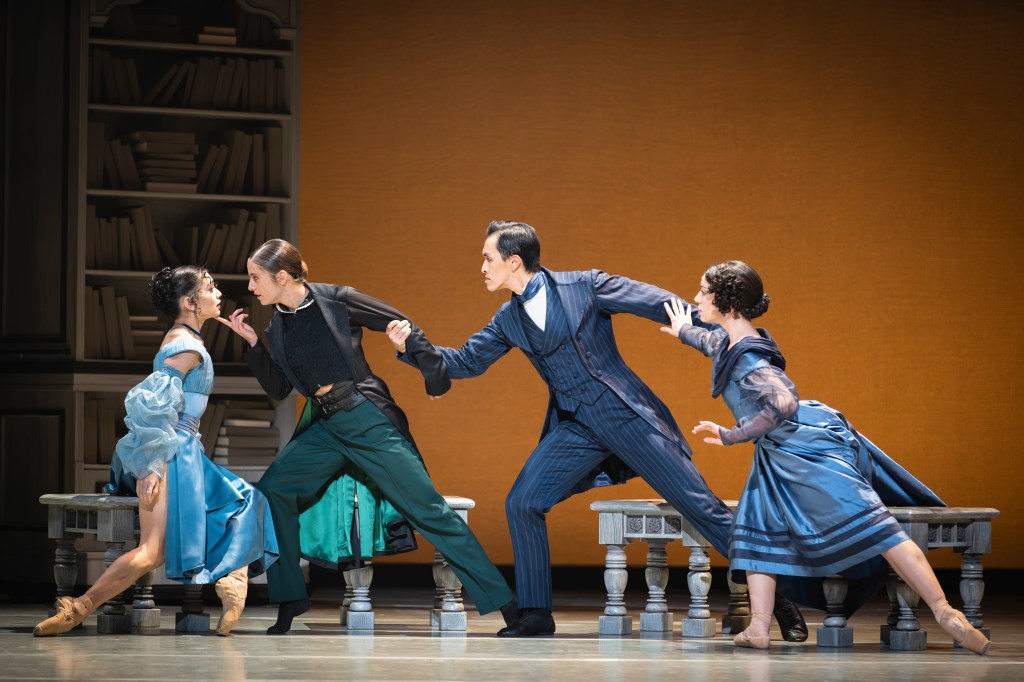
Rachael Gillespie, Gemma Coutts, George Liang and Alessandra Bramante in Gentleman Jack – Photo: Emily Nuttall

Rosie: Kirsty, the volunteer at Shibden whom we chatted with, mentioned the scene where Anne and her sister Marian disagree about Shibden, because Anne can’t bear to admit that the Hall was originally more like a farmhouse than a mansion.  It’s a cracking scene.  And there’s another one where their father (Timothy West) points out that Anne loves to conveniently forget that the Listers’ ancestors were “trade”, because that’s unthinkable to Anne, who likes to thinks of the family as higher up the echelons of society.

Philippa: Anne Choma also writes about Anne’s snobbishness in her book (40).

Rosie: There are so many Ann/es—I love that she’s an Anne too—and we haven’t even talked about Aunt Anne yet!  But I’m not sure how much Anne’s snobbishness comes through in the ballet.  I’ll look out for it when I watch it next time.  What does come through is that she “was not such a kind person”, as Annabelle says (“Gentleman Jack | First Look”).  It’s so ironic that despite being pioneering in so many ways, Anne Lister was properly reactionary in other ways.  She could be harsh with her tenants (Choma 47-48); she did not believe in women involving themselves in politics (apart from herself, of course) (89); she didn’t believe in extending the franchise to men of a lower class without property (xiii, 88).  In the ballet I think this comes through really clearly in the scene where she suddenly decides to join forces with Rawson, her arch-enemy, because the miners are protesting about their wages, and “workers must be kept in their place” (“The Story 4”).

Philippa: Although there’s a clear chronology to the ballet, the scenes seem to be focussed on specific aspects of her personality and her relationships more than aiming to convey a plot—like this one you’re describing.  So it made sense when I discovered that Annabelle described the ballet as a portrait rather than a biopic (“Northern Ballet’s Gentleman Jack | In rehearsal”).  And it makes sense with the ending of the ballet—that moment when Anne is literally framed like a portrait is brilliant.
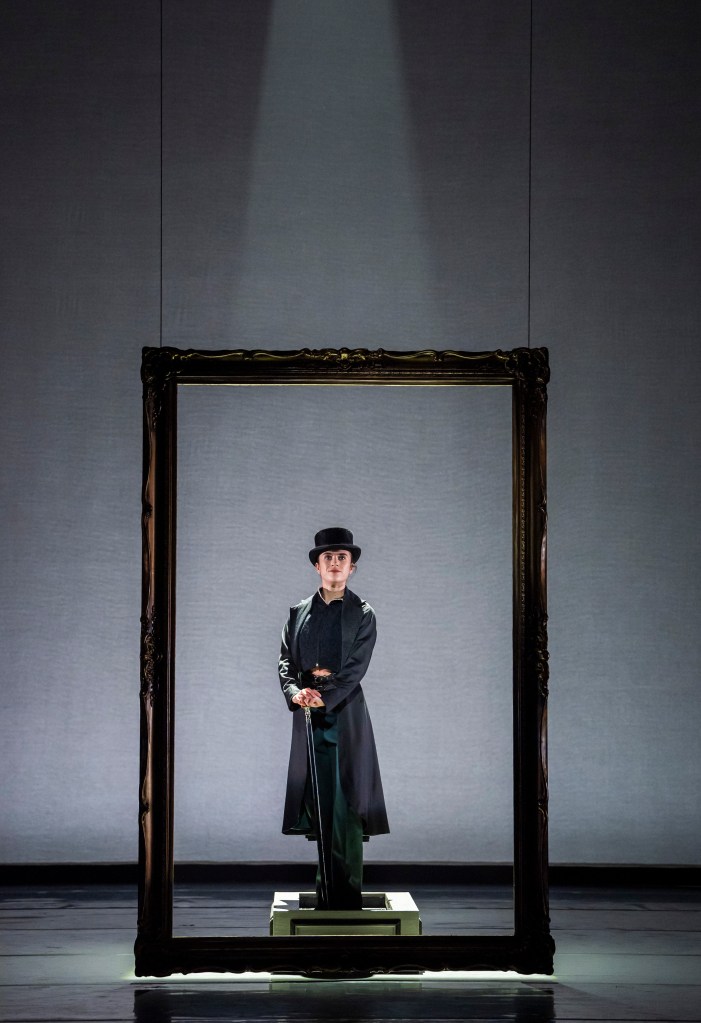
Gemma Coutts in Gentleman Jack – Photo: Tristram Kenton

Rosie: I think you were wondering whether the ballet would end with Anne’s death, but Annabelle wanted the work to end on a “positive” and “inspiring” note (May).  And there are enough ballets that end in death, right?

Philippa: There are indeed.  The union with Ann Walker was such an iconic moment in Anne’s life, so it seemed fitting that this was the climax to the work.  Settling down with a female companion was something she truly wanted: she planned for it and probably prayed for it, because she had religious faith and took the notion of marriage with another woman very seriously. 
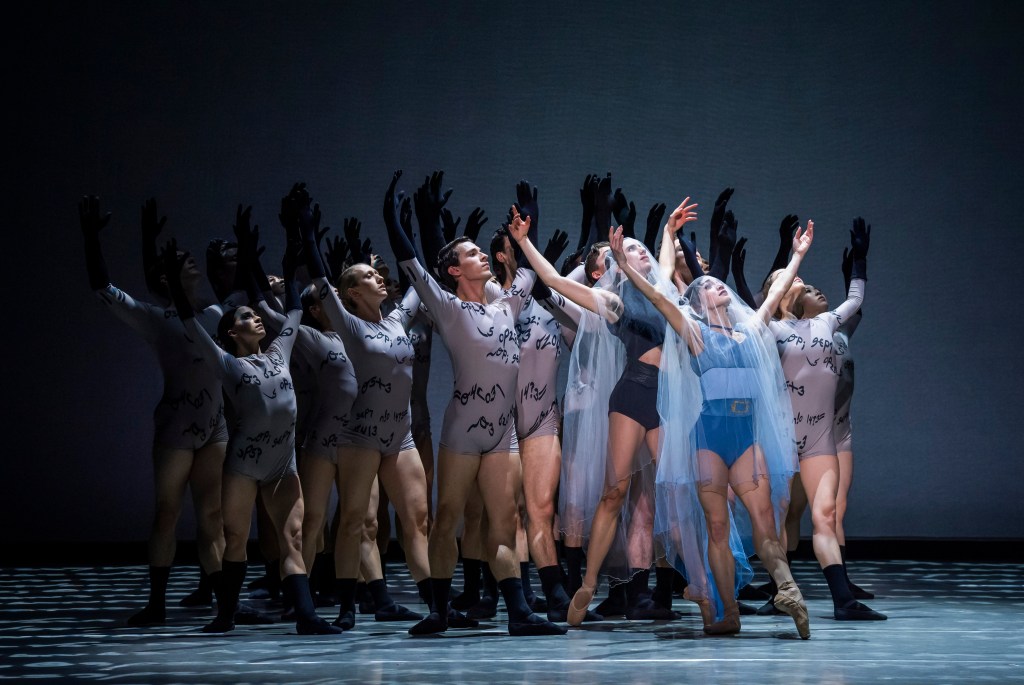
Northern Ballet dancers in Gentleman Jack – Photo: Tristram Kenton

Rosie: Yes, and I felt there was a spiritual atmosphere to that scene, especially with the white veils and pointe shoes, and the way the Brides are held aloft face-to-face with their palms touching.  It’s very idealistic.  They’re framed by the Chorus of Words, as if this moment is the fulfilment of all Anne’s secret desires, and the Words are giving the union their blessing. I do love the use of a chorus—it’s a device that Annabelle has used before, like in Broken Wings with the Chorus of Male Fridas.  Cathy Marston does this too, for example in Jane Eyre.  It gives an insight into the interior world of the protagonists.   

Philippa: And it makes complete sense in this ballet, because Anne Lister’s diaries are the key to our knowledge of her life.  But I found the Chorus most effective in the scene with Ann Walker: her growing desire and longing for Anne felt really palpable with all those yearning, reaching movements.
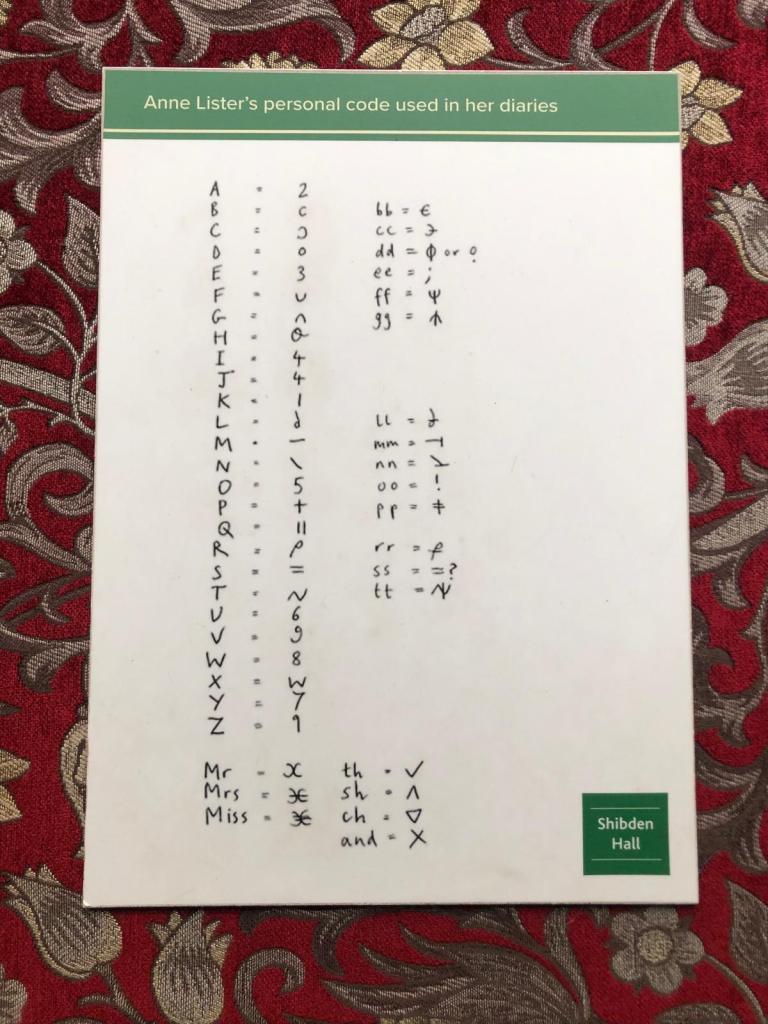
Anne Lister’s code

Rosie: I enjoyed our conversation with Kirsty about Anne’s “crypthand”, as she called it.  Last autumn Annabelle and Northern Ballet visited Shibden, and there was talk about the idea of the code being integral to the design and the choreography, but Kirsty didn’t know if that idea had been realised.  It was great to let her know that it was, with symbols from the code embellishing the costumes for the Chorus of Words, as well as being used as a stimulus for creating movement (“Northern Ballet’s Gentleman Jack | Decoding the Diary”).
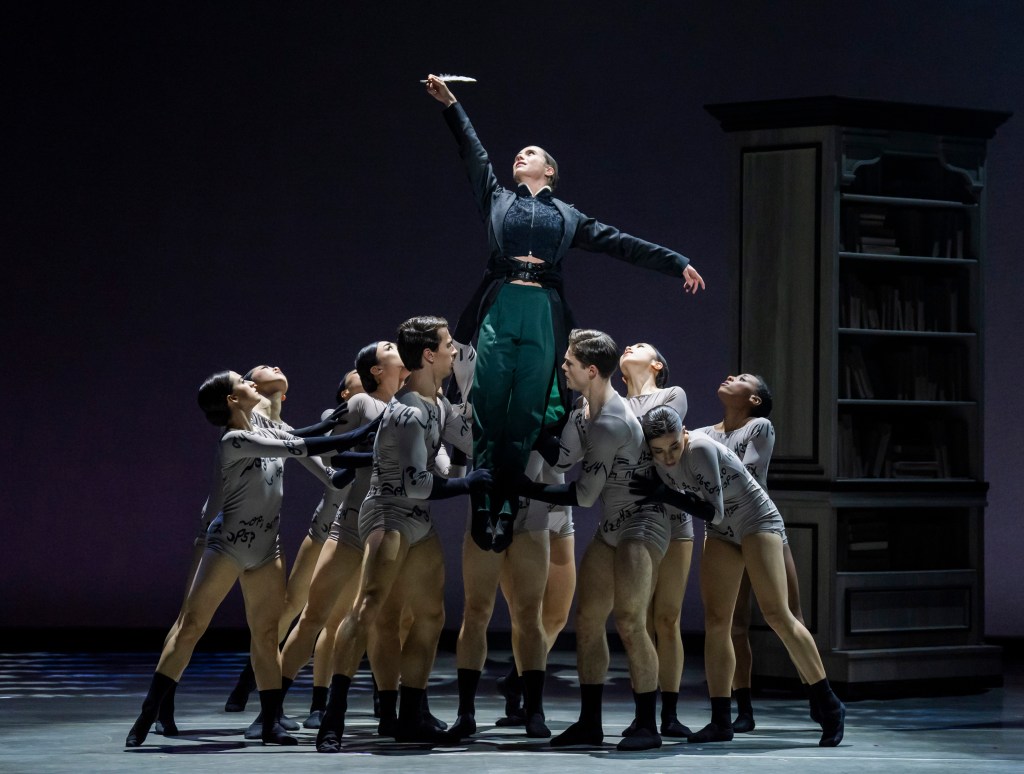
Northern Ballet dancers in Gentleman Jack – Photo: Tristram Kenton

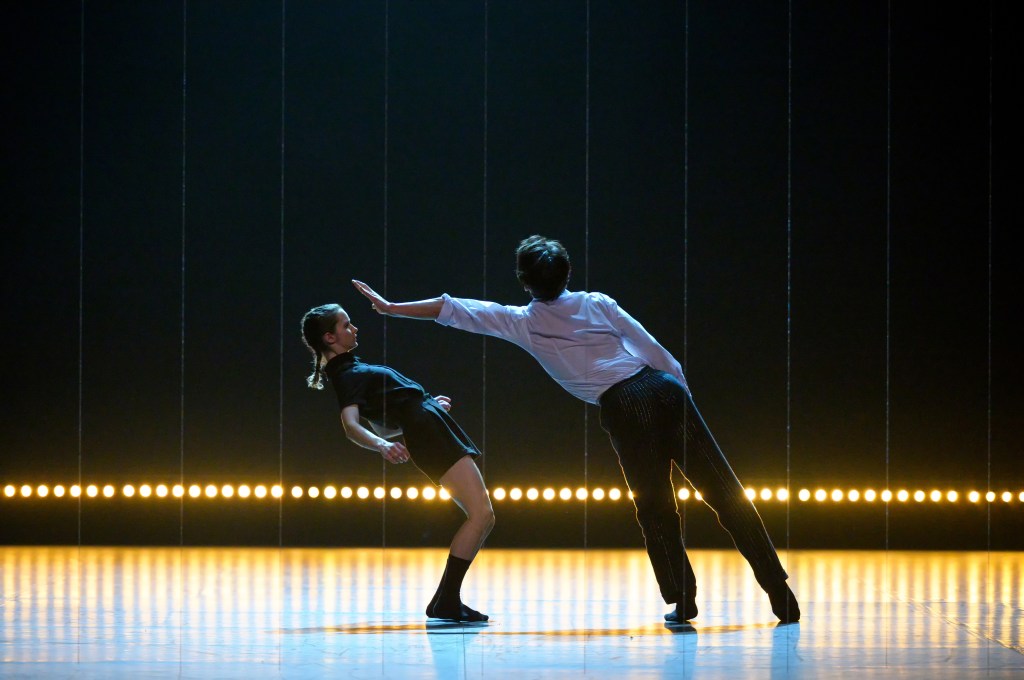
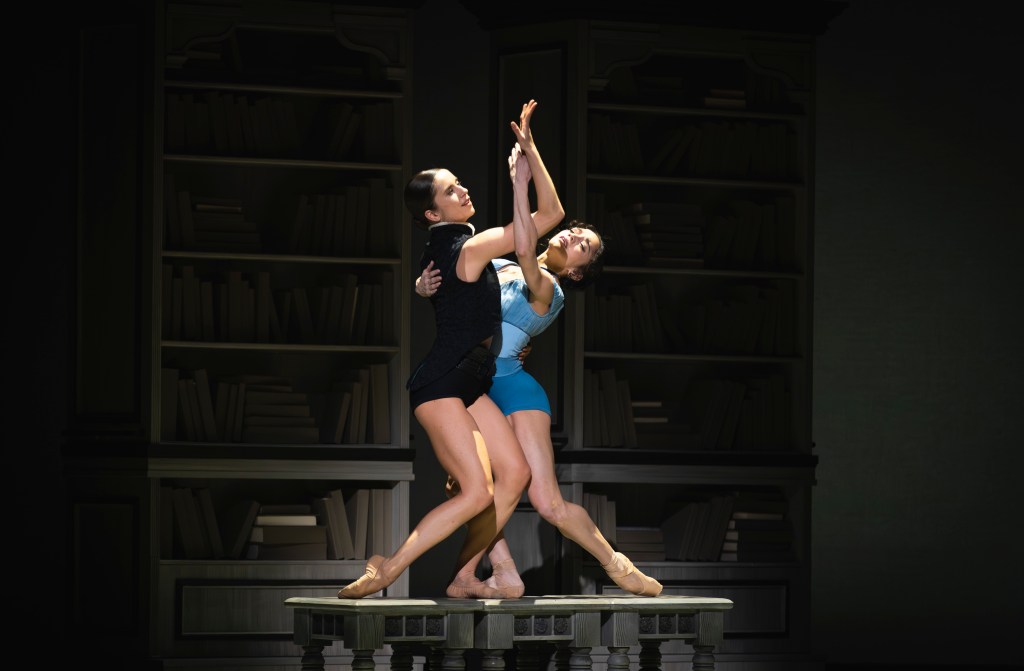
But to go back to the notion of the portrait, there were two main duets (one in Act I with Marianna and the other in Act II with Ann Walker), and they seemed to me to be representative of those romantic relationships rather than simply being a part of the plot.
Gemma Coutts and Rachael Gillespie in Gentleman Jack – Photo: Emily Nuttall

Philippa: Yes I agree.  They’re both very sensual, but one is clearly an established sexual relationship, whereas the other starts more tentatively, as Anne Lister is seducing Ann Walker (“Gentleman Jack | First Look”).  I love the way Anne used the feather in this second duet—for me it connects to her journal writing, because she’s “writing” about her desires and emotions with a quill.

Rosie: When we watched the work in the theatre, I noticed a motif during the duet between Anne and Mariana, which I believe I saw again at the end of the seduction scene between Anne and Ann: it involves their legs crossing over one another so that we can see the letter X.  This seems significant to me because the letter X in the margins of the coded parts of her journals indicated an orgasm (“The Secret Diaries of Anne Lister”).   

Philippa: So it’s a bit like the audience are reading Anne’s code through the choreography.  So clever.  So imaginative.

Rosie: Yes, Something that surprised me was the duet between Anne and her Aunt Anne.  In a way I feel it shouldn’t have been surprising, because here was the opportunity to investigate a different kind of relationship between women.  Aunt Anne was her confidante: unusually she was someone who really seemed to understand Anne, as well as loving her dearly (Choma 77).  I found it very tender. 

Philippa: This happens at the start of Act II, doesn’t it? She comes home after being assaulted by a group of men.  At this point she’s shown to be both physically and emotionally vulnerable, because Marianna, the love of her life, has made the decision to stay with her husband, so Anne is heartbroken and then beaten up when she’s already at a low point.  It’s quite a rare moment.  A startling moment. 

Rosie: There’s a similar scene in the drama: Ann Walker has said she can’t go on with the relationship, and Anne is attacked on her way home.  It’s based on a real incident, which Anne makes very light of in her diary (Choma 201) but it’s been given dramatic impact and significance by Sally Wainwright (creator of the BBC drama and creative consultant for the ballet).  I know that Annabelle felt strongly that her “portrait” of Anne would not be interesting, or complete, I suppose, if Anne were shown to be totally unassailable in every situation.  She says “We need to show some flaws, we need to show some cracks, some vulnerabilities” (“Northern Ballet’s Gentleman Jack | In rehearsal”). 

Philippa: I even felt that Anne appeared a bit vulnerable earlier on in her meeting with Christopher Rawson and his business associates, whereas you saw them as trying to manipulate her but ultimately failing.  But I was really interested when Kirsty pointed out that we only have Anne’s word for it that she came out on top—Rawson might have written in his diary that he got the deal he wanted.  Annabelle uses the word “resilient” to describe Anne, and I think she hits the nail on the head there.  One of the great ways she depicts this in movement is Gentleman Jack’s motif of looking boldly out to the audience, as if breaking the fourth wall.  I especially noticed it when she leaves the stage, which made me think of Suranne Jones talking to the camera in the drama.

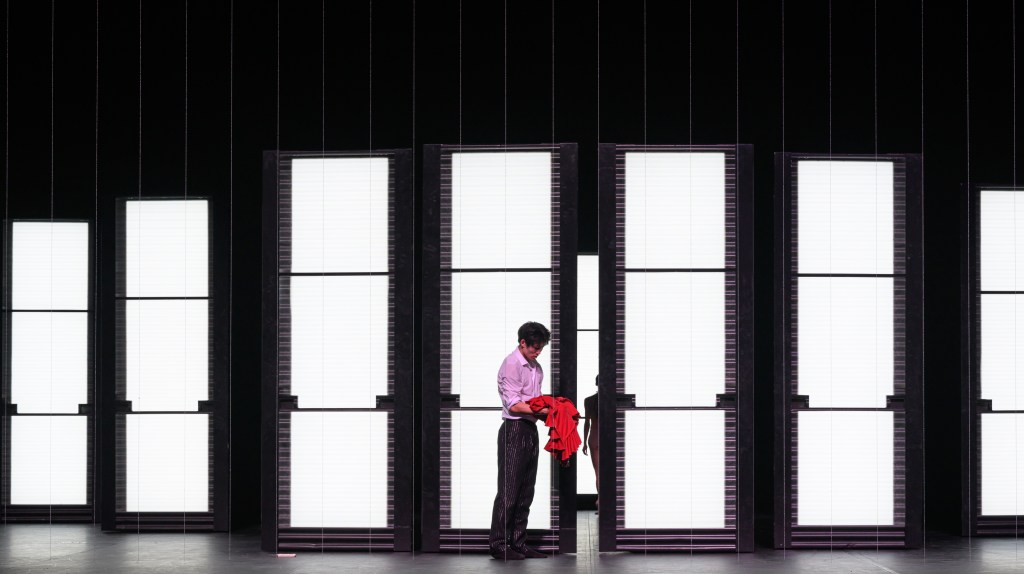
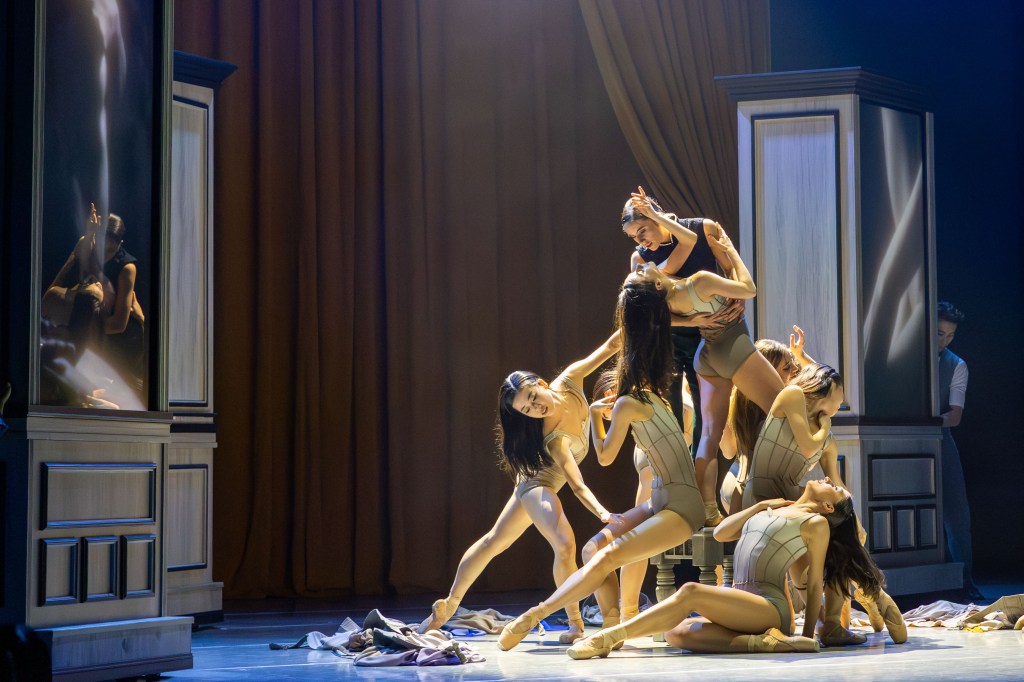
Rosie: It’s very expressive choreography.  But I think that aspects of Gentleman Jack’s character are portrayed through the design too.  I’m not 100% convinced that the moving bookcases were entirely successful, but I think that the concept itself is brilliant.
Northern Ballet dancers in Gentleman Jack – Photo: Colleen Mair

Philippa: Maybe something got lost in translation, so to speak.  The idea of bookcases that can be moved around easily to create different indoor spaces (rooms in people’s homes, Rawson’s office) immediately spoke of Anne’s love for books and learning—she has been called a “voracious learner” (“Gentleman Jack”).  But the projections on the back of the bookcases used to indicate a variety of other spaces that were important to Anne looked like television screens to me, so they just seemed too modern for the time when she lived.

Rosie: They reminded me of those touchscreens where you place your order for a takeaway.  I wondered whether they would work better if they were larger.  Having said that, though, I think the combination of the way they are so easily moved and frequent changing of projections really gives a sense of Anne’s restlessness, her love of walking and travelling and being busy.  And they help keep up the pace of the work, which is important for conveying Anne’s character.  There’s an account in the Choma book (153-55) of Anne’s day on the 8th October 1832, when she made no less than five visits (a mixture of social and business) before lunchtime, and this included going into Halifax, after which she undertook the “forty-five minute hike up the hill” (155) to visit Ann Walker.  

Philippa: I bet it would take us longer than 45 minutes! 

The panels definitely give a sense of place—the countryside, Paris, Shibden itself.  And when Anne uses the attitude motif you were talking about with a moving image of the Yorkshire landscape in the background, you really can visualise her eating up space with her purposeful stride (à la Suranne Jones, as you would say).  Obviously it would be great to see the ballet again—things can seem so different on repeated viewing.

Rosie: I’ve booked myself a ticket in the stalls at Sadler’s Wells (unheard of!) to see how the designs look from that level. 

Philippa: Oooh, I look forward to hearing what that was like.

Rosie: Four years after Annabelle created the one-act Broken Wings, she developed the work into a larger scale two-act ballet.  Even though Gentleman Jack already has two acts, it’s not a very long ballet at 1 hour 40 minutes, so if she chose to extend the work, I was wondering what we might like to see added or developed.

Philippa: Well, that’s an interesting thought …

Rosie: Anne Lister was such a multifaceted character.  I would like to see something more about her passion for travelling and thirst for knowledge, and all the work she did on Shibden—both the physical work and her architectural achievements.  Tragically, she and Ann were away traveling in the Caucasus when she died, so she never got to use the new study and library she had designed at Shibden.  This of course was at a time when a university education was not available to women.
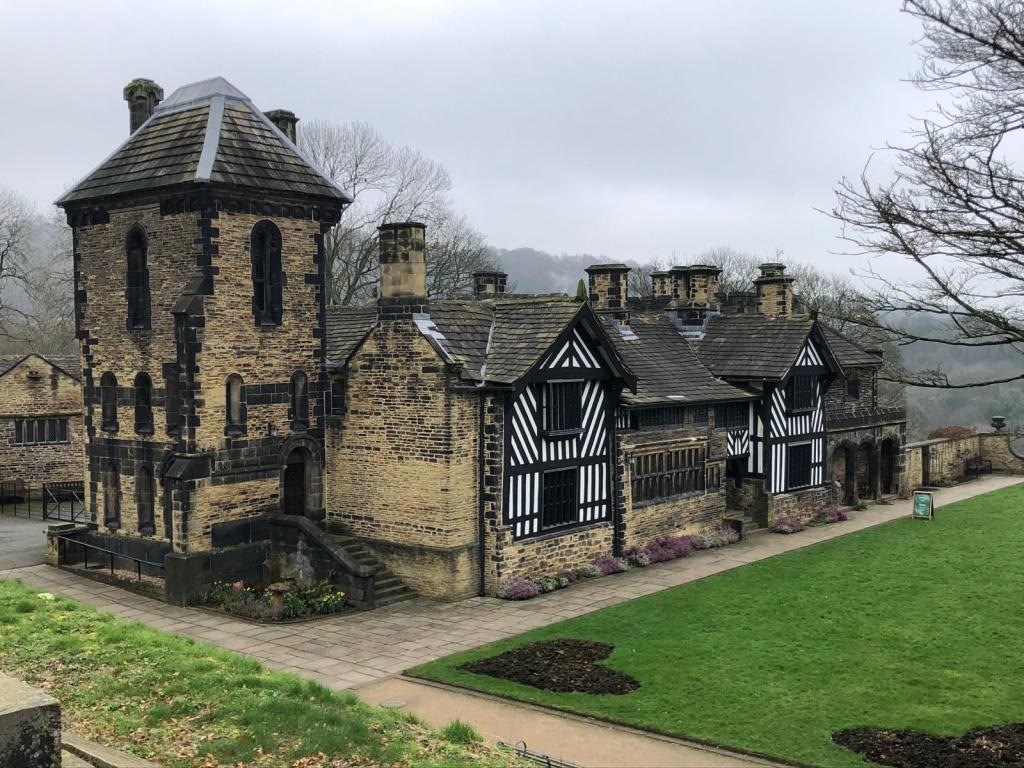
Shibden Hall

Philippa: Another tragedy is that the marriage lasted only about six years because of Anne’s death.  By all accounts the road to Ann Walker’s final commitment to the relationship was a bumpy one, partly because of her mental health issues, and also of course due to the social mores of the time.  I think I’d like to have seen the complexity of that situation explored in the ballet.  I feel it says something of Anne’s resilience and her desire for a lifelong partner that she didn’t give up on Ann Walker.  

Rosie: I’m not sure I’d have been brave enough to commit—I think I’d have been more of a Marianna and accepted a proposal from a suitable gentleman, so to speak.

Philippa: I think it was astonishingly brave of Ann Walker to commit to such an unconventional union for the time.

Rosie: It’s so great that we were able to witness the premiere of this work—it shows how ballet is able to grow as an art form.  As does Scottish Ballet’s Mary Queen of Scots (Laplane/Bonas, 2025), which we watched the evening before.  But that will be for another post …

© British Ballet Now & Then

References


“Anne Lister ‘Gentleman Jack’ of Shibden Hall”. Calderdale Council, 27 Sept. 2024, https://new.calderdale.gov.uk/leisure/local-history/glimpse-past/people/anne-lister.

“The Anne Lister Story by Helena Whitbread”. YouTube, uploaded by Calderdale Council, May 2019, https://www.youtube.com/watch?v=HWMMdnz0jbY

Capelle, Laura. “‘Gentleman Jack’ Brings a Quiet Revolution to Ballet”. The New York Times, 2 Mar. 2026, https://www.nytimes.com/2026/03/02/arts/dance/gentleman-jack-northern-ballet.html.

Choma, Anne. Gentleman Jack: the real Anne Lister. Penguin, 2019.

Eyres, Jennie. “Gentleman Jack – Leeds Grand Theatre”. The Reviews Hub, 8 Mar. 2026, https://www.thereviewshub.com/gentleman-jack-leeds-grand-theatre/.

“Gentleman Jack”. IMDb, https://www.imdb.com/title/tt7211618/. Accessed 12 Apr. 2026.

“Gentleman Jack | First Look”. YouTube, uploaded by Northern Ballet 16 Jan. 2026, https://www.youtube.com/watch?v=hmItwHp78j8.

“Gentleman Jack | Trailer”. YouTube, uploaded by Northern Ballet 18 Mar. 2026,  https://www.youtube.com/watch?v=tSUdalypey4&list=RDtSUdalypey4&start_radio=1

May, Emily. “In Gentleman Jack, Anabelle Lopez Ochoa Brings 19th-Century Queer Icon Anne Lister to Life”. Pointe, 5 Mar. 2026, https://pointemagazine.com/gentleman-jack-ballet/#gsc.tab=0.

“Northern Ballet’s Gentleman Jack | Decoding the Diary”. YouTube, uploaded by Northern Ballet 17 Feb. 2026, https://www.youtube.com/watch?v=PttBljw0sYU

“Northern Ballet’s Gentleman Jack | In rehearsal”. YouTube, uploaded by Northern Ballet 5 Feb. 2026, https://www.youtube.com/watch?v=WuaNmmWt3Ps.

“The Secret Diaries of Anne Lister – Cracking the Crypthand Code”. Visit Calderdale, 12 Aug. 2021, https://www.visitcalderdale.com/the-secret-diaries-of-anne-lister-cracking-the-crypthand-code/.

“The Story”. Programme for Gentleman Jack at Leeds Grand Theatre, 2026, pp. 4-5.

Spotlight on English National Ballet’s Carmen

I have always thought you would kill me.  The very first time I saw you I had just met a priest at the door of my house.  And tonight, as we were going out of Cordova, didn’t you see anything? A hare ran across the road between your horse’s feet.  It is fate. (Mérimée 44) 

Carmen is having a moment! This year marks the 150th anniversary of Georges Bizet’s celebrated opera, and new ballet adaptations have been created by Arielle Smith for San Francisco Ballet (April 2024) and by Annabelle Lopez Ochoa for Miami City Ballet (April 2025).  As you may remember, both of these choreographers have featured in previous British Ballet Now & Then blog posts.  In this post, however, we are focussing on Johan Inger’s Carmen, created in 2015 and now in the repertoire of English National Ballet.

Last year’s English National Ballet premiere was our first encounter with Inger’s Carmen.  On first viewing we were mostly struck by the performances of the dancers.  We had seen Minju Kang before with Northern Ballet, and of course we were hoping to see her in Kenneth Tindall’s Geisha, which was created on her, but we had no idea how feisty she was.  Unsurprisingly, James Streeter received praise as Zuñiga, Don José’s commanding officer (from critics Teresa Guerreiro and Deborah Weiss, for instance), and Erik Woolhouse was sensational as Torero.  Erik is our favourite ever Birbanto in Le Corsaire—another extrovert, audacious character, and we are still hoping to catch him as Hilarion in Akram Khan’s Giselle

The set design by Estudio Dedos is another aspect of the work that we found very satisfying on first night: sets that create different spaces in a fluid and symbolic way capture our imagination (like the black cube in Annabelle Lopez Ochoa’s Broken Wings, or the bookcases in Cathy Marston’s Victoria).  As set designer Curt Allen explains, “the entire set arises out of one shape: an equilateral triangle”. Nine 3-sided prisms are moved around the stage space transporting the audience from mundane tobacco factory to glittering party venue to the foreboding mountains of Don José’s flight.  Each side of each prism is different—mirror, concrete, black corrugated material—inviting parallels with the triangular relationship central to the dark tale: “three are a crowd, three stir up jealousy, three, alas, erupt into violence” (Allen). 

Set, movement and music work together synergistically, like a Gesamtkunskwerk (total art work) that results in more than the sum of its parts.  Rodion Schedrin’s 1967 orchestration of Georges Bizet’s opera (1875) has additional percussion, which adds a layer of energy, and maybe even suggests the violence that so interests Inger.  But new music by Marc Àlvarez is integrated into this existing score to explore Don José’s inner world.  What we found so impressive was the seamlessness of the result, a seamlessness that supports the recurring shifting between the tangible world and Don José’s inner torment.  

The focus on Don José rather than on Carmen herself was something unexpected.  However, given that Inger went back to Prosper Mérimeé’s 1845 novella, in which Don José tells the narrator his life story, after giving himself up and being condemned for Carmen’s murder, this focus was understandable.  Yet despite Inger’s aim to explore the darkness of Don José’s psyche and expose the story’s domestic violence against women (qtd. in Compton), we found ourselves sympathising more with the tortured Don José than the deviant Carmen.  It is Don José who both brings Act I to a close and then starts Act II with an unnerving running motif, and while he is clearly running from the authorities after killing Zuñiga, the vicious undercurrents of the score speak of a man desperately attempting to escape from himself and his own obsession.  

We wondered whether our sympathy was also connected to the casting.  Rentaro Nakaaki, a young dancer who joined the Company in 2018 and almost still looks like a teenager, has an air of naivety about him.  Critic Jenny Gilbert commented on the effect of his “loose-limbed dancing” on her sympathetic reaction to the character, stating that he “was a joy to watch throughout”.  But on subsequent viewings we still found ourselves sympathising with this character.  Inger himself aims to be “honest” and “very human” in his choreography “to get to the people beneath” (qtd. in Compton), and his choreography for Don José accentuates the character’s struggles, with ample solo time for dancers to explore nuances in interpretation.  For example, Aitor Arrieta seemed to highlight the character’s concern for his image and his desire to “do the right thing”.  There was an awareness of and anxiety about the incongruities in his behaviour, so the tension was driven by his desperate struggle to resist his urges and hang on to his sense of self.  In contrast, Fernando Carratalá Coloma seemed to succumb to the inevitable with less resistance, and his desperation was more an expression of his grief at unrequited desire, and his perceived lack of agency in the situation.

Something we struggled with was what we saw as something of a disconnect between Inger’s description of Carmen as a “feminist” and the way Carmen, and indeed the other Cigarreras, were represented on the stage. When the women enter the first time and dance in unison, they appear to take charge of the space as powerful determinants of their own destiny: most of all we remember the motif of the low wide fourth position, their arms in attitude greque and their gaze directed firstly to the audience and then on repeat to Zuñiga.   But they are also brazen and flirt outrageously, as well as fighting amongst themselves in a way that could be perceived as disempowering.  We found it difficult not to interpret the way they strut their stuff as inviting the male gaze rather than challenging it and wondered whether a female choreographer would present them differently.  On the other hand, Carmen’s refusal to play by societal rules that demand a certain behaviour from her afford her a strength of character that Don José, so bound by those rules, lacks.   

We always enjoy ambiguity in a work, so we were intrigued by The Boy, who is in fact performed by a female dancer.  Significantly, they frame the whole narrative, perhaps symbolising youth and innocence that ultimately breaks down, but possibly also representing an integral feature of Don José’s character, even a stereotypically feminine side.  Here we are thinking in particular of his longing for domesticity, and the reticence of his public demeanour, particularly in contrast to the other male protagonists, and in fact to Carmen and the other Cigarreras.  To us this reticence was really noticeable in Carratalá Coloma’s posture on his first entrance, and in the way that Nakaaki was at times a palpable presence on stage, but without being central to the action—more like an onlooker.  

One of the scenes that stood out was a trio with Don José, Carmen and The Boy that represents Don José’s vision of domestic bliss in the middle of a vicious fight with Carmen.  It was noticeable that this pas de trois, which struck us as rather humorous, even ironic, was choreographed to the music that is given to the central pas de deux for Carmen and Don José in Roland’s Petit’s 1949 choreography for himself and Zizi Jeanmaire. 

Other ambiguous characters are The Shadows, dressed in black, who seemed to us to represent fate—fate that Carmen is all too aware of in Mérimée’s novella.  The presence of fate manifests itself in the structure of Inger’s piece, beginning and ending as it does with The Boy and one of The Shadows.  As the work progresses The Shadows multiply and visibly draw it to its climax. It is as if they are the driver of Don José’s obsession, and as if Carmen’s death at his hand were preordained by some inexorable force—maybe even societal forces that drive the way we construct gender and therefore perceive man- and womanhood.  

It’s noticeable that although we see Carmen philandering with her other lovers, the only duet she performs is with Don José.  And the mirroring in the choreography clearly communicates a connection between them.  But despite this, Carmen’s behaviour demonstrates that she is in no way tempted to accept Don José as a permanent fixture in her life.   And then again we wondered whether this connection were simply a figment of Don José’s imagination, or wishful thinking on his part.

We are very aware that we have focused a lot of attention on Don José in this post, but that, we feel, is a reflection of Inger’s work.  Carmen’s character is clear from her actions: she is energetic, fiery and independent, but also violent, rude and unfeeling.  We wondered whether, if she had more solo material, we would see more depth in her character. 

We found Matthew Paluch’s perspective helpful.  He says: 

Femicide is a deeply uncomfortable, pressingly current topic, but it doesn’t make the premise of Carmen any easier to swallow. Inger’s Carmen is very difficult to like, as her raison d’être seems to have zero consideration for others, so the audience is presented with questions as to how we approach her demise. It’s a very conflicting tactic.

We relish the wealth of possible meanings engendered by Inger’s ballet, and we appreciate the perplexing nature of the work.  To us it seems to reflect Carmen’s words to Don José before he murders her:

You mean to kill me, I see that well.  It is fate.  But you’ll never make me give in … You are my rom [husband], and you have the right to kill your romi, but Carmen will always be free. (Mérimée 46) 

Nonetheless, this is a work by a male choreographer, commissioned by a male artistic director (José Carlos Martínez), and based on a novella by a male writer, made famous by a male composer.   The two recent adaptations that we mentioned at the start of this post have been created by female choreographers, and commissioned by female artistic directors (Tamara Rojo and Lourdes Lopez, respectively).  Both choreographers have noted the emphasis on Don José in the original story and expressed their desire to present a work more focussed on Carmen herself:

The very basic theme, that I think is powerful, is it’s a piece about a woman … And that, for me, on the very basic level, was my job, was to make this piece Carmen’s story; otherwise we shouldn’t call it Carmen. (Smith 07:15-07:34)

I wanted my ballet to be more about a strong woman that yearns to be independent, that wants a job and that wants to go higher in the social rankings. (Ochoa 0:32-01:46)

Crucial for us is that both Carmens are involved in business: Smith’s heroine takes over the family restaurant, while Ochoa’s protagonist develops her career from card dealer to poker queen.  This gives them a different kind of agency to Mérimeé’s creation: feisty and rebellious though she may be, the original Carmen does not use her wit and intelligence to better her lot in life or resist her fate, but accepts that her community can demand her life if she refuses to conform to its mores. 

Carmen is clearly a seductive subject matter for artistic creators, but with its themes of violence and cultural stereotyping, an increasingly difficult one.  We welcome further balletic investigations into Carmen’s character, but for starters we would love to see the interpretations of Arielle Smith and Annabelle Lopez Ochoa on a UK stage.   

With thanks to Jodie Nunn for her contribution to the writing of this post

© British Ballet Now & Then

References

Allen, Curt. “Setting the Scene.” Programme for Johan Inger’s Carmen at Sadlers Wells Theatre, English National Ballet, London, 2024.

Crompton, Sarah. “Getting under the skin of Carmen: interview with Johan Inger.” Programme for Johan Inger’s Carmen at Sadlers Wells Theatre, English National Ballet, London, 2024.

Gilbert, Jenny. “Carmen, English National Ballet review”. The Arts Desk, 3 Apr. 2024, https://theartsdesk.com/dance/carmen-english-national-ballet-review-lots-energy-even-violence-nothing-new-say

Guerreiro, Teresa. “English National Ballet, Carmen Review”. Culture Whisper, 28 Mar. 2024, https://www.culturewhisper.com/r/dance/english_national_ballet_carmen_sadlers_wells/17825

Mérimée, Prosper. Carmen. Alpha Editions, 2021.

Ochoa, Annabelle Lopez. “Carmen: In Conversation”. YouTube, uploaded by Miami City Ballet, April 2025, https://www.youtube.com/watch?v=-vXgM9B8XdM.

Paluch, Matthew. “Review: English National Ballet – Carmen”. Broadway World, 28 Mar. 2024, https://www.broadwayworld.com/westend/article/Review-ENGLISH-NATIONAL-BALLET-CARMEN-Sadlers-Wells-20240328.         

Smith, Arielle. “‘She never felt like the protagonist of her own story’”. YouTube, uploaded by San Francisco Ballet, 16 Nov. 2023, https://www.youtube.com/watch?v=lfdCAk7FbOM.

Weiss, Deborah. “English National Ballet: Johan Inger’s Carmen is chillingly topical”. Backtrack, 28 Mar. 2024, https://bachtrack.com/review-carmen-johan-inger-english-national-ballet-sadlers-wells-march-2024

Gender Fluidity Now & Then: fairy tale, myth and icon

Gender Fluidity Now

The Sleeping Beauty now

When the curtains rises on Marius Petipa’s 1890 The Sleeping Beauty, we are left in no doubt that we are entering a world of rigid codes in terms of clothing, etiquette, and hierarchy.  And as the ballet progresses, we quickly become aware of its binary nature, with clear-cut distinctions between good and evil, beauty and ugliness, youth and age, male and female.

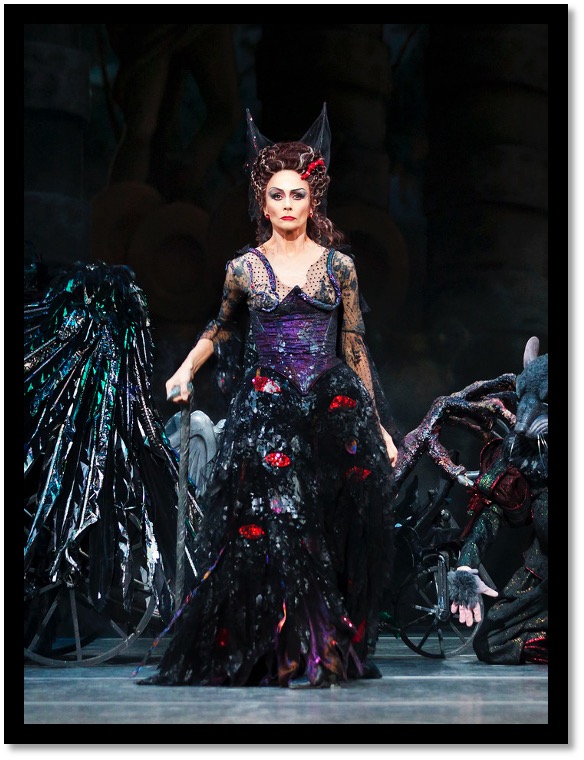
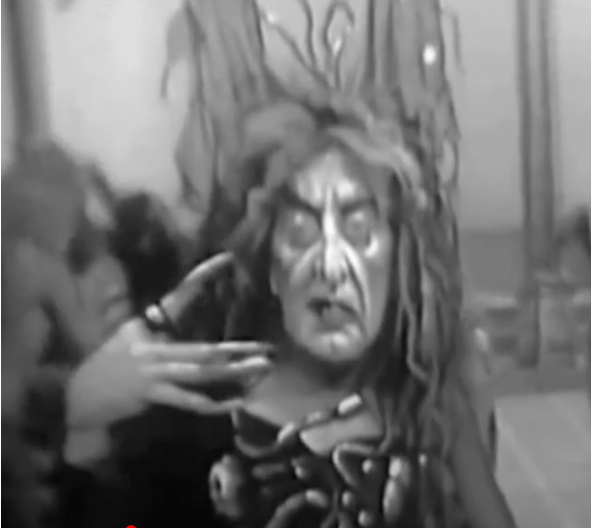
Based on Charles Perrault’s “old fairy”, the Evil Fairy Carabosse is indisputably female.  Nonetheless, following perhaps the example of Old Madge in August Bournonville’s La Sylphide (1836), Carabosse was originally performed by the renowned virtuoso and mime artist Enrico Cecchetti, and is still frequently performed by a male dancer.  Another contributory factor to this decision may have been the nature of Baba Yaga, the “supreme scare figure of the Russian nursery”, who in mythographer Marina Warner’s words “breaks the laws of nature.  Baba Yaga isn’t quite a woman, and certainly not feminine; there’s something of Tiresias about her, double-sexed and knowing” (more about Tiresias in the Then section of this post).  

Writing in 1998, American historian Sally Banes describes Carabosse as “old, ugly, wicked, hunchbacked” (54).  Clearly Carabosse is guilty of wickedness (although we are not given any explanation why), and her other attributes are implied through her name: bosse meaning hump or swelling, and cara meaning face.  This is indisputably the archetypal figure of the ugly old crone (Warner; Watson; Windling).

Banes analyses the ways in which Carabosse flaunts all the codes integral to Sleeping Beauty’s court life:

She breaks the polite bodily codes of the courtiers.  She takes up too much space; her movements are angular, spasmodic, and grotesque.  She transgresses the boundary between female power seen as beautiful and good (as in the Lilac Fairy’s commanding presence) and female power seen as ugly and evil … Usually played by a man (like Madge in La Sylphide, symbolizing her distinctly unfeminine traits and behavior), Carabosse has all the wrong proportions, above all gigantic hands.  She is a monster precisely because she is a category error, seemingly violating gender boundaries by combining aspects of male and female.

In this world a woman can be either powerful, good and beautiful or powerful, evil and ugly.   However, not only is Carabosse ugly and evil, and old, but like Baba Yaga she simultaneously embodies an archetypal female stereotype and fails to adhere to ideals of femininity.  And in this world of classical ballet, she is incapable of executing la danse d’école: “Unlike the good fairies, who balance confidently on one leg while dancing, she cannot even balance on two legs, for she walks with a cane” (Banes 54).

Kristen McNally as Carabosse, 2023 © ROH/Johan Persson

The Royal Ballet’s last run of Sleeping Beauty showcased a variety of female dancers in the role, including Kristen McNally, who has been performing Carabosse since 2009.  Reviews of McNally demonstrate that in her interpretation, while the Evil Fairy may indeed be a monster by nature, she strays far from Banes’ description of Carabosse:  Gerald Dowler describes her as “icily beautiful” with “an evil heart”, while Jann Parry sees her as similarly “glamorous and spiteful”.  One of McNally’s predecessors Genesia Rosato, who performed the role in the first decade of this century, and is our favourite Carabosse, was perceived by reviewers not as “a grotesque old hag …, but a rather sexy and dangerous woman” (Titherington), a “beautiful fairy turned spiteful and gothic” (Liber).

Genesia Rosato as Carabosse with artists of The Royal Ballet, 2011 © ROH/Johan Persson

Fortunately for us, both of these compelling performances are available commercially, so we were able to analyse the dancers’ movements closely in relation to Banes’ words and our knowledge of non-verbal communication and gender representation.  As is characteristic of women, both Rosato and McNally walk with a narrower gait and keep their gestures rather closer to the body than do their male predecessors, such as Anthony Dowell and Frederick Ashton, and they use their canes to poke rather than beat the offending Catalabutte, who forgot to invite Carabosse to the Christening. Unlike the figure of the “ugly old crone” they walk upright, their skin is smooth, and their lips red; and there are no “gigantic hands”.  Nonetheless we still see some “violation of gender boundaries” in their behaviour: they command the space around them; their gestures are strong, broad and intrusive, their eye contact ferocious.  In fact their behaviour in general exhibits the kind of dominance more typical of men (Argyle 284; Burgoon et al. 381; Carli et al. 1031; Mast and Sczesny 414). 

It seems clear that these renditions of Carabosse as glamorous and beautiful do not transgress the gender binary in the way that Banes has in mind, even though some masculine traits are visible.  However, for us, the critical point about gender here is that in this particular world of Sleeping Beauty, a woman can be powerful and evil … and yes, beautiful.  

Over at English National Ballet, who last performed The Sleeping Beauty in 2018, Kenneth MacMillan’s 1986 production provides a different, but equally fascinating, lens through which to view Carabosse, thanks to the costuming of Nicholas Georgiadis.  Luke Jennings’ colourful description of Carabosse with her “sallow features and madly crimped [red] hair” is an unmistakable reference to Queen Elizabeth I, so renowned for her combination of masculine and feminine traits. 

In 2018 casts included both male and female performers.  Clearly, from critic Vera Liber’s point of view, there was a noticeable distinction between the interpretations of the first and second casts, one male, one female:

On first night, James Streeter revels in playing up the panto villain, giving it plenty of gothic largesse, whereas second cast Stina Quagebeur is a deliciously spiteful Nicole Kidman lookalike, a vengeful woman wronged.

James Streeter as Carabosse in English National Ballet’s The Sleeping Beauty, 2018 © Laurent Liotardo

Even though not explicit, the comparison with a female actor and choice of words “deliciously spiteful” and “vengeful woman” do strongly imply that, to Liber, Stina Quagebeur appears markedly more feminine than James Streeter.  And her depiction of Quagebeur’s Carabosse is very much in line with the descriptions of Genesia Rosato and Kristen McNally in the role, combining evil, beauty and power.  

What Carabosse and Elizabeth I have in common is that they both have the power to wreck the dynasty: Elizabeth through her choice not to bear children, and Carabosse by scheming to prevent Aurora from producing an heir.  And this parallel with Elizabeth informs our understanding of Carabosse as a character that does not fit comfortably within a single gender category.  

The Scottish preacher and author John Knox (1514-1572) declared that “God hath revealed to some in this our age that it is more than a monster in nature that a woman should reign and bear empire above man” (2).  So whether performed by a male or female dancer, this Elizabeth-Carabosse can been seen as “a monster … seemingly violating gender boundaries”.  And on a personal note, we would have to say that Stina Quagebeur is without a doubt the most terrifying Carabosse we have ever encountered.

Cinderella now

Last season Scottish Ballet explored gender fluidity, again in the context of a familiar, well-loved fairy-tale ballet, but in an unusual and innovative way.  

Bruno Micchiardi as Cinders in Scottish Ballet’s Cinders. Credit Andy Ross

Renamed Cinders! the narrative of Cinderella on some nights featured the usual female Cinders, who falls in love with the Prince, while on others, romance blossomed between a male Cinders and the Princess.  

The cast was deliberately not released in advance, so each audience remained uncertain of Cinders’ gender until their appearance on the stage.  Consequently, when purchasing tickets, audiences had at least to be open to the challenge of a new way of viewing the work.

Scottish Ballet describes Cinders! as “an evolution and adaptation of Christopher Hampson’s [2015] Cinderella”.  Given ballet’s rigid gender codes in terms of roles, behaviours, technique and vocabulary, you may, like us, be wondering how such a gender swap could ever be achieved. Critic Kathy Elgin asks with apparent consternation, “Would a man have to cope with girly bourrée-ing?”.  Evidently, however, the adaptations were far more subtle than these musings suggest, as Elgin asserts that “the choreography is much the same irrespective of who’s playing what, except for some obvious variation in solos to accommodate male / female specialities. That is, in pas de deux, each is dancing the steps they would have danced in any pairing”.  Yet despite the subtlety of the changes, it is clear that for both dancers and viewers the approach to characterisation made a substantial difference, resulting in fresh insights into of the nature of the protagonists.

Bruno Micchiardi as Cinders and Jessica Fyfe as Princess Louise in Scottish Ballet’s Cinders. Credit Andy Ross

Principal Dancer Bruno Michiardi reflected on the rehearsal process:

What I’ve found most interesting about the fluidity of the roles of the Cinders leads is just how different and new it’s made the ballet feel. We all know and love the classic story of Cinderella, but this new version means we’re suddenly working in this amazing upside-down realm, where the male part (previously a more traditionally stoic character) is a complex mixture of vulnerability and resilience, and the female role (usually quite timid and downtrodden for most of the original ballet) is empowered and full of charisma… I’m excited at the prospect of exploring this further and sharing that with the audience! (“Introducing Cinders”)

Reviewer Tom King sees this exchange of gender as a “re-written … dialogue of the dance between the Princess and Cinders … so the gender prominence of this work now changes completely too as it is the male lead who now dominates and performs so much of this ballet”.  In contrast Elgin notes that “the commanding style of a princess in her own right reminds us how rarely women get the chance to make that kind of confident statement”.  

Bruno Micchiardi as Cinders in Scottish Ballet’s Cinders. Credit Andy Ross

These different perspectives highlight what is most important to us about the Cinders! gender swap—that is, the opportunity for both dancers and audience to reappraise how they perceive gender roles within the context of a traditional ballet narrative.

Broken Wings and the Male Fridas

In 2016 choreographer Annabelle Lopez Ochoa created a very different world to that of The Sleeping Beauty and Cinderella for English National Ballet.   Based on the life of artist Frida Kahlo, this ballet presents gender fluidity in a unique way—unique, but completely in line with Kahlo’s life and art.

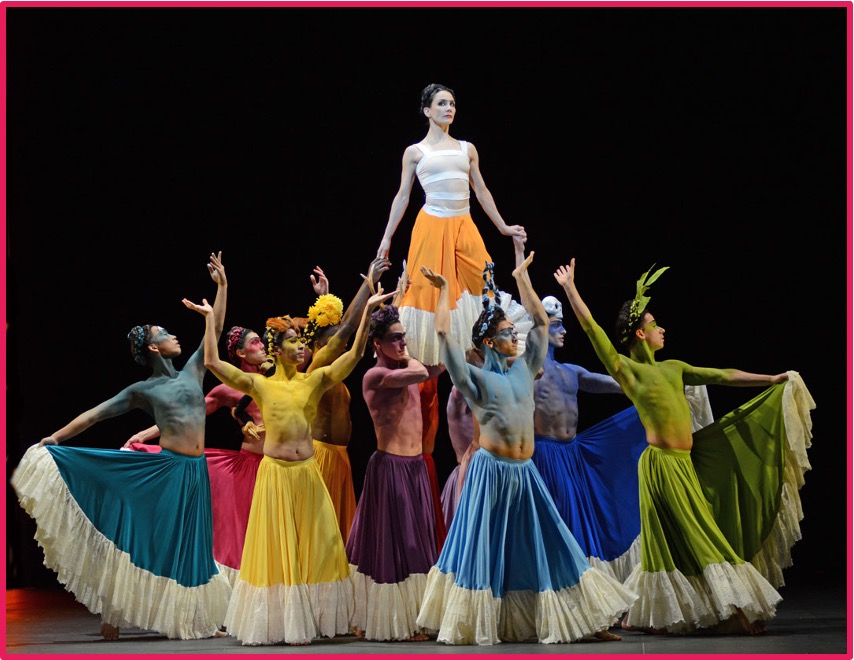
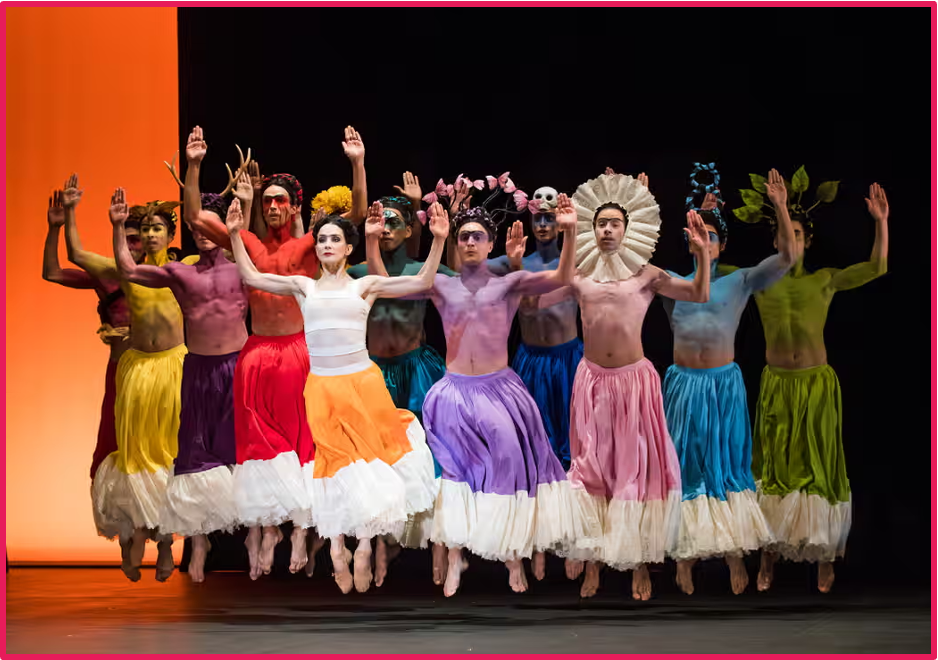
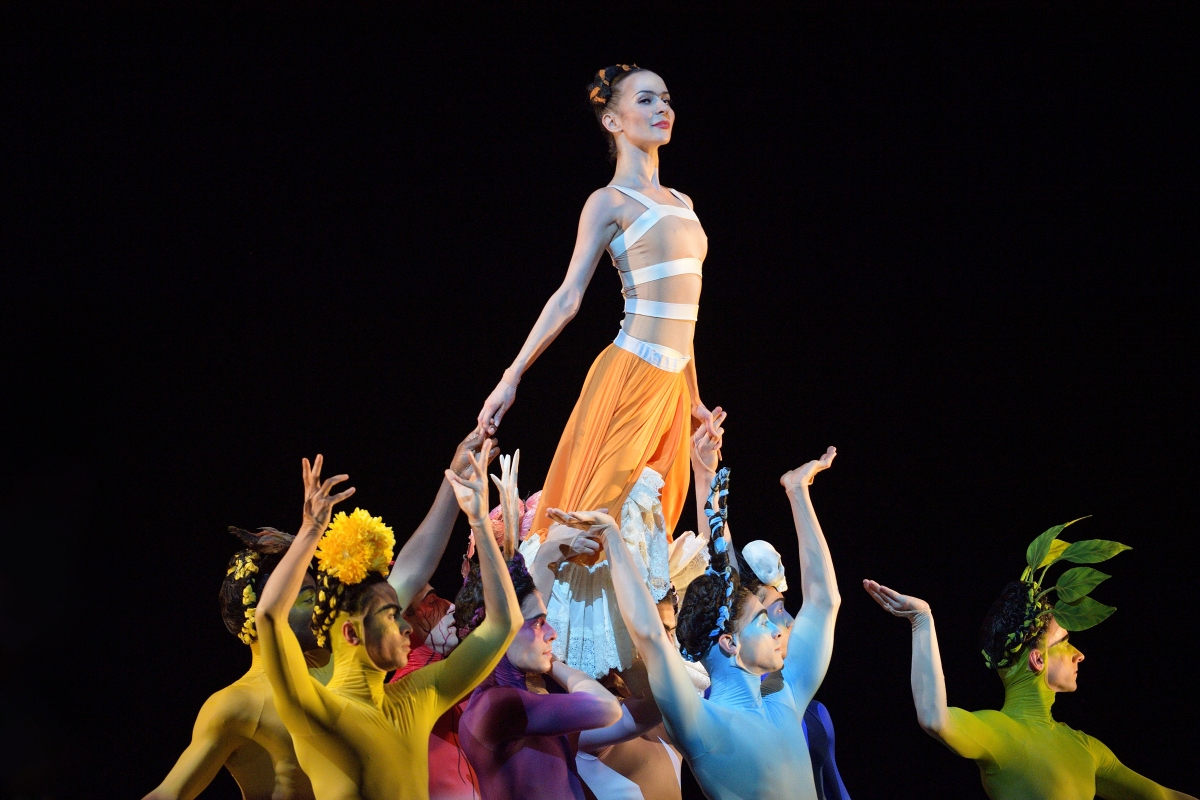
Like Queen Elizabeth I, Kahlo was known for her own peculiar union of masculinity and femininity.  In the ballet this is perhaps most notable through the presence of eleven “Male Fridas” who bring Kahlo’s paintings into three-dimensional life. 

Performed by male members of the company, these Fridas, described by designer Dieuweke van Reij as an “extension of Frida herself”, sport billowing full-length ruffled skirts, in bright, contrasting colours, inspired by traditional Tehuana dress. Their headdresses include flowers, butterflies, antlers, and the ceremonial resplandor, referencing specific self-portraits by Kahlo, including Self-Portrait with a Necklace of Thorns (1940), Self-Portrait as a Tehuana (1943), and Self-Portrait with a Monkey (1948).  Their torsos are painted to match their skirts.  

Tamara Rojo & Artists of English National Ballet, 2016 © Dave Morgan

The costumes are inspired by Kahlo’s iconic dress style, which is undeniably feminine, with the soft folds of the material and decorative headdresses.  But Kahlo was also known for a more androgynous style of dressing: even as a teenager she was known to wear a man’s suit with waistcoat and tie, and in her 1940 Self-Portrait with Cropped Hair she has cut her hair short and wears a man’s dark suit.  Her monobrow, moustache and strong features were also celebrated, even exaggerated, in her paintings.  And neither in terms of her behaviour did Kahlo conform to stereotypical femininity, with her forthrightness, her revolutionary politics, and her sexual appetite for both female and male lovers.  But despite the evident femininity of the Broken Wings costumes, they also connote power.  This is because the Tehuana dress is the traditional dress of the Zapotec women from the Isthmus of Tehuantepec, who are unconventional in being considered, to some extent at least, a matriarchal society, and from which, significantly, Kahlo’s mother hailed.

As the Male Fridas swirl and sway with bold lunges and leaps, and expansive leg gestures, they make full use of their skirts, creating a riot of colour and energy.  And Frida joins them, dressed in an orange Tehuana skirt, dancing in the same bold but non-gendered style, sometimes in unison.  Her dominance is writ large as the Male Fridas hold her aloft, and she boldly leads and directs their movements, displaying Kahlo’s own peculiar fusion of masculinity and femininity.

Tamara Rojo & Artists of English National Ballet, 2016
© Tristram Kenton

Further, the non-binary nature of the “Male Fridas” is accentuated by their strong resemblance to the “muxes” of Zapotec culture.  The muxes are considered neither female nor male, but instead are a recognised third gender.  While they are assigned male at birth, as adults they exhibit more stereotypically female attributes in their behaviours, and economic and societal roles.  This can be seen, for example, in the way they dress, their skill at embroidering and weaving, and their caregiving to elderly relatives (Balderas; Plata).

And now we return to The Sleeping Beauty and Cinderella to discover how gender fluidity manifested itself in British ballet in the past, before exploring a less conventional work …

Gender Fluidity Then

The Sleeping Beauty then

As we said in the Now section of this post, in 1890 Marius Petipa created the character of Carabosse for Enrico Cecchetti.  However, it’s interesting that when Sergei Diaghilev mounted his production of The Sleeping Beauty in London in 1921, Carabosse was performed by Carlotta Brianza, the originator of the role of Princess Aurora.  Over the last century there have been phases of male and female Carabosses, and following the lead of Petipa and Diaghilev, the calibre of dancers has sometimes been extraordinary, including Frederick Ashton, Robert Helpmann, Monica Mason, Lynn Seymour, Anthony Dowell, Edward Watson and Zenaida Yanowsky.  

  Frederick Ashton, 1955 © Showcase Productions

While it’s of interest that Brianza performed Carabosse for Diaghilev, it’s even more fascinating that it was not the role of Carabosse that the Impresario originally had in mind for Brianza; rather, it was her original role of Princess Aurora (Christoudia 201).  By 1921 Brianza was in her mid-50s.  According to the drama The Ballerinas, it was Brianza herself who suggested that she perform the part of the Evil Fairy.  It would be understandable if Brianza had considered herself unsuitable for Aurora at this point in her career (Tamara Rojo famously stated that she believed ballerinas should not be performing Aurora beyond the age of forty, and the first night went to the 26-year-old Olga Spessivtseva).  Ironically though, Carla Fracci, who performs sections of Aurora’s choreography as both Brianza and Spessivtseva in the programme, was herself just shy of fifty when it was recorded, and we would defy anyone to say she looks anything but youthful in both her appearance and her dancing.  At the 1890 premiere designer Alexander Benois described Brianza as “very pretty”, while reviews highlighted her grace and elegance (qtd. in Wiley 189).  Perhaps the most celebrated photograph of Brianza as Aurora shows her balancing sur pointe in cou de pied, her hands placed demurely by her neck, so that her forearms partially hide her décolleté, and attired in a tutu that gives her the perfect wasp-like waist.  The picture of femininity.  There seems no logical reason then that in her 50s Brianza would have lost all of her beauty, grace and elegance.  

It is difficult to know what Brianza was like as Carabosse, but we were able to find a small number of photos of her in the role, which make it crystal clear that Carabosse in this production was bereft of beauty, grace and elegance.  One photo shows her surrounded by her entourage of rats that seem to tower over her, making her appear a rather petite figure, her stature diminished by her hunched back and lankness of her hair (“Carlotta Brianza as Carabosse”). Feminine, but hardly the ideal of femininity.  In another she is seems to be mistress of all she surveys.  The stoop and the lank hair are still in evidence, but her silhouetted profile brings a baleful mystery to her lone, and in this image androgynous, figure (MacDonald 280).

Luckily, however, we have a very good idea of how Carabosse was portrayed in the 1950s by the Royal Ballet in the celebrated 1946 production by Nicholas Sergeyev and Ninette de Valois, thanks to two recordings of the work, made in 1955 and 1959.  On opening night Robert Helpmann accomplished the astonishing feat of performing both Carabosse and the Prince. However, it is Ashton who appears in the 1955 recording, while the 1959 film features Yvonne Cartier, who by this time was focussing on mime due to an inoperable ankle injury. 

Yvonne Cartier, 1959
© Royal Academy of Dance / ArenaPAL

Even though these two performances feature a male and a female dancer, they both exhibit a remarkable likeness to the image of Carabosse that we outlined in the Now section of this post.  With their blemished skin and stooping gait both Ashton and Cartier display the attributes of the archetypal “ugly old crone” or “grotesque old hag”.  More particularly, the words of Sally Banes could have been written specifically for these renditions of the Evil Fairy: Ashton’s movement are indisputably “angular, spasmodic, and grotesque”, while Cartier spreads her arms wide like enormous wings, and as a result “takes up too much space”.  And they have “the wrong proportions”.  Ashton has an exaggerated prosthetic nose, and they both have “gigantic hands” due to their long fake nails, threatening gestures, and in the case of Cartier, the spreading of her fingers like a raptor’s talons.

Yvonne Cartier, 1959
© Royal Academy of Dance / ArenaPAL

It seems that not even Brianza, the hyperfeminine Aurora of 1890, could escape the curse of being transformed from benign and pulchritudinous to malevolent and unsightly.  But as we have seen, the figure of Carabosse has evolved quite drastically over the last decades of the 20th century and into the current century, challenging the binaries of female vs. male, ugliness vs. beauty, good vs. evil.  How will that evolution continue, we wonder?

Cinderella then

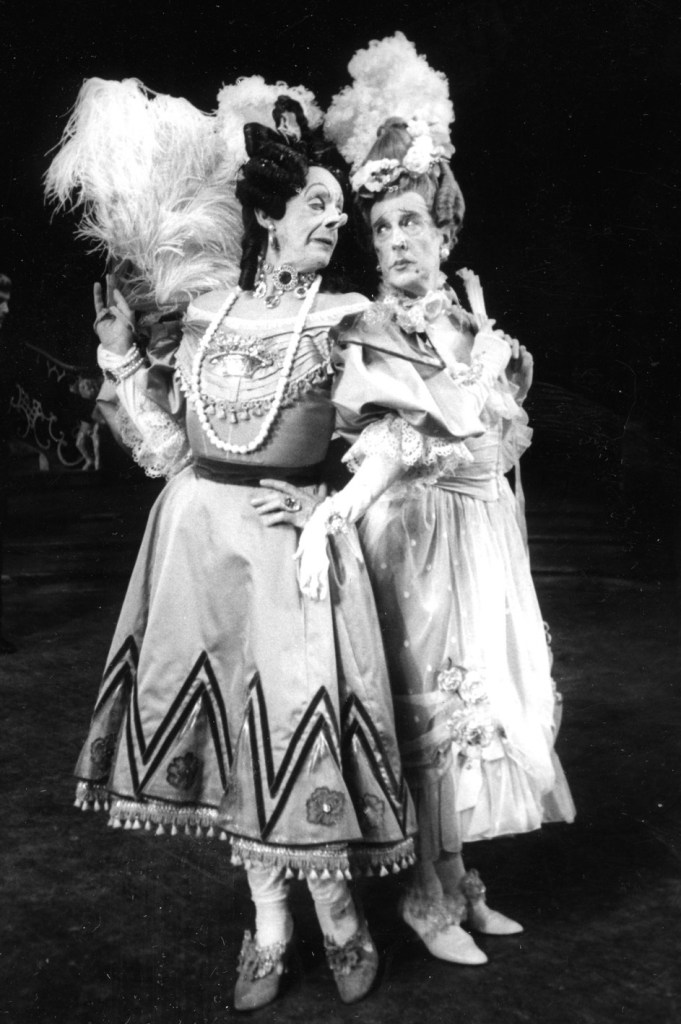
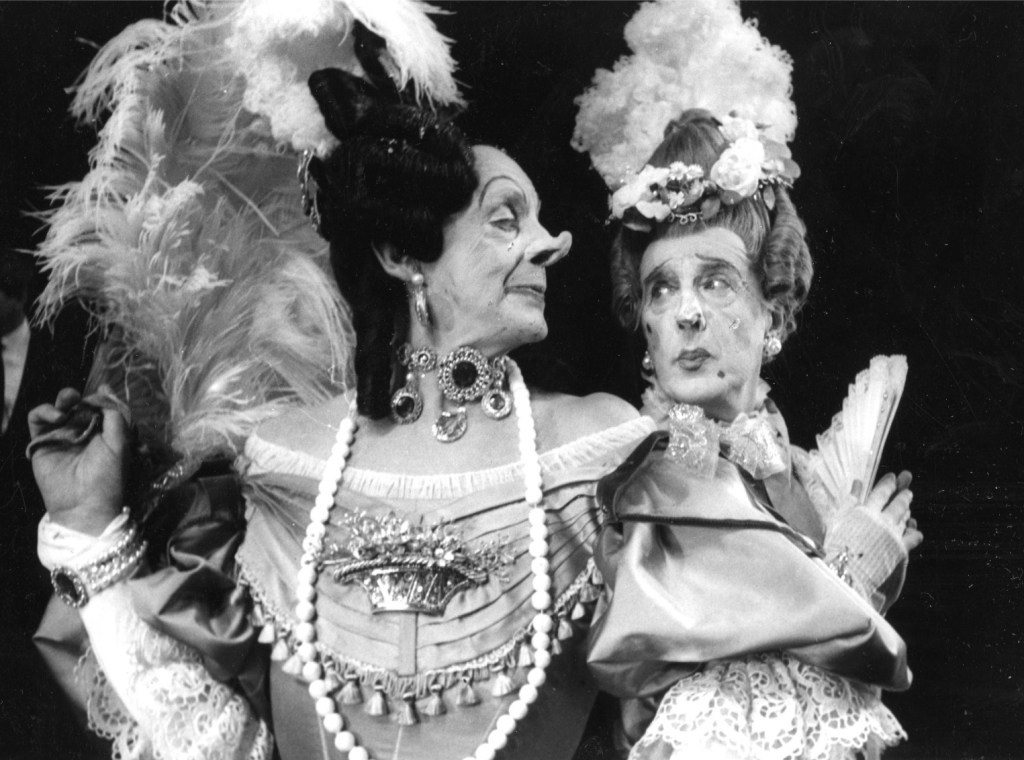
The Royal Ballet’s decision to cast female Stepsisters as well as the traditional male Stepsisters in their 2023 production of Ashton’s Cinderella caused quite a stir (“Ashton’s Cinderella”; Pritchard), and we were excited about this “new” development.  However, we soon discovered that it had been Ashton’s original intention to create his choreography on female dancers, more specifically on Margaret Dale (the pioneer ballet filmmaker) and Moyra Fraser.  It was in fact Fraser’s unavailability that caused the change in plan, resulting in the celebrated Ashton-Helpmann Stepsister twosome.

Although critic Judith Mackrell has referred to the Stepsisters as “monsters”, in stark contrast to Carabosse, they are “monsters of delusional vanity” (“Girls Aloud”) rather than monsters of evil.  Their behaviour and movements are noticeably “feminine”: they preen in front of the mirror, fuss about their clothes, bicker, walk in a flouncing manner and perform “female” variations at the Ball.  These variations overtly reference typical vocabulary from classical pas for ballerinas: small sissonnes piqué arabesque into retiré, a series of pas de chatdéveloppé à la secondeemboîtés en tournant; they even include lifts and fish dives supported by their male partners.  In fact the solo for the timid Stepsister, performed by Ashton, draws on the Sugar Plum Fairy variation, and perhaps also on Walt Disney’s hippo ballerina Hyacinth (Fantasia, 1940), inspired by the Baby Ballerina Tatiana Riabouchinska.

Further, there are additional layers of femininity to these characters.  Firstly, with their exaggerated costumes and comedic manners, they recognisably reference the tradition of the Pantomime Dame, so familiar to audiences in this country.  Secondly, Ashton had performed the Prince in Andrée Howard’s 1935 Cinderella, and according to David Vaughan (234) was influenced by some aspects of the characterisation, costumes and wig of the sister which Howard choreographed, designed and performed herself.  And thirdly, both Ashton and Helpmann were known for their mimicry, notably of women, and both were said to have been influenced by specific “female eccentrics” (Kavanagh 365): Helpmann by Jane Clark (renowned for her feistiness) and comedienne Beatrice Lillie (Vaughan 234), and Ashton himself by Edith Sitwell (Kavanagh 365). 

According to dance critic and historian David Vaughan, a female cast was unsuccessful, because “the kind of observation of the female character that lay beneath these performances could be achieved only by men” (234).  However, we would argue that, as in the case of the Pantomime Dame, performers and audience share an understanding that the performers are male, and much of the humour resides in this shared understanding, despite the overt performative femininity: “The audience and the character comically share the knowledge that the Dame is not really a woman” (“‘It’s behind you!’”).  And there must have been a delicious additional irony attached to the first cast at the premiere in 1948, given the status of both Ashton and Helpmann as key figures in the development of British ballet. 

While the Sisters each perform a ballerina solo, their dancing is very poor in classical terms, with turned-in feet, shaky balance, poor coordination and spatial confusion.  This of course adds to the humour of the work, a humour that perhaps loses some of its edge when these Pantomime Dames are performed by women. However, it also suggests that female characters who are not fully female, as it were, are in some way lacking, incapable as they are of performing female danse d’école, even when they are female dancers pretending to be male dancers pretending to be female.  

Moyra Fraser and Margaret Hill, 1958
© Royal Academy of Dance / ArenaPAL

Although Ashton and Helpmann were the most fêted “twin monsters” (Mackrell, “Girls Aloud”), the 1957 recording of the work featured Kenneth MacMillan instead of Helpmann.  Writing about MacMillan’s performance, Peter Wright spotlights the humour that arises from the play on gender in this context:

Kenneth’s performance is remarkably considered, recognisably feminine but still decidedly masculine in the best tradition of pantomime dame … He was very funny. (149)

Tiresias

Happily, undertaking research for this post gave us the opportunity to discover  more about a lesser known ballet by Frederick Ashton which, according to the Royal Opera House performance database, was performed only fourteen times over a period of four years after the premiere in 1951.  Based on the titular figure from Greek mythology, Tiresias was a tale of sexual identity and pleasure, following the life of Tiresias, who was transformed from man into woman and then back to manhood as the result of his reaction to witnessing a pair of copulating snakes.  Having experienced life as both man and woman, he is asked to decide the quarrel between Zeus and Hera as to whether males or females gain more enjoyment from the sexual act.  

As we might expect from a ballet of this era, the eponymous Tiresias was not gender fluid in the way that Frida and her corps de ballet are in Broken Wings.  Instead, Tiresias was performed by two dancers: Michael Somes as the male Tiresias, and Margot Fonteyn as his female counterpart.  Nonetheless, David Raher, writing in The Dancing Times (15) after the premiere, made some comments about Fonteyn’s performance that are pertinent to our discussion: 

Instead of contrasting femininity, she conveyed a masculinity in the attack and brio of her dancing.  Incontestable evidence of her gender, however, lay in the soft yet firm arm placements and in the unsurpassed magic of controlled développés …

While we ourselves may not make the same gender associations as Raher, the critic’s commentary clearly demonstrates that he perceived aspects of male and female in Fonteyn’s performance.  

David Vaughan, who also wrote Ashton’s biography, refers to the “wonderfully ambiguous eroticism” of the pas de deux (254), perhaps implying that the representation of gender is not as straightforward as is generally the case in ballet.  Although there seems to be no publicly available video footage of the ballet, we have found some sources that suggest the sensual nature of the choreography:  Julie Kavanagh’s description of the pas de deux as “fizz[ing] up into a kind of orgasm” (391), and John Wood’s photograph of Tiresias and her Lover (danced by John Field) showing them in a stylised pose of post-coital bliss, splayed across one another on the floor in a mirror image as they gaze into one other’s eyes.  

Judging from the reviews, the number of performances, and the literature on Tiresias, the ballet was neither a critical nor a commercial success.  Perhaps the sexually charged choreography and risqué subject matter (glossed over in the programme notes) were too ahead of their time.  After Fonteyn’s fiancé forbad her from performing the role again, her replacement Violetta Elvin took on the role, and when her she remarried, the same thing happened: her new husband banned her from dancing in further performances (Macaulay).  

Clearly the erotic nature of the choreography was challenging in 1951.  And this seems to have been the sticking point   However, the iconoclastic choice of gender fluidity and sexual identity as subject matter, in addition to sexual pleasure, should in our opinion not be forgotten, as it is a testament to the daring nature of a choreographer who is perhaps too often associated with conventionality. 

Concluding Thoughts

From this exploration of a small number of British ballets based on fairy tales and myth, it is clear that ballet is not entirely new to the concept of gender fluidity, and the more we dig into the characters, the more complex they become.  Nonetheless, while attitudes towards gender, and the stereotypes associated with two strictly defined genders, are becoming more open in everyday life, ballet is only very slowly reflecting this cultural shift.  Happily, this autumn two British companies have announced upcoming productions that will clearly feature gender-fluid characters: Northern Ballet’s Gentleman Jack, choreographed by Annabelle Lopez Ochoa, and Scottish Ballet’s Mary Queen of Scots in choreography by Sophie Laplane.

As long ago as 2012 Gretchen Alterowitz urged her readers to “contemplate the possibility of multiple or varied genders having a place in the ballet world” (21).  We would suggest that the example of Annabelle Lopez Ochoa’s Broken Wings based on the icon Frida Kahlo shows us that ballet does in fact have the capacity to create worlds where a greater diversity of gender representation can be explored—a diversity more suited to our current world and more relevant to the global art form that ballet has become.   

Next time on British Ballet Now and Then 
Autumn 2024 saw Noel Streatfeild’s 1936 novel Ballet Shoes adapted for the National Theatre.  We investigate this new stage production, television adaptations, and the original book itself.   

© British Ballet Now & Then

References

Alterowitz, Gretchen. “Contemporary Ballet: inhabiting the past while engaging the future”. Conversations Across the Field of Dance Studies, no. 35, 2015, pp. 20-23.

Argyle, Michael. Bodily Communication. 2nd ed., Routledge, 1988.

“Ashton’s Cinderella – new Royal Ballet production”. BalletcoForum,https://www.balletcoforum.com/topic/26439-ashtons-cinderella-new-royal-ballet-production/. Accessed 1 Sept. 2024.

Balderas, Jessica Rodriguez. “Muxes, the third gender that challenges heteronormativity”. Institute of Development Studies, 3 Feb. 2020, https://alumni.ids.ac.uk/news/blogs-perspectives-provocations-initiatives/513/513-Muxes-the-third-gender-that-challenges-heteronormativity

“The Ballerinas”.  YouTube, uploaded by markie polo, 24 May 2020, https://www.youtube.com/watch?v=Sx2D40Wavwg&t=10586s.

Banes, Sally. Dancing Women: female bodies on the stage. Routledge, 1998.

Burgoon et al. Nonverbal communication. 2nd ed., Routledge, 2022.

Carli, Linda L. et al. “Nonverbal Behavior, Gender, and Influence”. Journal of Personality and Social Psychology, vol. 68, no. 6, 1995, pp. 1030–1041, https://doi.org/10.1037/0022-3514.68.6.1030.

“Carlotta Brianza as Carabosse with her entourage of rats in the opening scene of The Sleeping Princess 1921”. Victoria and Albert Museumhttps://www.vam.ac.uk/blog/diaghilev-and-ballets-russes/more-diaghilev-and-film-industry

“Cinders! 2023”. Scottish Ballethttps://scottishballet.co.uk/discover/our-repertoire/cinders/. Accessed 16 May 2024.

Christoudia, Melanie Trifona. “Carlotta Brianza”. International Dictionary of Ballet, edited by Martha Bremser, pp. 200-01

Dowler, Gerald. “The Royal Ballet – The Sleeping Beauty”. Classical Source, 3 Jan. 2017, www.classicalsource.com/concert/the-royal-ballet-the-sleeping-beauty-3/

Elgin, Kathy. “Scottish Ballet’s Cinders! confirms Hampson is a savvy theatre-maker”. Bachtrack, 9 Jan. 2024   https://bachtrack.com/review-cinders-scottish-ballet-hampson-glasgow-edinburgh-december-january-2023-24

Fracci, Carla. “The Ballerinas”. YouTube, uploaded by Markie polo, 24 May 2020,  https://www.youtube.com/watch?v=Sx2D40Wavwg

“Introducing Cinders with a Charming Twist to the Tale”. Scottish Ballet, 2013, scottishballet.co.uk/discover/news-and-articles/introducing-cinders/

“‘It’s behind you! A look into the history of pantomime’”. University of York, 2010, www.york.ac.uk/news-and-events/features/pantomime/.

Jennings, Luke. “The Sleeping Beauty/English National Ballet – review”. The Guardian, 9 Dec. 2012, www.theguardian.com/stage/2012/dec/09/sleeping-beauty-english-national-ballet

Kavanagh, Julie. Secret Muses: the life of Frederick Ashton. Faber & Faber, 1996.

Knox, John. 1558. The First Blast of the Trumpet against the Monstrous Regiment of WomenBlackmask Online, 2022, http://public-library.uk/ebooks/35/36.pdf

Liber, Vera. “The Sleeping Beauty”. British Theatre Guide, 2009, www.britishtheatreguide.info/reviews/RBsleepingbeauty-rev

Macdonald, Nesta. Diaghilev Observed. Dance Horizons, 1975

Macaulay, Alastair. “Ashton and Balanchine: parallel lines”. NYU The Center for Ballet and the Arts, 2018, https://balletcenter.nyu.edu/lkl2018-script/

Mackrell, Judith. “Chase Johnsey’s unlikely success is a bold and beautiful victory for ballet”. The Guardian, 6 Feb. 2017, www.theguardian.com/stage/2017/feb/06/chase-johnsey-success-national-dance-awards

—. “Girls Aloud”. The Guardian, 1 Dec. 2003, www.theguardian.com/stage/2003/dec/01/dance

Mast, Marianne Schmid, and Sabine Sczesny. “Gender, Power, and Nonverbal Behavior”. Handbook of Gender Research in Psychology, vol. 1, Jan. 2010, pp. 411-25, SpringerLinkhttps://doi.org/10.1007/978-1-4419-1465-1_20

Plata, Gabriel. “Celebrating diversity: Meet Mexico’s Third Gender”. Inter-American Development Bank, 19 May 2019, https://www.iadb.org/en/story/celebrating-diversity-meet-mexicos-third-gender

Parry, Jann. “Royal Ballet – The Sleeping Beauty – London”. DanceTabs, 14 Nov. 2019, https://dancetabs.com/2019/11/royal-ballet-the-sleeping-beauty-london-2/

Pritchard, Jim. “The Royal Ballet exhibits Ashton’s Cinderella choreography in their Disneyfied new staging”. Seen and Heard International, 14 Apr. 2023, https://seenandheard-international.com/2023/04/the-royal-ballet-exhibits-ashtons-cinderella-choreography-in-their-disneyfied-new-staging/

Reij, Dieuweke van. “Broken Wings: interview with designer Dieuweke van Reij”. English National Ballet, 20 Jan. 2019,  www.ballet.org.uk/blog-detail/broken-wings-interview-designer-dieuweke-van-reij/

Rojo, Tamara. “Tamara Rojo South bank show 3”. YouTube, uploaded by Kabaiivansko2, 23 Apr. 2014, https://www.youtube.com/watch?v=hfOoX16RLFM

Titherington, Alan. “Tchaikovsky: The Sleeping Beauty (Royal Ballet – 2006)”. Myreviewer.com, 29 Sept. 2008, www.myreviewer.com/DVD/108291/Tchaikovsky-The-Sleeping-Beauty-Royal-Ballet-2006/108400/Review-by-Alan-Titherington

Vaughan, David. Frederick Ashton and his Ballets. Rev. ed., Dance Books, 1999.

Wright, Peter. Wrights and Wrongs: my life in dance. Oberon, 2016.

Warner, Marina. “Witchiness”. London Review of Books, vol. 31, no. 16, 2009, https://www.lrb.co.uk/the-paper/v31/n16/marina-warner/witchiness

Watson, Paul. “On Fairy Tales and Witches”. The Lazarus Corporation, 6 Jan. 2015, https://www.lazaruscorporation.co.uk/blogs/artists-notebook/posts/on-fairy-tales-and-witches

Windling, Terri. “Into the Wood, 9: Wild Men & Women”. Myth and Moor, 31 May 2013, https://windling.typepad.com/blog/2013/05/into-the-wood-8-wild-men-and-women.html

SPOTLIGHT ON ANNABELLE LOPEZ OCHOA

THE MOTH AND THE BUTTERFLY

The ballet A Streetcar Named Desire (2012) begins and ends on a dimly lit stage with Blanche Dubois reaching up towards a lightbulb to the sound of an eerie, unnerving tremolo on the strings.  Moth like, her fragile body is torn between desire and caution, her fluttering hands betraying her extreme vulnerability, her sharp withdrawals from the light accentuating her fear.

The ballet Broken Wings (2016) begins with Skeletons sitting on and leaning against a large black box, which represents different spaces in Frida Kahlo’s life through the course of the work.  Frida  arises from the dark cube, aided by the Skeletons. The ballet ends with her encased in the same construct, but now opened to reveal a vibrant orange, red and yellow butterfly inside, to which Frida forms the centre.  After the black box is closed by the Skeletons, a brightly coloured bird emerges and turns continuously as the curtains close, fluttering into eternity, as it were.

Both of these ballets were choreographed by Annabelle Lopez Ochoa, whom we introduced to our readers in one of our early posts, Female Choreographers Now and Then.  Although based in Amsterdam, Lopez Ochoa works for ballet companies across the globe—from Seattle to Cuba, Estonia to Australia.  The two works that form the basis of this post, however, were both created for British ballet companies.  Former Artistic Director of Scottish Ballet Ashley Page commissioned Streetcar, while Broken Wings was choreographed as part of English National Ballet’s 2016 She Said programme, commissioned by Tamara Rojo, and comprising three new works by female choreographers.  In both cases Lopez Ochoa worked with the theatre and film director Nancy Meckler, which highlights for us the centrality of characterisation, narrative and drama in these ballets. 

On the face of it, Tennessee Williams’ fictional Blanche and the artist Frida Kahlo have little in common.  But we are fascinated by the imagery used by Lopez Ochoa that tempts us to make comparisons that we would otherwise undoubtedly have failed to notice.

Marge Hendrick with Ryoichi Hirano in A Streetcar Named Desire
© Andy Ross
Katja Khaniukova as Frida Kahlo in Annabelle Lopez Ochoa’s Broken Wings © Laurent Liotardo  

Loss 

The three protagonists of Williams’ play are Blanche, her sister Stella, and Stanley, Stella’s husband.  Set in the New Orleans of 1947, the year in which Williams wrote his play, the action takes place in the claustrophobic atmosphere of Stella’s apartment where Blanche has come to escape her old life.  Blanche is trapped by memories of the past, combined with a fantasy world of her own imagination.  The story of Blanche’s past and the losses that she has incurred are revealed gradually, bit by bit, as the play progresses.  In contrast, Lopez Ochoa’s ballet depicts Blanche’s life chronologically, beginning with her wedding as a young girl, which visibly portrays her as the “tender and trusting” character that Stella describes to Stanley (Williams 81). 

Scottish Ballet company in A Streetcar Named Desire. Photo: Andy Ross

But the joyous wedding is followed by a brutal stream of losses occurring one after the other in unremitting succession. First comes the suicide of Blanche’s young homosexual husband, Allan, for which she feels an inescapable, hounding guilt, demonstrated by his haunting blood-stained reappearances through the course of the work.  After Stella leaves for New Orleans, their relatives disappear from the tableau of the family photograph, represented by the cast collapsing one after the other with a sickly inevitability.  The structure of Blanche’s life as she knows it finally gives way with the loss of Belle Reve, the ancestral home, which without warning, suddenly disintegrates block by block, crashing to a pile on the floor.  For Marge Hendrick, one of Scottish Ballet’s Principals who performs Blanche, this approach to communicating the narrative explains the reasons for Blanche’s behaviour (qtd. in O’Brien 15).  Hendrick further asserts, “We can see her in her best light at the start, and really see the decline, which is progressive” (1:14-1:23).  And for us, this means that we are seeing the narrative through the eyes of Blanche: Lopez Ochoa has given her a “voice”.  

Scottish Ballet company in A Streetcar Named Desire. Photo: Andy Ross

Kahlo’s life is also depicted as a chronology in Broken Wings.  After her “birth” from the black box, a structure that is central to the narrative and, as noted, symbolises various locations and aspects of Kahlo’s life, she meets her first love, who is with her when she experiences the accident that will change her life forever, causing permanent damage to her spine and pelvis.  The severity of her injuries impacts on her ability to bear children, and leads to a series of operations over the course of almost three decades.  Like the loss of Belle Reve, Kahlo’s accident is depicted vividly and symbolically.  Four of the Skeletons, two moving towards Frida’s front and two towards her back, form a line that travels through her centre, representing the bus handrail that pierced right through her pelvis. The slow motion of the action reflects Kahlo’s own memory of the incident: “It was a strange crash, not violent but dull and slow” (qtd. in Svoboda).  The Skeletons place her inside the black box, now transformed into the hospital.

Response to loss

Lopez Ochoa and her collaborator Meckler leave us in no doubt as to the impact of loss and guilt on Blanche in Streetcar.  Living a lonely, haunted life alone in a hotel room, she turns to alcohol to escape from her savage memories, and to promiscuity (“intimacies with strangers”, as she describes it in the play) to fill her “empty heart” (Williams 87).  In dance critic Sara Veale’s pithy words, we witness Blanche “drowning her sorrows with bottle after bottle and stranger after stranger”.  Hendrick sees the sexual encounters, conveyed with a sensual, tactile fluidity, as “the only thing that makes her feel alive” (1:03-1:06).  But the garish neon hotel sign accentuates the insalubrious nature of Blanche’s pitiful existence, as well as the impersonal atmosphere of the environment.  The scene makes for a drastic contrast to the warmth of the “soft and sprightly” duet for Blanche and Allan back at Belle Reve (Veale).  This chapter of Blanche’s life culminates in inappropriate sexual behaviour with a minor, for which she is driven out of town “by a chorus of disapproving, stomping grey people” (Parry). This aggressive crowd is patently devoid of the empathy the creators of the ballet wish us to feel for Blanche.  

And so Blanche arrives in New Orleans in the hope of starting a fresh life.  Her actions reveal her insecurity: she surreptitiously swigs from a bottle, flirts demurely with Stanley, and takes a bath as if she can cleanse herself of her recent past.  But the image that she presents is based on her young affluent life, her upbringing as a Southern belle, and consequently clashes harshly with her new environment.  On entering Stella and Stanley’s apartment, she scans the room with visible dismay and swipes the dirt uneasily from her hands. Blanche’s genteel demeanour and the stylish wardrobe she has brought with her belong to the world of her youth, a world to which she retreats to preserve her sense of self-worth and dignity.  Towards the end of Act II she wears a deep fuchsia gown, made of heavy silk and covered with rhinestones and diamantes, behind which she can indulge in her memories and in her fantasy world, where she is a gentlewoman of great refinement and respectability, with a host of admirers.  Eve Mutso, who created the role of Blanche, comments on the symbolism of the dress: “You can’t see through this dress: it’s a cover; it’s a façade she puts on. And it’s fake” (9:45-9:50).

Guest Principal Ryoichi Hirano & Principal Marge Hendrick in Scottish Ballet’s A Streetcar Named Desire. Photo by: Andy Ross

Like Blanche, Frida too must begin a fresh life after the accident that creates such a devastating impact on her health.  In the hospital interior of Broken Wings’ black cube—white, cold, impersonal— we witness Frida’s despair, the paralysis of her trauma, her physical pain and feelings of hopeless entrapment imposed upon her by the two-dimensionality of her surroundings.  But from this clinical environment is born Frida’s life of imagination, as her paintings are brought into three-dimensional life by a group of 11 Male Fridas, sporting billowing full-length ruffled skirts in bright, contrasting colours, inspired by traditional Tehuana dress. Their headdresses include flowers, butterflies, antlers, and the ceremonial resplandor.  Through their reference to Kahlo’s self-portraits, such as Self-Portrait with a Monkey (1948), Self-Portrait with a Necklace of Thorns (1940), and Self-Portrait as a Tehuana (1943), these costumes, designed by Dieuweke van Reij, simultaneously refer to Frida’s iconic dress style and to her phenomenal imagination and talent as an artist.  As the Male Fridas swirl and sway with bold lunges and leaps, and expansive leg gestures, they make full use of their skirts, creating a riot of colour and energy, filling the stage with Kahlo’s own peculiar union of masculinity and femininity.  Frida now strides purposefully out of the black box, dressed in an orange Tehuana skirt to dance in the same style.  She is held aloft by the Male Fridas, dances in unison with them, and boldly leads and directs their movements. 

Katja Khaniukova as Frida Kahlo in Annabelle Lopez Ochoa’s Broken Wings
© Laurent Liotardo  
Katja Khaniukova as Frida Kahlo in Annabelle Lopez Ochoa’s Broken Wings © Laurent Liotardo 

The strength of Frida’s imagination comes to her aid again after she endures a miscarriage, portrayed on stage with a red cord reminiscent of her painting Henry Ford Hospital (1932).  Now the cube becomes a blood-bespattered hospital room in which she cowers after her desperate struggle to keep hold of the cord, which is inevitably wrenched from her grasp by one of the Skeletons.  But in spite of the pain that engulfs her being, she is distracted by leaves creeping through the gap between the door and frame of the cube, as if they are growing through an open wound, making us think of Roots (1943), in which Kahlo is “stretched out on the ground dressed in her Tehuana costume, with leafy green stems full of sap, emerging from her chest and taking root in the arid, fissured landscape” (Burrus 90).  Significantly, this painting, such a rich evocation of rebirth, depicts Kahlo in an orange skirt, the colour of Frida’s skirt in Broken Wings.  And indeed the leaves emerge as fantastical creatures, who gradually entice Frida out of the box again.

For both Frida and Blanche fantasy becomes integral to their survival.  As an unmarried, unemployed woman with no family apart from her sister, Blanche is both suspect and vulnerable.  To survive she needs a husband, so the fantasy she creates about her life is in part to this end, even telling Stanley’s friend Mitch, a prospective spouse, “I don’t want realism … I’ll tell you what I want. Magic!” (Williams 86).  Blanche sees Mitch as “a cleft in the rock of the world that I could hide in” (88).  Like the moth, which Williams considered for the title of the play, she avoids the light of reality. 

In contrast, the fantasy of Frida’s life is of an entirely different ilk: it is not Kahlo’s way of hiding from the world; rather it is her way of coping with the catastrophes that beleaguer her, making sense of her troubled life through drawing from the treasure trove of her prodigious talent.  Kahlo “paint[s] her reality”, as art writer Christina Burrus emphasises by quoting the artist’s own words in the subtitle of her biography of Kahlo: images inspired by bodily and emotional torture share the canvas with symbols of the natural world and the manufactured world.  In Broken Wings Frida’s reality is communicated not only through the choreography of suffering, but through her costume based on The Broken Column (1944), in which Kahlo’s damaged body is held together by a brace, and later through the figure of The Deer, who is pierced by an arrow, referring to the 1946 painting The Wounded Deer.

The Presence of death

Just as tragic loss and harsh reality connect Blanche and Frida, so does the constant presence of death. 

The Skeletons, present at both the start and end of Broken Wings, make regular appearances throughout the course of the ballet, either actively observing or participating in the action.  Ominous though this may sound, and it is ominous, they are often rather comical characters, lounging against the black box in their boredom, playing with a ladder, cavorting with sombreros, mimicking guitar playing; and when they interfere too much, Frida gives them a sharp rap over the knuckles. 

Katja Khaniukova as Frida Kahlo in Annabelle Lopez Ochoa’s Broken Wings © Laurent Liotardo

This is not only a reflection of Frida’s feisty spirit, but also of her culture.  In Mexico death is perceived as a part of everyday life (Burrus 77), and traditions connected to the  Dias de los Muertos (Day of the Dead), when people dress up as skeletons and have their faces painted as skulls, are laced with irony and humour (Ward).  Having survived polio as a child and escaped the eager clutches of death in her near-fatal accident, Frida seems to have the upper hand over death.  At the end of the ballet two of the Skeletons slowly fold the doors of the box shut, and as the brightly plumaged bird bourrées around and around atop the black cube, Kahlo’s own words come to mind: “Nothing is absolute. Everything changes, everything moves, everything revolves, everything flies and goes away” (qtd. in Almeida).

Reminders of death in Streetcar Named Desire escalate not only through the recurring appearance of Allan in his blood-drenched shirt, but through the lone Mexican Flower Seller from Act I multiplying into a corps de ballet of dark figures carrying flowers for the dead in Act II.

Dance critic Judith Mackrell describes the “horror” of the rape scene in the ballet as “focused not on the act of penetration but on the preceding struggle, during which Blanche is stripped, manhandled and degraded by Stanley to become an abject thing”.  That Blanche is stripped is significant: she is robbed of her fuchsia gown, which has enabled her to hide from reality and given her some sense of hope and identity.  Now, having been reduced to an “abject thing”, she no longer has the capacity to cope with real life at all.  Although Blanche has not experienced a death that takes her physically from this world, this metaphorical death creates the final irreversible rift between herself and the reality of the world around her—a reality that has passed sentence on her but has acquitted her assailant. 

Through the vision of Lopez Ochoa, we come to understand how the “tender and trusting” young Blanche becomes the doomed moth of Tennessee Williams’ play. 

Equally our eyes are opened to the butterfly that is Frida Kahlo, reborn and transformed in all her glory: vulnerable and ephemeral, but with the capacity for rebirth and transformation through the life of her creations. 

Begona Cao as Frida Kahlo and James Streeter as Diego Rivera in Annabelle Lopez Ochoa’s Broken Wings © Laurent Liotardo

© British Ballet Now & Then

References

Almeida, Laura. “Quotes from Frida Kahlo”. Denver Art Museum, 28 Dec. 2020, https://www.denverartmuseum.org/en/blog/quotes-frida-kahlo.

Burrus, Christina. Frida Kahlo ‘I Paint my Reality’. Thames & Hudson, 2008.

Garcia, Peyton. “Inside the Fantastical World of Frida Kahlo”. RED, 8 Apr. 2022, https://red.msudenver.edu/2022/inside-the-fantastical-world-of-frida-kahlo/#:~:text=I%20paint%20my%20own%20reality,of%20Denver’s%20Department%20of%20Art.

Hendrick, Marge. “Scottish Ballet: A Streetcar Named Desire – Becoming Blanche”. YouTube, uploaded by Scottish Ballet, 8 June 2023, https://www.youtube.com/watch?v=rG1aQDZiIFU&t=87s.

Mackrell, Judith. “A Streetcar Named Desire review – erotic and tragic ballet”. The Guardian, 1 Apr. 2015, https://www.theguardian.com/stage/2015/apr/01/streetcar-named-desire-sadlers-wells-scottish-ballet-review.

Mutso, Eve. “Scottish Ballet: A Streetcar Named Desire Uncut”. YouTube, uploaded by Scottish Ballet, 9 Mar. 2015, https://www.youtube.com/watch?v=mUT7wJxzxKE&t=592s.

O’Brien, Róisín. “Getting Lost in the Story”. Programme for A Streetcar Named Desire, 2023, pp. 12-16.

Parry, Jann. “Scottish Ballet – A Streetcar Named Desire – London”. DanceTabs, 29 Apr. 2012, https://dancetabs.com/2012/04/scottish-ballet-a-streetcar-named-desire-london/.

Svoboda, Elizabeth. “How a Devastating Accident Changed Frida Kahlo’s Life and Inspired Her Art”. Sky History, 9 Mar. 2022, www.history.com/news/frida-kahlo-bus-accident-art.

Veale, Sara. “Real Magic”. Fjord Review, 2 Apr. 2015, https://fjordreview.com/blogs/all/scottish-ballet-streetcar-named-desire.

Ward, Logan. “Top 10 things to know about the Day of the Dead”. National Geographic, 14 Oct. 2022, https://www.nationalgeographic.com/travel/article/top-ten-day-of-dead-mexico.

Williams, Tennessee. A Streetcar Named Desire. Penguin Modern Classics, 2009.