Romeo and Juliet On Screen Now & Then

The year 2025 marks the 60th anniversary of Kenneth MacMillan’s Romeo and Juliet.  

At the premiere in 1965, Margot Fonteyn and Rudolf Nureyev famously received forty-three curtain calls (“The Royal Ballet’s Romeo and Juliet”).  Since then the work has been staged regularly, filling the Royal Opera House. Moreover, despite the abundance of balletic Romeo and Juliets performed across the globe, as Emma Byrne of the Evening Standard points out, MacMillan’s adaptation is often considered to be the “definitive” ballet version of Shakespeare’s play.

From 1966 to the present day MacMillan’s Romeo and Juliet has also been screened in the cinema, on television, and since the 1980s reproduced on VHS tapes, then DVDs, and now on streaming services.  This is the topic of our discussion below, originally written in 2022, and now updated, and enhanced with original artwork by Victoria Trentacoste of thinkcreatewrite.com.

Romeo and Juliet on Screen Now

Given the importance of this year’s anniversary in the history of MacMillan’s ballet, the announcement that a performance would be live-steamed in cinemas once again came as no surprise.  In contrast, when a 2007 recording of Romeo and Juliet starring the celebrated dance partnership of Tamara Rojo and Carlos Acosta arrived in cinemas the following year, it caused quite a stir, as well as a debate about the advantages of watching ballet in cinemas (Wilkinson).  Since then cinema screenings in the arts have become a regular occurrence, not only from the Royal Opera House but from, amongst other venues, the Metropolitan Opera in New York, the Palais Garnier in Paris, and the National Theatre here in London.  And no fewer than four live performances of MacMillan’s Romeo and Juliet have been screened in cinemas since 2008, featuring the following principals: Lauren Cuthbertson and Federico Bonelli (2012); Yasmine Naghdi and Matthew Ball (2019); Anna Rose O’Sullivan and Marcelino Sambé (2022); Fumi Kaneko and Vadim Muntagirov (2025). Apart from this year’s offering (which will presumably be released in due course), all of these recordings have been made commercially available either on DVD or on Royal Ballet and Opera Stream, and all have been directed for the screen by Ross MacGibbon, former dancer with the Royal Ballet, and now a renowned filmmaker specialising in dance and theatre.

In preparation for our original Romeo and Juliet post in 2022 we studied all of the recordings available on DVD.  However, for the purposes of our discussion below we focussed on only one of these recordings.  We found it quite tricky to choose, but we decided that the ballet partnership of Rojo and Acosta made a neat parallel with the Fonteyn and Nureyev partnership featured in the Romeo and Juliet on Screen Then section of this post.  

By the time of filming Rojo and Acosta were an established partnership in both the 19th century classics, particularly Giselle (Perrot/Coralli, 1841) La Bayadère (Petipa, 1877) and Swan Lake (Petipa/Ivanov, 1895), and in MacMillan’s Manon (1974), as well as Romeo and Juliet.  Described as taking the Royal Ballet “by storm” when they joined the company (Acosta in 1998, Rojo in 2000) (Guiheen), over time they became known on stage as the “Brangelina of ballet” (Tan).  This suggests that although they indubitably did not cause the sensation of Fonteyn and Nureyev (has any couple in the history of British ballet?), they were unquestionably a ballet partnership of glamour, and a force to be reckoned with.  Further, they had received outstanding notices for their performances.  John Percival, for example, claimed that Rojo “must be the best Royal Ballet Juliet for a quarter century or more, since Gelsey Kirkland’s guest seasons”, adding that Acosta was “on equally fine form”, while according to Sarah Crompton, their performances “absolutely gleam[ed] with greatness” (qtd. in “Reviews 2004-2007”). In contrast, with the exception of Bonelli, all of the other protagonists filmed in Romeo are home grown, so to speak, all having had at least some training at the Royal Ballet School; neither were their partnerships celebrated to the same extent.  However, by the 2012 Bonelli-Cuthbertson performance, cinema screenings of ballet were well established, and consequently perhaps no longer needed the draw of an international star partnership. 

By now you must be asking yourselves about still the most publicised screening of the ballet in recent years, that is, Romeo and Juliet: Beyond Words … which we have of course not forgotten.  For their 2019 Beyond Words former Royal Ballet dancers Michael Nunn and William Trevitt held auditions, resulting in the cast being led by two more home-grown talents: Francesca Hayward and William Bracewell.  Undoubtedly the reason for the additional publicity was that Nunn and Trevitt produced and directed an adaptation of the ballet filmed on location.  Their choice of location was the Renaissance backlot of the Korda Studios in Hungary.  Constructed for the TV series The Borgias, the backlot is a magnificent and atmospheric set of buildings, courtyards, piazzas, alleys and interiors depicting historical Italy.  

Filming the ballet on location was of course not an original idea. As early as 1955, Lev Arnshtam directed the seminal Romeo and Juliet by Leonid Lavrovsky (1940) on location in the Yalta Film Studio.  Perhaps more important for our discussion, however, is the film of Shakespeare’s play directed by Franco Zeffirelli.  We know that MacMillan had been inspired by Zeffirelli’s 1960 Old Vic staging.  Further, the naturalism emphasised by Zeffirelli in his direction lent itself well to an on-location filming, including the Palazzo Borghese in Rome, the streets of the medieval town of Gubbio, and the Basilica of St Peter in Tuscania.  Therefore, this way of breathing fresh life into MacMillan’s choreography and bringing the ballet to potential new audiences seemed to us entirely compatible with the choreographer’s own vision for his work.  

In all of the recent live recordings on DVD the familiar rich colour palette of Nicholas Georgiadis’ designs dominates: deep reds, browns and golds, with injections of white, noticeably in the costumes of the two Lovers.  In contrast to this, Beyond Words is altogether brighter and livelier in its initial visual impact, opening as it does on the sun beaming down on a courtyard scene of hens and a dog, a busy servant, and a small child running off on some errand.  Juliet’s room is no longer a minimally furnished vast stage space, but a chamber embellished with pale light drapes that let the sunshine in, and filled with various furnishings, including a chest, cushions, a settle, chairs and candles.    

MacMillan’s ballet began life in 1964 when he was commissioned to create a short work for Canadian television.  This work in fact became the Balcony pas de deux, which MacMillan created on his muses Lynn Seymour and Christopher Gable.  This duet was the beginning of the full ballet that premiered the following year in London.  Given its place both within the narrative and as the culmination of Act I, it is of course one the ballet’s main climaxes; but for us, the fact that the rest of the work emerged from this pas de deux gives it a special significance.   

At the start of the scene Tamara Rojo’s Juliet emerges from the darkness of the balcony, the whiteness of her skin and dress gleaming softly through the night air, and we think of Romeo’s wistful words …

But soft! What light through yonder window breaks?

It is the East and Juliet is the sun!

(11.2.2-3)

She looks down at the hand that Romeo touched when they first met in the Ballroom, brings her hands together and holds them to her cheek.  Again, we hear the voice of Romeo: 

See how she leans her cheek upon her hand!

Oh that I were a glove upon that hand,

That I might touch that cheek!

(11.2.23-25).
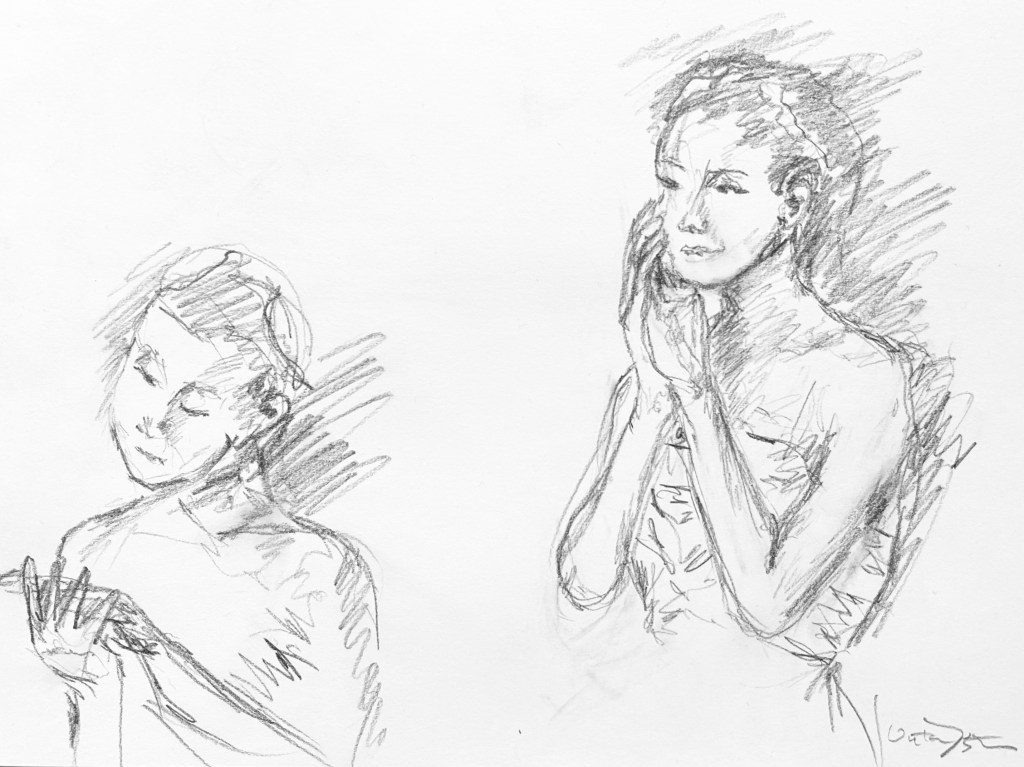
Given that MacMillan, Seymour and Gable worked with Shakespeare’s text, it seems reasonable to assume that these gestures were integral to the original choreography, but even if not, we know that Rojo studied Shakespeare’s text in her preparation for dancing the ballet, thereby rendering her approach to creating her own version of Juliet faithful to the spirit of the work (“Tamara Rojo on being Juliet”).  We also find that the resonances with Shakespeare’s soul-stirring verse, and the reference to their first meeting lend a palpable air of longing to the opening of the scene.  

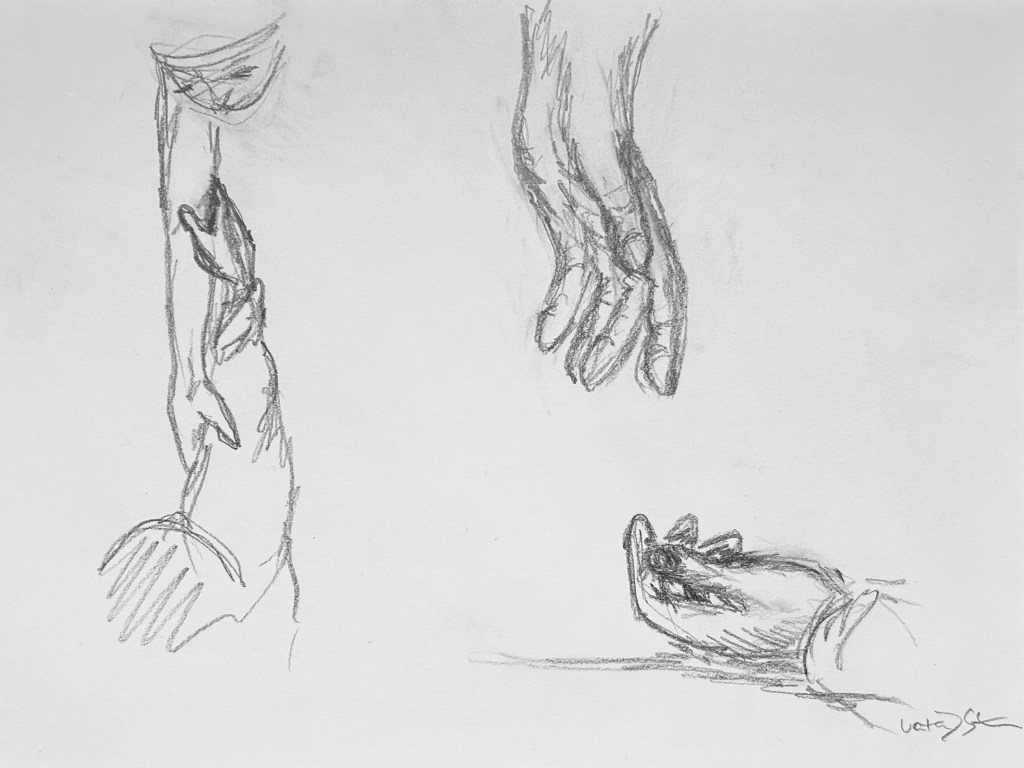
At the end of the scene Juliet returns to the balcony, only to kneel down immediately and reach for Romeo, who is straining up towards her.  But despite their burning passion, their hands don’t quite meet—a reminder perhaps that the distance imposed upon them is simply too great; or maybe it is an expression of unfulfilled desire; or perhaps both.  Whatever our feelings about this moment, it is also a foreshadowing of the tomb scene where Rojo’s Juliet lacks the strength to keep hold of Romeo’s hand as she draws her last breath.

In an interview after the Beyond Words premiere, Hayward talked about how important the set was to her understanding and portrayal of Juliet.  At the start of the Balcony Scene music we see the Nurse (Romany Pajdak) brushing Juliet’s hair.  Juliet seems preoccupied, restless.  As she approaches her balcony, we watch her from behind, almost as if we are following her into another world.  But the scene is softly aglow with the light of the moon, so there is no sense of Juliet lighting up the darkness; neither are there any noticeable gestures referring to Juliet’s first meeting with Romeo or to Shakespeare’s text.  But what we are given here is a sense of being physically present in Verona, as we watch the Lovers through the foliage of the garden.  And at the end of the scene not only do their hands touch, but they are able to hold one another’s forearms before letting go again.  Although the scene is to us rather less poetic than the stage version, it recreates the sense of realism that MacMillan was so eager to effect in a work—a realism to which we have perhaps become too accustomed to fully appreciate.

At the end of the film our minds return to this moment of joy: looking through the grille enclosing the crypt, we witness Juliet’s failed attempt to reach Romeo’s hand.  In close-up shot all we can see in the final moments are her hands dangling over the tomb, almost as if they were disembodied.  It is well known that MacMillan wanted no sentimentality to be portrayed in this scene: “… the death scene was crucial to Kenneth.  His lovers were not reunited in death.  They did not die in each other’s arms” wrote Seymour (186).  As far as MacMillan was concerned, the death of Romeo and Juliet was a complete waste of young life (qtd. in Seymour 186), and this ending seems to us a fitting indictment on all those involved in precipitating the death of the teenagers. 

Another memory that Seymour writes about is the now iconic scene where Juliet sits alone and still on her bed in desperation until she resolves to visit Friar Laurence for help with her predicament.  Sixty years after the premiere, this is still a suspenseful moment of high emotion in a live performance, a moment when we invariably reach for our opera glasses to experience more intensely Juliet finding a glimmer of hope through her despair.  As if mimicking our opera glasses, in both the recordings we’re analysing the camera moves in close, so that we can witness the expressivity of Rojo and Hayward in their near stillness, watch the quickening of their breath, the agitation in Hayward’s face, and the transformation from Rojo’s dark mien to the return of light to her face.  And sixty years after the premiere, this must surely still constitute a challenge for the ballerina to project her interpretation of Juliet’s emotions through the most economical of means.  Rojo herself states, “The hardest thing is the moment when you sit in bed and you have no movement at all to express your feelings” (“Tamara Rojo on being Juliet”).

Romeo and Juliet on Screen Then

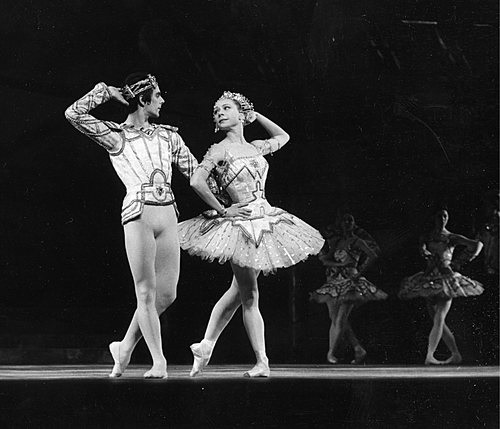
For commercial recordings of Romeo and Juliet from earlier years there is no problem of choice: as far as we are aware, there are only two.  These are the film version made just one year after the creation of the work, starring Fonteyn and Nureyev, and the 1984 recording for BBC television featuring Wayne Eagling and a 21-year-old Alessandra Ferri.

We found comparing the two in terms of visual impact very interesting.  Although recorded in Pinewood Studios, the film version attempts to simulate a theatre experience with the opening and closing of the curtains at the start and end of each act, and curtain calls at the end.  Given that it was produced and directed by the film maker Paul Czinner, we would guess that the budget was quite substantial.  In contrast, the quality of the television film is rather poor, far from the high definition to which we have now become accustomed.  Although a sense of opulence is still conveyed with some imagination on the part of the viewer, the television production values are of the time, and we must confess that to us it is rather drab looking.  This MacMillan may of course have appreciated in a way, given his love for realism in the theatre.

On the other hand, from the start the Czinner film blazes with colour like a Renaissance painting, with bright blues and highly pigmented reds, striking yellows and dazzling golds and greens vying for attention.  For us these original sets and costumes provide an ideal frame for the kind of vibrancy that MacMillan had so admired in Zeffirelli’s Old Vic production of the play in 1960 and wished for his own ballet.  In fact he told Georgiadis, who often attended rehearsals, that he wanted a Verona “where young horny aristocrats roamed the town full of romantic, adventurous spirits” (qtd. Seymour 181).

Just as there is such a dramatic contrast between the look of the two recordings, there are some equally alerting contrasts in the particular moments that we have discussed above in the Now section of this post.

When booking tickets at the Royal Opera House, we have always preferred to sit on the left side of the auditorium for this ballet, to ensure that we can watch Juliet on her balcony.  There seems to be a substantial amount of freedom from performer to performer with regard to how she uses the opening music of this scene, and very likely ballerinas won’t even perform exactly the same movements from one performance to the next; so this is another moment when the opera glasses come out.  Ferri appears with an air of blissful restlessness, looking up at the moon, down to her hands, over the balcony and up to the moon again.  Leaning her elbows on the balustrade, the most telling moment is when she holds her hands to her cheek, swaying her body gently from side to side with an ecstatic smile on her face.  But Fonteyn’s use of this moment of freedom to explore Juliet’s feelings we find almost disconcerting.  As in the 2007 and 1984 productions, she emerges from darkness to light up like Romeo’s “bright angel” (Shakespeare 11.2 26, p. 37), after which she gestures slowly upwards with her right arm towards the moon.  Although we know the moon to be significant to Shakespeare’s scene, in our opinion the gesture does not reveal much about Juliet’s thoughts and emotions.  This was contrary to the intentions of MacMillan, Seymour and Gable who had “tried to find steps and gestures to express the characters’ state of mind” (Parry 279).

The scandal of the world premiere of Romeo and Juliet being given to Fonteyn and Nureyev in favour of Seymour and Gable, who had contributed so much to the rehearsal process, is well documented.  Not only was Seymour cast as the fifth Juliet, but it was she who taught the role of Juliet to the other four ballerinas: “Margot … wanted to create her own Juliet”, she recalls (188).  This is particularly noticeable in some movements near the start of the Balcony Scene that are reminiscent of “The Kingdom of the Shades” from Marius Petipa’s 1877 La Bayadère, which Nureyev had staged in 1963: supported pirouettes ending in arabesque accentuate Fonteyn’s classical line, and were presumably chosen by her for this reason.  At the close of the scene Nureyev remains downstage right in a lunge, elegantly gesturing towards Juliet on the balcony as she reciprocates by unfolding her arm in his direction.  This approach does accentuate the irreconcilable distance that the family feud has imposed upon the Lovers; but the poses strike us as symbolic, rather than reflecting the naturalism and urgent emotion that MacMillan was after.  As Seymour put it during a coaching session on the Balcony Scene:

He wanted you to be a real pimply teenager, both of you, who bump noses when they first try to kiss and do all that sort of thing.  They didn’t do it beautifully … it was a little awkward, and a little wonderful, and a little gawky and a little this and a little that.  So try not to deal with it as if you’re some kind of ballerina.

(“Romeo and Juliet Masterclass”)

Another noticeable discrepancy that jars somewhat is Fonteyn’s choice of movement when her Juliet is trying to find a solution to her approaching marriage to Paris.  Rather than sitting on the bed facing directly downstage, she kneels by the bed facing downstage left and mimics crying before raising her head and slowly moving her gaze to downstage right, almost as if watching herself rushing to Friar Laurence.  Perhaps this worked at the time, but when the viewer is accustomed to the drama of being confronted with Juliet’s stillness face-on, it breaks the intensity of the moment.

Seymour recalls what a daring decision it was to reduce movement to a minimum at this climactic point in the narrative, and what a challenge it presented for her, but that MacMillan was convinced that she was capable of holding the audience (185-86).  And his belief in Seymour was justified: audiences and journalists alike were struck by the audaciousness of the sequence, Seymour claiming that it “had a singularly terrifying effect on the scalp of balletgoers” (193).

Presumably it was a combination of Fonteyn’s celebrity status and the challenge presented by the innovative choreographic and dramatic ideas conjured up by MacMillan, Gable, and Seymour that persuaded the other Juliets to adopt Fonteyn’s approach to interpreting the choreography and character, resulting in MacMillan’s fear that his vision of the ballet would not be realised onstage (189).  However, as the recording of Ferri’s 1984 performance testifies, MacMillan’s fears were ultimately unfounded.  The Balcony Scene ends with Romeo and Juliet straining towards one another in their burning desire to touch one another’s hands just one more time before they part.  Ferri’s Juliet sits on the bed facing the audience as Colin Nears’ camera zooms out, thereby emphasising her aloneness in the vast stage space that represents her room.  And Ferri, who became such a long-standing interpreter of the role, showed no reluctance in the death scene to allow the weight of her body to hang in a precarious backbend over the sepulchre with no thought to elegance, unable to keep hold of Romeo’s hand.  Fonteyn’s Juliet, on the other hand, dies holding onto Romeo’s arm and with her body carefully arranged so we can still see her face, and with little sense of the precariousness that might disrupt the ballerina image.  

Ironically perhaps, the Czinner recording states overtly that the purpose of the film is twofold: to preserve the performance for a wider audience and as a record for posterity.  For us, however, the importance of the film lies not so much in its preservation of the dancing of the two undisputed ballet stars of the era, but the way in which the reluctance of the performers to engage fully with MacMillan’s vision highlights the radical nature of MacMillan’s choreography seen both in performance and in the later films.

Concluding thoughts

Having grown up at a time when the only way to engage with ballet choreographies apart from seeing them live was through written materials, photos, LPs and the occasional television broadcast, we feel immensely privileged to have access to all of these recordings of MacMillan’s Romeo and Juliet.  

The films offer us an insight into the radical nature of the choreography, and ways in which the politics of power can have an impact on the nature of a choreographic work.  We can also re-evaluate the work after a long period of familiarity and find new ways of appreciating it through the imaginative work of directors and new casts that bring the work to life again.

© British Ballet Now & Then

References

Byrne, Emma. “Romeo and Juliet review: an inspired choice for the Royal Ballet’s return”. Evening Standard, 6 Oct. 2021, www.standard.co.uk/culture/dance/romeo-and-juliet-review-royal-opera-house-b959020.html

Guiheen, Julia. “Tamara Rojo and Carlos Acosta in “Romeo and Juliet” (2007)”. Pointe Magazine, 20 Nov. 2019, pointemagazine.com/tbt-tamara-rojo-carlos-acosta/

Parry, Jann. Different Drummer: the life of Kenneth MacMillan. Faber & Faber, 2009.

“Reviews 2004-2007”. Tamara Rojo, 7 Mar. 2006, www.tamara-rojo.com/reviews-2004-2007/.

“The Royal Ballet’s Romeo and Juliet: 50 years of star-crossed dancers – in pictures”. The Guardian, 2 Oct. 2015, www.theguardian.com/stage/gallery/2015/oct/02/royal-ballet-romeo-and-juliet-50-years-of-star-crossed-dancers-in-pictures.

Seymour, Lynn, with Paul Gardner. Lynn: the autobiography of Lynn Seymour. Granada, 1984.

—. “Romeo and Juliet Masterclass: Balcony pas de deux”. Revealing MacMillan, Royal Academy of Dance, 2002. 

“Tamara Rojo on being Juliet”. Dance Australia, 26 May 2014, http://www.danceaustralia.com.au/news/tamara-rojo-on-being-juliet

Tan, Monica. “Tamara Rojo and Carlos Acosta: the Brangelina of ballet on chemistry, ageing and loss of innocence”. The Guardian, 27 June, 2014, www.theguardian.com/culture/australia-culture-blog/2014/jun/27/tamara-rojo-carlos-acosta-brangelina-of-ballet

Wilkinson, Sarah. “Why Watch Ballet on the Silver Screen?”. The Guardian, 15 Aug. 2008, www.theguardian.com/stage/theatreblog/2008/aug/15/whyshouldipaytoseeprerec

The 19th Century Canon Now & Then

The 19th Century Canon Now

Last summer Birmingham Royal Ballet (BRB) brought their new production of Marius Petipa’s 1869 Don Quixote to London, after it had premiered four months earlier at the Birmingham Hippodrome.  With the exception of The Nutcracker, which is pretty much obligatory fare for any major ballet company (as discussed in our very first British Ballet Now & Then post, this was the first work from the 19th century ballet canon to have been performed by BRB since Carlos Acosta took over as Artistic Director in January 2020.  The premiere had originally been planned for the start of Acosta’s inaugural season, but like so many productions had to be postponed due to the Covid pandemic.

Matador Scene featuring Brandon Lawrence as Espada Photo with Artists of Birmingham Royal Ballet; photo: Emma Kauldhar

The choice of Don Quixote in favour of any other work from the 19th century canon was hardly surprising: Acosta himself has been long associated with the role of Basilio.  At the age of 17 he won the Prix de Lausanne after dancing Basilio’s Act III variation; he performed the role with the Royal Ballet (RB) in Rudolf Nureyev’s staging mounted by Ross Stretton and then created his own production of the ballet for the Company, now adapted for his own Company.

Like the other 19th century classics, Don Quixote provides technical challenges for dancers of different ranking, and opportunities for a large cast of performers to engage in different styles: classical, character and mime.  Other works in the British ballet repertoire that offer similar opportunities are La Sylphide (Bournonville, 1836), Giselle (Coralli/Perrot, 1841), Coppélia (Saint-Léon, 1870; Petipa, 1884) La Bayadère (Petipa, 1877), The Sleeping Beauty (Petipa, 1890), Swan Lake (Petipa/Ivanov, 1895) Raymonda (Petipa, 1898) and Le Corsaire (Petipa, 1899).

Artists of English National Ballet in La Sylphide, photo: Laurent-Liotardo
Jurgita Dronina and Isaac Hernandez in La Sylphide, photo: Laurent Liotardo

Apart from the fact that these works were all created during the 1800s, when ballet as an art form became more recognisably what we understand as ballet today, with its focus on the female dancer, themes inspired by Romanticism, and development of pointe work and ballets blancs, they are all connected by the fact that they were originally choreographed in France or Russia and “travelled” to this country via various routes (as we will discuss further in the Then section of this post).  Although we are sure that you are all familiar with Don Quixote, La Bayadère, Raymonda and Le Corsaire, these works took a number of decades to become established within the British repertoire, being produced in the UK at different times by different companies from 1962 to 2022, and not always in their entirety.

If you follow this blog, you will already know the history of Raymonda in the UK prior to English National Ballet’s evening-length production, which premiered in January last year.  Important details for this particular post is the fact that it was Nureyev, just three years after his defection from the Soviet Union, who first staged Raymonda in this country, initially in a complete production for the Royal Ballet (1964), and then as a one-act ballet based on the final act of the work, in 1966.  In this form Raymonda can stand on its own as a divertissement within a mixed bill, and between 1993 and 2014 English National Ballet also performed a single-act Raymonda, firstly in a production by Frederick Franklin (the British-American dancer, teacher, choreographer and director), and then, in 1993 in Nureyev’s staging, as part of the Nureyev Celebration, marking 75 years since Nureyev’s birth and 20 years since his death.

Momoko Hirata as Kitri and Mathias Dingman as Basilio, with Artists of Birmingham Royal Ballet in Don Quixote; photo: Johan Persson

Similarly, it was Nureyev who first staged La Bayadère in the UK—not in its entirety, but in that superb example of high classicism, the “Kingdom of the Shades”—and who introduced the Le Corsaire grand pas de deux to the British repertory.  In 1985 the “Kingdom of the Shades” entered the repertory of English National Ballet in a production by Natalia Makarova, and in 2013 the same company became the only British ballet company to perform the complete Corsaire.

The three most celebrated ballet defectors from the Soviet Union all had a tremendous impact on dancing in the West, but like Nureyev, Makarova and Mikhail Baryshnikov also had a substantial influence on the expansion of the 19th century repertoire, by staging major full-length productions for American Ballet Theatre: La Bayadère (Makarova, 1980) and Don Quixote (Baryshnikov, 1978).  Relevant for the development of British ballet is the fact that both of these productions were also mounted on the Royal Ballet.  While La Bayadère was the first complete version of the work to be performed in Britain (and remains the only full-length production in the UK), Don Quixote has had a far more varied history in this country, including stagings by Ballet Rambert (1962) and by London Festival (now English National) Ballet (1970), both mounted by Polish ballet master Witold Borkowski, in addition to the two more recent RB productions.  It seems that it is only since the RB’s staging of Baryshnikov’s version in 1993 that the work has become more firmly established within the British ballet repertoire. 

Although these star dancers from the Soviet Union also mounted new productions of 19th century works already established within the British ballet repertoire (including Nureyev’s Nutcracker for the Royal Ballet in 1968, and Makarova’s 1988 production of Swan Lake for London Festival Ballet), it is noticeable that they focused their efforts primarily on the 19th century works that they knew from their experiences at the Vaganova Academy and Mariinsky Ballet but were absent from North American and Western European companies.  And the newer 19th century additions to the British ballet repertoire have indubitably enriched our understanding of ballet as an art form, given dancers new challenges and offered audiences both entertainment and food for thought.  Don Quixote belongs to a very small number of comedic ballets, and provides a great variety of character and demi-character roles.  Le Corsaire is teeming with opportunities for virtuoso male dancers.   And can any scene in the ballet repertoire surpass the transcendence of the “Kingdom of the Shades”?

Artists of English National Ballet in Le Corsaire photo: Laurent-Liotardo

Yet even ballet, with its highly stylised technique, and its penchant for magic and fantasy and reputation for escapism, is not immune from the changing attitudes of our Zeitgest.  Although ENB’s production of Le Corsaire is little over a decade old, the last time it was performed (at the start of 2020), it came with a caveat from the Artistic Director, Tamara Rojo:

When English National Ballet commissioned its new production of Le Corsaire, we worked to challenge some of the traditions of this work, and therefore made adaptations to tone [down] the characters.  We know that still some elements, such as the attitude towards women and other cultures, now seem unacceptable to our values.  However, we present this traditional work with the strength of the assumption that the audience has the knowledge and the critical frame of judgement to view them in the context in which they were created.

As explored in our Raymonda post, in her own 2022 production of Raymonda, Rojo was at pains to address conflicts between current attitudes and those prevalent in Petipa’s original production, by offering a heroine with greater agency over her own life, and a reconceptualisation of Abderakhman the Muslim Saracen to address the traditional othering of this character.

The Royal Ballet last staged La Bayadère in 2018.  For the most part, as is usual for works that are already established in the repertoire, reviews highlighted the performances of the principals, and as is usual for works which feature major ballets blancs, commented on the unison of the corps de ballet (Desvignes; Hugill; Jennings; Parry).  However, both Robert Hugill and Luke Jennings raised concerns regarding Bayadère‘s promotion of orientalist attitudes manifest in “its inanely capering fakirs, lustful priests and blithe appropriation of Hindu, Islamic and Buddhist religious and cultural motifs” (Jennings). 

In recent years BRB, ENB, RB, and Scottish Ballet have all made revisions to the choreography, costumes and/or make-up of the Arabian and Chinese Dances from the Nutcracker productions in order to start confronting such offensive stereotypes.  But how does a company approach revising a whole full-evening work?

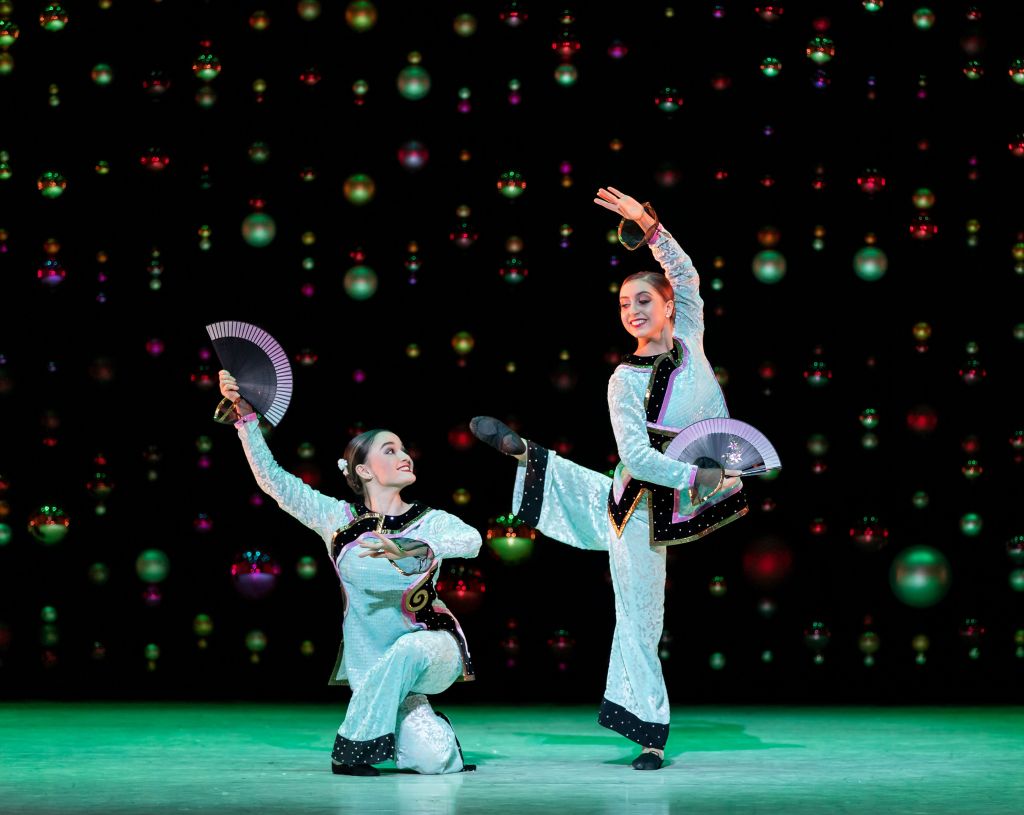
Scottish Ballet Artist Alice Kawalek and First Artist Kayla-Maree Tarantolo in Chinese Tea Dance. Photo credit: Andy Ross

In the United States, Arts Educator and Co-founder of Final Bow for Yellow Face Phil Chan is producing his own versions of Le Corsaire and La Bayadère to make them more suitable and relevant for American 21st century audiences by addressing what he perceives to be their inherent racism and misogyny.  In his plans, Le Corsaire takes place at a beauty pageant complete with “scheming showgirls, gunslinging beauty queens” (Chan), while La Bayadère will feature Hollywood cow girls and references to Busby Berkeley’ oeuvre, as well as a plot line similar to Singin’ in the Rain (Donen/Kelly, 1952).  These ideas may avoid racial stereotyping, but on paper at least they seem to raise other problematic issues.  Neither do we understand how the tragic nature of La Bayadère will translate into this new context.  Perhaps the productions themselves will transcend their description on paper …

The 19th Century Canon Then

In the 1920s and early 1930s, when Marie Rambert and Ninette de Valois were taking their first steps to establish ballet as a British art form, there was no canon of 19th century “classics” as we know it today. 

So what exactly was the tradition of ballet in 19th century Britain?

Well, in the 1840s, during the flourishing era of ballet Romanticism, Her Majesty’s Theatre Haymarket became a centre for the art form, with important works being created there by the pre-eminent French choreographers of the day Jules Perrot (co-creator of Giselle in 1841, with Jean Coralli) and Arthur Saint-Léon (choreographer of Coppélia, 1870).  These included Ondine, La Esmeralda and Pas de quatre by Perrot, and La Vivandière by Saint-Léon.  However, the situation changed radically in the later decades of the century, when music halls and variety theatres, such as the Empire and the Alhambra on Leicester Square, became regular venues for ballet performances, a situation that continued into the 20th century.  Despite the frequency of performances and popularity of ballet in these theatres, the works created specifically for the music halls were short lived, and even the names of the choreographers, such as Carlo Coppi and Katti Lanner, are not generally well known to today’s ballet-going public.  Further, these connections to popular theatre meant that the status of ballet as a serious art form was on thin ice, even though versions of Giselle and Coppélia, now generally considered as works of the highest calibre, were staged at the Empire in the 1880s.  And when in 1921 Serge Diaghilev mounted his sumptuous production of Tchaikovsky’s The Sleeping Beauty, based on Marius Petipa’s 1890 choreography but titled The Sleeping Princess, it was also produced in a music hall setting: at the Alhambra.

SLEEPING BEAUTY, Deanne Bergsma ( as The Lilac Fairy ) ; The Royal Ballet at the Royal Opera House, London, UK ; January 1969 ; Credit: G.B.L. Wilson / Royal Academy of Dance / ArenaPAL

When de Valois set up the Vic-Wells Ballet (later to become the UK’s flagship company the Royal Ballet) in 1931, she had a clear vision of the kind of repertoire she considered necessary for a national British company.  It consisted of four categories:

  1. Traditional-classical and romantic works
  2. Modern works of future classic importance
  3. Current works of more topical interest
  4. Works encouraging a strictly national identity in their creation generally

(Bland 57)

With both Ashton and herself at the helm creating new choreographies, it is clear how her last three aims might be fulfilled.  But of course, what interests us in this post is the way de Valois obtained the “Traditional-classical and romantic works”.

SWAN LAKE ; Nadia Nerina , Shirley Grahame and Doreen Wells ; Choreographed by Ashton and de Valois ; Designed by Hurry ; Music by Tchaikovsky ; the Royal Ballet New Group, at the Royal Opera House, London, UK ; May 1965 ; Credit : G.B.L. Wilson / Royal Academy of Dance / ArenaPAL

What we find fascinating is that political events came to de Valois’ aid: like many other figures from the Russian ballet world, the Mariinsky régisseur Nikolai Sergeyev had fled his home after the 1917 Revolution.  With him he took scores of 19th century works in a dance notation system devised by Vladimir Stepanov.  These included The Sleeping Beauty, The Nutcracker and Swan Lake, as well as Giselle and Coppélia; ballets of which de Valois had some, but limited, knowledge (Walker 129).  The distinct advantage of mounting the works from the notation scores was of course that it must have given a sense of gravitas to the productions through an authenticity that most music hall productions were unlikely to match, even if that was indeed an aim.  Before Sergeyev started to work for de Valois, he had already staged two works in London: Diaghilev’s The Sleeping Princess, and The Camargo Society’s Giselle.  However, the work of staging these ballets for de Valois’ fledgling company created a cornerstone of the British ballet repertoire.  Further, this process was solidified by Mona Inglesby, founder of International Ballet in 1941, another highly significant figure who promoted 19th century works in Britain, and for whom Sergeyev worked from 1946 until his death in 1951.  Crucially, the company toured these works the length and breadth of the British Isles: from the suburbs of London through the Midlands to Liverpool and Manchester, up to Newcastle, Glasgow and Edinburgh, and over to Belfast and Dublin.  In fact, although the Company folded in 1953, International Ballet was of such significance in its day that it was chosen to appear at the opening of the Royal Festival Hall in 1951.

LA BAYADERE – Dress rehearsal Royal Opera House – Covent Garden November 1963 SIR FREDERICK ASHTON / RUDOLPH NUREYEV and THE CORPS DE BALLETS Credit: Royal Academy of Dance / ArenaPAL

De Valois’ and Inglesby’s selection of works seems highly interesting to us, because the ballets they produced constituted only approximately one quarter of the works that could have been staged.  La Bayadère, Le Corsaire and Raymonda could have entered the British ballet repertoire decades sooner; we might have enjoyed The Pharaoh’s Daughter (Petipa, 1862) and La Esmeralda (Petipa after Perrot, 1886) or the Petipa and Ivanov version of La Fille mal gardée (1885).  Both Inglesby and Pavlova before her had made plans to produce La Bayadère, but had reached the conclusion that it was “too old fashioned” (Inglesby 97; Pritchard “Bits” 1121).  While Pavlova did mount a version of Don Quixote, according to historian and expert in British ballet history, Jane Pritchard, this also struck audiences as rather dated after Leonid Massine’s Le Tricorne (1919) (Anna Pavlova 112).  La Esmeralda also proved enticing to Inglesby, but was rejected as a project by the Royal Opera House (Inglesby 106-107).  On other hand, Giselle, Coppélia, The Sleeping Beauty and Swan Lake all had two distinct advantages: they had already been introduced to the British public, and they all had superb scores (Tchaikovsky was known to have admired the compositions of both Adolf Adam and Leo Delibes) (Pullinger).

RAYMONDA ( Act III ) ; Donald MacLeary and Svetlana Beriosova ( as Jean de Brienne and Raymonda ) ; The Royal Ballet at The Royal Opera House, London, UK ; March 1969 ; Credit: G.B.L. Wilson / Royal Academy of Dance / ArenaPAL

In addition to music hall performances of Coppélia at the Empire Leicester Square from the 1880s into the early 1900s, we were also intrigued to discover that in 1890, the same year that Petipa had choreographed the ballet for the Mariinsky Theatre with Carlotta Brianza as Aurora, one of the other Italian ballerinas who starred with the Russian Imperial Ballet, Pierinna Legnani, had danced the same role in a full production at the Alhambra, but to the choreography of Leon Espinoza with music by Georges Jacobi.  Further, in the years immediately leading up to the first London season of the Ballets Russes in 1911, the West End evidently became a veritable hive of ballet activity, with appearances from Lydia Kyasht, Tamara Karsavina, Olga Preobrazhenska, Alexandra Baldina, Ekaterina Geltzer, and of course Anna Pavlova.  Included in these performances were shortened versions of works that were to become “the classics”: in 1910 Preobrazhenska staged Swan Lake at the Hippodrome, while Karsavina mounted a truncated production of Giselle at the Coliseum.  The following year saw the complete Giselle, The Sleeping Beauty Grand pas de deux and a two-act condensed Swan Lake at the Royal Opera House performed by the Ballets Russes.

And what of the ubiquitous Nutcracker? Well, if you have been following British Ballet Now & Then since the start, you will know that the notion of The Nutcracker as a quasi-obligatory Christmas treat is a phenomenon of the later 20th century. In fact this ballet was not well known in this country before de Valois’ Vic-Wells Ballet staged it in 1934.  However, the Nutcracker Suite, which was in fact presented in concert halls before the ballet premiered at the Mariinsky Theatre, was performed in London as early as 1896. 

SADLER’S WELLS BALLET – THE NUTCRACKER 1943 ROBERT HELPMANN / MARGOT FONTEYN Credit: Royal Academy of Dance / ArenaPAL

Ballets Russes audiences would also have known some excerpts, because Diaghilev himself was a great admirer of the score and interpolated some of the numbers into his productions of The Sleeping Beauty and Swan Lake (Newman 20-21).

But you may be asking yourself how La Sylphide became integral to the 19th century canon. The original work by Filippo Taglioni, created for his daughter Marie Taglioni, the most celebrated of Romantic ballerinas, was hugely popular in its day and was performed at Covent Garden only a few months after the March premiere in Paris, 1832.  Marie Taglioni also performed it in Russia, where it continued to be included in the repertoire, and was revived by Petipa in 1892.  However, it does not seem to have been amongst the works that were recorded in the Stepanov notation, and sometime during the first half of the last century Filippo Taglioni’s choreography was lost, although the Romantic ballet expert Pierre Lacotte did produce a reconstruction of it for the Paris Opera Ballet in 1972.  As you probably are aware, the choreography that has been passed down through the generations is the version by August Bournonville, who saw the original production in Paris, but then created his own in 1836.  According to Pritchard (who also happens to be one of our favourite dance historians), Marie Rambert, who established the first ballet company in the UK, loved Romantic ballet (“Marie Rambert” 1177).  She had become familiar with Giselle during her time with the Ballets Russes, and in 1946 Giselle became the first long work to enter the repertoire of Ballet Rambert (now Rambert).  This production was staged with the help of historian Cyril Beaumont, author of The Ballet Called Giselle, first published in 1944, and still available to purchase today.  Beaumont devotes a substantial section of his book to La Sylphide, exploring its influence on Giselle in terms of themes, style, technique and structure.  The work he discusses is the original Taglioni La Sylphide, which was of course not available for Rambert to stage.  Instead, the Bournonville version was staged in 1960, by Bournonville expert Elsa Marianne von Rosen.  In contrast to the full-length Giselle and La Sylphide, only extracts from The Sleeping Beauty, The Nutcracker and Swan Lake were performed by Rambert.  However, Rambert seems to have produced an appetite for Bournonville’s ballet in Britain: Danish ballet master Hans Brenaa was invited to stage a production for Scottish Ballet in 1973; in 1979 the Danish dancer Peter Schaufuss (later to become Artistic Director) mounted his production for English National Ballet; and eventually the Royal Ballet acquired the work in Johan Kobborg’s 2005 staging.  Perhaps one factor that contributed to the growing familiarity with La Sylphide of the British ballet audience was the BBC broadcast of the Act II Pas de deux in 1960 with von Rosen herself, followed by a broadcast of the complete work with Ballet Rambert less than a year later.  Another factor was undoubtedly Rudolf Nureyev’s performances with Scottish Ballet at the London Coliseum in 1976, in which he danced James at every performance over the course of two weeks.

Concluding thoughts

A brief glance through Instagram leaves us in no doubt about the popularity of the 19th century canon across the globe.  And the importance of the works to the British ballet repertoire cannot be denied: in the 2022-2023 season, in addition to the The Nutcracker, Birmingham Royal Ballet have performed Swan Lake, English National Ballet both Raymonda and Swan Lake, and the Royal Ballet The Sleeping Beauty.

We perhaps think of the classics as being exempt from politics, but this is a fallacy: neither their content nor their arrival to these shores can be said to be divorced from politics.  The word “timeless” is also often associated with the term “classics”, but of course the style of performance varies over space and time and our perception of and relationship with the works changes with the Zeitgeist.

Ballet has traditionally been perceived as an ephemeral art form, being handed down by dancers from generation to generation, with limited means for recording the choreography.  But today, with the regular use of Benesh Movement Notation and video to record works in their different productions, perhaps we can feel more secure about the preservation of the 19th century repertoire. 

How would you like to see these works preserved? Would you like to see them performed in a style more compatible with the original style, with original choreography restored, as Alexei Ratmansky has done with his productions of The Sleeping Beauty and Swan Lake? Or would you prefer a more experimental approach, in response to a more contemporary world view, such as that proposed by Phil Chan?  We would love to hear your thoughts!   

© British Ballet Now & Then

We would like to thank our dear friend and colleague Paul Doyle for his help with this post.

Next time on British Ballet Now and Then … Ballet has a reputation for being very gender specific.  However, there is a tradition of subverting gender norms in certain circumstances.  The Royal Ballet’s recent run of Cinderella has seen both female and male identifying dancers perform the Step-Sisters, while the last time English National Ballet staged The Sleeping Beauty, the cast included a gender-fluid dancer, as well as both male and female performers in the role of Carabosse.  So this will be the focus of our next Now and Then post …     

References

Beaumont, Cyril W. The Ballet Called Giselle. Dance Books, 2011.

Bland, Alexander. The Royal Ballet: the first fifty years. Threshold Books, 1981.

Chan, Phil. “On Yellowface and a way forward for Diverse Audiences”. One Dance UK, 2020, https://www.onedanceuk.org/resource/on-yellowface-and-a-way-forward-for-diverse-audiences/.

Desvignes, Alexandra. “Marianela Nuñez shines in a star-studded, polished Bayadère at The Royal Ballet”. Bachtrack, 3 Nov. 2018, https://bachtrack.com/review-bayadere-royal-ballet-nunez-muntagirov-osipova-opera-house-london-november-2018.

Hugill, Robert. “Iconic but flawed: La Bayadère the Royal Ballet”. Planet Hugill, 12 Nov. 2018, https://www.planethugill.com/2018/11/iconic-but-flawed-la-bayadere-royal.html.

Inglesby, Mona, with Kay Hunter. Ballet in the Blitz: the story of a ballet company. Groundnut Publishing, 2008.

Jennings, Luke. “La Bayadère review – moonlit heights from Nuñez and co”. The Guardian, 11 Nov. 2018, https://www.theguardian.com/stage/2018/nov/11/la-bayadere-royal-ballet-review-marianela-nunez-natalia-osipova.

Newman, Barbara. The Nutcracker. Aurum Press, 1985.

Parry, Jann. “Royal Ballet – La Bayadère – London”. DanceTabs, 6 Nov. 2018, https://dancetabs.com/2018/11/royal-ballet-la-bayadere-london-2/.

Pritchard, Jane. Anna Pavlova Twentieth Century Ballerina,

—. “Bits of Bayadère in Britain”. Dancing Times, vol. no. , 1989.

—. “Marie Rambert”. International Dictionary of Ballet, edited by Martha Bremser, St. James Press, 1993, pp. 1175-77.

Pullinger, Mark. “A step into the world of Tchaikovsky’s ballets: Swan Lake”. Bachtrack, 23 July 2017, https://bachtrack.com/ballet-focus-tchaikovsky-swan-lake-petipa-july-2017.

Rojo, Tamara. “A Word from Tamara Rojo, Artistic Director”. Le Corsaire programme Jan. 2020, English National Ballet, London.

Walker, Katherine Sorely. Ninette de Valois: idealist without illusions. Dance Books, 1987.


Romeo and Juliet On Screen Now & Then

Like many of you, no doubt, we were perplexed when the BBC announced at the start of this year that the Royal Ballet would be staging a brand-new production of Romeo and Juliet.

For one thing, we had already booked tickets for what we understood to be Kenneth MacMillan’s adaptation of William Shakespeare’s 1597 play; for another, why on earth would the Company want to stage a different production? At the premiere in 1965, Margot Fonteyn and Rudolf Nureyev evidently received forty-three curtain calls (“The Royal Ballet’s Romeo and Juliet”).  Since then the work has been staged regularly, filling the Royal Opera House (we went to the 531st ROH performance, with the searing Mayara Magri dancing to a packed house).  Plus, despite the abundance of balletic Romeo and Juliets performed across the globe, as Emma Byrne of the Evening Standard points out, this adaptation is often considered to be the “definitive” ballet version of Romeo and Juliet.

From 1966 to the present day (Valentine’s Day this year, to be precise) MacMillan’s Romeo and Juliet has also been screened in the cinema, on television, and since the 1980s reproduced on VHS tapes, and then DVDs.  And this is the topic of our discussion below …

Romeo and Juliet on Screen Now

Unlike the news that the Royal Ballet would be staging a new production of Romeo and Juliet, the announcement that a special screening of the ballet would be live-steamed in cinemas on 14th February this year came as no surprise: we have become accustomed to live cinema screenings and encore screenings, and Romeo and Juliet seems to be a favourite for this purpose. 

When the 2007 recording starring the celebrated dance partnership of Tamara Rojo and Carlos Acosta arrived in cinemas in 2008, it caused quite a stir, as well as a debate about the advantages of watching ballet in cinemas (Wilkinson).  Since then cinema screenings in the arts have become a regular occurrence, not only from the Royal Opera House, but notably from the Bolshoi Theatre in Moscow, the Metropolitan Opera in New York, and from the National Theatre here in London.  And no fewer than three live performances of Romeo and Juliet have been screened in cinemas since 2008, featuring the following principals: Lauren Cuthbertson and Federico Bonelli (2012); Yasmine Naghdi and Matthew Ball (2019); Marcelino Sambé and Anna Rose O’Sullivan (2022).  Apart from this year’s offering (which will presumably be released in due course), all of these recordings have been made commercially available as DVDs, and all have been directed for the screen by Ross MacGibbon, former dancer with the Royal Ballet, and now a renowned filmmaker, specialising in dance and theatre.

In preparation for this post we studied all of the recordings available on DVD.  However, for the purposes of our discussion below we will focus on only one of these recordings.  We found it quite tricky to choose, but we decided that the ballet partnership of Rojo and Acosta made a neat parallel with the Fonteyn and Nureyev partnership featured in the Romeo and Juliet on Screen Then section of this post. 

By the time of filming, Rojo and Acosta were an established partnership in both the 19th century classics, particularly Giselle (Perrot/Coralli, 1841) La Bayadère (Petipa, 1877) and Swan Lake (Petipa/Ivanov, 1895), and in MacMillan’s Manon (1974), as well as Romeo and Juliet.  Described as taking the Royal Ballet “by storm” when they joined the company (Acosta in 1998, Rojo in 2000) (Guiheen), over time they became known on stage as the “Brangelina of ballet” (Tan).  This suggests that although they indubitably did not cause the sensation of Fonteyn and Nureyev (has any couple in the history of British ballet?), they were unquestionably a ballet partnership of glamour, and a force to be reckoned with.  Further, they had received outstanding notices for their performances.  John Percival, for example claimed that Rojo “must be the best Royal Ballet Juliet for a quarter century or more, since Gelsey Kirkland’s guest seasons”, adding that Acosta was “on equally fine form”, while according to Sarah Crompton, their performances “absolutely gleam[ed] with greatness” (qtd. In “Reviews 2004-2007”). In contrast, with the exception of Bonelli, all of the other protagonists filmed in Romeo are home grown, so to speak, all having had at least some training at the Royal Ballet School; neither were their partnerships celebrated to the same extent.  However, by the 2012 Bonelli-Cuthbertson performance, cinema screenings of ballet were well established, and consequently perhaps no longer needed the draw of an international star partnership.

By now you must be asking yourselves about surely the most publicised screening of the ballet in recent years, that is, Romeo and Juliet: Beyond Words … which we have of course not forgotten.  For their 2019 Beyond Words former Royal Ballet dancers Michael Nunn and William Trevitt held auditions, resulting in the cast being led by two more home-grown talents: Francesca Hayward and William Bracewell.  Undoubtedly the reason for the additional publicity was that Nunn and Trevitt produced and directed an adaption of the ballet filmed on location.  Their choice of location was the Renaissance backlot of the Korda Studios in Hungary.  Constructed for the TV series The Borgias, the backlot is a magnificent and atmospheric set of buildings, courtyards, piazzas, alleys and interiors depicting historical Italy. 

Filming the ballet on location was of course not an original idea. As early as 1955, Lev Arnshtam directed the seminal Romeo and Juliet by Leonid Lavrovsky (1940) on location in the Yalta Film Studio.  Perhaps more important than this, however, is the film of Shakespeare’s play directed by Franco Zeffirelli.  We know that MacMillan had been inspired by Zeffirelli’s 1960 Old Vic staging.  Further, the naturalism emphasised by Zeffirelli in his direction leant itself well to an on-location filming, including the Palazzo Borghese in Rome, the streets of the medieval town of Gubbio, and the Basilica of St Peter in Tuscania.  Therefore, this way of breathing fresh life into MacMillan’s choreography and bringing the ballet to potential new audiences seemed to us entirely compatible with the choreographer’s own vision for his work. 

In all of the recent live recordings the familiar rich colour palette of Nicholas Georgiadis’ designs dominates: deep reds, browns and golds, with injections of white, noticeably in the costumes of the two Lovers.  In contrast to this, Beyond Words is altogether brighter and livelier in its initial visual impact, opening as it does on the sun beaming down on a courtyard scene of hens and a dog, a busy servant, and a small child running off on some errand.  Juliet’s room is no longer a minimally furnished vast stage space, but a chamber embellished with pale light drapes that let the sunshine in, and filled with various furnishings, including a chest, cushions, a settle, chairs and candles.   

MacMillan’s ballet began life in 1964 when he was commissioned to create a short work for Canadian television.  This work in fact became the Balcony pas de deux, which MacMillan created on his muses Lynn Seymour and Christopher Gable.  This duet was the beginning of the full ballet that premiered the following year in London.  Given its place both within the narrative and as the culmination of Act I, it is of course one of the ballet’s main climaxes; but for us, the fact that the rest of the work emerged from this pas de deux gives it a special significance.  

At the start of the scene Tamara Rojo’s Juliet emerges from the darkness of the balcony, the whiteness of her skin and dress gleaming softly through the night air, and we think of Romeo’s wistful words …

But soft! What light through yonder window breaks?

It is the East and Juliet is the sun!

(11.2.2-3)

She looks down at the hand that Romeo touched when they first met in the Ballroom, brings her hands together and holds them to her cheek.  Again, we hear the voice of Romeo:

See how she leans her cheek upon her hand!

Oh that I were a glove upon that hand,

That I might touch that cheek!

(11.2.23-25)

Given that MacMillan, Seymour and Gable worked with Shakespeare’s text, it seems reasonable to assume that these gestures were integral to the original choreography, but even if not, we know that Rojo studied Shakespeare’s text in her preparation for dancing the ballet, thereby rendering her approach to creating her own version of Juliet faithful to the spirit of the work (“Tamara Rojo on being Juliet”).  We also find that the resonances with Shakespeare’s soul-stirring verse, and the reference to their first meeting lend a palpable air of longing to the opening of the scene. 

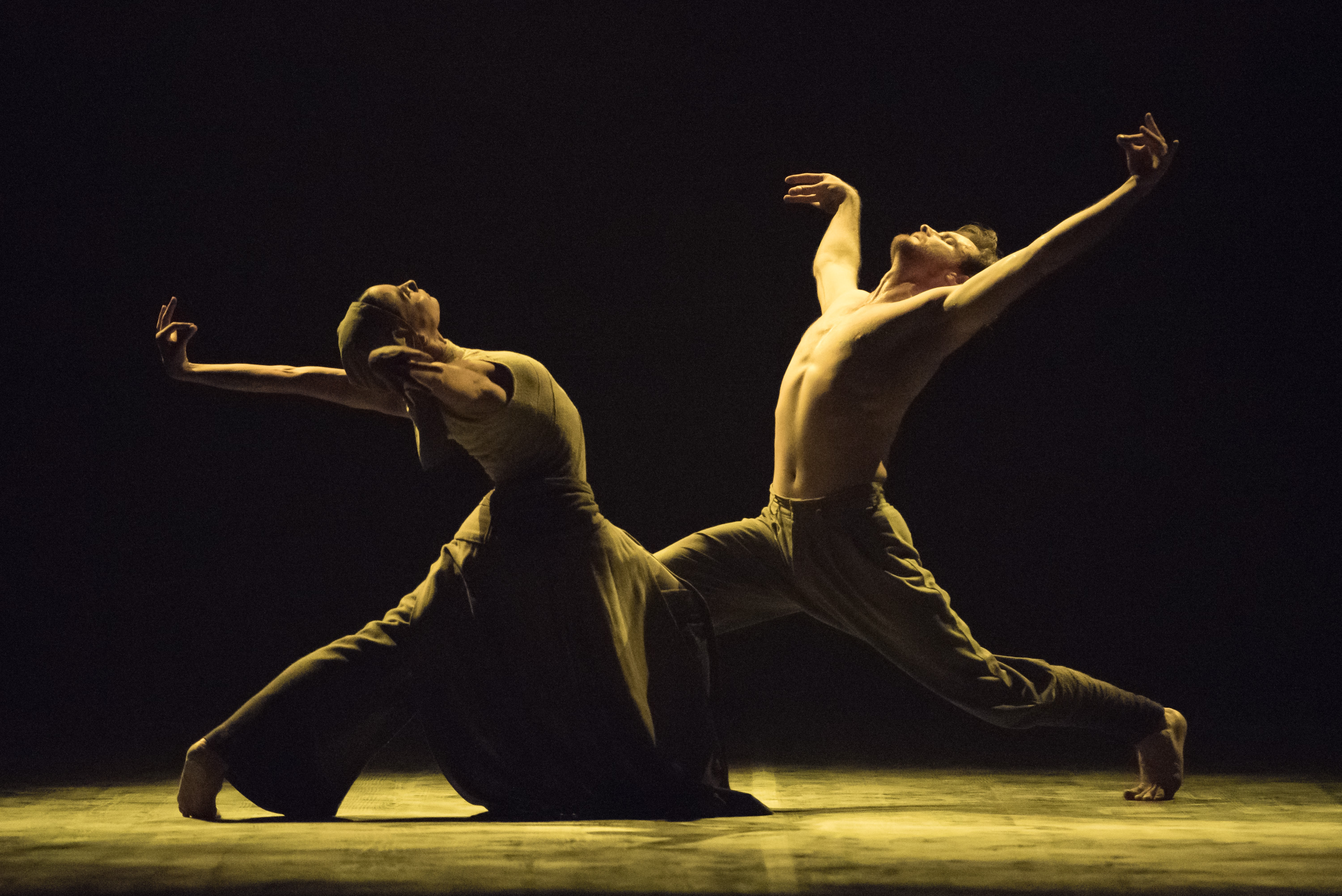
At the end of the scene Juliet returns to the balcony, only to kneel down immediately and reach for Romeo, who is straining up towards her.  But despite their burning passion, their hands don’t quite meet—a reminder perhaps that the distance imposed upon them is simply too great; or maybe it is an expression of unfulfilled desire; or perhaps both.  Whatever our feelings about this moment, it is also a foreshadowing of the tomb scene where Rojo’s Juliet lacks the strength to keep hold of Romeo’s hand as she draws her last breath.

In an interview after the Beyond Words premiere, Hayward talked about how important the set was to her understanding and portrayal of Juliet.  At the start of the Balcony Scene music we see the Nurse (Romany Pajdak) brushing Juliet’s hair.  Juliet seems preoccupied, restless.  As she approaches her balcony, we watch her from behind, almost as if we are following her into another world.  But the scene is softly aglow with the light of the moon, so there is no sense of Juliet lighting up the darkness; neither are there any noticeable gestures referring to Juliet’s first meeting with Romeo or to Shakespeare’s text.  But what we are given here is a sense of being physically present in Verona, as we watch the Lovers through the foliage of the garden.  And at the end of the scene not only do their hands touch, but they are able to hold one another’s forearms before letting go again.  Although the scene is to us rather less poetic than the stage version, it recreates the sense of realism that MacMillan was so eager to effect in the work—a realism to which we have perhaps become too accustomed to fully appreciate.

At the end of the ballet our minds return to this moment of joy: looking through the grille enclosing the crypt, we witness Juliet’s failed attempt to reach Romeo’s hand.  In close-up shot all we can see in the final moments are her hands dangling over the tomb, almost as if they were disembodied.  It is well known that MacMillan wanted no sentimentality to be portrayed in this scene: “… the death scene was crucial to Kenneth.  His lovers were not reunited in death.  They did not die in each other’s arms” wrote Seymour (186).  As far as MacMillan was concerned the death of Romeo and Juliet was a complete waste of young life (qtd. in Seymour 186), and this ending seems to us a fitting indictment on all those involved in precipitating the death of the teenagers.
Another memory that Seymour writes about is the now iconic scene where Juliet sits alone and still on her bed in desperation until she resolves to visit Friar Laurence for help with her predicament.  Fifty-seven years after the premiere, this is still a suspenseful moment of high emotion in a live performance, a moment when we invariably reach for our opera glasses to experience more intensely Juliet finding a glimmer of hope through her despair.  As if mimicking our opera glasses, in both the recordings we’re analysing the camera moves in close, so that we can witness the expressivity of Rojo and Hayward in their near stillness, watch the quickening of their breath, the agitation in Hayward’s face, and the transformation from Rojo’s dark mien to the return of light to her face.  Fifty-seven years after the premiere, this must surely still constitute a challenge for the ballerina to project her interpretation of Juliet’s emotions through the most economical of means.  Rojo herself states, “The hardest thing is the moment when you sit in bed and you have no movement at all to express your feelings” (“Tamara Rojo on being Juliet”).

Romeo and Juliet on Screen Then

For commercial recordings of Romeo and Juliet from earlier years there is no problem of choice: as far as we are aware, there are only two.  These are the film versions made just one year after the creation of the work, starring Fonteyn and Nureyev, and the 1984 recording for BBC television featuring Wayne Eagling and a 21-year-old Alessandra Ferri.

We found comparing the two in terms of visual impact very interesting.  Although filmed in Pinewood Studios, there is an attempt to simulate a theatre experience with the opening and closing of the curtains at the start and end of each act, and curtain calls at the end.  The film was produced and directed by the film-maker Paul Czinner, and we would guess that the budget was quite substantial.  In contrast, the quality of the television film is rather poor, far from the high definition to which we have now become accustomed.  Although a sense of opulence is still conveyed with some imagination on the part of the viewer, the television production values are of the time, and we must confess that to us it is rather drab looking.  This MacMillan may of course have appreciated in a way, given his love for realism in the theatre.

On the other hand, from the start the Czinner film blazes with colour like a Renaissance painting, with bright blues and highly pigmented reds, striking yellows and dazzling golds and greens vying for attention.  For us these original sets and costumes provide an ideal frame for the kind of vibrancy that MacMillan had so admired in Zeffirelli’s Old Vic production of the play in 1960 and wished for his own ballet.  In fact he told Georgiadis, who often attended rehearsals, that he wanted a Verona “where young horny aristocrats roamed the town full of romantic, adventurous spirits” (qtd. in Seymour 181).

Just as there is such a dramatic contrast between the look of the two recordings, there are some equally alerting contrasts in the particular moments that we have discussed above in the Now section of this post.

When booking tickets at the Royal Opera House, we have always preferred to sit on the left side of the auditorium for this ballet, to ensure that we can watch Juliet on her balcony.  There seems to be a substantial amount of freedom from performer to performer with regard to how she uses the opening music of this scene, and very likely ballerinas won’t even perform exactly the same movements from one performance to the next; so this is another moment when the opera glasses come out.  Ferri appears with an air of blissful restlessness, looking up at the moon, down to her hands, over the balcony and up to the moon again.  Leaning her elbows on the balustrade, the most telling moment is when she holds her hands to her cheek, swaying her body gently from side to side with an ecstatic smile on her face.  But Fonteyn’s use of this moment of freedom to explore Juliet’s feelings we find almost disconcerting.  As in the 2012 and 1984 productions, she emerges from darkness to light up like Romeo’s “bright angel” (Shakespeare 11.2 26, p. 37), after which she gestures slowly upwards with her right arm towards the moon.  Although we know the moon to be significant to Shakespeare’s scene, in our opinion the gesture does not reveal much about Juliet’s thoughts and emotions.  This was contrary to the intentions of MacMillan, Seymour and Gable who had “tried to find steps and gestures to express the characters’ state of mind” (Parry 279).

The scandal of the world premiere of Romeo and Juliet being given to Fonteyn and Nureyev in favour of Seymour and Gable, who had contributed so much to the rehearsal process, is well documented.  Not only was Seymour cast as the fifth Juliet, but it was she who taught the role of Juliet to the other four ballerinas: “Margot … wanted to create her own Juliet”, she recalls (188).  This is particularly noticeable in some movements near the start of the Balcony Scene that are reminiscent of “The Kingdom of the Shades” from Marius Petipa’s 1877 La Bayadère, which Nureyev had staged in 1963: supported pirouettes ending in arabesque accentuate Fonteyn’s classical line, and were presumably chosen by her for this reason.  At the close of the scene Nureyev remains downstage right in a lunge, elegantly gesturing towards Juliet on the balcony as she reciprocates by unfolding her arm in his direction.  This approach does accentuate the irreconcilable distance that the family feud has imposed upon the Lovers; but the poses strike us as symbolic, rather than reflecting the naturalism and urgent emotion that MacMillan was after.  As Seymour put it during a coaching session on the Balcony Scene:

He wanted you to be a real pimply teenager, both of you, who bump noses when they first try to kiss and do all that sort of thing.  They didn’t do it beautifully … it was a little awkward, and a little wonderful, and a little gawky and a little this and a little that.  So try not to deal with it as if you’re some kind of ballerina.

(“Romeo and Juliet Masterclass”)

Another noticeable discrepancy that jars somewhat is Fonteyn’s choice of movement when her Juliet is trying to find a solution to her approaching marriage to Paris.  Rather than sitting on the bed facing directly downstage, she kneels by the bed facing downstage left and mimics crying before raising her head and slowly moving her gaze to downstage right, almost as if watching herself rushing to Friar Laurence.  Perhaps this worked at the time, but when the viewer is accustomed to the drama of being confronted with Juliet’s stillness face-on, it breaks the intensity of the moment.

Seymour recalls what a daring decision it was to reduce movement to a minimum at this climactic point in the narrative, and what a challenge it presented for her, but that MacMillan was convinced that she was capable of holding the audience (185-86).  And his belief in Seymour was justified: audiences and journalists alike were struck by the audaciousness of the sequence, Seymour claiming that it “had a singularly terrifying effect on the scalp of balletgoers” (193).

Presumably it was a combination of Fonteyn’s celebrity status and the challenge presented by the innovative choreographic and dramatic ideas conjured up by MacMillan, Gable, and Seymour that persuaded the other Juliets to adopt Fonteyn’s approach to interpreting the choreography and character, resulting in MacMillan’s fear that his vision of the ballet would not be realised onstage (189).  However, as the recording of Ferri’s 1984 performance testifies, MacMillan’s fears were ultimately unfounded.  The Balcony Scene ends with the Romeo and Juliet straining towards one another in their burning desire to touch one another’s hands just one more time before they part.  Ferri’s Juliet sits on the bed facing the audience as Colin Nears’ camera zooms out, thereby emphasising her aloneness in the vast stage space that represents her room.  And Ferri, who became such a long-standing interpreter of the role, showed no reluctance in the death scene to allow the weight of her body to hang in a precarious backbend over the sepulchre with no thought to elegance, unable to keep hold of Romeo’s hand.  Fonteyn’s Juliet, on the other hand, dies holding onto Romeo’s arm and with her body carefully arranged so we can still see her face, and with little sense of the precariousness that might disrupt the ballerina image. 

Ironically perhaps, the Czinner recording states overtly that the purpose of the film is twofold: to preserve the performance for a wider audience and as a record for posterity.  For us, however, the importance of the film is not so much in its preservation of the dancing of the two undisputed ballet stars of the era, but the way in which the reluctance of the performers to engage fully with MacMillan’s vision highlight the radical nature of MacMillan’s choreography seen both in performance and in the later films.

Concluding thoughts

Having grown up at a time when the only way to engage with ballet choreographies apart from seeing them live was through written materials, photos, LPs and the occasional television broadcast, we feel immensely privileged to have access to all of these recordings of MacMillan’s Romeo and Juliet

The films offer us an insight into the radical nature of the choreography, and ways in which the politics of power can have an impact on the nature of a choreographic work.  We can also re-evaluate the work after a long period of familiarity and find new ways of appreciating it through the imaginative work of directors and new casts that bring the work to life again.

© British Ballet Now & Then

References

Byrne, Emma. “Romeo and Juliet review: an inspired choice for the Royal Ballet’s return”. Evening Standard, 6 Oct. 2021, www.standard.co.uk/culture/dance/romeo-and-juliet-review-royal-opera-house-b959020.html.

Guiheen, Julia. “Tamara Rojo and Carlos Acosta in “Romeo and Juliet” (2007)”. Pointe Magazine, 20 Nov. 2019, pointemagazine.com/tbt-tamara-rojo-carlos-acosta/.

Parry, Jann. Different Drummer: the life of Kenneth MacMillan. Faber & Faber, 2009.

“Reviews 2004-2007”. Tamara Rojo, 7 Mar. 2006, www.tamara-rojo.com/reviews-2004-2007/.

“The Royal Ballet’s Romeo and Juliet: 50 years of star-crossed dancers – in pictures”. The Guardian, 2 Oct. 2015, www.theguardian.com/stage/gallery/2015/oct/02/royal-ballet-romeo-and-juliet-50-years-of-star-crossed-dancers-in-pictures.

Seymour, Lynn, with Paul Gardner. Lynn: the autobiography of Lynn Seymour. Granada, 1984.

—. “Romeo and Juliet Masterclass: Balcony pas de deux”. Revealing MacMillan, Royal Academy of Dance, 2002.

“Tamara Rojo on being Juliet”. Dance Australia, 26 May 2014, http://www.danceaustralia.com.au/news/tamara-rojo-on-being-juliet.

Tan, Monica. “Tamara Rojo and Carlos Acosta: the Brangelina of ballet on chemistry, ageing and loss of innocence”. The Guardian, 27 June, 2014, www.theguardian.com/culture/australia-culture-blog/2014/jun/27/tamara-rojo-carlos-acosta-brangelina-of-ballet.

Wilkinson, Sarah. “Why Watch Ballet on the Silver Screen?”. The Guardian, 15 Aug. 2008, www.theguardian.com/stage/theatreblog/2008/aug/15/whyshouldipaytoseeprerec.

Spotlight on British Ballet Lockdown

How does ballet function in lockdown? Julia and Rosie have been closely following the activities of British ballet companies during the COVID-19 lockdown.  Here are our thoughts …

When people started to absent themselves from public places, and events started to be cancelled we became quite nervous, as we had various performances planned, including the Heritage programme in the Linbury Theatre (a programme of works by Ninette de Valois, Frederick Ashton and Kenneth MacMillan), Kenneth Tindall’s Geisha created for Northern Ballet, and Akram Khan’s Creature choreographed for English National Ballet.  We cheered when Geisha received its world premiere in Leeds, but once lockdown was announced, it was clear that the London performances would be cancelled.  And even more devastating was the cancellation of Creature – Khan’s third collaboration with English National Ballet, featuring the extraordinary Jeffrey Cirio, who has excelled in roles as diverse as Ali in Le Corsaire, Des Grieux in Manon and Hilarion in Akram Khan’s Giselle.

However, we were amazed at how quickly dancers and companies, in the face of a lockdown, started to organise a whole host of online activities, both for themselves and for their audiences.

The first event we recall was actually just prior to lockdown when Tamara Rojo both taught and did class herself with a small number of English National Ballet dancers at City Island, the Company’s new home.  The class was streamed live on Facebook and YouTube, and it was wonderful to see the comments – people were clearly so appreciative, not only of Tamara’s teaching and the skill and dedications of the dancers, but also of the music, as it was the amazing Nicki Williamson playing. After two classes, Tamara had to move what became daily streamed classes to her kitchen.

Tamara-Rojo-C-Paul-Stuart-2
Tamara Rojo – Photo by Paul Stuart

Although it’s a professional class, it’s still manageable for people who regularly take ballet class at an intermediate level, and Tamara explains really clearly, which makes it easy to modify exercises if necessary.  Because she teaches from her kitchen, it has a very personal feel.  This also came across in Birmingham Royal Ballet’s class, which launched their Home from Home series: you can see the dancers in different parts of their houses – Carlos Acosta at the banister, for example.  It was a beautiful sunny day, so it was delightful to see Mathias Dingman doing the centre work in his garden with one of his small sons “joining in”.  In fact, seeing dancers “make do” in their living rooms and dining rooms, holding on to various bits of furniture as makeshift barres and adapting to spaces quite different from a dance studio has become an inspiring symbol of these times.  Beth Meadway of Ballet Cymru even demonstrated and danced a lovely “grand allegro” in a tiny space between bed and wardrobe.

But it’s not only ballet classes for professionals and experienced amateurs that are offered.  English National Ballet was a pioneer of Dance for Parkinson’s, and other companies have followed suit, as well as developing other classes to support people with various health issues.  And these members of the population have not been forgotten.  English National Ballet Artist Kate Hartley-Stevens is teaching Dance for Parkinson’s classes, while Katie Mason delivers sessions for ballet lovers with restricted mobility.  Meanwhile, Scottish Ballet live stream Health classes every week day, including Dance for Parkinson’s Scotland, Dance for Multiple Sclerosis, classes for people with dementia, and more generally for people over the age of sixty.

As we have been researching for this post and keeping our eyes open for new initiatives, it seems that each day brings something new, from English National Ballet’s array of ballet classes at various levels delivered by members of the Company, to Scottish Ballet’s Family Barre for parents and children led by Principal dancer Bethany-Kingsley-Garner, to Birmingham Royal Ballet’s recently announced Baby Ballet uploaded on YouTube in bite-size chunks, including “Stretch those Feet”, “Butterflies” and “Fireworks”.  As the country’s flagship opera house, the Royal Opera House have announced a more ambitious project which will run over the next twelve weeks entitled Create and Learn.  Children are introduced to ballet and opera, if they are not already familiar with the art forms, and given the opportunity to write, make videos, engage in art, and make dances.  The activities are very clearly structured with guidance regarding age suitability and time requirements.  Learning outcomes are even provided.

Even smaller adult ballet enterprises, such as Everybody Ballet (led by Bennet Gartside of the Royal Ballet) and The Ballet Retreat, have now developed digital platforms.  The Ballet Retreat, as the name suggests, is a little different from attending a regular ballet class.  It was co-founded by Hannah Bateman of Northern Ballet and David Paul Kierce, formerly of the same company, and they run adult ballet intensives (from 1 to 3 days), where people are given the opportunity to learn extracts from the traditional ballet repertoire.  Although they still have courses planned for late spring and summer in London and Leeds, currently they are offering a range of ballet classes run by members of Northern Ballet, which has included a Disney ballet barre by Gavin McCaig.

So far our focus has been very strongly on classes, with dancers being wonderfully creative in both doing class themselves and in teaching class, thereby developing additional skills.  As lecturers ourselves, we know that teaching requires a range of intellectual, interpersonal and communication skills, and an extra layer of complexity is demanded for online delivery, we feel.    However, performances of various types are also being offered online, from works previously released on commercial DVD, such as the Royal Ballet’s The Metamorphosis and The Winter’s Tale, and Northern Ballet’s 1984, to performances created in people’s homes for the specific purpose of bringing us cheer.

Northern Ballet in Jonathan Watkins’ 1984. Photo by Emma Kauldhar

Northern Ballet are well known for their children’s ballets, such as Puss in Boots and The Ugly Duckling. These ballets are adapted for television in collaboration with CBeebies.  This year it was heart breaking that they had to cancel the tour of their latest children’s production Little Red Riding Hood, but the show has been made available on BBC iPlayer with the usual supplementary activities on CBeebies, such as jigsaw puzzles at various levels and movement to try at home.

Without a doubt the most entertaining of the performances have been the films made by Sean Bates and Mlindi Kulashe of Northern Ballet in their flat and the adjacent car park.  They made the news with their renditions of “The Greatest Show” and “Tomorrow”, evidently breaking some furnishings in the procedure.

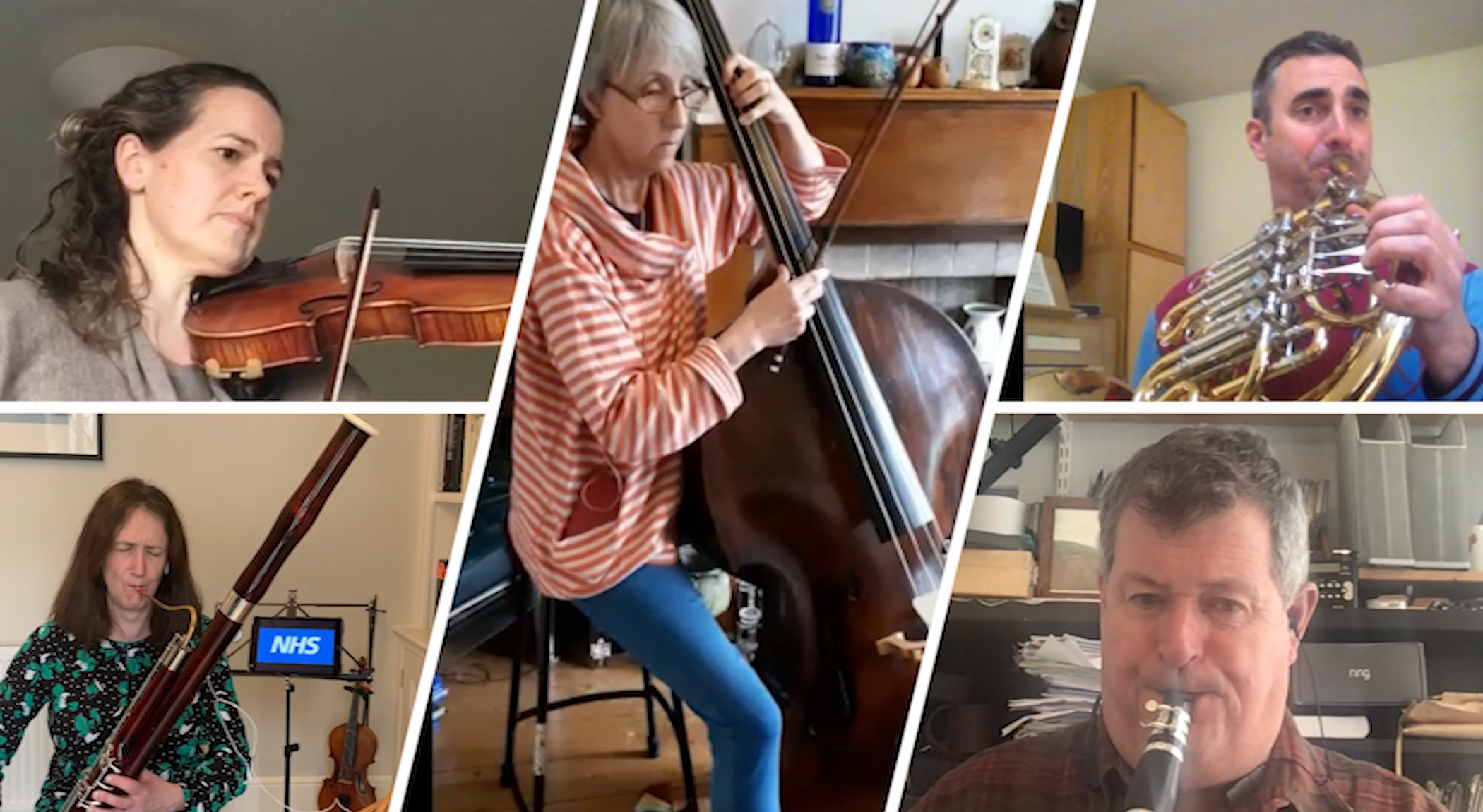
At the other end of the scale, one of the most stirring performances was the except from Raymonda played by the English National Ballet Philharmonic under the baton of Music Director Gavin Sutherland.  The orchestra members were all playing from their homes, and the film was beautifully edited to highlight different sections of the orchestra, enhancing the gorgeous melodies and sumptuous textures of Alexander Glazunov’s score.  But what made this performance particularly rousing was its dedication to NHS Staff and its title “Play for our Carers”.  While of the surface, this might seem quite random, let’s remember that Tamara Rojo’s new adaptation of Raymonda opening in the autumn is inspired by Florence Nightingale.  Not someone to do things by halves, Tamara has been researching the life of Florence Nightingale for four years in preparation for this production, so the dedication was more than fitting.

ENB Philharmonic

As we were writing this post, English National Ballet announced the most exciting initiative yet – their Wednesday Watch Parties.  Each Wednesday a full recording of a Company performance will be premiered online; no complete recordings of these works have ever been made available before.  For the first two Wednesdays two jewels of their recent repertoire are being released on Facebook and YouTube for 48 hours: Akram Khan’s Dust (2014) and Anna Lopez-Ochoa’s Broken Wings (2016).  And there will be more jewels to come no doubt …

Tamara Rojo and James Streeter in Dust by Akram Khan – Photo by ASH

At this time of crisis, British ballet companies are working assiduously to keep themselves fit and ready to return to work, but they are also demonstrating their creativity in ways that help to bolster the nation in body, mind and spirit.  We hope that their generosity of spirit and invaluable contribution to people’s health and well-being at this time will be recognised and rewarded in both the short and the long term.


Kenneth MacMillan’s Choral Works Now & Then

The Choral Works Now

Kenneth MacMillan’s choral works Song of the Earth (1965), Requiem (1976) and Gloria (1980) must surely number amongst the choreographer’s most eloquent, moving and beautifully crafted ballets.  Ideally we would have preferred all three of these ballets to be staged during this season of celebrating MacMillan’s oeuvre.  Even though this was not to be, happily both Song of the Earth and Gloria were not only performed as part of the celebrations, but were staged for the first time by English National Ballet (ENB) and Northern Ballet Theatre (NBT) respectively.

ENB’s first performance of Song of the Earth took place in October in a double bill with La Sylphide in Manchester, while Gloria opened with NBT in Bradford in a triple bill of MacMillan’s work.  The companies also performed the ballets at the Royal Opera House as part of Kenneth MacMillan: a National Celebration, alongside performances by both Royal Ballet Companies and Scottish Ballet that spanned the decades of the choreographer’s creative life.  Fortunately there are still opportunities to see Song of the Earth at the London Coliseum (9th – 13th January) and Gloria at the Leeds Grand Theatre (16th – 17th March).

In case you’re not familiar with these ballets, here is a brief overview.  All three works are set to examples of iconic choral music that had lives of their own well before MacMillan created his choreography to them: Gustav Mahler’s Song of the Earth (1909), Gabriel Fauré’s Requiem (1890) and Benjamin Britten’s Gloria (1959).  All of them deal with existential themes, including the omnipresence of death in our lives, the unnecessary loss of life, especially young life, to war, and the laying to rest of the soul in death.

Unlike MacMillan’s famous evening-length works, such as Romeo and Juliet and Manon, these are not heavily narrative ballets and are relatively sparse in design.  In place of a narrative are intensely evocative images that arise from the themes, music score and lyrics.  An example is the famous image of eternity that closes Song of the Earth: to the elongated notes of the repeated word ewig, meaning forever, the three main figures (The Woman, The Man and The Eternal One or Messenger of Death) gradually move towards the audience, slowly rising and falling, rising and falling, rising and falling, with no break in the flow… Still rising and falling as the curtain falls.

Requiem was visually inspired by the drawings of William Blake.  Here the characters are more fluid than in Song of the Earth.  The central female character in white chiffon sometimes seems childlike, other times angelic (Parry 461-62); when she enfolds the male figure in a stylised embrace she appears maternal. Similarly, this male character can be interpreted in more than one way: in his loin cloth, is he a reference to Christ or to John the Baptist (462)?  Even the corps de ballet in Requiem can be perceived in contrasting ways, as both “mourners and blessed spirits” (462).

Gloria, inspired by Vera Brittain’s Testament of Youth, clearly references the trench warfare of World War I.  Sacrifice and loss are suggested by the configuration of the dancers in the shape of crucifixes.  Towards the end of the ballet the lead female dancer is supported by the two main male characters in a similar pose; in her ethereality and with her elongated but soft arms draped along their arms, she is also reminiscent of Giselle in Act II protecting Albrecht by the cross on her grave.

In recent years the principal roles in these choral ballets have been performed by such Royal Ballet luminaries as Carlos Acosta, Leanne Benjamin, Nehemiah Kish, Sarah Lamb, Laura Morera, Marianela Núñez, Tamara Rojo, Thiago Soares and Edward Watson. In fact, Song of the Earth was chosen by Darcey Bussell for her farewell performance at the Royal Opera House in 2007.

But Song of the Earth did not always enjoy the status it has nowadays. In 1965 it was quite a different story …


The Choral Works Then

Song of the Earth, Requiem, and Gloria are without doubt compelling works due to the imaginative and expressive choreography and perhaps because they are so rich in symbolism and allusion. And their history is equally compelling.

MacMillan is celebrated as a choreographer who was eager to extend ballet where subject matter was concerned, for example through the portrayal of rape in The Invitation (1958) or the depiction of a Nazi concentration camp in Valley of Shadows (1983).  However, the themes explored in the choral works were hardly new to ballet.  What was new was the treatment of those themes, how they were expressed.

In the Romantic era, when ballet enjoyed a great flourishing, themes of death, love, loss, evil, the spirit world, the afterlife, and the human soul were integral to ballet. These themes were expressed through symbols and metaphors in the narratives and characters of the ballets, and are still clear to see today in the two most celebrated works of the era: La Sylphide created in 1832 by Filippo Taglioni, and Giselle choreographed by Jean Coralli and Jules Perrot in 1841. Nowadays we might perceive the treatment of those themes to be rather quaint or naïve, although if we use some historical imagination, facilitated by last year’s documentary Giselle: Belle of the Ballet introduced by Tamara Rojo, with contributors David Allen (historian) and Marina Warner (mythologist), we might gain some insight into the kind of unsettling impact those works may have made in their early years.

It seems that the Royal Opera House Board members were similarly unsettled when MacMillan approached them about choreographing a ballet to Mahler’s Song of the Earth, as they rejected the idea on the grounds that “great music addressing elevated subjects, such a Mahler’s Song of the Earth, was unsuitable for ballet” (Parry 459).  If they did not recognise the similar “elevated subjects” within the Romantic repertoire, you would think that they might have been aware of them in Frederick Ashton’s wartime ballets, most famously Dante Sonata (1940). Evidently neither did they perceive the ballet music of composers such as Tchaikovsky, Stravinsky or Ravel to be “great music”.

The rejection from the Board was the reason why MacMillan mounted Song of the Earth on Stuttgart Ballet, where his friend John Cranko, another British choreographer, and mentor to MacMillan, was Artistic Director.  In Stuttgart the work proved to be a success.  So, only six months after the premiere in Stuttgart, the Royal Ballet staged Song of the Earth at Covent Garden, where it was “hailed as a major achievement” (Parry 305).

It would seem logical therefore that when MacMillan approached the Board in the mid-70s as Director of the Royal Ballet and Principal Choreographer, about creating a ballet to Fauré’s Requiem, that the response would be more positive than the reaction to the proposed Song of the Earth ballet.  Nothing could be further from the truth.  Fearing that such a ballet might “offend the religious beliefs of the public at large” (MacMillan qtd. in Parry 459) the Board again refused to commission the work.   Again MacMillan staged the work in Stuttgart; and again the work entered the repertoire of the Royal Ballet, though not before he had staged his third choral work, Gloria, for the Royal Ballet, this time with no objection from the Board.  Interestingly, MacMillan had decided to give exclusive performance rights to Requiem to Stuttgart Ballet for six years, by which time Beryl Grey had requested it for London Festival Ballet (Parry 464), suggesting the growing significance of these choreographic works by the early 1980s.  In fact, in 1982, Gloria was recorded by Granada Television for transmission on Remembrance Sunday 1982 (556).

Currently the Royal Opera House website describes Song of the Earth in proud and glowing terms as “Kenneth MacMillan’s powerful exploration … of love, loss and renewal”; Requiem is described as “moving” and “boldly inventive” “with some striking pas de deux”.  In our opinion MacMillan’s persistence in following through his choral projects resulted in some of the most distinctive, innovative and expressive additions to the British ballet canon, and we are indeed fortunate not only in being given the opportunity to see two of these works, but also in benefitting from the ENB billing of  La Sylphide from the Romantic era juxtaposed with Song of the Earth – two works that demonstrate such contrasting approaches to themes of human frailty, love, loss and transcendence in the art form that we love.

This post is dedicated to Helen Boyle and Andrew Dilworth.

Next time on British Ballet Now and Then … to coincide with the young Royal Ballet principals Francesca Hayward and Yasmi Naghdi dancing the title role in Giselle, we will be thinking about celebrated Giselles of the past in British ballet companies.

References

Giselle: Belle of the Ballet, directed by Dominic Best, British Broadcasting Corporation with English National Ballet, 2 Apr. 2017.

Parry, Jan. Different Drummer: the life of Kenneth MacMillan. Faber and Faber, 2009.

Royal Opera House. “Requiem”, Royal Opera House, 2017, http://www.roh.org.uk/productions/song-of-the-earth-by-kenneth-macmillan. Accessed 4 Dec. 2017.

—. “Song of the Earth”, Royal Opera House, 2017, http://www.roh.org.uk/productions/song-of-the-earth-by-kenneth-macmillan. Accessed 4 Dec. 2017.

© Rosemarie Gerhard 2017