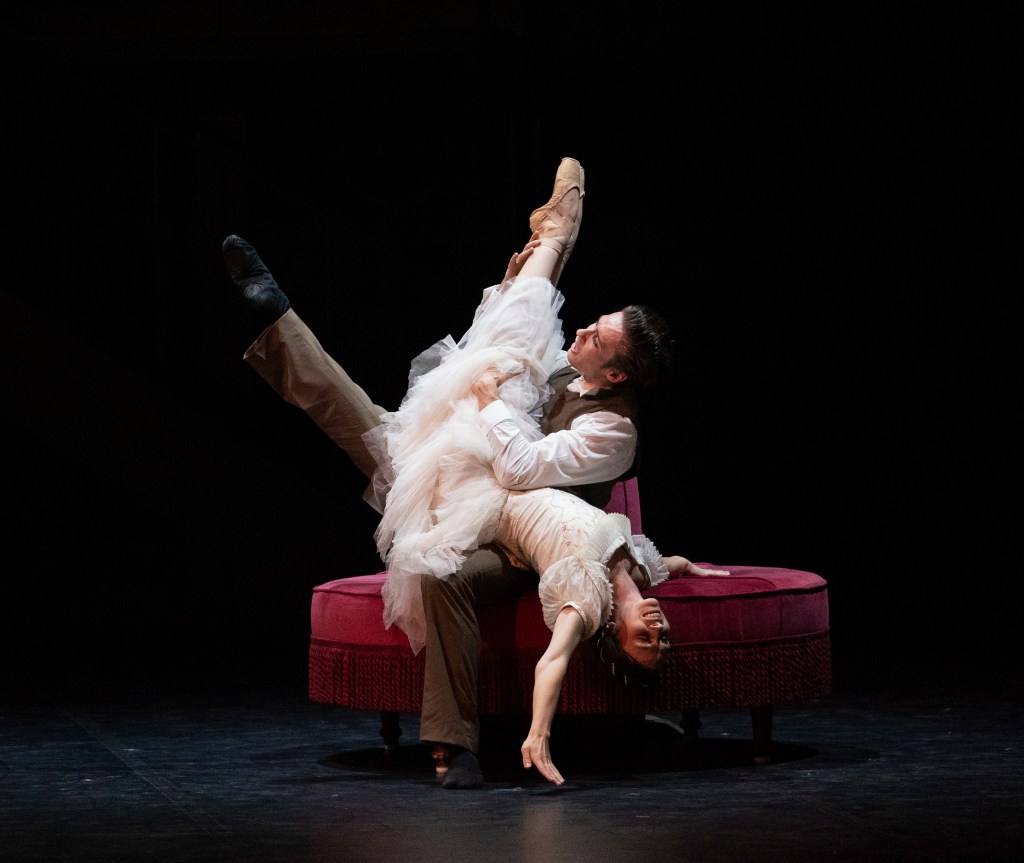
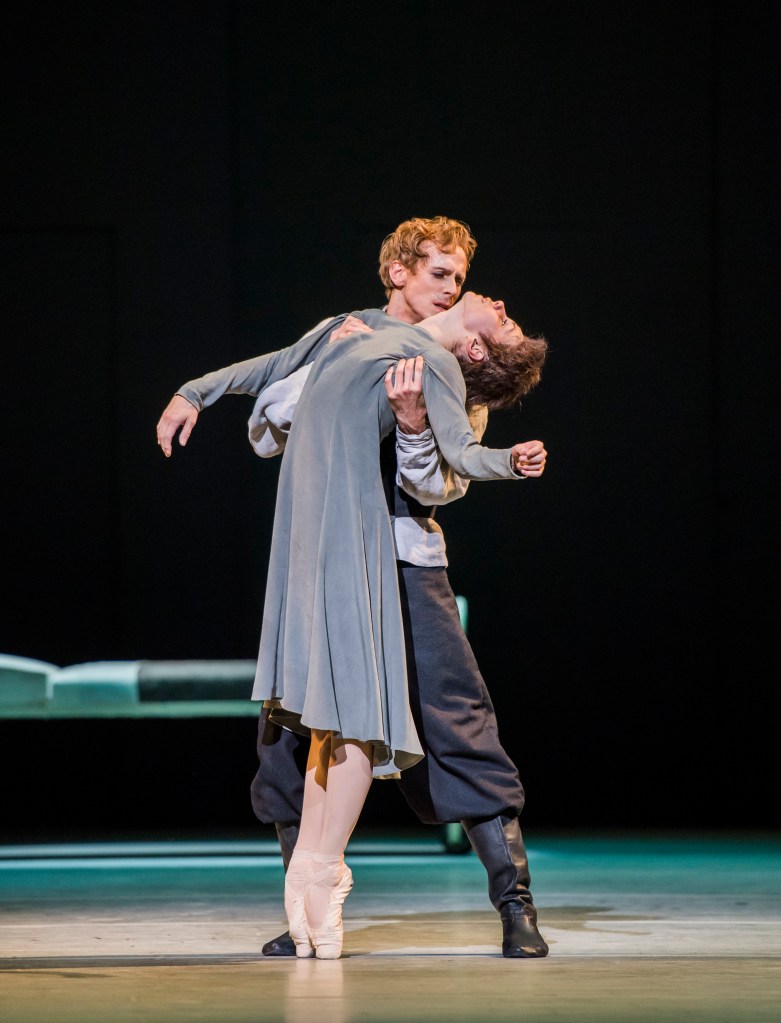
Watching with British Ballet Now and Then: Northern Ballet’s Romeo & Juliet

We are a tad nervous.  Northern Ballet is one of our favourite companies: we’ve travelled out of London to watch them perform Cathy Marston’s Jane Eyre and Victoria, as well as David Nixon’s Cinderella and The Great Gatsby.  But this is Romeo and Juliet, and over the years there has been such a plethora of productions to see in this country, and even a cluster of celebrated versions created for, or at least staged by, British companies: English National Ballet have staged both Rudolf Nureyev’s and Frederick Ashton’s choreographies, Scottish Ballet John Cranko’s, and of course both Royal Ballet companies the iconic adaptation of Shakespeare’s play by Kenneth MacMillan, often described as the “definitive” Romeo and Juliet ballet (Byrne; Watts).  Having been watching it since our teens, it is the Romeo with we are most familiar, the one that is indelibly seared on our memory.

How is it possible to compete with these celebrated works? We did in fact once see Northern Ballet’s production, which was choreographed by Massimo Moricone, and directed and devised by the dancer and actor Christopher Gable, who famously created MacMillan’s Romeo in 1965.  But that was long ago, in the 1990s, when it was new, and our understanding of adaptation not as developed as it is now.  We have read positive reviews, and we enjoy the conducting of Daniel Parkinson (Associate Conductor), as well as the dancing of members of the cast we are about to see: Dominique Larose (Juliet), Joseph Taylor (Romeo), and Rachael Gillespie (one of Juliet’s Friends).  So, tentative as we are, let’s see what happens …

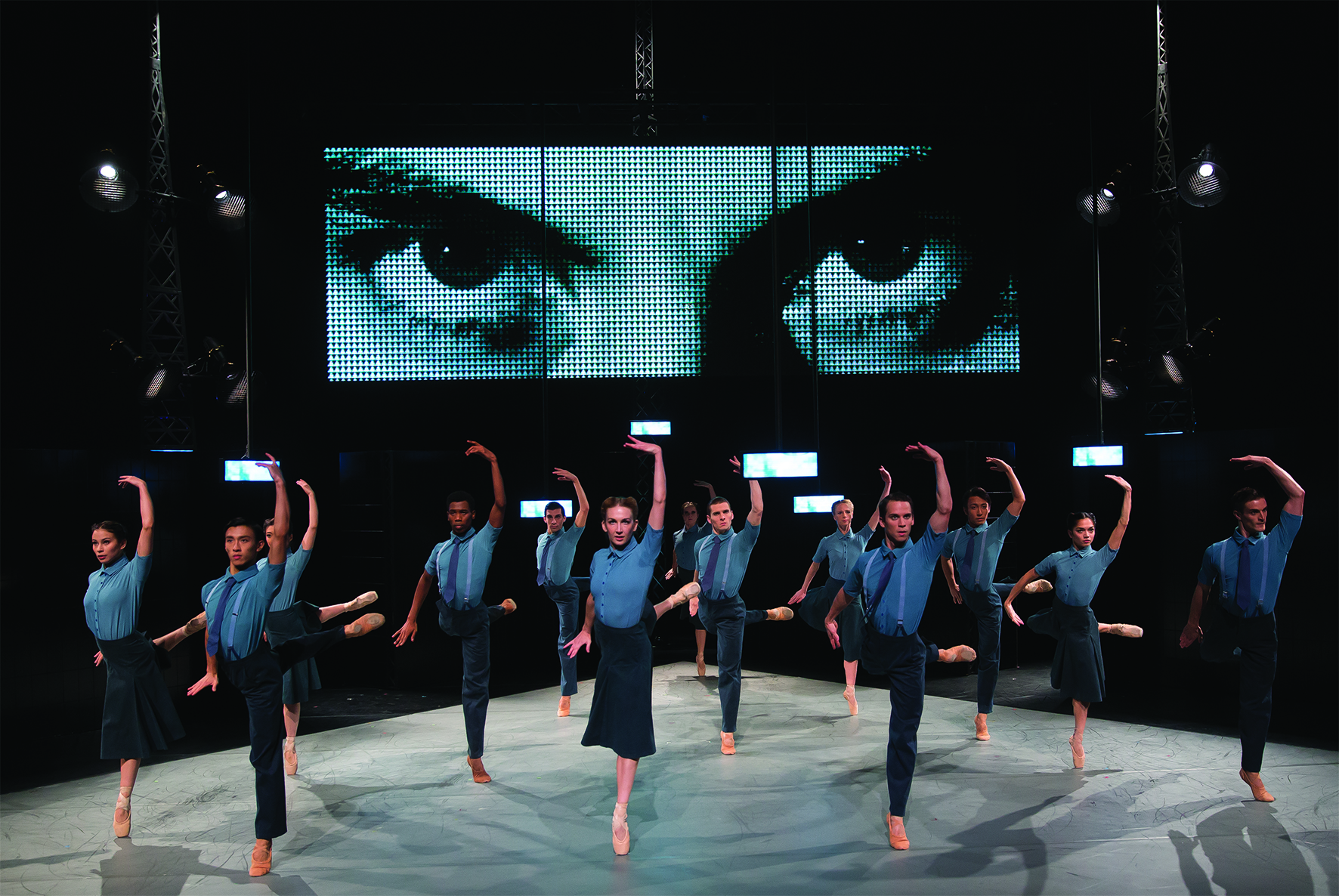
At first the scale of the work bothers us slightly: the market scenes are not teeming with people, and surely the ball is a rather slight gathering for a family as proud and powerful as the Capulets.  But let’s shift our watching a bit and think of the stage action more as symbolic than realistic …  There are other ingredients that bring the work to life. There are children in the marketplace (not all choreographers have followed August Bournonville’s enthusiasm for including children in the villages and towns that provide the setting of their narratives); there are great swaying, streaming carnival pennants that fill the space and add energy to the movement.  

But what is most noticeable about the first fight scene is its humour.  Montagues and Capulets jump on each other’s backs.  There are fisticuffs. Lord Capulet tries to throttle his rival Montague. It’s all a bit uncouth.  And there seems to be more flag waving and stick wielding than real intention to kill, despite the menacing posturing of the Capulets.  Lethal weapons are scant.
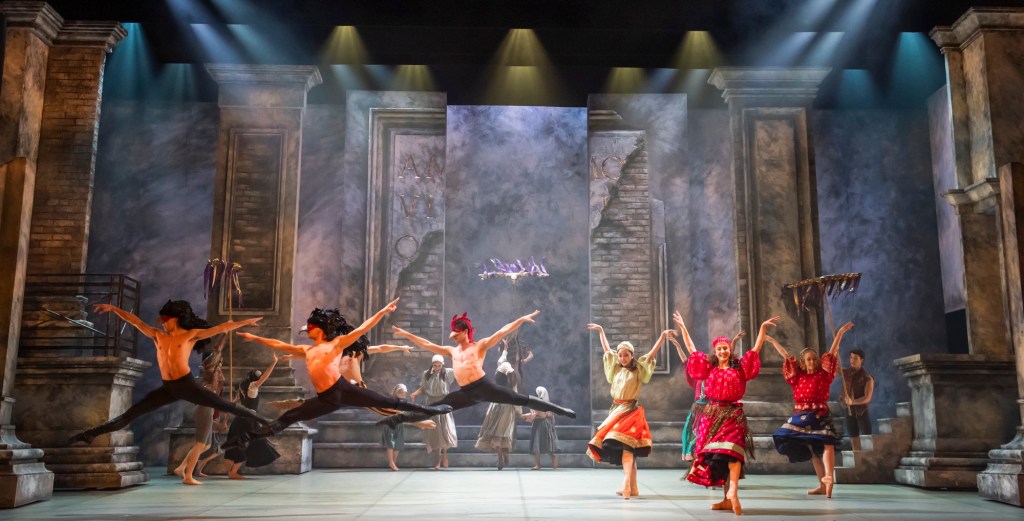
Northern Ballet dancers in Romeo and Juliet ©Tristram Kenton

Nonetheless, this first fight ends on a note of strange tragedy.  A child dies and is held up by Prince Escalus for all to see.  It seems a bit out of place amidst all the raucous behaviour.  But again, thinking of it on a symbolic level, it functions as a forewarning of events to come.

Similarly, the Ballroom Scene, while relatively small in scale, is rich in action—so much so that it is quite a challenge (albeit a pleasurable one) to pick up on all the narrative detail.  Our eyes roam around the stage to follow all the activity … Once he has spotted Juliet, Romeo moves around and across the space, as if drawn to her by an invisible thread.  There are some shenanigans going on between Lady Capulet and her Nephew Tybalt in the background, which seems to cause some tension with Lord Capulet.  And joy of joys, Juliet’s friends have personality—their function is definitely not simply to frame Juliet as the ballerina, but to convey something of the excitement and sheer pleasure of youth. They flit around the stage, eagerly watching the dancing, animatedly “chatting” amongst themselves, with Juliet’s Nurse, and with the Guests; they are prominent in the dancing with the Guests and with Juliet.  And their thrill at being at the ball ratchets up a notch when they notice, all aflutter, the instant and magnetic attraction between Juliet and Romeo.  

The hustle and bustle of the ballroom dissolves into dark stillness as a pool of soft light creates Romeo and Juliet’s new world of radiant and tender love, a love that is also pitted against the escalating friction between the aggressive Tybalt and mapcap Mercutio. 

And now to the climax of Act I … The sets that separate the protagonists as the curtain opens on the first scene is now used to explore their desire for one another before they come together in their duet.  At the start of the scene their breathless anticipation is palpable.  Juliet above and Romeo below, they lean their bodies against the balcony, feeling its surfaces with sensuous touch, like a surrogate lover.  Now moving around the stage together, their touch is reciprocated: they stroke one another’s hair, embrace, lean on one another and eventually kiss.  Although the heady sweep of MacMillan’s choreography is still so alive in our minds, there are moments in the choreography before us where we see the movement follow Sergei Prokofiev’s score in a different way, as their bodies open and close, rise and fall with the melody. 

Dominique Larose and Joseph Taylor in Romeo and Juliet ©Tristram Kenton

And so to Act II … The light-hearted, comedic tone resumes, with jocund carnival dancing, while Romeo sets himself up for a good ribbing as he wanders the town square in a state of swooning reverie, followed by bawdy fun with Juliet’s Nurse when she brings Romeo his letter from Juliet.  Even the fight between Tybalt and Mercutio begins more as derring-do than any serious intention to wound, let alone cause a mortal wound.  Mercutio goads his opponent by waving Tybalt’s own gloves in his face, spinning, leaping and cartwheeling around him, like an acrobat.  This ridiculing is too much for the vain and vicious Tybalt, who avails himself of a metal claw to strike out at Mercutio.  And suddenly there is Mercutio impaled on the wall stabbed by his own dagger.
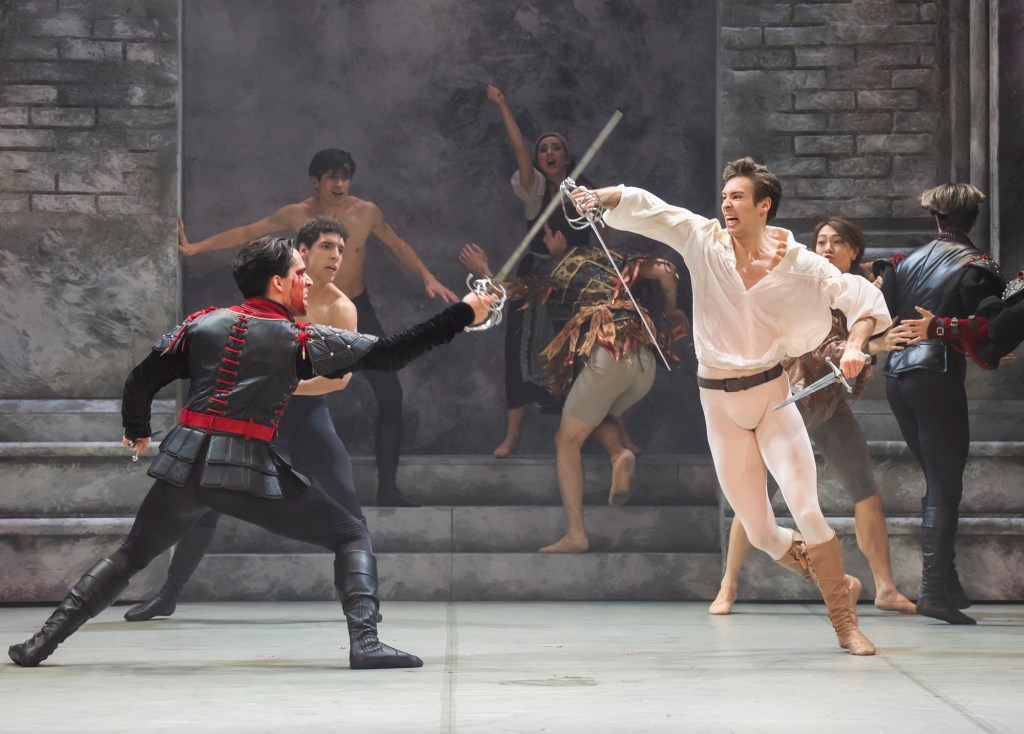
Harry Skoupas and Joseph Taylor in Romeo and Juliet ©Tristram Kenton

The duel between Romeo and Tybalt is of an utterly different order to all the fighting that precedes it.  Right from the start both parties wield their lethal swords, one in each hand, fighting to the death.  The clash of metal and the speed of movement expose the emotional intensity of this fight.  But the violence culminates not only in the anticipated thrust of Romeo’s sword: the two men seize one another’s throats, with the result that Romeo kills Tybalt with his bare hands around Tybalt’s neck.  The murder of Mercutio has flipped comedy to tragedy, play fighting to murderous violence.  Sheets of rain cascade down from the heavens, with thunder and lightning, closing the act like an echo of Mercutio’s curse “A plague a’both your houses!” (3.1.106).

In the final act, the gawky child whose feet dangle from the bed is jolted into womanhood.  We watch this transition with awe.  The ferocity with which Juliet rips off the signature Capulet red and black apparel establishes her independence.  Completely alone on the stage and in life, betrayed by her Nurse, in conflict with her Parents, her Cousin killed by her exiled Husband, Juliet has to make the decision that will determine the rest of her life.  Shakespeare leaves us in no doubt about Juliet’s fears of what may transpire if she decides to take the potion.  She imagines the “foul mouth” of the tomb, Tybalt “festering in his shroud”, “loathsome smells”, and “madly play[ing] with my forefathers’ joints” (4.3.34-51).  

We watch Juliet dance a pas de deux in this scene, with the vial of sleeping potion replacing her partner.  Dancing a pas de deux, her aloneness is all the more poignant: by rights she should be dancing with her husband on the first joyful morning of their marriage.   She holds the vial close to her body, away from her body, moves it in circular motions around her—in front, above, behind her—turning, bending, swaying, twisting as she explores the space around her. She may be making a decision, but the vial seems welded to her very being, as if fate has decided for her.
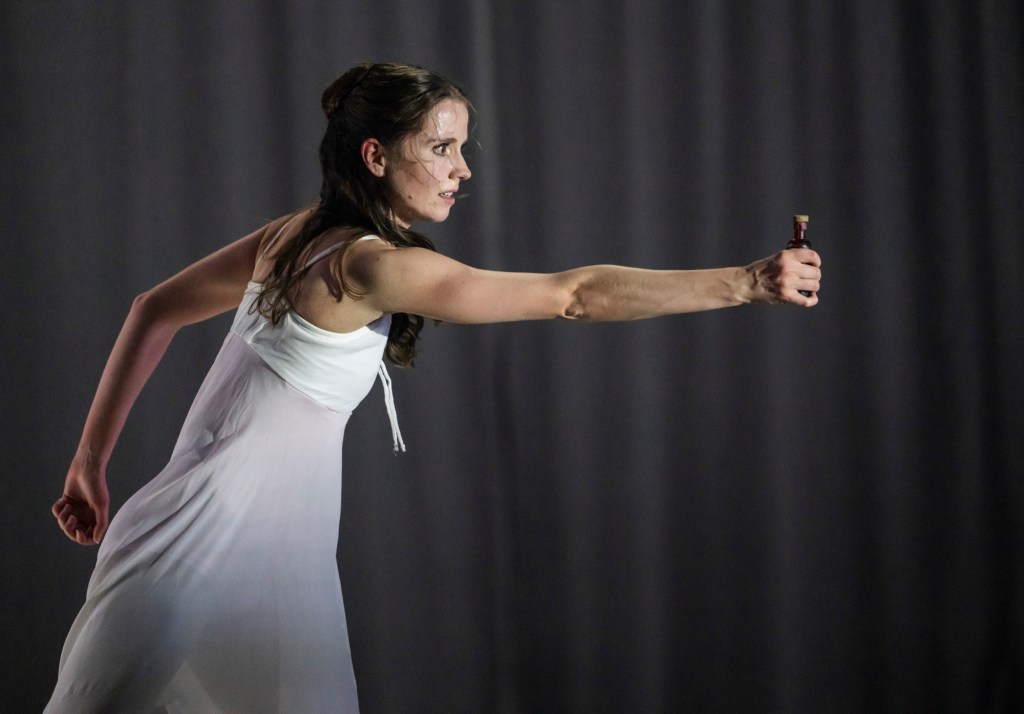
Dominique Larose in Romeo and Juliet ©Tristram Kenton

Lady Capulet instructs the Nurse to see to Juliet’s body.  After the warm, playful exchanges between Juliet and her Nurse, after the sharing of confidences and the Nurse’s fierce defence of Juliet in the face of Lord Capulet’s rage at his Daughter’s flagrant disobedience (more striking in this version than others, we feel), the Nurse’s deft, uncompromising, seemingly detached, stripping of the bed and rearranging of Juliet’s body conveys its own peculiar sense of brutality.  

The violence of this work strikes us again in the Tomb Scene when Romeo’s response to Paris’ assault on him with a dagger is to smash Paris’ head against the wall—the nearest, most immediate weapon to hand.  Romeo’s grief again manifests itself in raw physical brutality before he lovingly and tenderly dances with Juliet’s comatose body, wrapping her limbs around him, wrapping his body around hers, stroking her soft skin, feeling her still-warm body against his own to relive their brief time together.  Juliet’s joy at waking to find herself in Romeo’s arms is palpable but of course short lived.

Dominique Larose and Joseph Taylor in Romeo and Juliet ©Tristram Kenton

As Lord Capulet and Montague become reconciled in their grief we sense Mercutio’s curse lifting.  But the scene is not so long as to detract from the loss of young lives that has precipitated this long overdue reconciliation.  

We leave the theatre, our minds astir with images that bring to mind Linda Hutcheon’s concept of adaptation as a “creative act” (8), and our nervousness assuaged. We are great admirers of MacMillan’s Romeo and Juliet, but we don’t feel comfortable with the notion of a “definitive” adaptation of anything really—it just seems too limiting to us.  This adaptation of Shakespeare’s play has emphasised humour and sexual awakening on the one hand, and the pragmatism, grief and violence associated with death on the other. And we’re fine with that.

©British Ballet Now & Then


References

Byrne, Emma. “Romeo and Juliet review: an inspired choice for the Royal Ballet’s return”. The Standard, 6 Oct. 2021, https://www.standard.co.uk/culture/dance/romeo-and-juliet-review-royal-opera-house-b959020.html

Hutcheon, Linda and Siobhan O’Flynn. A Theory of Adaptation. 2nd ed. Routledge, 2013.

Shakespeare, William. Romeo and Juliet. Penguin Books, 1967.

Watts, Graham. “Northern Ballet’s Romeo & Juliet: a plethora of outstanding dancers”. Bachtrack, 29 May 2024, https://bachtrack.com/review-romeo-and-juliet-northern-ballet-sadlers-wells-may-2024


Spotlight on British Ballet Lockdown

How does ballet function in lockdown? Julia and Rosie have been closely following the activities of British ballet companies during the COVID-19 lockdown.  Here are our thoughts …

When people started to absent themselves from public places, and events started to be cancelled we became quite nervous, as we had various performances planned, including the Heritage programme in the Linbury Theatre (a programme of works by Ninette de Valois, Frederick Ashton and Kenneth MacMillan), Kenneth Tindall’s Geisha created for Northern Ballet, and Akram Khan’s Creature choreographed for English National Ballet.  We cheered when Geisha received its world premiere in Leeds, but once lockdown was announced, it was clear that the London performances would be cancelled.  And even more devastating was the cancellation of Creature – Khan’s third collaboration with English National Ballet, featuring the extraordinary Jeffrey Cirio, who has excelled in roles as diverse as Ali in Le Corsaire, Des Grieux in Manon and Hilarion in Akram Khan’s Giselle.

However, we were amazed at how quickly dancers and companies, in the face of a lockdown, started to organise a whole host of online activities, both for themselves and for their audiences.

The first event we recall was actually just prior to lockdown when Tamara Rojo both taught and did class herself with a small number of English National Ballet dancers at City Island, the Company’s new home.  The class was streamed live on Facebook and YouTube, and it was wonderful to see the comments – people were clearly so appreciative, not only of Tamara’s teaching and the skill and dedications of the dancers, but also of the music, as it was the amazing Nicki Williamson playing. After two classes, Tamara had to move what became daily streamed classes to her kitchen.

Tamara-Rojo-C-Paul-Stuart-2
Tamara Rojo – Photo by Paul Stuart

Although it’s a professional class, it’s still manageable for people who regularly take ballet class at an intermediate level, and Tamara explains really clearly, which makes it easy to modify exercises if necessary.  Because she teaches from her kitchen, it has a very personal feel.  This also came across in Birmingham Royal Ballet’s class, which launched their Home from Home series: you can see the dancers in different parts of their houses – Carlos Acosta at the banister, for example.  It was a beautiful sunny day, so it was delightful to see Mathias Dingman doing the centre work in his garden with one of his small sons “joining in”.  In fact, seeing dancers “make do” in their living rooms and dining rooms, holding on to various bits of furniture as makeshift barres and adapting to spaces quite different from a dance studio has become an inspiring symbol of these times.  Beth Meadway of Ballet Cymru even demonstrated and danced a lovely “grand allegro” in a tiny space between bed and wardrobe.

But it’s not only ballet classes for professionals and experienced amateurs that are offered.  English National Ballet was a pioneer of Dance for Parkinson’s, and other companies have followed suit, as well as developing other classes to support people with various health issues.  And these members of the population have not been forgotten.  English National Ballet Artist Kate Hartley-Stevens is teaching Dance for Parkinson’s classes, while Katie Mason delivers sessions for ballet lovers with restricted mobility.  Meanwhile, Scottish Ballet live stream Health classes every week day, including Dance for Parkinson’s Scotland, Dance for Multiple Sclerosis, classes for people with dementia, and more generally for people over the age of sixty.

As we have been researching for this post and keeping our eyes open for new initiatives, it seems that each day brings something new, from English National Ballet’s array of ballet classes at various levels delivered by members of the Company, to Scottish Ballet’s Family Barre for parents and children led by Principal dancer Bethany-Kingsley-Garner, to Birmingham Royal Ballet’s recently announced Baby Ballet uploaded on YouTube in bite-size chunks, including “Stretch those Feet”, “Butterflies” and “Fireworks”.  As the country’s flagship opera house, the Royal Opera House have announced a more ambitious project which will run over the next twelve weeks entitled Create and Learn.  Children are introduced to ballet and opera, if they are not already familiar with the art forms, and given the opportunity to write, make videos, engage in art, and make dances.  The activities are very clearly structured with guidance regarding age suitability and time requirements.  Learning outcomes are even provided.

Even smaller adult ballet enterprises, such as Everybody Ballet (led by Bennet Gartside of the Royal Ballet) and The Ballet Retreat, have now developed digital platforms.  The Ballet Retreat, as the name suggests, is a little different from attending a regular ballet class.  It was co-founded by Hannah Bateman of Northern Ballet and David Paul Kierce, formerly of the same company, and they run adult ballet intensives (from 1 to 3 days), where people are given the opportunity to learn extracts from the traditional ballet repertoire.  Although they still have courses planned for late spring and summer in London and Leeds, currently they are offering a range of ballet classes run by members of Northern Ballet, which has included a Disney ballet barre by Gavin McCaig.

So far our focus has been very strongly on classes, with dancers being wonderfully creative in both doing class themselves and in teaching class, thereby developing additional skills.  As lecturers ourselves, we know that teaching requires a range of intellectual, interpersonal and communication skills, and an extra layer of complexity is demanded for online delivery, we feel.    However, performances of various types are also being offered online, from works previously released on commercial DVD, such as the Royal Ballet’s The Metamorphosis and The Winter’s Tale, and Northern Ballet’s 1984, to performances created in people’s homes for the specific purpose of bringing us cheer.

Northern Ballet in Jonathan Watkins’ 1984. Photo by Emma Kauldhar

Northern Ballet are well known for their children’s ballets, such as Puss in Boots and The Ugly Duckling. These ballets are adapted for television in collaboration with CBeebies.  This year it was heart breaking that they had to cancel the tour of their latest children’s production Little Red Riding Hood, but the show has been made available on BBC iPlayer with the usual supplementary activities on CBeebies, such as jigsaw puzzles at various levels and movement to try at home.

Without a doubt the most entertaining of the performances have been the films made by Sean Bates and Mlindi Kulashe of Northern Ballet in their flat and the adjacent car park.  They made the news with their renditions of “The Greatest Show” and “Tomorrow”, evidently breaking some furnishings in the procedure.

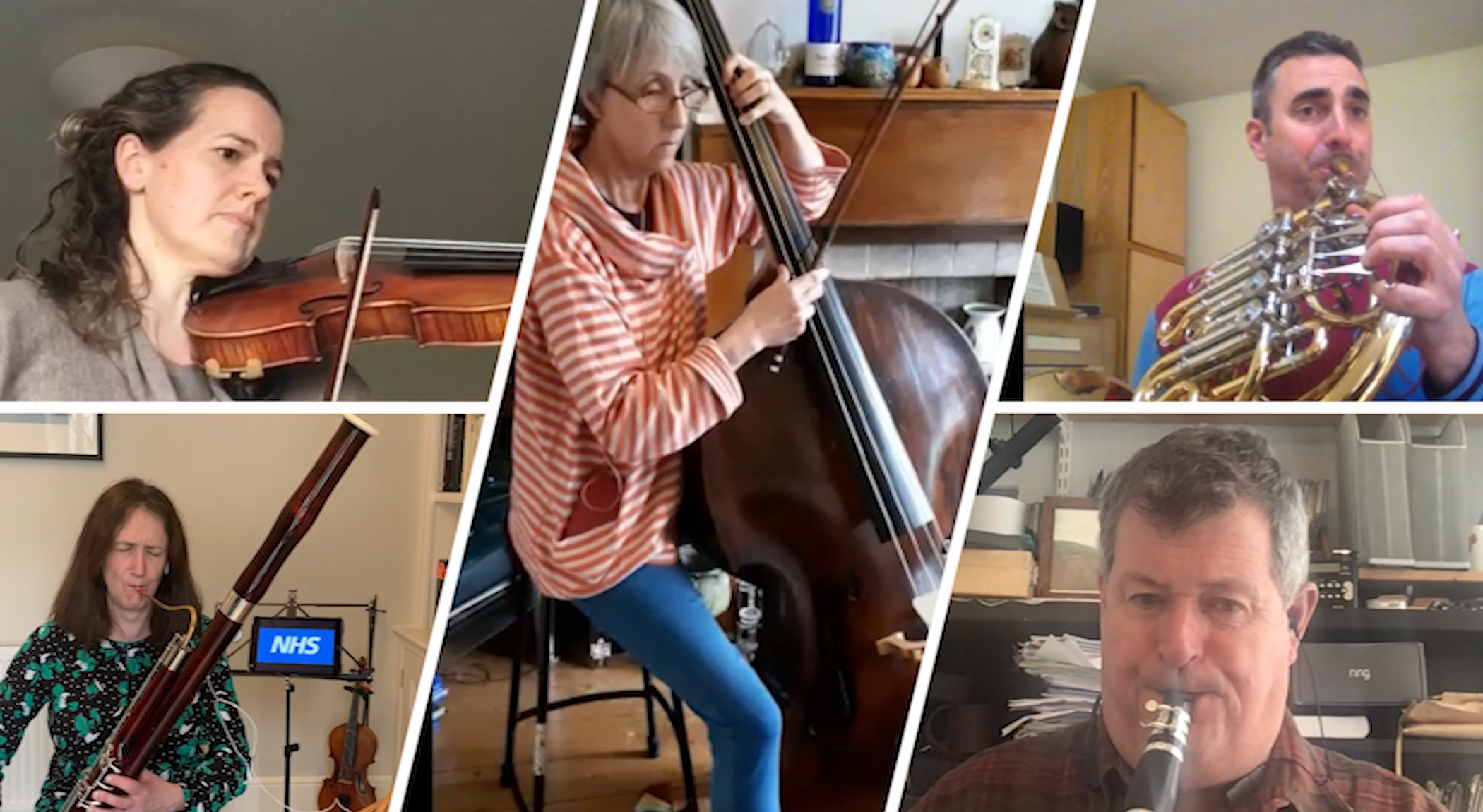
At the other end of the scale, one of the most stirring performances was the except from Raymonda played by the English National Ballet Philharmonic under the baton of Music Director Gavin Sutherland.  The orchestra members were all playing from their homes, and the film was beautifully edited to highlight different sections of the orchestra, enhancing the gorgeous melodies and sumptuous textures of Alexander Glazunov’s score.  But what made this performance particularly rousing was its dedication to NHS Staff and its title “Play for our Carers”.  While of the surface, this might seem quite random, let’s remember that Tamara Rojo’s new adaptation of Raymonda opening in the autumn is inspired by Florence Nightingale.  Not someone to do things by halves, Tamara has been researching the life of Florence Nightingale for four years in preparation for this production, so the dedication was more than fitting.

ENB Philharmonic

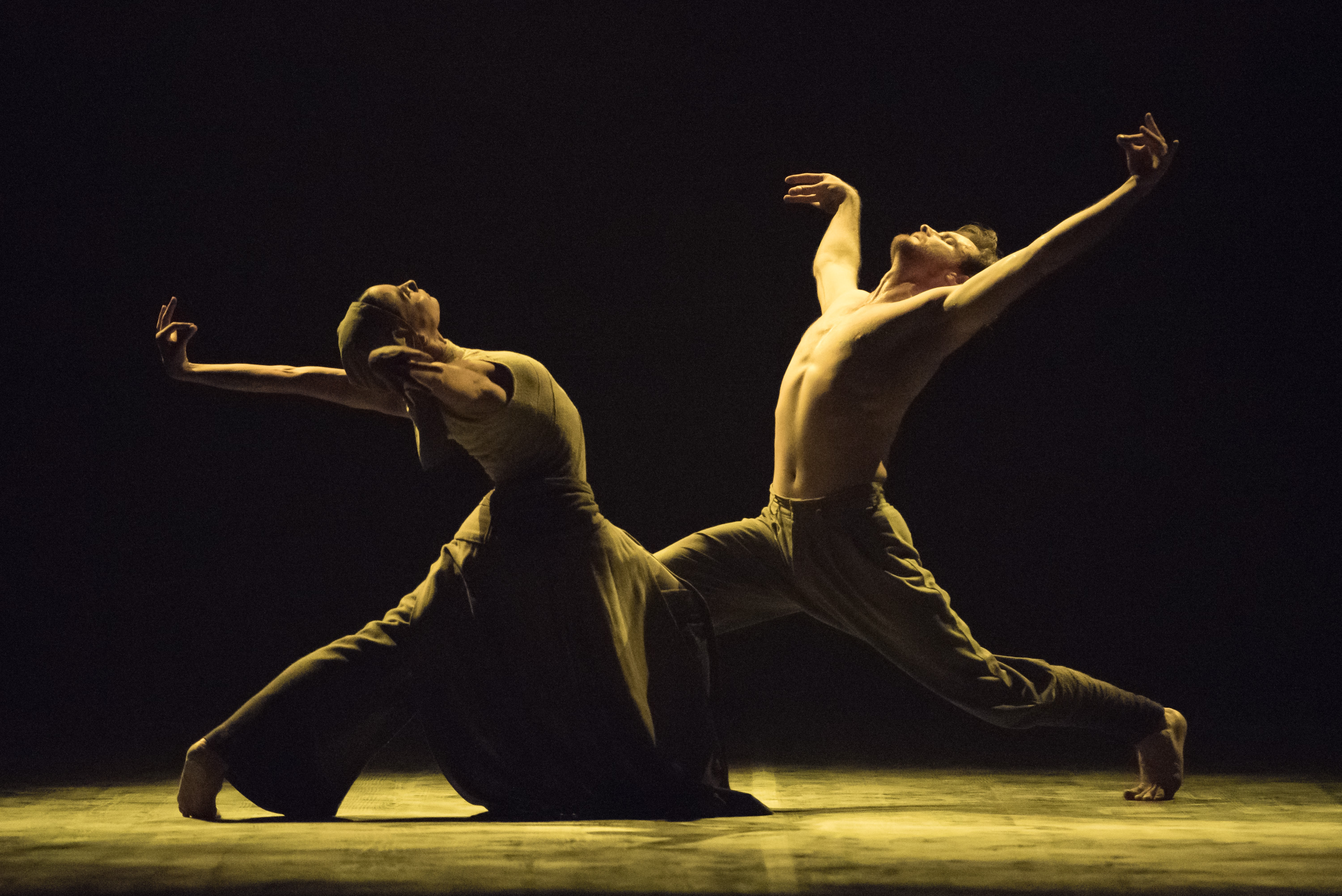
As we were writing this post, English National Ballet announced the most exciting initiative yet – their Wednesday Watch Parties.  Each Wednesday a full recording of a Company performance will be premiered online; no complete recordings of these works have ever been made available before.  For the first two Wednesdays two jewels of their recent repertoire are being released on Facebook and YouTube for 48 hours: Akram Khan’s Dust (2014) and Anna Lopez-Ochoa’s Broken Wings (2016).  And there will be more jewels to come no doubt …

Tamara Rojo and James Streeter in Dust by Akram Khan – Photo by ASH

At this time of crisis, British ballet companies are working assiduously to keep themselves fit and ready to return to work, but they are also demonstrating their creativity in ways that help to bolster the nation in body, mind and spirit.  We hope that their generosity of spirit and invaluable contribution to people’s health and well-being at this time will be recognised and rewarded in both the short and the long term.


Biographical Ballets Now & Then

Biographical Ballets Now

When we started researching biographical ballets, we were under the impression that such ballets were a rarity. Fortunately however, discussions with friends and colleagues revealed a multitude of works, including forgotten and unknown examples, demonstrating that, as in cinema, people’s lives offer a rich source for creation in ballet.

Internationally a number of recent biographical ballets have been based on the lives of iconic figures from the arts, amongst them Broken Wings (Lopez Ochoa, 2016), based on the life and work of Frida Kahlo; John Neumeier’s Nijinsky and Yuri Possokhov’s Nureyev, both from 2017; and Morgann Runacre-Temple’s The Kingdom of Back (2018) about the relationship between Mozart’s elder sister Nannerl, also a composer, Mozart himself and their father.

Our focus for this post is of course driven by the successful addition to the British ballet repertoire that is Cathy Marston’s Victoria for Northern Ballet. Monarchs and royals are no strangers to the ballet stage. Kenneth MacMillan devoted full-evening works to exploring the lives of the Grand Duchess Anastasia Nikolevna of Russia (Anastasia, 1971) and Rudolf, Crown Prince of Austria (Mayerling, 1978) in his inimitable full-blooded style. Between these two ballets, in 1976, came Peter Darrell’s Mary Queen of Scots, while in 1995 David Bintley tackled the subject of Edward II through the lens of Christopher Marlowe’s 1592 play. On a smaller scale is the more recent Elizabeth by Will Tuckett (2013), but this choreography incorporates spoken and sung text, as well as onstage musicians.

Like Elizabeth I, Queen Victoria is such a familiar figure to us. Even if we never learnt about her in school, there are documentaries and films available, as well as the current ITV series Victoria, now having completed a third series. Literature is aplenty in the form of both biographies and fiction, diaries and letters, and a Christmas never goes by without a reminder of how she and Albert established family traditions such as gathering round a decorated Christmas tree. In everyday London life their names crop up repeatedly: Victoria Station, the Victoria line, the Victoria and Albert Museum, the Royal Albert Hall, the Albert Memorial, the Victoria Memorial. To say nothing of the numerous statues of Victoria throughout the UK …

But Queen Victoria reigned for over six decades, and writings by her and about her were carefully edited. She had a hugely important public persona to develop and project, as well as a private life to lead with its famed tragedies. Consequently, she is frequently portrayed in conflicting ways, which we definitely experienced as we watched documentaries in preparation for this post (“Queen Victoria’s Letters” 1&2; “The Secret Life of Queen Victoria”; “Queen Victoria’s Children 1,2,3”; “King Edward Parts 1&2”). So how can a choreographer create a ballet about Victoria, who was celebrated as wife, mother and widow, as well as empress and queen, over so many years of political change, in a single evening?

The solution that Cathy Marston and librettist Uzma Hameed came up with was to portray Victoria from a very specific perspective – that of Beatrice, Victoria’s youngest daughter. This enabled a sufficiently narrow focus for a two-act ballet, with a selection of a restricted number of characters and events covering the many decades from Victoria as a young woman prior to ascending the throne right up to her death.

While the notion of “narrowness” and “restriction” may initially seem limiting, if you think about it, this process of paring down is absolutely essential in any adaptation that involves a change of medium necessitating any substantial change in length or duration, such as the adaptation of an 800-page book into a 100-minute film, or years of a person’s life into a 300-page volume. Such are the skills necessary to achieve a process of adaptation of this kind, that they have been referred to as a “surgical art” (H. Porter Abbott qtd. in Linda Hutcheon and Siobhan O’Flynn 19).

Victoria premiered on March 16th of this year, and has received a substantial amount of media attention, including interviews with the choreographer, articles, and numerous reviews. Therefore, the fact that the ballet is framed by Beatrice’s rewriting of her Mother’s diaries and presented in flashbacks following Beatrice’s reading in the diaries is well documented. Some of the reviews stand out to us in the way they highlight the writing and rewriting of history (King, Lowe, Monahan, Roy, Winter). Unsurprisingly, this topic of how history is written is close to our hearts, although for some Marston’s delight at finding an “unreliable witness” (qtd. in Dennison) to Victoria’s life may come as a surprise. However, to us this seems to be at the heart of the ballet, not only in how it portrays the events of Victoria’s life, but how it challenges some of our preconceptions of Victoria, and therefore startles and stirs us in equal measure.

If you have been following the ITV series Victoria, you will be familiar with the passion of the young Victoria; however, we see nothing in the series to compare with the sheer sexual pleasure expressed by Marston’s choreography for Victoria and Albert’s wedding night duet (“Northern Ballet’s Victoria”), which on one occasion in our viewing elicited a “wow!” from the audience.

Victoria and Albert on their Wedding Night –   Abigail Prudames as Victoria and Joseph Taylor as Albert in Victoria. Photo Emma Kauldhar
In the course of this pas de deux hardly a moment goes by without the couple stroking and kissing one another’s limbs, torsos, heads and faces. They spin and swoop together around the stage in arcs of elation; they wrap themselves around one another emanating exquisite sensual satisfaction. Even though Victoria’s decades of grieving for her husband are almost an historical cliché, we tend not to associate the figure in black with the physical passion that she clearly shared with Albert and that Marston has expressed with such ravishing eloquence.

The Wedding Night – Abigail Prudames as Victoria and Joseph Taylor as Albert in Victoria. Photo Emma Kauldhar

Similarly, our pervasive awareness of Victoria’s love for her consort may inhibit our ability to connect such passion with the disagreements over Albert’s role in politics. With characteristic economy of means Marston conveys these turbulent arguments through tussles over a red box symbolising affairs of state. But in the ballet Victoria’s intransigence is seen at its most passionate in her furious resistance to Beatrice’s desire to marry: bent over double with fists clenched, her rage is palpable. And while we may indeed envision Victoria as domineering and controlling, the ferocity of her physicality collides with the conventional image of Victoria.

Watching Marston’s Victoria makes us feel on the one hand that we’re learning more about the iconic monarch, but on the other hand the experience of having our well-worn vision of Victoria challenged is destabilising. Consequently, and counterintuitively, Victoria seems to become more of a mystery than previously. Perhaps this is because Marston presents her as a human being – as daughter, lover and mother, as well as queen and empress. But equally, because we so clearly witness her through layers of subjectivity. Marston makes this crystal clear through her words in interviews and rehearsals, and no less through the stage action itself. Victoria writes, and Beatrice reads, remembers, discovers, reacts and edits: the lives of Victoria and Beatrice written by Victoria and rewritten by Beatrice with nostalgia and longing on the one hand, and surprise, disapprobation and anger on the other.

Biographical Ballets Then

Unlike in the case of Queen Victoria, the royal lives that MacMillan chose to adapt are probably perceived by British audiences as more than usually mysterious. This is particularly the case for Grand Duchess Anastasia Romanova, who was believed by some to have survived the massacre of the Imperial Russian family by the Bolsheviks in 1917. But the circumstances of Crown Prince Rudolf’s death, the last of the Habsburg dynasty, was deliberately covered up for political reasons and therefore also shrouded in mystery. This sense of mystery has perhaps been intensified by the highly romanticised 1956 Anastasia featuring Ingrid Bergman in the titular role, and Mayerling with Omar Sharif and Catherine Deneuve (1968).

What probably attracted MacMillan to these two historical figures was his inclination towards sombre subject matter and characters who experienced a sense of being an outsider – a theme that MacMillan revisited repeatedly (Parry “Creating Anastasia” 4). But in both cases, as we watch, we gain a sense that the creators were intent on revealing some kind of perceived truth through the ballets, that they were committed to uncovering a mystery and replacing it with historical “reality”.

MacMillan created what was to become the final act of Anastasia in 1967 during his time as Director of the Deutsche Oper Ballett in Berlin. The German city was rife with stories of a woman named Anna Anderson claiming to be Anastasia Romanova, youngest daughter of Tsar Nicholas II, a woman frequently referred to as “Fräulein Unbekannt” (“Miss Unknown”) (Welch 8). Anna had been saved from drowning in a Berlin canal in 1920 and had been living in Germany ever since, and from 1932 striving to legally prove her royal identity (Parry “Creating Anastasia” 4).

This one-act ballet was set in a mental hospital, where Anna is seen reliving life as a member of the Imperial family before the Russian Revolution, and witnessing the assassination of her family before being rescued. Flickering film footage of the Imperial family and Russian political events accompanied by a musique concrète score of fractured, distorted voices and harsh, jarring sounds opens the work. This moves into Bohuslav Martinŭ’s dissonant Symphony No. 6 which complements MacMillan’s visceral, angular and splintered movement material, revealing Anna’s emotional turmoil. Her battle to be accepted as Anastasia is exacerbated by memories of her turbulent personal history, which includes the loss of a husband and child.

Anastasia-24-10-16-Royal Ballet-5042 Natalia Osipova and Edward Watson by Tristram Kenton

Figures from her past – her parents, siblings, Rasputin, Bolshevik soldiers –haunt her, randomly emerging and re-enacting crucial events; at times they are confused with her present alienating company of medical staff and visitors. The theme of the outsider is patently clear: Anna is segregated from any potential community in her current life by the four walls of her hospital room, and she is segregated from the community of her past through their death.

Four years later when MacMillan was working as Artistic Director of the Royal Ballet, the choreographer developed the one-act work into a three-act ballet, portraying the Imperial family in events leading up to World War I (Act I) and the 1917 Revolution (Act II). Although the flashbacks that fill Anna’s mind in the final act are fragmented and muddled, indicating her state of mind, the first two acts follow a clear chronology. Therefore, the characters who haunt her in Act III are initially presented logically and in context, conveying to the audience a sense of factual reality. This means that there is no disconnect between Anastasia’s historical past and Anna’s memories, giving credence to Anna’s claims. And the final moments seem to confirm this: “At the end of the ballet, she stands like a ship’s figurehead at the prow of her bed as it sails round the stage, a small defiant figure floating on a sea of darkness” (Parry Different Drummer 327).

Gillian Freeman, who wrote the scenario for Mayerling, organised three acts that cover the last eight years of Rudolf’s life from his wedding day to his suicide with his young mistress Mary Vetsera. Rudolf’s troubled relationships with women, from his mother and wife to his various mistresses provided rich material for transforming into expressive pas de deux, one of MacMillan’s great talents as a choreographer. It is abundantly clear that the choreographer wanted to portray Rudolf as a tormented human being who had been abused as a young boy, was emotionally neglected, suffered from venereal disease and was obsessed with death. Although MacMillan focused on the emotional aspects of his life, he also dealt with the political pressure that Rudolf faced from his friends campaigning for Hungarian independence.

What we find particularly fascinating is that Freeman insists that she wanted the ballet to be rooted in fact, and that all the events portrayed in the ballet can be historically verified (“Mayerling: South Bank special, part 1, 1978”), including Mary Vetsera’s arrival at Rudolf’s quarters wearing only a coat and a nightdress, his fascination with guns and skulls , and bringing his wife to the tavern managed by his Mistress Mitzi Casper (Freeman “The Uncertain Beyond” 10-11).

Mayerling Sarah Lamb as Mary Vetsera ROH 2017 Photographed by Alice Pennefather

Freeman was very insistent that the ballet portray the true circumstances of Rudolf and Mary’s death, so different from the sanitised version of events that was publicly announced in an effort to disguise the truth (“Mayerling: South Bank special, part 4, 1978”).

Therefore, in the case of both Anastasia and Mayerling there is a sense of a mystery solved and a truth revealed: Rudolf’s nature and the events surrounding his death are revealed, as is Anna’s identity.

Afterthought

In 2017 historical novelist Hilary Mantel stated the following:

… history is not the past – it is the method we have evolved of organising our ignorance of the past …It is no more “the past” than a birth certificate is a birth, or a script is a performance, or a map is a journey. It is the multiplication of the evidence of fallible and biased witnesses, combined with incomplete accounts of actions not fully understood by the people who performed them.

In our opinion, one of the aspects that distinguishes Marston’s approach to the creation of biographical ballets from MacMillan’s is her attitude to the past and to history. This reflects the shift in thinking about the past and how we construct both personal and public history that evolved over the second half of the 20th century, and is so wonderfully expressed by Mantel. Rather than attempting to discover unbiased facts, Marston recognises that history depends on “biased witnesses”. Nonetheless, whether consciously or subconsciously, in creating these ballets both choreographers have expertly and inventively deployed not only their choreographic imaginations but also their historical imaginations.

In 1994 DNA tests proved that Anna Anderson was not in fact Tsarevna Anastasia. Yet this is perhaps not the point. All of these ballets can be interpreted in a more open way, helping us to think about issues of identity, the way we see ourselves and make sense of our own pasts and to question assumptions that we make about the way we understand the past from the remnants it leaves behind.

©British Ballet Now & Then

We are very grateful for the support of Rachel Evans, Senior Communications Officer of Northern Ballet, and Ashley Woodfield, Head of Ballet Press of Royal Opera House in the production of this post.

Next time on British Ballet Now & Then Last Saturday the Royal Ballet staged Margot Fonteyn a Celebration to mark the centenary of the British Prima Ballerina Assoluta’s birth. In response we will discuss Fonteyn plus three of the ballerinas who participated in the celebration: Lauren Cuthbertson, Francesca Hayward and Yasmine Naghdi.

References

Dennison, Matthew. “Victoria through the eyes of her favourite child: how the life of Queen Victoria became a ballet”. The Telegraph, 25 Feb. 2019, http://www.telegraph.co.uk/dance/what-to-see/victoria-eyes-favourite-child-life-queen-victoria-became-ballet/. Accessed 11 June 2019.

Freeman, Gillian. “The Uncertain Beyond”. Mayerling. Programme. Royal Opera House, 2018, pp. 9-12.

Hutcheon, Linda, and Siobhan O’Flynn. A Theory of Adaptation. 2nd ed., Routledge, 2013.

“King Edward VII – Part 1”, YouTube, 1 June 2011, http://www.youtube.com/watch?v=pdRddYn605c&t=1278s. Accessed 10 June 2019.

“King Edward VII – Part ”, YouTube, 1 June 2011, http://www.youtube.com/watch?v=7S-4veChkRA. Accessed 10 June 2019.

King, Tom. “Northern Ballet Victoria Festival Theatre Edinburgh”. Entertainment Edinburgh / Southside Advertiser, 10 April 2019, http://www.southsideadvertiser.biz/Northern-Ballet-Victoria=Festival-Theatre-Edinburgh-2019.htm. Accessed 11 June 2019.

Lowe, Philip. “Review: Victoria”. East Midlands Theatre, 2 April 2019, http://www.eastmidlandstheatre.com/2019/04/03/review-victoria-northern-ballet-touring-curve-leicester-2-6-april-2019/. Accessed 2 June 2019.

Mantel, Hilary. “Hilary Mantel: why I became a historical novelist”. The Guardian, 3 June 2017, http://www.theguardian.com/books/2017/jun/03/hilary-mantel-why-i-became-a-historical-novelist. Accessed 10 June 2019.

“Mayerling: South Bank special, part 1, 1978”, YouTube, 10 Sept. 2013, http://www.youtube.com/watch?v=0IntawIGac4. Accessed 2 June 2019.

Monahan, Mark “Victoria, Northern Ballet, Sadler’s Wells, review: a fascinating tale of royal passion being struck from history”. The Telegraph, 27 March 2019, http://www.telegraph.co.uk/dance/what-to-see/victoria-review-northern-ballet-sadlers-wells-fascinating-tale/. Accessed 2 June 2019.

“Northern Ballet’s Victoria: behind the veil”. YouTube, uploaded by Northern Ballet, 13 Feb. 2019, http://www.youtube.com/watch?v=gw0RF8xUzR8. Accessed 1 June 2019.

Parry, Jann “Creating Anastasia”. Kenneth MacMillan’s Anastasia, performance by The Royal Ballet. DVD notes. 2016, Opus Arte, 2016, pp. 4-6.

—. Different Drummer – The Life of Kenneth MacMillan. Faber and Faber, 2019.

“Private Lives of the Monarchs – Ep01The Secret Life of Queen Victoria”, YouTube, 22 July 2018, http://www.youtube.com/watch?v=HyVIPGcXMPo. Accessed 2 June 2019.

“Queen Victoria’s Letters – A Monarch Unveiled – Episode 2”, YouTube, 28 Apr. 2016, http://www.youtube.com/watch?v=7–sZ_kH0pI. Accessed 2 June 2019.

“Queen Victoria’s Letters – A Monarch Unveiled – Episode 1”, YouTube, 28 Apr. 2016, http://www.youtube.com/watch?v=7–sZ_kH0pI. Accessed 2 June 2019.

“Queen Victoria’s Children – Episode 1”, YouTube, 15 June 2015, http://www.youtube.com/watch?v=rv4RvQuCmR4. Accessed 2 June 2019.

“Queen Victoria’s Children – Episode 2”, YouTube, 20 Dec. 2016, http://www.youtube.com/watch?v=hovoqQDllbw. Accessed 2 June 2019.

“Queen Victoria’s Children – Episode 3”, YouTube, 21 Sept. 2017, http://www.youtube.com/watch?v=rv4RvQuCmR4. Accessed 2 June 2019.

Roy, Sanjoy, “Northern Ballet: Victoria review – royal story is a feast of brilliance”. The Guardian, 10 March 2019, http://www.theguardian.com/stage/2019/mar/10/northern-ballet-victoria-review-  cathy-marston-ballet-queen-daughter-beatrice-choreography-grand-leeds. Accessed 1 June 2019.

Welch, Frances “The False Grand Duchess Anastasia”. Kenneth MacMillan’s Anastasia, performance by The Royal Ballet. DVD notes. 2016, Opus Arte, 2016, pp. 6-8. 

Winter, Anna. “Victoria review at Sadler’s Wells, London – ‘a ballet to treasure’”. The Stage, 27 March 2019, http://www.thestage.co.uk/reviews/2019/victoria-review-sadlers-wells-london/. Accessed 2 June.