The 19th Century Canon Now & Then

The 19th Century Canon Now

Last summer Birmingham Royal Ballet (BRB) brought their new production of Marius Petipa’s 1869 Don Quixote to London, after it had premiered four months earlier at the Birmingham Hippodrome.  With the exception of The Nutcracker, which is pretty much obligatory fare for any major ballet company (as discussed in our very first British Ballet Now & Then post, this was the first work from the 19th century ballet canon to have been performed by BRB since Carlos Acosta took over as Artistic Director in January 2020.  The premiere had originally been planned for the start of Acosta’s inaugural season, but like so many productions had to be postponed due to the Covid pandemic.

Matador Scene featuring Brandon Lawrence as Espada Photo with Artists of Birmingham Royal Ballet; photo: Emma Kauldhar

The choice of Don Quixote in favour of any other work from the 19th century canon was hardly surprising: Acosta himself has been long associated with the role of Basilio.  At the age of 17 he won the Prix de Lausanne after dancing Basilio’s Act III variation; he performed the role with the Royal Ballet (RB) in Rudolf Nureyev’s staging mounted by Ross Stretton and then created his own production of the ballet for the Company, now adapted for his own Company.

Like the other 19th century classics, Don Quixote provides technical challenges for dancers of different ranking, and opportunities for a large cast of performers to engage in different styles: classical, character and mime.  Other works in the British ballet repertoire that offer similar opportunities are La Sylphide (Bournonville, 1836), Giselle (Coralli/Perrot, 1841), Coppélia (Saint-Léon, 1870; Petipa, 1884) La Bayadère (Petipa, 1877), The Sleeping Beauty (Petipa, 1890), Swan Lake (Petipa/Ivanov, 1895) Raymonda (Petipa, 1898) and Le Corsaire (Petipa, 1899).

Artists of English National Ballet in La Sylphide, photo: Laurent-Liotardo
Jurgita Dronina and Isaac Hernandez in La Sylphide, photo: Laurent Liotardo

Apart from the fact that these works were all created during the 1800s, when ballet as an art form became more recognisably what we understand as ballet today, with its focus on the female dancer, themes inspired by Romanticism, and development of pointe work and ballets blancs, they are all connected by the fact that they were originally choreographed in France or Russia and “travelled” to this country via various routes (as we will discuss further in the Then section of this post).  Although we are sure that you are all familiar with Don Quixote, La Bayadère, Raymonda and Le Corsaire, these works took a number of decades to become established within the British repertoire, being produced in the UK at different times by different companies from 1962 to 2022, and not always in their entirety.

If you follow this blog, you will already know the history of Raymonda in the UK prior to English National Ballet’s evening-length production, which premiered in January last year.  Important details for this particular post is the fact that it was Nureyev, just three years after his defection from the Soviet Union, who first staged Raymonda in this country, initially in a complete production for the Royal Ballet (1964), and then as a one-act ballet based on the final act of the work, in 1966.  In this form Raymonda can stand on its own as a divertissement within a mixed bill, and between 1993 and 2014 English National Ballet also performed a single-act Raymonda, firstly in a production by Frederick Franklin (the British-American dancer, teacher, choreographer and director), and then, in 1993 in Nureyev’s staging, as part of the Nureyev Celebration, marking 75 years since Nureyev’s birth and 20 years since his death.

Momoko Hirata as Kitri and Mathias Dingman as Basilio, with Artists of Birmingham Royal Ballet in Don Quixote; photo: Johan Persson

Similarly, it was Nureyev who first staged La Bayadère in the UK—not in its entirety, but in that superb example of high classicism, the “Kingdom of the Shades”—and who introduced the Le Corsaire grand pas de deux to the British repertory.  In 1985 the “Kingdom of the Shades” entered the repertory of English National Ballet in a production by Natalia Makarova, and in 2013 the same company became the only British ballet company to perform the complete Corsaire.

The three most celebrated ballet defectors from the Soviet Union all had a tremendous impact on dancing in the West, but like Nureyev, Makarova and Mikhail Baryshnikov also had a substantial influence on the expansion of the 19th century repertoire, by staging major full-length productions for American Ballet Theatre: La Bayadère (Makarova, 1980) and Don Quixote (Baryshnikov, 1978).  Relevant for the development of British ballet is the fact that both of these productions were also mounted on the Royal Ballet.  While La Bayadère was the first complete version of the work to be performed in Britain (and remains the only full-length production in the UK), Don Quixote has had a far more varied history in this country, including stagings by Ballet Rambert (1962) and by London Festival (now English National) Ballet (1970), both mounted by Polish ballet master Witold Borkowski, in addition to the two more recent RB productions.  It seems that it is only since the RB’s staging of Baryshnikov’s version in 1993 that the work has become more firmly established within the British ballet repertoire. 

Although these star dancers from the Soviet Union also mounted new productions of 19th century works already established within the British ballet repertoire (including Nureyev’s Nutcracker for the Royal Ballet in 1968, and Makarova’s 1988 production of Swan Lake for London Festival Ballet), it is noticeable that they focused their efforts primarily on the 19th century works that they knew from their experiences at the Vaganova Academy and Mariinsky Ballet but were absent from North American and Western European companies.  And the newer 19th century additions to the British ballet repertoire have indubitably enriched our understanding of ballet as an art form, given dancers new challenges and offered audiences both entertainment and food for thought.  Don Quixote belongs to a very small number of comedic ballets, and provides a great variety of character and demi-character roles.  Le Corsaire is teeming with opportunities for virtuoso male dancers.   And can any scene in the ballet repertoire surpass the transcendence of the “Kingdom of the Shades”?

Artists of English National Ballet in Le Corsaire photo: Laurent-Liotardo

Yet even ballet, with its highly stylised technique, and its penchant for magic and fantasy and reputation for escapism, is not immune from the changing attitudes of our Zeitgest.  Although ENB’s production of Le Corsaire is little over a decade old, the last time it was performed (at the start of 2020), it came with a caveat from the Artistic Director, Tamara Rojo:

When English National Ballet commissioned its new production of Le Corsaire, we worked to challenge some of the traditions of this work, and therefore made adaptations to tone [down] the characters.  We know that still some elements, such as the attitude towards women and other cultures, now seem unacceptable to our values.  However, we present this traditional work with the strength of the assumption that the audience has the knowledge and the critical frame of judgement to view them in the context in which they were created.

As explored in our Raymonda post, in her own 2022 production of Raymonda, Rojo was at pains to address conflicts between current attitudes and those prevalent in Petipa’s original production, by offering a heroine with greater agency over her own life, and a reconceptualisation of Abderakhman the Muslim Saracen to address the traditional othering of this character.

The Royal Ballet last staged La Bayadère in 2018.  For the most part, as is usual for works that are already established in the repertoire, reviews highlighted the performances of the principals, and as is usual for works which feature major ballets blancs, commented on the unison of the corps de ballet (Desvignes; Hugill; Jennings; Parry).  However, both Robert Hugill and Luke Jennings raised concerns regarding Bayadère‘s promotion of orientalist attitudes manifest in “its inanely capering fakirs, lustful priests and blithe appropriation of Hindu, Islamic and Buddhist religious and cultural motifs” (Jennings). 

In recent years BRB, ENB, RB, and Scottish Ballet have all made revisions to the choreography, costumes and/or make-up of the Arabian and Chinese Dances from the Nutcracker productions in order to start confronting such offensive stereotypes.  But how does a company approach revising a whole full-evening work?
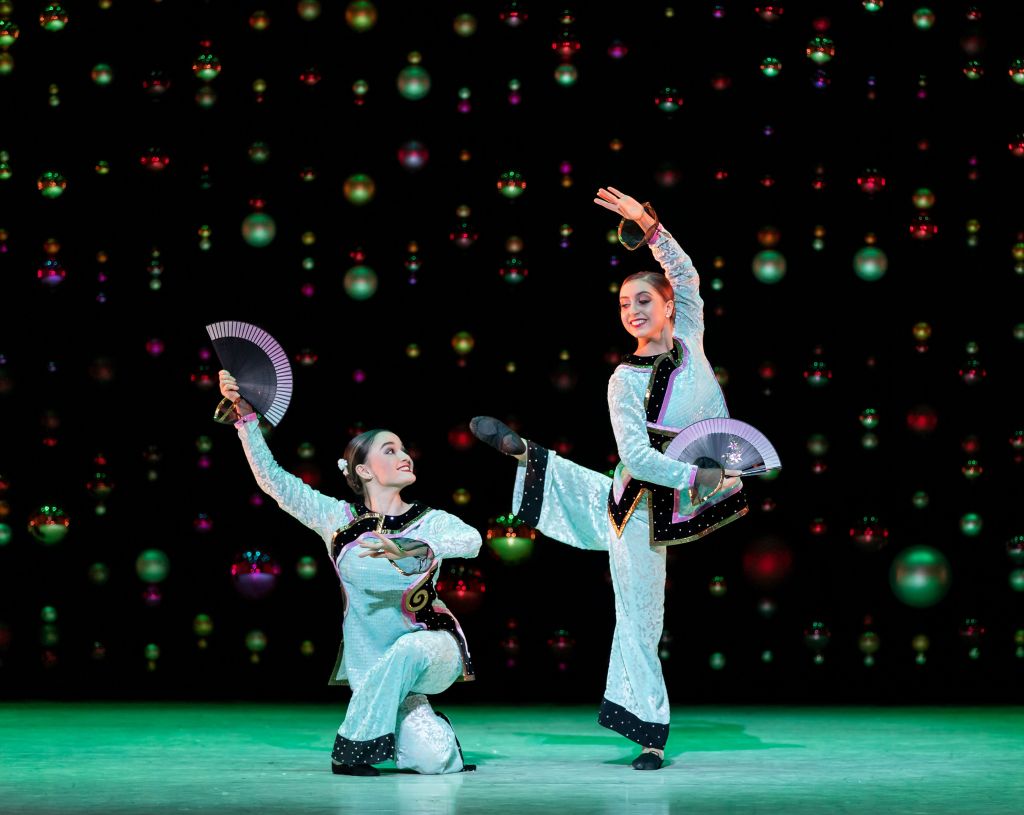
Scottish Ballet Artist Alice Kawalek and First Artist Kayla-Maree Tarantolo in Chinese Tea Dance. Photo credit: Andy Ross

In the United States, Arts Educator and Co-founder of Final Bow for Yellow Face Phil Chan is producing his own versions of Le Corsaire and La Bayadère to make them more suitable and relevant for American 21st century audiences by addressing what he perceives to be their inherent racism and misogyny.  In his plans, Le Corsaire takes place at a beauty pageant complete with “scheming showgirls, gunslinging beauty queens” (Chan), while La Bayadère will feature Hollywood cow girls and references to Busby Berkeley’ oeuvre, as well as a plot line similar to Singin’ in the Rain (Donen/Kelly, 1952).  These ideas may avoid racial stereotyping, but on paper at least they seem to raise other problematic issues.  Neither do we understand how the tragic nature of La Bayadère will translate into this new context.  Perhaps the productions themselves will transcend their description on paper …

The 19th Century Canon Then

In the 1920s and early 1930s, when Marie Rambert and Ninette de Valois were taking their first steps to establish ballet as a British art form, there was no canon of 19th century “classics” as we know it today. 

So what exactly was the tradition of ballet in 19th century Britain?

Well, in the 1840s, during the flourishing era of ballet Romanticism, Her Majesty’s Theatre Haymarket became a centre for the art form, with important works being created there by the pre-eminent French choreographers of the day Jules Perrot (co-creator of Giselle in 1841, with Jean Coralli) and Arthur Saint-Léon (choreographer of Coppélia, 1870).  These included Ondine, La Esmeralda and Pas de quatre by Perrot, and La Vivandière by Saint-Léon.  However, the situation changed radically in the later decades of the century, when music halls and variety theatres, such as the Empire and the Alhambra on Leicester Square, became regular venues for ballet performances, a situation that continued into the 20th century.  Despite the frequency of performances and popularity of ballet in these theatres, the works created specifically for the music halls were short lived, and even the names of the choreographers, such as Carlo Coppi and Katti Lanner, are not generally well known to today’s ballet-going public.  Further, these connections to popular theatre meant that the status of ballet as a serious art form was on thin ice, even though versions of Giselle and Coppélia, now generally considered as works of the highest calibre, were staged at the Empire in the 1880s.  And when in 1921 Serge Diaghilev mounted his sumptuous production of Tchaikovsky’s The Sleeping Beauty, based on Marius Petipa’s 1890 choreography but titled The Sleeping Princess, it was also produced in a music hall setting: at the Alhambra.

SLEEPING BEAUTY, Deanne Bergsma ( as The Lilac Fairy ) ; The Royal Ballet at the Royal Opera House, London, UK ; January 1969 ; Credit: G.B.L. Wilson / Royal Academy of Dance / ArenaPAL

When de Valois set up the Vic-Wells Ballet (later to become the UK’s flagship company the Royal Ballet) in 1931, she had a clear vision of the kind of repertoire she considered necessary for a national British company.  It consisted of four categories:

  1. Traditional-classical and romantic works
  2. Modern works of future classic importance
  3. Current works of more topical interest
  4. Works encouraging a strictly national identity in their creation generally

(Bland 57)

With both Ashton and herself at the helm creating new choreographies, it is clear how her last three aims might be fulfilled.  But of course, what interests us in this post is the way de Valois obtained the “Traditional-classical and romantic works”.

SWAN LAKE ; Nadia Nerina , Shirley Grahame and Doreen Wells ; Choreographed by Ashton and de Valois ; Designed by Hurry ; Music by Tchaikovsky ; the Royal Ballet New Group, at the Royal Opera House, London, UK ; May 1965 ; Credit : G.B.L. Wilson / Royal Academy of Dance / ArenaPAL

What we find fascinating is that political events came to de Valois’ aid: like many other figures from the Russian ballet world, the Mariinsky régisseur Nikolai Sergeyev had fled his home after the 1917 Revolution.  With him he took scores of 19th century works in a dance notation system devised by Vladimir Stepanov.  These included The Sleeping Beauty, The Nutcracker and Swan Lake, as well as Giselle and Coppélia; ballets of which de Valois had some, but limited, knowledge (Walker 129).  The distinct advantage of mounting the works from the notation scores was of course that it must have given a sense of gravitas to the productions through an authenticity that most music hall productions were unlikely to match, even if that was indeed an aim.  Before Sergeyev started to work for de Valois, he had already staged two works in London: Diaghilev’s The Sleeping Princess, and The Camargo Society’s Giselle.  However, the work of staging these ballets for de Valois’ fledgling company created a cornerstone of the British ballet repertoire.  Further, this process was solidified by Mona Inglesby, founder of International Ballet in 1941, another highly significant figure who promoted 19th century works in Britain, and for whom Sergeyev worked from 1946 until his death in 1951.  Crucially, the company toured these works the length and breadth of the British Isles: from the suburbs of London through the Midlands to Liverpool and Manchester, up to Newcastle, Glasgow and Edinburgh, and over to Belfast and Dublin.  In fact, although the Company folded in 1953, International Ballet was of such significance in its day that it was chosen to appear at the opening of the Royal Festival Hall in 1951.

LA BAYADERE – Dress rehearsal Royal Opera House – Covent Garden November 1963 SIR FREDERICK ASHTON / RUDOLPH NUREYEV and THE CORPS DE BALLETS Credit: Royal Academy of Dance / ArenaPAL

De Valois’ and Inglesby’s selection of works seems highly interesting to us, because the ballets they produced constituted only approximately one quarter of the works that could have been staged.  La Bayadère, Le Corsaire and Raymonda could have entered the British ballet repertoire decades sooner; we might have enjoyed The Pharaoh’s Daughter (Petipa, 1862) and La Esmeralda (Petipa after Perrot, 1886) or the Petipa and Ivanov version of La Fille mal gardée (1885).  Both Inglesby and Pavlova before her had made plans to produce La Bayadère, but had reached the conclusion that it was “too old fashioned” (Inglesby 97; Pritchard “Bits” 1121).  While Pavlova did mount a version of Don Quixote, according to historian and expert in British ballet history, Jane Pritchard, this also struck audiences as rather dated after Leonid Massine’s Le Tricorne (1919) (Anna Pavlova 112).  La Esmeralda also proved enticing to Inglesby, but was rejected as a project by the Royal Opera House (Inglesby 106-107).  On other hand, Giselle, Coppélia, The Sleeping Beauty and Swan Lake all had two distinct advantages: they had already been introduced to the British public, and they all had superb scores (Tchaikovsky was known to have admired the compositions of both Adolf Adam and Leo Delibes) (Pullinger).
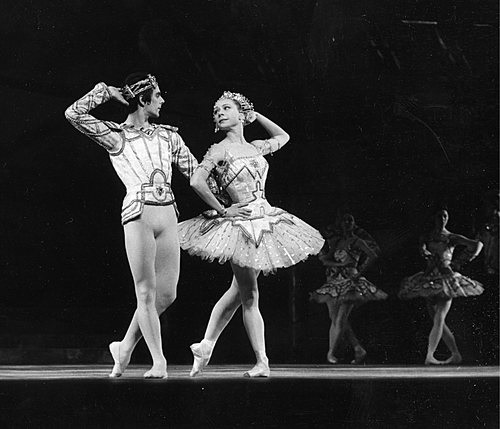
RAYMONDA ( Act III ) ; Donald MacLeary and Svetlana Beriosova ( as Jean de Brienne and Raymonda ) ; The Royal Ballet at The Royal Opera House, London, UK ; March 1969 ; Credit: G.B.L. Wilson / Royal Academy of Dance / ArenaPAL

In addition to music hall performances of Coppélia at the Empire Leicester Square from the 1880s into the early 1900s, we were also intrigued to discover that in 1890, the same year that Petipa had choreographed the ballet for the Mariinsky Theatre with Carlotta Brianza as Aurora, one of the other Italian ballerinas who starred with the Russian Imperial Ballet, Pierinna Legnani, had danced the same role in a full production at the Alhambra, but to the choreography of Leon Espinoza with music by Georges Jacobi.  Further, in the years immediately leading up to the first London season of the Ballets Russes in 1911, the West End evidently became a veritable hive of ballet activity, with appearances from Lydia Kyasht, Tamara Karsavina, Olga Preobrazhenska, Alexandra Baldina, Ekaterina Geltzer, and of course Anna Pavlova.  Included in these performances were shortened versions of works that were to become “the classics”: in 1910 Preobrazhenska staged Swan Lake at the Hippodrome, while Karsavina mounted a truncated production of Giselle at the Coliseum.  The following year saw the complete Giselle, The Sleeping Beauty Grand pas de deux and a two-act condensed Swan Lake at the Royal Opera House performed by the Ballets Russes.

And what of the ubiquitous Nutcracker? Well, if you have been following British Ballet Now & Then since the start, you will know that the notion of The Nutcracker as a quasi-obligatory Christmas treat is a phenomenon of the later 20th century. In fact this ballet was not well known in this country before de Valois’ Vic-Wells Ballet staged it in 1934.  However, the Nutcracker Suite, which was in fact presented in concert halls before the ballet premiered at the Mariinsky Theatre, was performed in London as early as 1896. 

SADLER’S WELLS BALLET – THE NUTCRACKER 1943 ROBERT HELPMANN / MARGOT FONTEYN Credit: Royal Academy of Dance / ArenaPAL

Ballets Russes audiences would also have known some excerpts, because Diaghilev himself was a great admirer of the score and interpolated some of the numbers into his productions of The Sleeping Beauty and Swan Lake (Newman 20-21).

But you may be asking yourself how La Sylphide became integral to the 19th century canon. The original work by Filippo Taglioni, created for his daughter Marie Taglioni, the most celebrated of Romantic ballerinas, was hugely popular in its day and was performed at Covent Garden only a few months after the March premiere in Paris, 1832.  Marie Taglioni also performed it in Russia, where it continued to be included in the repertoire, and was revived by Petipa in 1892.  However, it does not seem to have been amongst the works that were recorded in the Stepanov notation, and sometime during the first half of the last century Filippo Taglioni’s choreography was lost, although the Romantic ballet expert Pierre Lacotte did produce a reconstruction of it for the Paris Opera Ballet in 1972.  As you probably are aware, the choreography that has been passed down through the generations is the version by August Bournonville, who saw the original production in Paris, but then created his own in 1836.  According to Pritchard (who also happens to be one of our favourite dance historians), Marie Rambert, who established the first ballet company in the UK, loved Romantic ballet (“Marie Rambert” 1177).  She had become familiar with Giselle during her time with the Ballets Russes, and in 1946 Giselle became the first long work to enter the repertoire of Ballet Rambert (now Rambert).  This production was staged with the help of historian Cyril Beaumont, author of The Ballet Called Giselle, first published in 1944, and still available to purchase today.  Beaumont devotes a substantial section of his book to La Sylphide, exploring its influence on Giselle in terms of themes, style, technique and structure.  The work he discusses is the original Taglioni La Sylphide, which was of course not available for Rambert to stage.  Instead, the Bournonville version was staged in 1960, by Bournonville expert Elsa Marianne von Rosen.  In contrast to the full-length Giselle and La Sylphide, only extracts from The Sleeping Beauty, The Nutcracker and Swan Lake were performed by Rambert.  However, Rambert seems to have produced an appetite for Bournonville’s ballet in Britain: Danish ballet master Hans Brenaa was invited to stage a production for Scottish Ballet in 1973; in 1979 the Danish dancer Peter Schaufuss (later to become Artistic Director) mounted his production for English National Ballet; and eventually the Royal Ballet acquired the work in Johan Kobborg’s 2005 staging.  Perhaps one factor that contributed to the growing familiarity with La Sylphide of the British ballet audience was the BBC broadcast of the Act II Pas de deux in 1960 with von Rosen herself, followed by a broadcast of the complete work with Ballet Rambert less than a year later.  Another factor was undoubtedly Rudolf Nureyev’s performances with Scottish Ballet at the London Coliseum in 1976, in which he danced James at every performance over the course of two weeks.

Concluding thoughts

A brief glance through Instagram leaves us in no doubt about the popularity of the 19th century canon across the globe.  And the importance of the works to the British ballet repertoire cannot be denied: in the 2022-2023 season, in addition to the The Nutcracker, Birmingham Royal Ballet have performed Swan Lake, English National Ballet both Raymonda and Swan Lake, and the Royal Ballet The Sleeping Beauty.

We perhaps think of the classics as being exempt from politics, but this is a fallacy: neither their content nor their arrival to these shores can be said to be divorced from politics.  The word “timeless” is also often associated with the term “classics”, but of course the style of performance varies over space and time and our perception of and relationship with the works changes with the Zeitgeist.

Ballet has traditionally been perceived as an ephemeral art form, being handed down by dancers from generation to generation, with limited means for recording the choreography.  But today, with the regular use of Benesh Movement Notation and video to record works in their different productions, perhaps we can feel more secure about the preservation of the 19th century repertoire. 

How would you like to see these works preserved? Would you like to see them performed in a style more compatible with the original style, with original choreography restored, as Alexei Ratmansky has done with his productions of The Sleeping Beauty and Swan Lake? Or would you prefer a more experimental approach, in response to a more contemporary world view, such as that proposed by Phil Chan?  We would love to hear your thoughts!   

© British Ballet Now & Then

We would like to thank our dear friend and colleague Paul Doyle for his help with this post.

Next time on British Ballet Now and Then … Ballet has a reputation for being very gender specific.  However, there is a tradition of subverting gender norms in certain circumstances.  The Royal Ballet’s recent run of Cinderella has seen both female and male identifying dancers perform the Step-Sisters, while the last time English National Ballet staged The Sleeping Beauty, the cast included a gender-fluid dancer, as well as both male and female performers in the role of Carabosse.  So this will be the focus of our next Now and Then post …     

References

Beaumont, Cyril W. The Ballet Called Giselle. Dance Books, 2011.

Bland, Alexander. The Royal Ballet: the first fifty years. Threshold Books, 1981.

Chan, Phil. “On Yellowface and a way forward for Diverse Audiences”. One Dance UK, 2020, https://www.onedanceuk.org/resource/on-yellowface-and-a-way-forward-for-diverse-audiences/.

Desvignes, Alexandra. “Marianela Nuñez shines in a star-studded, polished Bayadère at The Royal Ballet”. Bachtrack, 3 Nov. 2018, https://bachtrack.com/review-bayadere-royal-ballet-nunez-muntagirov-osipova-opera-house-london-november-2018.

Hugill, Robert. “Iconic but flawed: La Bayadère the Royal Ballet”. Planet Hugill, 12 Nov. 2018, https://www.planethugill.com/2018/11/iconic-but-flawed-la-bayadere-royal.html.

Inglesby, Mona, with Kay Hunter. Ballet in the Blitz: the story of a ballet company. Groundnut Publishing, 2008.

Jennings, Luke. “La Bayadère review – moonlit heights from Nuñez and co”. The Guardian, 11 Nov. 2018, https://www.theguardian.com/stage/2018/nov/11/la-bayadere-royal-ballet-review-marianela-nunez-natalia-osipova.

Newman, Barbara. The Nutcracker. Aurum Press, 1985.

Parry, Jann. “Royal Ballet – La Bayadère – London”. DanceTabs, 6 Nov. 2018, https://dancetabs.com/2018/11/royal-ballet-la-bayadere-london-2/.

Pritchard, Jane. Anna Pavlova Twentieth Century Ballerina,

—. “Bits of Bayadère in Britain”. Dancing Times, vol. no. , 1989.

—. “Marie Rambert”. International Dictionary of Ballet, edited by Martha Bremser, St. James Press, 1993, pp. 1175-77.

Pullinger, Mark. “A step into the world of Tchaikovsky’s ballets: Swan Lake”. Bachtrack, 23 July 2017, https://bachtrack.com/ballet-focus-tchaikovsky-swan-lake-petipa-july-2017.

Rojo, Tamara. “A Word from Tamara Rojo, Artistic Director”. Le Corsaire programme Jan. 2020, English National Ballet, London.

Walker, Katherine Sorely. Ninette de Valois: idealist without illusions. Dance Books, 1987.


English National Ballet Now & Then

Introductory thoughts

English National Ballet dancers take a bow at the end of Etudes part of the 70th Anniversary Gala (C) Piers Allardyce

If you are a regular reader of British Ballet Now & Then, you will know that what we offer here is a personal perspective on British ballet based on our own experiences of watching various British ballet companies over the years, and in some cases over a number of decades.  Inevitably, therefore, readers will notice lacunae in our discussion of English National Ballet (ENB) now & then (and please feel free to object!), but part of what makes this particular post so personal to us is the selection of directors, dancers, and repertoire that are alive in our memories and consequently form the foundation of our tribute to the Company in its 70th anniversary year.

For our Now section we are focussing on the period from 2012, that is, the period of Tamara Rojo’s directorship, as the steady realisation of her vision for the Company has already had a significant impact on both ENB itself and on ballet as an art form in Britain. 

ENB Now

It comes as no surprise to us that as a director Rojo has a very clear vision for her company.  After all, as a ballerina she has always expressed exceptional vision, demonstrated in the distinctive way in which she shapes her articulation of choreography and character.  This is evident in recordings of her work portraying a gamut of complex characters, from Marius Petipa’s Nikiya (La Bayadère, 1877), Kenneth MacMillan’s Juliet (1965) and Manon (1974) to Ashton’s Isadora (1976) and Akram Khan’s Giselle (2016).  Rojo’s distinctiveness, the intensity of her commitment to performance and dramatic cogency in her repertoire, has been commented on by critics including Zoë Anderson, Sarah Crompton, Luke Jennings (“Step into the Past), and Judith Mackrell (“Giselle”).  These qualities seem to us to be integral to what dance writer Graham Watts describes as being “possessed of an exceptional independence of spirit and a remarkable enquiry into [her] art”.

As expressed in their 2017-2018 Annual Review, ENB aims to “develop the art form of ballet by commissioning new choreography, design and musical composition as well as cherishing the classical repertoire” (5).  So let’s have a look at how ENB’s choice of repertoire reflects these aims …

Rojo’s very first season as Artistic Director opened with Kenneth MacMillan’s production of The Sleeping Beauty, which had been in repertoire since 2005.  The Sleeping Beauty is widely perceived as the pinnacle of classical ballet (Dodge; “The Sleeping Beauty Live”; Speer), and indeed, when we witnessed its revival in 2018 with Jurgita Dronina in the title role, it did indeed look “cherished”, as also attested by the critics (Anderson; Gilbert; Jennings “English National Ballet”).  Something that is very noticeable about the 19thcentury repertoire when performed by this company is the attention paid to stylistic detail, with the result that each work makes a quite different visual impact, as we have written about previously.  In our view this makes for extremely satisfying watching: not only is there a visible distinction between Romantic and classical styles, but even within those eras, there is clear differentiation between the specific articulation of the choreographies.  For example, dance writer Judith Mackrell highlights some of the key features of Bournonville’s style in Isaac Hernández’ “beautifully filleted beats and bounding jetés” as James in La Sylphide, and in the way in which Daniel Kraus as Gurn “joyously embod[ies] the mobile twists and turns of Bournonville’s épaulement” (“Song of the Earth).  In contrast, Giselle is distinguished by the careful schooling of the corps de ballet in the 19th century French style “as is apparent in their softly rounded arms and restrained line” (Jennings “Giselle Review”), while performances of the Russian Imperial Sleeping Beauty “evince …an absolute commitment to classical style and stage manners …You can see the concentration on the placement of arms and shoulders, on the expressiveness of wrists and hands, on the line of the neck and precise direction of gaze” (Jennings “English National Ballet”).  

ENBS students peform La Sylphide as part of ENB’s 70th Gala (c) Bill Cooper

Like The Sleeping BeautyLe Corsaire was choreographed by Marius Petipa for the Russian Imperial court.  But unlike The Sleeping Beauty, which holds a special place in British ballet history, the complete Le Corsaire is a recent addition to the British repertoire, having been staged for the first time in this country by English National Ballet in 2013.  And unlike The Sleeping BeautyLe Corsaire requires the kind of extravagant bravura in both classical and character dancing that is not generally associated with English style ballet.  Yet the Company has risen to this challenge with great spirit and self-assurance.  This was noted in reviews (Byrne; Gilbert; Winship), as well as in our own “In Conversation” post. Emma Byrne’s headline description “A swaggering, bravura spectacle” already conveys a strong sense of the dancers’ bold commitment to the style, as does Jenny Gilbert’s rendition of Jeffrey Cirio’s Ali, who “wins the biggest cheers of the night for his aerial fireworks, explosive energy following through to the tips of his fingers”.  We found it fascinating to discover as part of our research that ENB President Beryl Grey had discussed her thoughts on the Russian tradition of performing as part of her “Desert Island Discs”.  These thoughts were based on her first-hand experiences of dancing with the Bolshoi Ballet (more of Beryl Grey in the “Then” section of this post):

The dancers, they lived every single small role up to the biggest role … And I think you have in the Russian dancers this tremendous capacity to make believe.  And they’re never embarrassed – the ones I worked with anyway were never embarrassed  – whereas, in England … in my days one sort of half acted … until the performance … but in Russia every single rehearsal was full out, like a performance, and they actually get into the roles and live them truly. (31:12-32:13)

Let’s turn to Jenny Gilbert once again to reaffirm the achievement of ENB in this ballet, and make a connection between their physical commitment to the style and Grey’s description above: 

The plot [of Le Corsaire] is, frankly, ridiculous … It’s the sort of hokum it normally takes a Russian company to bring off, but English National Ballet meets the challenge with a swagger in its revival of Anna-Marie Holmes’s 2013 production.

So while the collection of works itself is of course significant, the understanding of style conveyed through the performance of those works demonstrates a commitment to “cherishing” the choreography rather than simply maintaining the works within the repertoire.  Jennings attributes this commitment to Rojo and her teaching staff (“English National Ballet”), as do we ourselves, having had the opportunity to watch her in rehearsal as well as in performance.  Further, one of the benefits of the Covid-19 lockdown seems to have been an increased number of opportunities to hear discussions with Rojo on various aspects of her professional life as both director and dancer.  From one of these discussions we are given an insight into Rojo’s hunger for knowledge and understanding, and her creative thinking in the face of adversity:

One thing that I thought was a negative when I was young has turned out to be a great positive … I did not come from any consolidated, respected ballet school:  I did not come from Paris Opera, from the Bolshoi, from the Mariinsky, from the Royal Ballet School.  And I always felt that I did not belong to one particular school and that that was a minus.  But in a way that actually was a huge plus, because first of all it gave me this imposter syndrome that meant that I kind of researched like a crazy person every aspect of each style, feeling that I had to do extra work because I wasn’t part of it. (“Tom and Ty Talk 23:12-23:58”)

As for ENB’s aim to develop the art form of ballet, there is ample evidence of this.  Amongst the names of choreographers who have created new work for the Company are William Forsythe, Akram Khan, Annabelle Lopez-Ochoa, Russell Maliphant and Yabin Wang, all of whom have demonstrated challenges to traditional ballet in their commissioned works for ENB.  This is completely in line with Rojo’s vision for her Company, her belief in ballet as an art form and her dedication to its continuing relevance. 

English National Ballet in Playlist (Track 2) as part of the Company’s 70th Gala (c) Bill Cooper

There is no doubt in our minds that the jewel in the crown of ENB’s new repertoire since 2012 is Akram Khan’s Giselle.  In an interview with Keke Chele of JoBurg Ballet, Rojo explained her decision to commission Akram Khan to reimagine the canonical Giselle:

I’ve always been fascinated by ballet history, and in my opinion it has been when our artform has been “polluted” (like the traditionalists would say) by other types of dance, whether that was folklore or musics that were not considered proper for ballet, or themes, you know like when Kenneth MacMillan started to introduce Manon, Mayerling, or you know, by different, like cross-fertilisation, is when I think cultures become better and arts become better, and that was my motivation to bring Akram.  This is an exceptional artist that I’ve admired for many years, that I’ve seen so many of his shows that had such capacity for story-telling and such strong technique of his own, that was kathak and contemporary, that I knew that he will understand an art form that is equally demanding in technique – the classical technique of ballet – but also that in itself it is a language to tell stories.  (“JoBurg Ballet Off Stage” 18:00-19:04 )

English National Ballet in Dust by Akram Khan © Bill Cooper

What we find extraordinary about Rojo is the way in which her insight into ballet history has driven her decisions as Artistic Director.  In her intrepid interrogation of ballet and its potential, she seems to have revived the spirit of Serge Diaghilev, the redoubtable impresario and founder of the Ballets Russes, whose leadership and exceptional vision engendered such radical but enduring works as Bronislava Nijinka’s Les Noces (1923) and George Balanchine’s Apollo (1927).

Fabian Reimair and Tamara Rojo in Annabelle Lopez Ochoa’s Broken Wings part of English National Ballet’s 70th Anniversary Gala (c) Laurent Liotardo

ENB Then

We first encountered the Company in the 1970s.  Some of the ballets we saw in the late 1970s and early 1980s have made an enduring impression on us.  We can still remember the curtain rising on the white opening tableau of Les Sylphides (Fokine, 1909) and the hushed atmosphere as the dancers seemed to float downstage.  The great Danish mime artist Niels Bjørn Larsen was unforgettable in his charismatic rendition of Madge in La Sylphide (Bournonville, 1836), as was the verve of the corps de ballet in the reel, and the poignancy of Eva Evdokimova’s Sylphide as her sight fails before her death.  And what a thrill was Etudes (Lander, 1948) with its seemingly inexorable build-up to the final climax and its sense of competition between the male dancers, particularly when performed by such brilliant virtuosi as Peter Schaufuss, Patrice Bart and Patrick Armand.

But in addition to the imprint these works made on our memories, within this tiny selection of repertoire we can see two distinct trends in the repertoire of London Festival Ballet: the highlighting of the Romantic heritage, and the connection with Danish ballet tradition – trends that Jane Pritchard, Archive Consultant to ENB, has drawn attention to.  This is also borne out by lists of repertoire in programmes from the 1950s and early 1960s.  These included Anton Dolin’s production of Giselle (Coralli/Perrot, 1841) and his reconstruction of Pas de Quatre (Perrot, 1844); the final act of Bournonville’s Napoli (1846) and the pas de deux from his 1858 Flower Festival in Genzano; and from 1909 and 1910 Fokine’s evocations of the Romantic era – Les Sylphides and Le Spectre de la rose.

PAVLOVA on TV Alicia Markova and Milorad Miskovitch dancing Giselle – January 1956 Credit: Royal Academy of Dance / ArenaPAL

As we wrote in our first Giselle post, Alicia Markova, who established the Company in 1950 with Anton Dolin, also performed the eponymous heroine in the first British production of the ballet in 1934, after which she became associated with the ballet through the course of her career.  Dolin’s production of the ballet was one of the first complete 19th century works to be mounted by Festival Ballet, and according to Pritchard, Markova’s initial involvement in the Company was dependent on having a new production of Giselle created specifically for her, thereby placing this work “at the heart of” ENB.   Mary Skeaping’s 1971 staging, commissioned by Beryl Grey,  was an extremely important production due the intensive historical research Skeaping had undertaken, which in our opinion gives the ballet more dramatic cogency, as well as a vivid sense of Romantic ballet style.  This, our favourite production of Giselle, has been performed by the Company with luminaries of the stature of Rudolf Nureyev and Natalia Makarova, and still receives excellent notices (Crompton; Jays; Watts “English National Ballet’s Exceptional”; Watts “Review”).   

GISELLE Alicia Markova and Michael Somes Sadler’s Wells Ballet Royal Opera House – Covent Garden London – 1948 Credit: Royal Academy of Dance / ArenaPAL

The first time Markova performed in Fokine’s Les Sylphides, his tribute to la danse ballonnée, she was only 15 or 16 years old.  However, only six years later, and only two months after her debut with the Company in 1932, she mounted the ballet for the Vic-Wells (later Royal Ballet) (Bland 30). Subsequently Markova staged further productions: for American Ballet Theatre (1964), Northern Ballet Theatre (1979), and for our present discussion most importantly her 1976 staging for London Festival Ballet.  Although we never saw Markova perform, Rosie has a memory of a photograph of Markova in Les Sylphides from her very first ballet book (which she still possesses), The Girls’ Book of Ballet by A. H. Franks, and was always struck by a quote from Markova about her relationship with the audience: “I do not try to reach out to them; I draw them in to me” (60).  In a way Markova continues to draw people to her through recordings of her performances in Giselleand Les Sylphides – recordings originally made in the early 1950s that therefore suggest the importance of these ballets for her career.  In fact, the 1951 film of Giselle, with Dolin as Albrecht, is also significant as the oldest surviving recording of English National Ballet.

Therefore, in our minds, through Alicia Markova, Beryl Grey and Mary Skeaping, English National Ballet is undeniably a curator of Romantic style repertoire.  As if to emphasise the importance of Romantic themes in the repertoire, Giselle was sometimes performed in a double bill with Le Spectre de la rose, as in the 1976 London Coliseum spring season.

BBC T.V. – LES SYLPHIDES – April 1953 Production and Rehearsals ALICIA MARKOVA / JOHN FIELD Credit: Royal Academy of Dance / ArenaPAL Les Sylphides La Sylphide http://www.arenapal.com

In the early years, the Danish tradition was represented by the two dancers Flemming Flindt and Toni Lander, both of whom had trained at the Royal Danish Ballet School before being accepted into the Copenhagen company.  Additionally, in 1955 Lander’s husband Harald staged his work Etudes, which was chosen as the climax to the 70th Anniversary Gala performances, having become a signature ballet for the Company with a total of over 700 performances over the years.  Another delicious nugget of information we uncovered was that it was Harald Lander who mounted ENB’s first Coppélia.  This was a re-staging of the Danish production first performed in 1896 and “carefully preserved” first by Ballet Master Hans Beck and later by Lander himself (Hall 57). 

In the 1970s and 1980s Festival Ballet’s connection with the Romantic and Danish traditions was consolidated and enriched through the dancer and director Peter Schaufuss.  Son of two Royal Danish Ballet dancers, and another graduate of the Royal Danish Ballet School, Schaufuss danced with the Company for much of the 1970s and into the early 1980s before becoming Artistic Director.  In 1978 he mounted his production of La Sylphide for the first time, with the exquisite and ethereal Eva Evdokimova, renowned for her portrayal of Romantic roles, in the eponymous role, and the supreme Niels Bjørn Larsen as Madge.  Ten years later he bestowed another jewel from the Danish tradition on the Company: Bournonville’s three act Napoli (1842).

SLEEPING BEAUTY – ACT II (The Vision) 1946 MARGOT FONTEYN / BERYL GREY Credit: Royal Academy of Dance / ArenaPAL http://www.arenapal.com

In our very first British Ballet Now and Then post we explored how The Nutcracker (Ivanov, 1892) became a family Christmas tradition in this country, largely through the work of ENB, who began performing it in its very first season.  By the time Grey took over as Artistic Director in 1968, the Company were also performing full-length productions of The Sleeping Beauty (Petipa, 1890) and Swan Lake (Petipa/Ivanov, 1895).  London Festival Ballet programme notes from 1976 emphasise Grey’s involvement in new productions of these works for the Company.  

SWAN LAKE, Photocall, Bryan Ashbridge and Beryl Grey, Royal Opera House, Covent Garden, London, UK, May 1960, Credit: Royal Academy of Dance / ArenaPAL http://www.arenapal.com

It seems that just as Markova had a special relationship with the ballets Giselle and Les Sylphides, Grey had a special relationship with the ballet Swan Lake, not only due to the extraordinary fact that she performed the dual role of Odette/Odile for the first time on her fifteenth birthday, but also because she was the first Western ballerina to dance in Soviet Russia and in Beijing, and danced this ballet on both occasions.

SLEEPING BEAUTY rehearsal March 1959 Sadler’s Wells Ballet – Covent Garden Beryl Grey / Caj Selling with Errol Addison Credit: Royal Academy of Dance / ArenaPAL

Grey had been a ballerina with the Royal Ballet and performed the Lilac Fairy to Margot Fonteyn’s Aurora at the famous reopening of the Royal Opera House after World War II.  Although Ninette de Valois evidently told Grey she would never dance Aurora as she was “far too tall to manage the attitude balances” of the “Rose Adagio”, Grey was determined to prove her wrong, and in fact she performed the role towards the end of that same season, just after her nineteenth birthday (Grey 51, 54).  When Grey performed in China, she also took the opportunity to assist in staging The Sleeping Beauty (195).  Although Grey first danced Giselle as a sixteen-year-old, and also performed the role in the Soviet Union, she is perhaps more associated with the character of Myrthe, which she danced to Fonteyn’s Giselle.  We loved the discovery that Grey performed the Queen of the Wilis when Markova and Dolin danced in Giselle at the Royal Opera House in 1948, bringing these three key figures together on the stage.  In the same year Swan Lake was added to the repertoire at Covent Garden.  In her autobiography Grey expresses her excitement at the prospect of dancing her favourite role on the Royal Opera House stage (68). 

SWAN LAKE – February 1959 Music: Tchaikovsky Royal Ballet – Covent Garden Beryl Grey and Caj Selling Credit: Royal Academy of Dance / ArenaPAL

No doubt we take it for granted that the London Coliseum is a major venue for English National Ballet. However, it was not until Grey’s tenure as Artistic Director that the Company started to perform regular seasons there.  Having first-hand experience of The Sleeping BeautyGiselle and Swan Lake in large-scale productions at the Royal Opera House, the Metropolitan Opera House New York and the Bolshoi Theatre in Moscow, Grey understood the power of these ballets for the audience, and their importance for the prestige and development of a company.  Therefore, negotiating seasons at the Coliseum where spectacular productions could be presented in an appropriately lavish environment seems like a significant step to us.  

As performers, Alicia Markova, Beryl Grey and Peter Schaufuss were all international stars, intrepid individuals who went on to shape the repertoire of ENB by incorporating and highlighting specific traditions associated with their prestigious dancing careers, thereby contributing to the Company’s distinctive identity.  In addition, as directors, Grey and Schaufuss launched major initiatives to bring a greater stability and sense of permanence to the Company: Grey secured Markova House as the Company’s first permanent home in 1976, while twelve years later Schaufuss, coming from one of the oldest ballet schools in the world, established English National Ballet School.  

PAVLOVA on TV. Alicia Markova dancing Giselle – January 1956 Credit: Royal Academy of Dance / ArenaPAL

Concluding Thoughts on ENB Now and Then

In 1993 Pritchard wrote: “English National Ballet has never been a notably innovative company determined to challenge its audience” (450).  Sixteen years later Sanjoy Roy made a similar comment, but framed it in more specific terms, portraying the decision not to challenge audiences as a pragmatic choice: “Like many other big ballet companies, ENB is cautious about programming too many modern works in case it loses audiences”.   

In January 2020 however, at the English National Ballet Gala Celebration, the Company that we witnessed hardly seemed to be “cautious about programming” or unwilling to “challenge its audience”.  The celebration garnered glowing reviews attesting to both the strength and vigour of the dancers, and the diversity and richness of the repertoire (Gaisford; Guerreiro; Watts; Weiss).  For us the Gala marked not only seventy years of Company history, but also over seven years of Tamara Rojo’s leadership.  We not only witnessed a company at the top of its game, but were excited about the inventive and well-laid plans for the future, as ENB entered a new phase of development with brand new purpose-built premises.  

As we all know, the year has not gone to plan for any of us.  Nonetheless, with its forthcoming digital season, including works by Sidi Larbi Cherkaoui, Russell Maliphant and Stina Quagebur, it would be difficult to recognise the Company in its current form from the words of Pritchard and Roy.  In our opinion it has now evolved into an innovative company that frequently challenges its audiences with unfamiliar movement and music styles, and subject matter, while still “delighting them with the traditional” (English National Ballet 4).  And in keeping with the optimism of their new address on Hopewell Square, we believe that ENB will continue to fulfil its vision of “celebrat[ing] the tradition of great classical ballet while embracing change, evolving the art form for future generations and encouraging audiences to deepen their engagement” (5).

Next time on British Ballet Now and Then … This season English National Ballet planned a restaging of Marius Petipa’s 1898 Raymonda based on a retelling of the narrative with Florence Nightingale at its heart.  In response to this we will consider how British ballet choreographers and directors have ensured the continuing relevance of ballet as an art form.

© British Ballet Now and Then

References

Anderson, Zoë. “Marguerite and Armand”. Independent, 13 Feb. 2013, http://www.independent.co.uk/arts-entertainment/theatre-dance/reviews/marguerite-and-armand-the-royal-ballet-sergei-polunin-and-tamara-rojo-royal-opera-house-london-8492773.html. Accessed 6 Sept. 2020.

Bland, Alexander. The Royal Ballet: the first 50 years. Royal Opera House, 1981.

Brown, Ismene. “Rojo is Queen of the Swans”. The Telegraph, 29 Nov. 2002 http://www.telegraph.co.uk/culture/theatre/dance/3586430/Rojo-is-queen-of-the-Swan-Queens.html, . Accessed 6 Sept. 2020.

Byrne, Emma. “English National Ballet/Le Corsaire review: A swaggering, bravura spectacle”. Evening Standard, 9 Jan. 2020, English National Ballet/Le Corsaire review: A swaggering, bravura spectacle. Accessed 9 Aug. 2020.

Crompton, Sarah. “Review: Giselle (English National Ballet, London Coliseum)”. WhatsOnStage, http://www.whatsonstage.com/london-theatre/reviews/giselle-english-national-ballet-coliseum_42636.html. Accessed 15 Aug. 2020.

—. “Radiant Rojo Brings Fairytale Alive”. The Telegraph, 13 Nov. 2006, http://www.telegraph.co.uk/culture/theatre/dance/3656529/Radiant-Rojo-brings-fairytale-alive.html. Accessed 6 Sept. 2020.

“Desert Island Discs: Dame Beryl Grey”. BBC Radio 4, 10 Mar. 2002, http://www.bbc.co.uk/programmes/p0094805. Accessed 10 Aug. 2020.

Dodge, Laura. “Birmingham Royal Ballet’s Sleeping Beauty – a lavish production of a magical fairy tale. bachtrack, 20 Oct. 2013, https://bachtrack.com/review-oct-2013-birmingham-royal-ballet-sleeping-beautny-sadlers-wells. Accessed 7 Aug. 2020.

English National Ballet. Annual Review 2017-2018. Accessed 20 Sept. 2020.

Franks, A. H., The Girls’ Book of Ballet. Burke, 1960.

Gaisford, Sue. “English National Ballet 70th Anniversary Gala, Coliseum review – a fine celebration. The Arts Desk, 22 Jan. 2020, https://theartsdesk.com/dance/english-national-ballet-70th-anniversary-gala-coliseum-review-fine-celebration. Accessed 20 Sept. 2020.

“Giselle recording with Alicia Markova and Anton Dolin”. YouTube, uploaded by English National Ballet, 16 Jan. 2017, http://www.youtube.com/watch?v=7HnNXvF0Kn0&feature=youtu.be. Accessed 18 Sept. 2020.

Gilbert, Jenny. The I newspaper, 9 Jan. 2020, https://inews.co.uk/culture/arts/le-corsaire-london-coliseum-review-this-flamboyant-ballet-is-a-tonic-for-the-january-blues-english-national-tickets-383518. Accessed 9 ug. 2020.

Grey, Beryl. For the Love of Dance. Oberon, 2017.

Guerreiro, Teresa.   “ENB’s anniversary gala review”. CutlureWhisper, 18 Jan. 2020, http://www.culturewhisper.com/r/dance/english_national_ballet_anniversary_galas_coliseum/14791 Accessed 20 Sept. 2020.

Hall, George A. London’s Festival Ballet Annual 1956-57. Gray’s Inn Press, 1957.

Jays, David. “Giselle review – Alina Cojocaru is sublime in signature role”. The Guardian, 12 Jan. 2017, http://www.theguardian.com/stage/2017/jan/12/giselle-coliseum-london-english-national-ballet-review-alina-cojocaru. Accessed 15 Aug. 2020.

Jennings, Luke. “English National Ballet: The Sleeping Beauty review – a way with the fairies”, The Guardian, June 2018, http://www.theguardian.com/stage/2018/jun/10/english-national-ballet-sleeping-beauty-review-alina-cojacaru. Accessed 7 Aug., 2020.

—. “Giselle Review – Xander Parish Steals the Show”. The Guardian, 22 Jan. 2017, http://www.theguardian.com/stage/2017/jan/22/giselle-review-english-national-ballet-coliseum-xander-parish-laurretta-summerscales. Accessed 7 Sept. 2020.

—. “Step into the Past”. The Guardian, 12 Mar. 2006, http://www.theguardian.com/stage/2006/mar/12/dance. Accessed 6 Sept. 2020.

“JoBurg Ballet Offstage: Tamara Rojo”. Instagram, 30 July 2020, http://www.instagram.com/tv/CDRo3OtFI1o/?igshid=up23dsd6movc. Accessed 9 Aug. 2020. 

Pritchard, Jane. “English National Ballet”. The International Dictionary of Ballet, edited by Martha Bremser, St James Press, 1993, pp. 450-5.

Mackrell, Judith. “Giselle”. The Guardian, 15 Jan. 2004, http://www.theguardian.com/stage/2004/jan/15/dance. Accessed 6 Sept. 2020.

—. “Giselle- a Romantic Ballet”. English National Ballet, Programme, Belfast, 2017.

—. “Song of the Earth/La Sylphide review – Rojo powers a demanding double bill”. The Guardian, 10 Jan. 2018, http://www.theguardian.com/stage/2018/jan/10/song-earth-sylphide-review-coliseum-london-english-national-ballet-rojo. Accessed 7 Sept. 2020.

Roy, Sanjoy. “Step-by-step guide to dance: English National Ballet”. The Guardian, 16 Jun. 2009, http://www.theguardian.com/stage/2009/jun/16/guide-dance-english-national-ballet. Accessed 16 Sept. 2020.

“THE SLEEPING BEAUTY LIVE from the Royal Ballet”. YouTube, uploaded by More2Screen, 8 Nov. 2011, http://www.youtube.com/watch?v=LuncvxSDIiY&feature=youtu.be. Accessed 7 Aug. 2020.

Speer, Dean. “Pacific Northwest Ballet: the pinnacle”. CriticalDance, 2 Feb. 2019, https://criticaldance.org/pacific-northwest-ballet-pinnacle/. Accessed 7 Aug. 2020.

“‘Les Sylphides’ Part 1”. YouTube, uploaded by John Hall, 31 Aug. 2013, http://www.youtube.com/watch?v=EqKyGBbYNXs. Accessed 20 Sept. 2020.

“‘Les Sylphides’ Part 2”. YouTube, uploaded by John Hall, 31 Aug. 2013, http://www.youtube.com/watch?v=AelTZYoc2_U&t=44s. Accessed 20 Sept. 2020.

“Tom and Ty Talk: ‘Ballet is honest’ with Tamara Rojo”. Tom and Ty Talk, 19 June 2020, https://pod.co/tom-and-ty-talk. Accessed 19 July 2020.

Watts, Graham. “English National Ballet’s Exceptional Giselle”. Backtrack, 14 Jan. 2017, https://bachtrack.com/review-giselle-skeaping-cojocaru-english-national-ballet-coliseum-london-january-2017. Accessed 15 Aug. 2020.

—. “Review – English National Ballet – Giselle – London Coliseum”. Londondance, 23 Jan. 2017, http://londondance.com/articles/reviews/english-national-ballet-giselle-london-coliseum-1/. Accessed 15 Aug. 2020.

—. “Review: Royal Ballet – The Sleeping Beauty – Royal Opera House”. Londondance, 24 Feb. 2014, http://londondance.com/articles/reviews/royal-ballet-sleeping-beauty-2014/. Accessed 6 Sept. 2020.

—. “A roller-coaster of diverse dance as English National Ballet celebrates its 70th anniversary”. Bachtrack, 19 Jan. 2020,  https://bachtrack.com/review-english-national-ballet-70-anniversary-gala-coliseum-london-january-2020. Accessed 20 Sept. 2020.

Weiss, Deborah. “English National Ballet – 70th Anniversary Gala – London”.  DanceTabs, 20 Jan. 2020, https://dancetabs.com/2020/01/englishnational-ballet-70th-anniversary-gala-london/. Accessed 20 Sept. 2020.

Winship, Lyndsey. “English National Ballet: Le Corsaire review – firecracker dancing”. The Guardian, 9 Jan. 2020, http://www.theguardian.com/stage/2020/jan/09/english-national-ballet-le-corsaire-review-firecracker-dancing. Accessed 9 Aug. 2020.