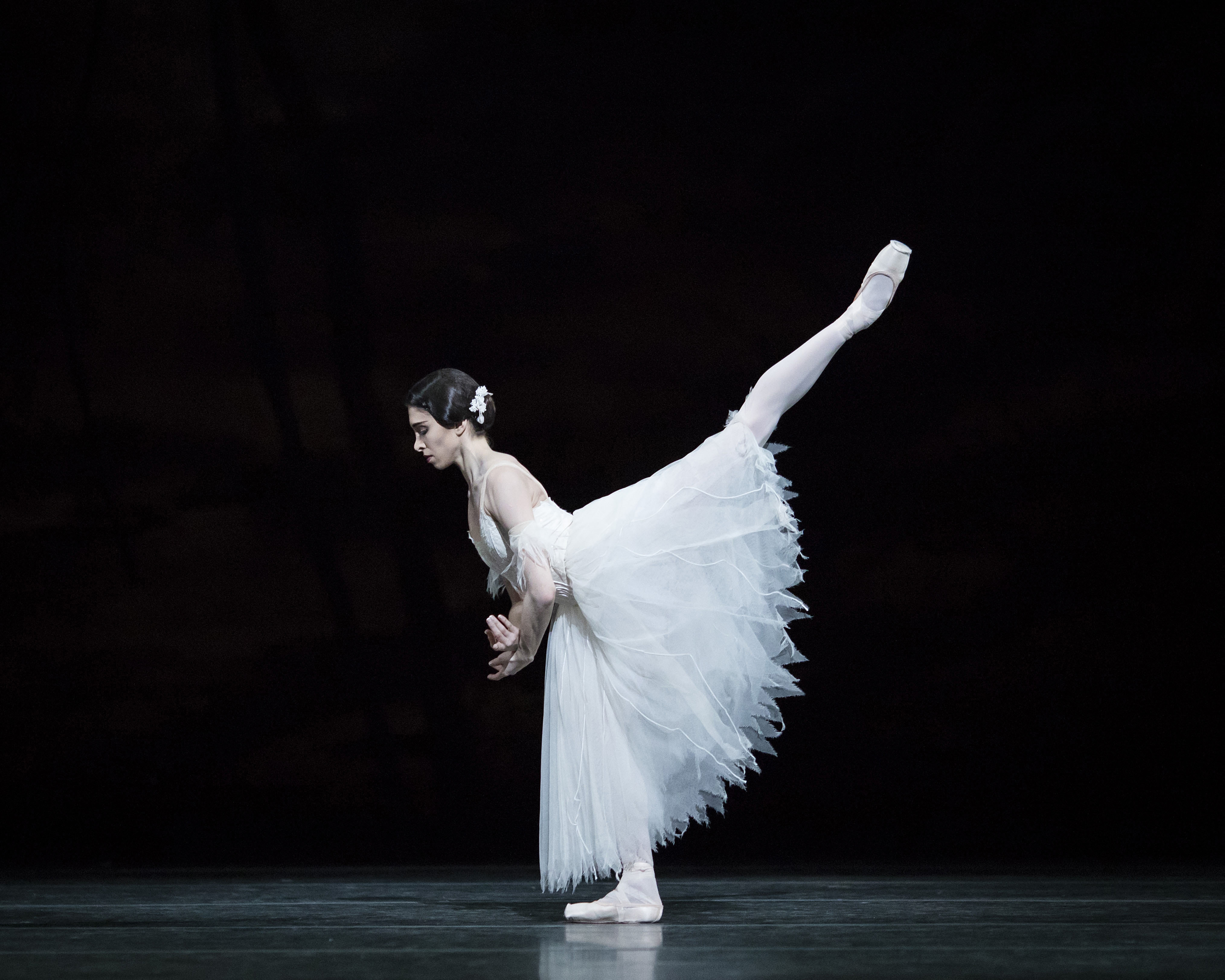
The 19th Century Canon Now & Then

The 19th Century Canon Now

Last summer Birmingham Royal Ballet (BRB) brought their new production of Marius Petipa’s 1869 Don Quixote to London, after it had premiered four months earlier at the Birmingham Hippodrome.  With the exception of The Nutcracker, which is pretty much obligatory fare for any major ballet company (as discussed in our very first British Ballet Now & Then post, this was the first work from the 19th century ballet canon to have been performed by BRB since Carlos Acosta took over as Artistic Director in January 2020.  The premiere had originally been planned for the start of Acosta’s inaugural season, but like so many productions had to be postponed due to the Covid pandemic.

Matador Scene featuring Brandon Lawrence as Espada Photo with Artists of Birmingham Royal Ballet; photo: Emma Kauldhar

The choice of Don Quixote in favour of any other work from the 19th century canon was hardly surprising: Acosta himself has been long associated with the role of Basilio.  At the age of 17 he won the Prix de Lausanne after dancing Basilio’s Act III variation; he performed the role with the Royal Ballet (RB) in Rudolf Nureyev’s staging mounted by Ross Stretton and then created his own production of the ballet for the Company, now adapted for his own Company.

Like the other 19th century classics, Don Quixote provides technical challenges for dancers of different ranking, and opportunities for a large cast of performers to engage in different styles: classical, character and mime.  Other works in the British ballet repertoire that offer similar opportunities are La Sylphide (Bournonville, 1836), Giselle (Coralli/Perrot, 1841), Coppélia (Saint-Léon, 1870; Petipa, 1884) La Bayadère (Petipa, 1877), The Sleeping Beauty (Petipa, 1890), Swan Lake (Petipa/Ivanov, 1895) Raymonda (Petipa, 1898) and Le Corsaire (Petipa, 1899).

Artists of English National Ballet in La Sylphide, photo: Laurent-Liotardo
Jurgita Dronina and Isaac Hernandez in La Sylphide, photo: Laurent Liotardo

Apart from the fact that these works were all created during the 1800s, when ballet as an art form became more recognisably what we understand as ballet today, with its focus on the female dancer, themes inspired by Romanticism, and development of pointe work and ballets blancs, they are all connected by the fact that they were originally choreographed in France or Russia and “travelled” to this country via various routes (as we will discuss further in the Then section of this post).  Although we are sure that you are all familiar with Don Quixote, La Bayadère, Raymonda and Le Corsaire, these works took a number of decades to become established within the British repertoire, being produced in the UK at different times by different companies from 1962 to 2022, and not always in their entirety.

If you follow this blog, you will already know the history of Raymonda in the UK prior to English National Ballet’s evening-length production, which premiered in January last year.  Important details for this particular post is the fact that it was Nureyev, just three years after his defection from the Soviet Union, who first staged Raymonda in this country, initially in a complete production for the Royal Ballet (1964), and then as a one-act ballet based on the final act of the work, in 1966.  In this form Raymonda can stand on its own as a divertissement within a mixed bill, and between 1993 and 2014 English National Ballet also performed a single-act Raymonda, firstly in a production by Frederick Franklin (the British-American dancer, teacher, choreographer and director), and then, in 1993 in Nureyev’s staging, as part of the Nureyev Celebration, marking 75 years since Nureyev’s birth and 20 years since his death.

Momoko Hirata as Kitri and Mathias Dingman as Basilio, with Artists of Birmingham Royal Ballet in Don Quixote; photo: Johan Persson

Similarly, it was Nureyev who first staged La Bayadère in the UK—not in its entirety, but in that superb example of high classicism, the “Kingdom of the Shades”—and who introduced the Le Corsaire grand pas de deux to the British repertory.  In 1985 the “Kingdom of the Shades” entered the repertory of English National Ballet in a production by Natalia Makarova, and in 2013 the same company became the only British ballet company to perform the complete Corsaire.

The three most celebrated ballet defectors from the Soviet Union all had a tremendous impact on dancing in the West, but like Nureyev, Makarova and Mikhail Baryshnikov also had a substantial influence on the expansion of the 19th century repertoire, by staging major full-length productions for American Ballet Theatre: La Bayadère (Makarova, 1980) and Don Quixote (Baryshnikov, 1978).  Relevant for the development of British ballet is the fact that both of these productions were also mounted on the Royal Ballet.  While La Bayadère was the first complete version of the work to be performed in Britain (and remains the only full-length production in the UK), Don Quixote has had a far more varied history in this country, including stagings by Ballet Rambert (1962) and by London Festival (now English National) Ballet (1970), both mounted by Polish ballet master Witold Borkowski, in addition to the two more recent RB productions.  It seems that it is only since the RB’s staging of Baryshnikov’s version in 1993 that the work has become more firmly established within the British ballet repertoire. 

Although these star dancers from the Soviet Union also mounted new productions of 19th century works already established within the British ballet repertoire (including Nureyev’s Nutcracker for the Royal Ballet in 1968, and Makarova’s 1988 production of Swan Lake for London Festival Ballet), it is noticeable that they focused their efforts primarily on the 19th century works that they knew from their experiences at the Vaganova Academy and Mariinsky Ballet but were absent from North American and Western European companies.  And the newer 19th century additions to the British ballet repertoire have indubitably enriched our understanding of ballet as an art form, given dancers new challenges and offered audiences both entertainment and food for thought.  Don Quixote belongs to a very small number of comedic ballets, and provides a great variety of character and demi-character roles.  Le Corsaire is teeming with opportunities for virtuoso male dancers.   And can any scene in the ballet repertoire surpass the transcendence of the “Kingdom of the Shades”?

Artists of English National Ballet in Le Corsaire photo: Laurent-Liotardo

Yet even ballet, with its highly stylised technique, and its penchant for magic and fantasy and reputation for escapism, is not immune from the changing attitudes of our Zeitgest.  Although ENB’s production of Le Corsaire is little over a decade old, the last time it was performed (at the start of 2020), it came with a caveat from the Artistic Director, Tamara Rojo:

When English National Ballet commissioned its new production of Le Corsaire, we worked to challenge some of the traditions of this work, and therefore made adaptations to tone [down] the characters.  We know that still some elements, such as the attitude towards women and other cultures, now seem unacceptable to our values.  However, we present this traditional work with the strength of the assumption that the audience has the knowledge and the critical frame of judgement to view them in the context in which they were created.

As explored in our Raymonda post, in her own 2022 production of Raymonda, Rojo was at pains to address conflicts between current attitudes and those prevalent in Petipa’s original production, by offering a heroine with greater agency over her own life, and a reconceptualisation of Abderakhman the Muslim Saracen to address the traditional othering of this character.

The Royal Ballet last staged La Bayadère in 2018.  For the most part, as is usual for works that are already established in the repertoire, reviews highlighted the performances of the principals, and as is usual for works which feature major ballets blancs, commented on the unison of the corps de ballet (Desvignes; Hugill; Jennings; Parry).  However, both Robert Hugill and Luke Jennings raised concerns regarding Bayadère‘s promotion of orientalist attitudes manifest in “its inanely capering fakirs, lustful priests and blithe appropriation of Hindu, Islamic and Buddhist religious and cultural motifs” (Jennings). 

In recent years BRB, ENB, RB, and Scottish Ballet have all made revisions to the choreography, costumes and/or make-up of the Arabian and Chinese Dances from the Nutcracker productions in order to start confronting such offensive stereotypes.  But how does a company approach revising a whole full-evening work?
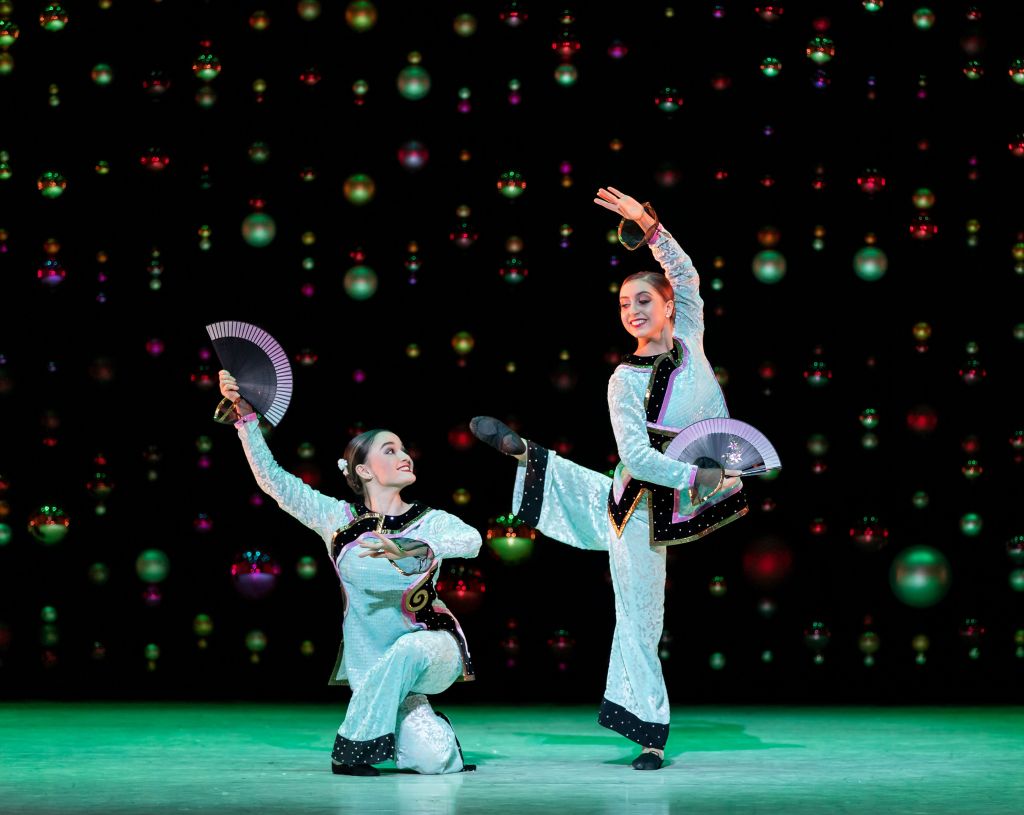
Scottish Ballet Artist Alice Kawalek and First Artist Kayla-Maree Tarantolo in Chinese Tea Dance. Photo credit: Andy Ross

In the United States, Arts Educator and Co-founder of Final Bow for Yellow Face Phil Chan is producing his own versions of Le Corsaire and La Bayadère to make them more suitable and relevant for American 21st century audiences by addressing what he perceives to be their inherent racism and misogyny.  In his plans, Le Corsaire takes place at a beauty pageant complete with “scheming showgirls, gunslinging beauty queens” (Chan), while La Bayadère will feature Hollywood cow girls and references to Busby Berkeley’ oeuvre, as well as a plot line similar to Singin’ in the Rain (Donen/Kelly, 1952).  These ideas may avoid racial stereotyping, but on paper at least they seem to raise other problematic issues.  Neither do we understand how the tragic nature of La Bayadère will translate into this new context.  Perhaps the productions themselves will transcend their description on paper …

The 19th Century Canon Then

In the 1920s and early 1930s, when Marie Rambert and Ninette de Valois were taking their first steps to establish ballet as a British art form, there was no canon of 19th century “classics” as we know it today. 

So what exactly was the tradition of ballet in 19th century Britain?

Well, in the 1840s, during the flourishing era of ballet Romanticism, Her Majesty’s Theatre Haymarket became a centre for the art form, with important works being created there by the pre-eminent French choreographers of the day Jules Perrot (co-creator of Giselle in 1841, with Jean Coralli) and Arthur Saint-Léon (choreographer of Coppélia, 1870).  These included Ondine, La Esmeralda and Pas de quatre by Perrot, and La Vivandière by Saint-Léon.  However, the situation changed radically in the later decades of the century, when music halls and variety theatres, such as the Empire and the Alhambra on Leicester Square, became regular venues for ballet performances, a situation that continued into the 20th century.  Despite the frequency of performances and popularity of ballet in these theatres, the works created specifically for the music halls were short lived, and even the names of the choreographers, such as Carlo Coppi and Katti Lanner, are not generally well known to today’s ballet-going public.  Further, these connections to popular theatre meant that the status of ballet as a serious art form was on thin ice, even though versions of Giselle and Coppélia, now generally considered as works of the highest calibre, were staged at the Empire in the 1880s.  And when in 1921 Serge Diaghilev mounted his sumptuous production of Tchaikovsky’s The Sleeping Beauty, based on Marius Petipa’s 1890 choreography but titled The Sleeping Princess, it was also produced in a music hall setting: at the Alhambra.

SLEEPING BEAUTY, Deanne Bergsma ( as The Lilac Fairy ) ; The Royal Ballet at the Royal Opera House, London, UK ; January 1969 ; Credit: G.B.L. Wilson / Royal Academy of Dance / ArenaPAL

When de Valois set up the Vic-Wells Ballet (later to become the UK’s flagship company the Royal Ballet) in 1931, she had a clear vision of the kind of repertoire she considered necessary for a national British company.  It consisted of four categories:

  1. Traditional-classical and romantic works
  2. Modern works of future classic importance
  3. Current works of more topical interest
  4. Works encouraging a strictly national identity in their creation generally

(Bland 57)

With both Ashton and herself at the helm creating new choreographies, it is clear how her last three aims might be fulfilled.  But of course, what interests us in this post is the way de Valois obtained the “Traditional-classical and romantic works”.

SWAN LAKE ; Nadia Nerina , Shirley Grahame and Doreen Wells ; Choreographed by Ashton and de Valois ; Designed by Hurry ; Music by Tchaikovsky ; the Royal Ballet New Group, at the Royal Opera House, London, UK ; May 1965 ; Credit : G.B.L. Wilson / Royal Academy of Dance / ArenaPAL

What we find fascinating is that political events came to de Valois’ aid: like many other figures from the Russian ballet world, the Mariinsky régisseur Nikolai Sergeyev had fled his home after the 1917 Revolution.  With him he took scores of 19th century works in a dance notation system devised by Vladimir Stepanov.  These included The Sleeping Beauty, The Nutcracker and Swan Lake, as well as Giselle and Coppélia; ballets of which de Valois had some, but limited, knowledge (Walker 129).  The distinct advantage of mounting the works from the notation scores was of course that it must have given a sense of gravitas to the productions through an authenticity that most music hall productions were unlikely to match, even if that was indeed an aim.  Before Sergeyev started to work for de Valois, he had already staged two works in London: Diaghilev’s The Sleeping Princess, and The Camargo Society’s Giselle.  However, the work of staging these ballets for de Valois’ fledgling company created a cornerstone of the British ballet repertoire.  Further, this process was solidified by Mona Inglesby, founder of International Ballet in 1941, another highly significant figure who promoted 19th century works in Britain, and for whom Sergeyev worked from 1946 until his death in 1951.  Crucially, the company toured these works the length and breadth of the British Isles: from the suburbs of London through the Midlands to Liverpool and Manchester, up to Newcastle, Glasgow and Edinburgh, and over to Belfast and Dublin.  In fact, although the Company folded in 1953, International Ballet was of such significance in its day that it was chosen to appear at the opening of the Royal Festival Hall in 1951.

LA BAYADERE – Dress rehearsal Royal Opera House – Covent Garden November 1963 SIR FREDERICK ASHTON / RUDOLPH NUREYEV and THE CORPS DE BALLETS Credit: Royal Academy of Dance / ArenaPAL

De Valois’ and Inglesby’s selection of works seems highly interesting to us, because the ballets they produced constituted only approximately one quarter of the works that could have been staged.  La Bayadère, Le Corsaire and Raymonda could have entered the British ballet repertoire decades sooner; we might have enjoyed The Pharaoh’s Daughter (Petipa, 1862) and La Esmeralda (Petipa after Perrot, 1886) or the Petipa and Ivanov version of La Fille mal gardée (1885).  Both Inglesby and Pavlova before her had made plans to produce La Bayadère, but had reached the conclusion that it was “too old fashioned” (Inglesby 97; Pritchard “Bits” 1121).  While Pavlova did mount a version of Don Quixote, according to historian and expert in British ballet history, Jane Pritchard, this also struck audiences as rather dated after Leonid Massine’s Le Tricorne (1919) (Anna Pavlova 112).  La Esmeralda also proved enticing to Inglesby, but was rejected as a project by the Royal Opera House (Inglesby 106-107).  On other hand, Giselle, Coppélia, The Sleeping Beauty and Swan Lake all had two distinct advantages: they had already been introduced to the British public, and they all had superb scores (Tchaikovsky was known to have admired the compositions of both Adolf Adam and Leo Delibes) (Pullinger).
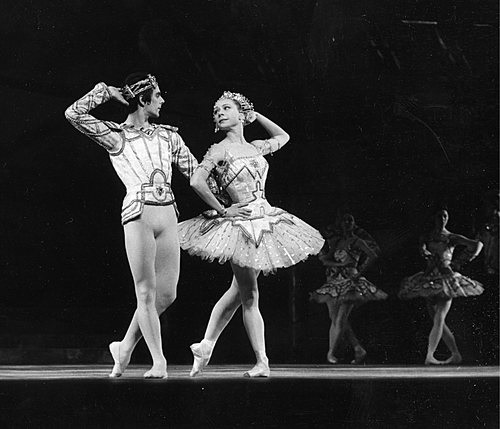
RAYMONDA ( Act III ) ; Donald MacLeary and Svetlana Beriosova ( as Jean de Brienne and Raymonda ) ; The Royal Ballet at The Royal Opera House, London, UK ; March 1969 ; Credit: G.B.L. Wilson / Royal Academy of Dance / ArenaPAL

In addition to music hall performances of Coppélia at the Empire Leicester Square from the 1880s into the early 1900s, we were also intrigued to discover that in 1890, the same year that Petipa had choreographed the ballet for the Mariinsky Theatre with Carlotta Brianza as Aurora, one of the other Italian ballerinas who starred with the Russian Imperial Ballet, Pierinna Legnani, had danced the same role in a full production at the Alhambra, but to the choreography of Leon Espinoza with music by Georges Jacobi.  Further, in the years immediately leading up to the first London season of the Ballets Russes in 1911, the West End evidently became a veritable hive of ballet activity, with appearances from Lydia Kyasht, Tamara Karsavina, Olga Preobrazhenska, Alexandra Baldina, Ekaterina Geltzer, and of course Anna Pavlova.  Included in these performances were shortened versions of works that were to become “the classics”: in 1910 Preobrazhenska staged Swan Lake at the Hippodrome, while Karsavina mounted a truncated production of Giselle at the Coliseum.  The following year saw the complete Giselle, The Sleeping Beauty Grand pas de deux and a two-act condensed Swan Lake at the Royal Opera House performed by the Ballets Russes.

And what of the ubiquitous Nutcracker? Well, if you have been following British Ballet Now & Then since the start, you will know that the notion of The Nutcracker as a quasi-obligatory Christmas treat is a phenomenon of the later 20th century. In fact this ballet was not well known in this country before de Valois’ Vic-Wells Ballet staged it in 1934.  However, the Nutcracker Suite, which was in fact presented in concert halls before the ballet premiered at the Mariinsky Theatre, was performed in London as early as 1896. 

SADLER’S WELLS BALLET – THE NUTCRACKER 1943 ROBERT HELPMANN / MARGOT FONTEYN Credit: Royal Academy of Dance / ArenaPAL

Ballets Russes audiences would also have known some excerpts, because Diaghilev himself was a great admirer of the score and interpolated some of the numbers into his productions of The Sleeping Beauty and Swan Lake (Newman 20-21).

But you may be asking yourself how La Sylphide became integral to the 19th century canon. The original work by Filippo Taglioni, created for his daughter Marie Taglioni, the most celebrated of Romantic ballerinas, was hugely popular in its day and was performed at Covent Garden only a few months after the March premiere in Paris, 1832.  Marie Taglioni also performed it in Russia, where it continued to be included in the repertoire, and was revived by Petipa in 1892.  However, it does not seem to have been amongst the works that were recorded in the Stepanov notation, and sometime during the first half of the last century Filippo Taglioni’s choreography was lost, although the Romantic ballet expert Pierre Lacotte did produce a reconstruction of it for the Paris Opera Ballet in 1972.  As you probably are aware, the choreography that has been passed down through the generations is the version by August Bournonville, who saw the original production in Paris, but then created his own in 1836.  According to Pritchard (who also happens to be one of our favourite dance historians), Marie Rambert, who established the first ballet company in the UK, loved Romantic ballet (“Marie Rambert” 1177).  She had become familiar with Giselle during her time with the Ballets Russes, and in 1946 Giselle became the first long work to enter the repertoire of Ballet Rambert (now Rambert).  This production was staged with the help of historian Cyril Beaumont, author of The Ballet Called Giselle, first published in 1944, and still available to purchase today.  Beaumont devotes a substantial section of his book to La Sylphide, exploring its influence on Giselle in terms of themes, style, technique and structure.  The work he discusses is the original Taglioni La Sylphide, which was of course not available for Rambert to stage.  Instead, the Bournonville version was staged in 1960, by Bournonville expert Elsa Marianne von Rosen.  In contrast to the full-length Giselle and La Sylphide, only extracts from The Sleeping Beauty, The Nutcracker and Swan Lake were performed by Rambert.  However, Rambert seems to have produced an appetite for Bournonville’s ballet in Britain: Danish ballet master Hans Brenaa was invited to stage a production for Scottish Ballet in 1973; in 1979 the Danish dancer Peter Schaufuss (later to become Artistic Director) mounted his production for English National Ballet; and eventually the Royal Ballet acquired the work in Johan Kobborg’s 2005 staging.  Perhaps one factor that contributed to the growing familiarity with La Sylphide of the British ballet audience was the BBC broadcast of the Act II Pas de deux in 1960 with von Rosen herself, followed by a broadcast of the complete work with Ballet Rambert less than a year later.  Another factor was undoubtedly Rudolf Nureyev’s performances with Scottish Ballet at the London Coliseum in 1976, in which he danced James at every performance over the course of two weeks.

Concluding thoughts

A brief glance through Instagram leaves us in no doubt about the popularity of the 19th century canon across the globe.  And the importance of the works to the British ballet repertoire cannot be denied: in the 2022-2023 season, in addition to the The Nutcracker, Birmingham Royal Ballet have performed Swan Lake, English National Ballet both Raymonda and Swan Lake, and the Royal Ballet The Sleeping Beauty.

We perhaps think of the classics as being exempt from politics, but this is a fallacy: neither their content nor their arrival to these shores can be said to be divorced from politics.  The word “timeless” is also often associated with the term “classics”, but of course the style of performance varies over space and time and our perception of and relationship with the works changes with the Zeitgeist.

Ballet has traditionally been perceived as an ephemeral art form, being handed down by dancers from generation to generation, with limited means for recording the choreography.  But today, with the regular use of Benesh Movement Notation and video to record works in their different productions, perhaps we can feel more secure about the preservation of the 19th century repertoire. 

How would you like to see these works preserved? Would you like to see them performed in a style more compatible with the original style, with original choreography restored, as Alexei Ratmansky has done with his productions of The Sleeping Beauty and Swan Lake? Or would you prefer a more experimental approach, in response to a more contemporary world view, such as that proposed by Phil Chan?  We would love to hear your thoughts!   

© British Ballet Now & Then

We would like to thank our dear friend and colleague Paul Doyle for his help with this post.

Next time on British Ballet Now and Then … Ballet has a reputation for being very gender specific.  However, there is a tradition of subverting gender norms in certain circumstances.  The Royal Ballet’s recent run of Cinderella has seen both female and male identifying dancers perform the Step-Sisters, while the last time English National Ballet staged The Sleeping Beauty, the cast included a gender-fluid dancer, as well as both male and female performers in the role of Carabosse.  So this will be the focus of our next Now and Then post …     

References

Beaumont, Cyril W. The Ballet Called Giselle. Dance Books, 2011.

Bland, Alexander. The Royal Ballet: the first fifty years. Threshold Books, 1981.

Chan, Phil. “On Yellowface and a way forward for Diverse Audiences”. One Dance UK, 2020, https://www.onedanceuk.org/resource/on-yellowface-and-a-way-forward-for-diverse-audiences/.

Desvignes, Alexandra. “Marianela Nuñez shines in a star-studded, polished Bayadère at The Royal Ballet”. Bachtrack, 3 Nov. 2018, https://bachtrack.com/review-bayadere-royal-ballet-nunez-muntagirov-osipova-opera-house-london-november-2018.

Hugill, Robert. “Iconic but flawed: La Bayadère the Royal Ballet”. Planet Hugill, 12 Nov. 2018, https://www.planethugill.com/2018/11/iconic-but-flawed-la-bayadere-royal.html.

Inglesby, Mona, with Kay Hunter. Ballet in the Blitz: the story of a ballet company. Groundnut Publishing, 2008.

Jennings, Luke. “La Bayadère review – moonlit heights from Nuñez and co”. The Guardian, 11 Nov. 2018, https://www.theguardian.com/stage/2018/nov/11/la-bayadere-royal-ballet-review-marianela-nunez-natalia-osipova.

Newman, Barbara. The Nutcracker. Aurum Press, 1985.

Parry, Jann. “Royal Ballet – La Bayadère – London”. DanceTabs, 6 Nov. 2018, https://dancetabs.com/2018/11/royal-ballet-la-bayadere-london-2/.

Pritchard, Jane. Anna Pavlova Twentieth Century Ballerina,

—. “Bits of Bayadère in Britain”. Dancing Times, vol. no. , 1989.

—. “Marie Rambert”. International Dictionary of Ballet, edited by Martha Bremser, St. James Press, 1993, pp. 1175-77.

Pullinger, Mark. “A step into the world of Tchaikovsky’s ballets: Swan Lake”. Bachtrack, 23 July 2017, https://bachtrack.com/ballet-focus-tchaikovsky-swan-lake-petipa-july-2017.

Rojo, Tamara. “A Word from Tamara Rojo, Artistic Director”. Le Corsaire programme Jan. 2020, English National Ballet, London.

Walker, Katherine Sorely. Ninette de Valois: idealist without illusions. Dance Books, 1987.


Spotlight on British Ballet Lockdown

How does ballet function in lockdown? Julia and Rosie have been closely following the activities of British ballet companies during the COVID-19 lockdown.  Here are our thoughts …

When people started to absent themselves from public places, and events started to be cancelled we became quite nervous, as we had various performances planned, including the Heritage programme in the Linbury Theatre (a programme of works by Ninette de Valois, Frederick Ashton and Kenneth MacMillan), Kenneth Tindall’s Geisha created for Northern Ballet, and Akram Khan’s Creature choreographed for English National Ballet.  We cheered when Geisha received its world premiere in Leeds, but once lockdown was announced, it was clear that the London performances would be cancelled.  And even more devastating was the cancellation of Creature – Khan’s third collaboration with English National Ballet, featuring the extraordinary Jeffrey Cirio, who has excelled in roles as diverse as Ali in Le Corsaire, Des Grieux in Manon and Hilarion in Akram Khan’s Giselle.

However, we were amazed at how quickly dancers and companies, in the face of a lockdown, started to organise a whole host of online activities, both for themselves and for their audiences.

The first event we recall was actually just prior to lockdown when Tamara Rojo both taught and did class herself with a small number of English National Ballet dancers at City Island, the Company’s new home.  The class was streamed live on Facebook and YouTube, and it was wonderful to see the comments – people were clearly so appreciative, not only of Tamara’s teaching and the skill and dedications of the dancers, but also of the music, as it was the amazing Nicki Williamson playing. After two classes, Tamara had to move what became daily streamed classes to her kitchen.

Tamara-Rojo-C-Paul-Stuart-2
Tamara Rojo – Photo by Paul Stuart

Although it’s a professional class, it’s still manageable for people who regularly take ballet class at an intermediate level, and Tamara explains really clearly, which makes it easy to modify exercises if necessary.  Because she teaches from her kitchen, it has a very personal feel.  This also came across in Birmingham Royal Ballet’s class, which launched their Home from Home series: you can see the dancers in different parts of their houses – Carlos Acosta at the banister, for example.  It was a beautiful sunny day, so it was delightful to see Mathias Dingman doing the centre work in his garden with one of his small sons “joining in”.  In fact, seeing dancers “make do” in their living rooms and dining rooms, holding on to various bits of furniture as makeshift barres and adapting to spaces quite different from a dance studio has become an inspiring symbol of these times.  Beth Meadway of Ballet Cymru even demonstrated and danced a lovely “grand allegro” in a tiny space between bed and wardrobe.

But it’s not only ballet classes for professionals and experienced amateurs that are offered.  English National Ballet was a pioneer of Dance for Parkinson’s, and other companies have followed suit, as well as developing other classes to support people with various health issues.  And these members of the population have not been forgotten.  English National Ballet Artist Kate Hartley-Stevens is teaching Dance for Parkinson’s classes, while Katie Mason delivers sessions for ballet lovers with restricted mobility.  Meanwhile, Scottish Ballet live stream Health classes every week day, including Dance for Parkinson’s Scotland, Dance for Multiple Sclerosis, classes for people with dementia, and more generally for people over the age of sixty.

As we have been researching for this post and keeping our eyes open for new initiatives, it seems that each day brings something new, from English National Ballet’s array of ballet classes at various levels delivered by members of the Company, to Scottish Ballet’s Family Barre for parents and children led by Principal dancer Bethany-Kingsley-Garner, to Birmingham Royal Ballet’s recently announced Baby Ballet uploaded on YouTube in bite-size chunks, including “Stretch those Feet”, “Butterflies” and “Fireworks”.  As the country’s flagship opera house, the Royal Opera House have announced a more ambitious project which will run over the next twelve weeks entitled Create and Learn.  Children are introduced to ballet and opera, if they are not already familiar with the art forms, and given the opportunity to write, make videos, engage in art, and make dances.  The activities are very clearly structured with guidance regarding age suitability and time requirements.  Learning outcomes are even provided.

Even smaller adult ballet enterprises, such as Everybody Ballet (led by Bennet Gartside of the Royal Ballet) and The Ballet Retreat, have now developed digital platforms.  The Ballet Retreat, as the name suggests, is a little different from attending a regular ballet class.  It was co-founded by Hannah Bateman of Northern Ballet and David Paul Kierce, formerly of the same company, and they run adult ballet intensives (from 1 to 3 days), where people are given the opportunity to learn extracts from the traditional ballet repertoire.  Although they still have courses planned for late spring and summer in London and Leeds, currently they are offering a range of ballet classes run by members of Northern Ballet, which has included a Disney ballet barre by Gavin McCaig.

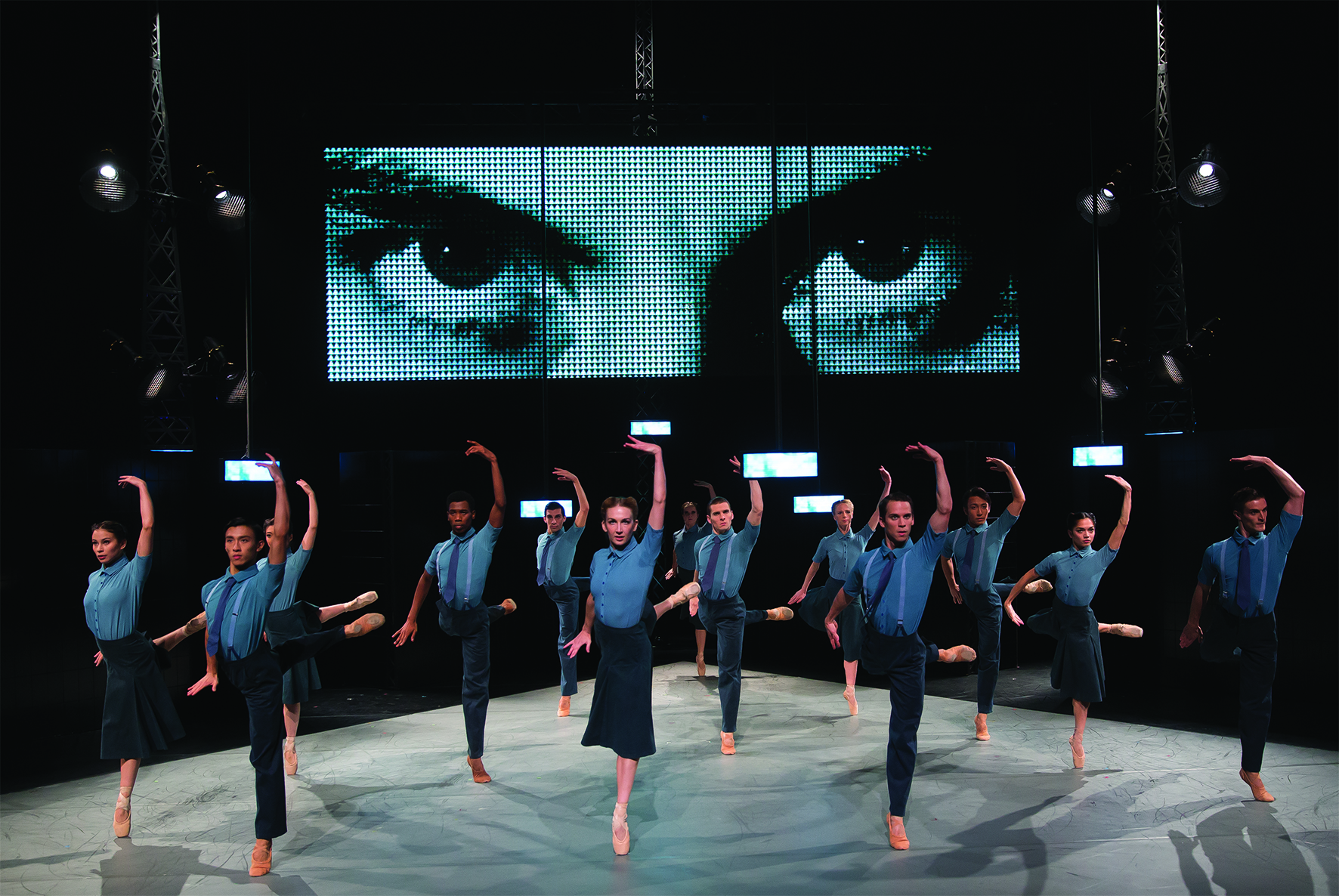
So far our focus has been very strongly on classes, with dancers being wonderfully creative in both doing class themselves and in teaching class, thereby developing additional skills.  As lecturers ourselves, we know that teaching requires a range of intellectual, interpersonal and communication skills, and an extra layer of complexity is demanded for online delivery, we feel.    However, performances of various types are also being offered online, from works previously released on commercial DVD, such as the Royal Ballet’s The Metamorphosis and The Winter’s Tale, and Northern Ballet’s 1984, to performances created in people’s homes for the specific purpose of bringing us cheer.

Northern Ballet in Jonathan Watkins’ 1984. Photo by Emma Kauldhar

Northern Ballet are well known for their children’s ballets, such as Puss in Boots and The Ugly Duckling. These ballets are adapted for television in collaboration with CBeebies.  This year it was heart breaking that they had to cancel the tour of their latest children’s production Little Red Riding Hood, but the show has been made available on BBC iPlayer with the usual supplementary activities on CBeebies, such as jigsaw puzzles at various levels and movement to try at home.

Without a doubt the most entertaining of the performances have been the films made by Sean Bates and Mlindi Kulashe of Northern Ballet in their flat and the adjacent car park.  They made the news with their renditions of “The Greatest Show” and “Tomorrow”, evidently breaking some furnishings in the procedure.

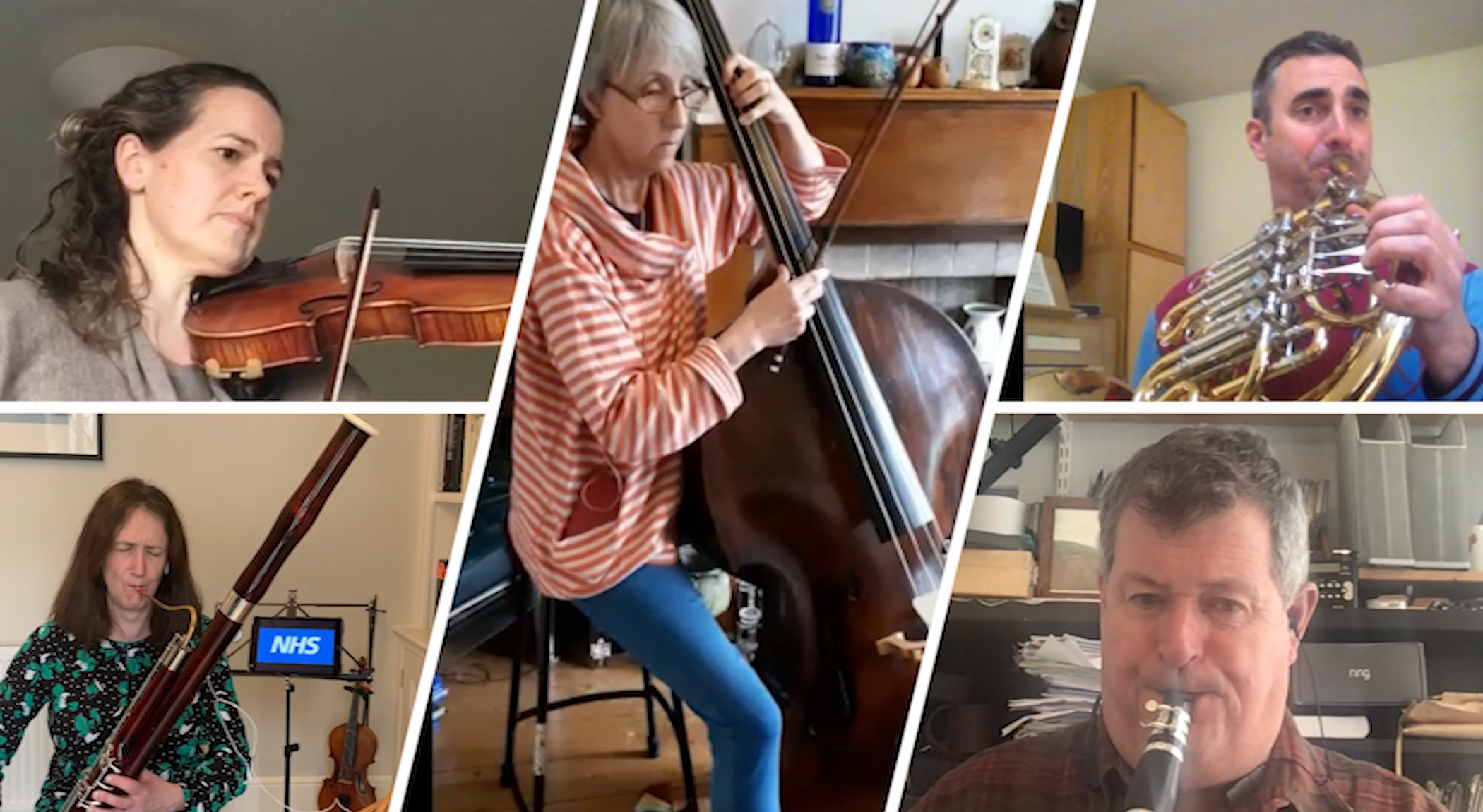
At the other end of the scale, one of the most stirring performances was the except from Raymonda played by the English National Ballet Philharmonic under the baton of Music Director Gavin Sutherland.  The orchestra members were all playing from their homes, and the film was beautifully edited to highlight different sections of the orchestra, enhancing the gorgeous melodies and sumptuous textures of Alexander Glazunov’s score.  But what made this performance particularly rousing was its dedication to NHS Staff and its title “Play for our Carers”.  While of the surface, this might seem quite random, let’s remember that Tamara Rojo’s new adaptation of Raymonda opening in the autumn is inspired by Florence Nightingale.  Not someone to do things by halves, Tamara has been researching the life of Florence Nightingale for four years in preparation for this production, so the dedication was more than fitting.

ENB Philharmonic

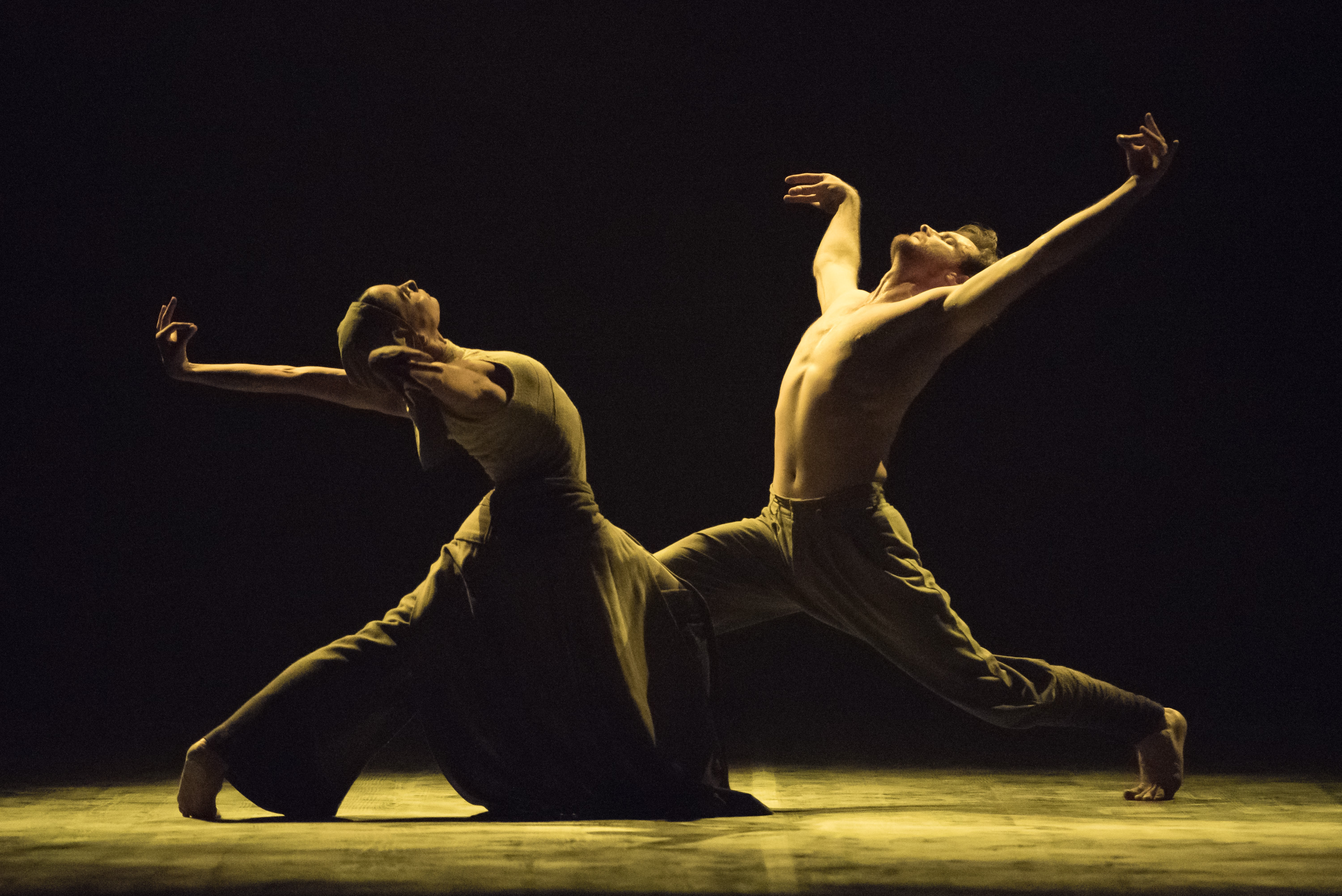
As we were writing this post, English National Ballet announced the most exciting initiative yet – their Wednesday Watch Parties.  Each Wednesday a full recording of a Company performance will be premiered online; no complete recordings of these works have ever been made available before.  For the first two Wednesdays two jewels of their recent repertoire are being released on Facebook and YouTube for 48 hours: Akram Khan’s Dust (2014) and Anna Lopez-Ochoa’s Broken Wings (2016).  And there will be more jewels to come no doubt …

Tamara Rojo and James Streeter in Dust by Akram Khan – Photo by ASH

At this time of crisis, British ballet companies are working assiduously to keep themselves fit and ready to return to work, but they are also demonstrating their creativity in ways that help to bolster the nation in body, mind and spirit.  We hope that their generosity of spirit and invaluable contribution to people’s health and well-being at this time will be recognised and rewarded in both the short and the long term.


Giselle Productions Now & Then

Giselle Now

As lovers of the ballet Giselle, first created in 1841 by Jean Coralli and Jules Perrot, we were beside ourselves with excitement when we learnt that Akram Khan was going to choreograph a re-envisioned adaptation of the Romantic work for English National Ballet.  Our only concern was whether the Company would retain a traditional production of their work in the repertoire.  Fortunately this fear was soon allayed when Artistic Director Tamara Rojo announced that Mary Skeaping’s Giselle would be revived in the very same season as the world premiere of what turned out to be a most extraordinary retelling of the work in an age of refugee crises and concerns about increasing social inequality and injustice both in the UK and globally.

This autumn, three years after the premiere of Akram Khan’s work, it is an ideal time for us to revisit Giselle.  Not only has Khan’s adaptation returned to Sadler’s Wells, but two additional stagings are being shown in the same theatre: both Dada Masilo’s 2017 feminist reading of the work, which draws on her South African heritage, in October, and David Bintley and Galina Samsova’s 1999 Giselle for Birmingham Royal Ballet in November.  Therefore, in this post we’re focussing predominantly on productions, rather than on what individual dancers bring to the role of Giselle, as we did in our first Giselle Now & Then post.

As you may know, while maintaining the broad outline of the plot, Khan and his dramaturg Ruth Little have based their narrative on a community of migrants who have lost their jobs in a garment factory and are now reduced to providing entertainment for the cruel Landlords (who replace the aristocrats of the original libretto).  In Act II the ghosts of dead Factory Workers wreak revenge on those who caused their death through the appalling working conditions in the factory.

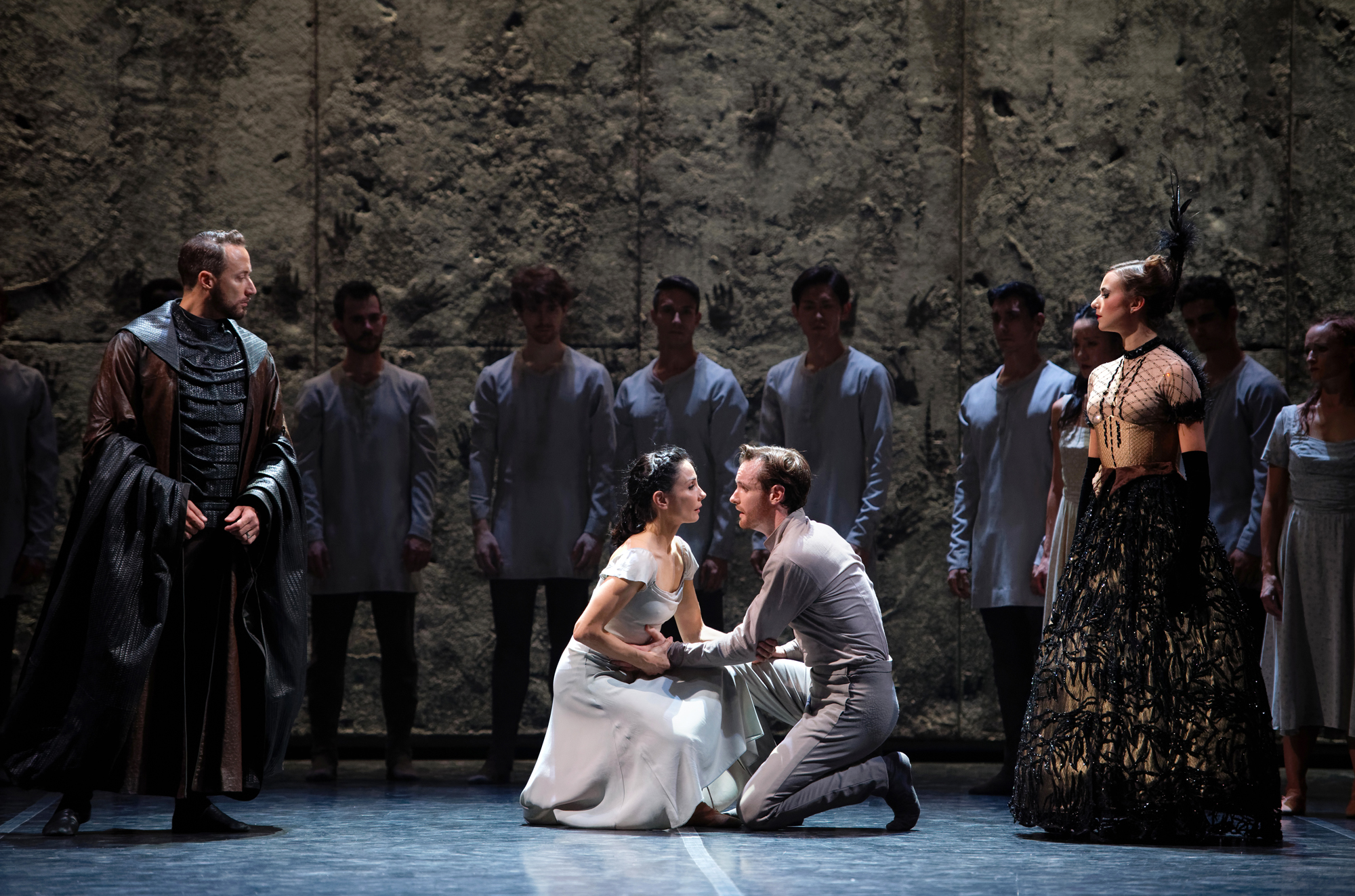
When watching an adaptation, be it in the same medium, or book to film, play to ballet, the question of characterisation is always an intriguing one.  There has been substantial discussion about the roles of Hilarion and Giselle herself.  While Hilarion is absolutely crucial to the plot, in traditional versions he is not given extensive stage time or activity.  In contrast, Khan’s Hilarion is a major character in terms of the stage action, and complexity of the role, as well as being a lynchpin in the storyline.  A climax to Act I is the altercation between Hilarion and Albrecht, where they circle around one another like two stags fighting over their territory in a ritual of dominance creating a palpable tension with their glaring eyes drilling into one another.  Hilarion is at the same time obsequious with the Landlords, supercilious with Albrecht and controlling with his fellow migrant Factory Workers.  His skewed love for Giselle is bound to end in catastrophe.

Giselle herself is depicted by Khan as a leader (“Akram Khan’s Giselle: discover the main characters”); her pride and defiance are writ large when she refuses to pick up the glove that Bathilde has deliberately dropped, and stubbornly resists bowing her head to the Landlords.  Khan sees Giselle as an optimist in the face of the disastrous closing of the factory and consequential unemployment, so she has no need to kowtow to the Landlords.  She is also in love and expecting Albrecht’s child, so she has broken the rules and rocked the boat of the precious status quo that Hilarion is so eager to hold in balance.

Tamara Rojo and Isabelle Brouwers in Akram Khan's Giselle (c) Laurent Liotardo
Tamara Rojo and Isabelle Brouwers in Akram Khan’s Giselle © Laurent Liotardo

Because of Hilarion’s centrality to Act I and the waywardness of his character, he seems to us to be a counterpart to Myrtha.  Dramaturg Ruth Little describes Hilarion as “both sinning and sinned against” (“Akram Khan’s Giselle: discover”). Luke Jennings once found a libretto for a ballet about Myrtha’s backstory that accounts for her transformation from a loving, joyful and compassionate young woman to a vengeful wraith (“Who was Myrtha?”), and we can imagine reasons for Hilarion’s behaviour and his need to do anything to survive.

Stina Quagebeur in Akram Khan's Giselle (c) Laurent Liotardo
Stina Quagebeur in Akram Khan’s Giselle © Laurent Liotardo

The 1841 Giselle is driven by dualisms: the daylight of the familiar village is pitted against the unknown of the dark forest; the poverty of the peasants is confronted by the blatant wealth of the aristocrats; a human community of corporeal beings is juxtaposed with the world of ethereal Wilis, where the relationship between flesh and spirit, body and soul is explored.  Because of the spiritual element, Tamara Karsavina has referred to it as “a blessed ballet or an holy ballet” (A Portrait of Giselle). The spirit world is defined by a specific style of dancing, la danse ballonnée with its fleet lightness and Romantic tutus that balloon out to create the illusion that the dancers are hovering in the air. As Albrecht moves towards Giselle and fails to catch her, as she floats heavenwards in lifts and reaches away from Albrecht in arabesque, his longing for her is constantly met with confirmation of her unattainability.  One of the reasons that Tamara Rojo chose Khan as the creative artist for this project was because of “the spirituality of the theme” and her belief that “he could find a different way of putting that on stage” (“Akram Khan’s Giselle: the creative”).  The corporeal and ethereal worlds are clearly pitted one against the other by Khan, but the effect is strikingly different…

From the moment the curtain opens we sense the physicality of the dancers’ bodies as they push with all their might against a huge overwhelming wall (designed by Tim Yip).

James Streeter in Akram Khan's Giselle (c) Laurent Liotardo
James Streeter in Akram Khan’s Giselle © Laurent Liotardo

Later, working as a group, they become the looms of their trade, mechanical pulsating machines; at other times they run in droves, almost like animals, as they escape their circumstances in search for new homes.  In the radiant, sometimes playful, Act I duet between Giselle and Albrecht they orbit around one another and visibly enjoy their repeated moments of physical contact.  Tenderly they touch one another’s head, neck, sternum, shoulders and palms, and Giselle places Albrecht’s hand on her abdomen to feel their child growing within her.

Tamara Rojo and James Streeter in Akram Khan's Giselle (c) Laurent Liotardo
Tamara Rojo and James Streeter in Akram Khan’s Giselle © Laurent Liotardo

But the most intimate form of touch is when they touch one another’s faces with their hand  – a movement reserved in Khan’s culture for husband and wife (Belle of the Ballet).

The Wilis of Act II wear pointe shoes, as a tribute to the Romantic tradition and the connection between pointe work and the notion of the otherworldly within that tradition. Moreover, the iconic scene where the Wilis cross one another in lines performing arabesque voyagé en avant is replicated.  Originally this displayed their domination over the forest; in this case they preside over the abandoned factory. But these eldritch factory Wilis pound their canes threateningly and relentlessly into the ground, suggesting a less binary approach to the connection between flesh and spirit, the corporeal and ethereal, soul and body in this rendition of Giselle; and Giselle’s body is literally dragged into the factory by Myrtha – she may be dead, but she is in no way insubstantial.

This connection between body and spirit is demonstrated at its most poignant in the Act II duet between Giselle and Albrecht. For us Jennings’ description of Giselle’s state in Act II rings true: “She’s not dead, but she’s not quite alive, either” (Akram Khan’s Giselle review – a modern classic in the making).  The choreography for Giselle and Albrecht’s duet is physically intimate, the closeness of the bodies more continuous than in the Act I pas de deux.  As they wrap themselves around one another, their touch is more sustained and prolonged.  It is this very physicality that suggests to us that their souls inhabit the same realm.  There are fleeting moments where Giselle seems to evaporate from Albrecht’s embrace, as if in memory of Giselle of old.  But her body is often limp, no longer able to resist the force of gravity, so Albrecht bears her weight and seems to try and woo her spirit back through the warmth of his body.  At one extraordinary moment he draws her up from the ground using the power of her hand on his face, as if the bond between them will return her to life, but she almost immediately sinks back down again. Despite the bond Giselle pushes his hand away from her stomach – a reminder that their child has died within her.  This is far from Romanticism’s trope of representing the spiritual as insubstantiality of body.  A final touch of the hand on the other’s face is the last instance of physical contact. Their final prolonged gaze at one another is so intense that Albrecht fails to notice the wall descending.  This ultimate physical separation in the face of the unassailable wall is gut-wrenching.

Giselle Then

The success of Khan’s Giselle with both critics and audiences in no way diminishes the power of traditional productions, so in this section we are discussing three traditional versions of Giselle performed by three major British ballet companies: David Bintley and Galina Samsova’s staging for Birmingham Royal Ballet, Peter Wright’s Royal Ballet production, and the version mounted by Mary Skeaping for London Festival (now English National) Ballet.  Even though they present “standard” versions of the narrative and choreography, there are differences in design, staging, characterisation and movement style.  These differences may initially seem slight, but on closer inspection they have a significant impact on performances and enable this 1841 Romantic ballet to maintain its freshness, and to continue to capture the imagination of the audiences.

When the Bintley-Samsova production of Giselle was first staged in 1999, Bintley expressed the objective of creating a “proper” Giselle (Marriott), meaning that he wanted to recreate some of the excitement felt by the 1840s audiences (Mackrell “Giselle: Birmingham”).  Part of this excitement was instigated by the designers’ realistic depiction of Giselle’s two contrasting worlds, including live animals in Act I and Wilis “flying” on wires in the second act. Consequently, one of the elements that was chosen as a focus was the visual element.

For this mounting of the work designer Hayden Griffiths created a waterfall, vineyards and mountains as the background for Act I, an environment that David Mead likens to “a Victorian painting come to life”.  The waterfall may also remind viewers of William Wordsworth’s The Waterfall and the Eglantine (1800), thereby making a satisfying connection with Romantic literature.  The verisimilitude of Act I includes “a pig’s bladder football … a dead hare, two live beagles and a real horse” (Mackrell “Giselle: Birmingham”). The village is also brought to life by the inclusion of children in the cast (because why wouldn’t a village have children?) and by ensuring that the dancers emphasise the individuality of each villager.  The bustling liveliness of this act, enhanced by the bright colours of the costumes, provides a striking contrast with the ballet blanc of Act II, with its “flying” aerial Wilis and its ruined abbey, in keeping with the tastes of the Romantic audiences, who relished the successful theatrical fashioning of the mystical and otherworldly.  David Mead captures the atmosphere: “Gothic arches soar heavenwards above the ruined choirs.  Lit by a full moon, peeking through what is left of the windows, it is spookiest of atmospheres”.

Giselle-3000px -revised
Birmingham Royal Ballet dancer Momoko Hirata © Bella Kotak

The waterfall of the first act is particularly significant, as water is an essential element in the legend of the Wilis – in Heinrich Heine’s Über Deutschland, one of the sources used for the original libretto of Giselle, Heine explains that their hems are constantly damp, as they dwell close to or even on the water.  In Giselle; or The Phantom Night Dancers, the play based on the ballet that was produced in London shortly after the ballet’s premiere in Paris, the inclusion of “Fountains of Real Water” in Act II provided a major attraction and was therefore highlighted on playbills in no uncertain terms (Morris 53).  Therefore, it’s interesting that Hanna Weibye  incorporates water imagery in her writing to convey the effect of the corps de ballet as the Wilis in Peter Wright’s production for the Royal Ballet, to convey the impression that they create: “In John Macfarlane’s creamy Romantic tutus they cross the stage in serried ranks like swells on the open ocean, seemingly unstoppable” (“Giselle, Royal Ballet Review”).

It is this staging of Giselle by Wright for the Royal Ballet that is undoubtedly the most celebrated British production of the ballet.  Wright has been producing Giselle since as long ago as 1966.  We were fascinated to discover that when he first saw the ballet in the 1940s, he could not take it seriously.  Once he had witnessed Galina Ulanova perform the title role on the Bolshoi Ballet’s first visit to London, however, he understood its potential; subsequently when John Cranko asked him to produce it for Stuttgart Ballet, Wright discovered (as we do!) that the more he researched, the more fascinated be became (“Getting it Right”).  The current production is the second version that Wright has created for the Royal Ballet, and they have continued performing it regularly since 1985.

Giselle
Giselle. Yasmine Naghdi as Giselle. Giselle. © ROH, 2018. Photographed by Helen Maybanks

Wright’s approach to producing Giselle was to ensure that the characters and the drama made complete sense in his mind.  To this end he made Bathilde into a more haughty, even heartless, character than she was in the original libretto, thereby creating a more sympathetic portrayal of Albrecht. This characterisation is often commented on by critics (Jennings “Giselle Review”; Mackrell “Giselle review”; Watts “An indelible performance”).  Jennings’ comments on Olivia Cowley’s performance is particularly telling: “Realising that Albrecht has broken the village girl’s heart, Cowley’s Bathilde appears not so much wounded as faintly nauseated”.  For Wright it is also essential that Giselle commits suicide, rather than dying of a broken heart, in order to account for her burial in the woods, outside the bounds of the churchyard and therefore unprotected from the Wilis (Monahan).

As in the case of Birmingham Royal Ballet’s production, design is a feature of the work that is essential to the creation of atmosphere, which has been described as “eerie”, with a “threatening” (Weibye) and “brooding” forest (Jennings).  Macfarlane demonstrates a different approach to that of Griffiths, with a more uniform colour palette, but Graham Watts’ vivid description of the Act II décor shows how imaginative design can recreate an atmosphere by bringing new ideas to work that conjure up fresh images in the minds of the audience:

The woods … with their uprooted trees and a ceiling of scrambled, entwined branches provide the perfect lair for the ghostly Wilis to take their revenge on the carefree men who foolishly pass by in the dead of night (“Review: Royal Ballet in Giselle”).

And now to our favourite traditional Giselle …Like Peter Wright, Mary Skeaping spent years researching the ballet, but she also had the added advantage of dancing in Anna Pavlova’s company, when Pavlova herself was performing Giselle.  In addition, Skeaping saw Olga Spessivtseva dance the role, and she received a great deal of support and guidance from Tamara Karsavina to help with her first staging of the ballet in 1953 for the Royal Swedish Ballet. In 1971 Skeaping mounted a production on London Festival Ballet (now English National Ballet), which is their current traditional Giselle.  Undoubtedly the most authentic of the British versions, this production is probably exceeded in authenticity internationally only by Pacific Northwest Ballet’s 2011 reconstruction based on primary sources including two 19th century notation scores and the research of historian Marian Smith’s (“Giselle”).

Jurgita Dronina as Giselle and Isaac Hernandez as Albrecht in Skeaping's Giselle © Laurent Liotardo (5) (1)
Jurgita Dronina as Giselle and Isaac Hernandez as Albrecht in Skeaping’s Giselle © Laurent Liotardo

One of the reasons we favour this production is pure sentimental nostalgia – in particular memories of Eva Evdokmova and Peter Schaufuss as the protagonists, Maina Gielgud as Myrtha and Matz Skoog in the Peasant Pas de deux, as well as the first performance of Natalia Makarova and Rudolf Nureyev dancing the ballet together.  However, we are also fascinated by the impact of recreating period style, so evident in the curved asymmetrical port de bras and posture of the Wilis.  It draws us into another era with its distinctive aura, “antique sense of the supernatural” (Mackrell “Giselle: Coliseum”) and restored sections, such as the complete Pas de vendages for Giselle and Albrecht. Giselle’s solo in this particular section gives a taste of a more authentic Romantic ballet style with its skimming terre-à-terre petit allegro, the batterie and ballon and quick changes of direction, all enhanced by gentle épaulement.  Not only do we appreciate the understated virtuosity of such passages and the way they extend our understanding and knowledge of ballet, but when we watched performances by English National Ballet in 2017, we were struck by the contribution the full Pas de vendages makes to the dramatic climax of Act I.  In comparison with the truncated version that is generally presented, the full Pas brings all the focus of both the onstage audience and the audience in the auditorium, to Giselle and Albrecht. It is playful and tender in its inclusion of the usual game of kisses, but also in the joie de vivre of the dancing style.  Consequently, it distracts us from the plot, giving no warning or sense of the impending disaster.  When Hilarion suddenly challenges Albrecht, it seems to cut like a razor through the celebrations.  After such idyllic moments of love witnessed by her community, Giselle’s isolation in her distress is all the more raw and brutal.  Perhaps it was this dramatic effect that inspired Bintley and Samsova to reinstate some of the usual musical cuts to their interpretation of the work, particularly with Samsova’s personal experience of dancing the title role in a number of different productions.

In our opinion all of these productions are relevant today.  Tamara Rojo herself highlights the impact of the social context on people’s behaviour when their actions are driven by their emotions (“Akram Khan’s Giselle: The Social Context”), a theme that is of course evident in both the 1841 Giselle and the 2016 reinterpretation.  Writing of the Royal Ballet’s production Hannah Weibye considers the added import of the ballet in the #metoo era, emphasising the themes of “abuse of power for sexual gratification” and questioning whether Albrecht deserves Giselle’s forgiveness.  Khan’s interpretation of Giselle is a monumental work of art in its own right.  As an adaptation, moreover, it provides us with a new lens through which to watch the Romantic work, find fresh insights, new emotional resonance, and to appreciate once again its own singular portrayal of love, betrayal and the beautiful, dangerous undead.

© British Ballet Now & Then

Next time on British Ballet Now and Then … To mark the start of the Royal Ballet’s new season and pay tribute to the centenary of the British Prima Ballerina Assoluta’s birth, we will discuss Fonteyn plus three of the ballerinas who participated in June’s Margot Fonteyn a Celebration at the Royal Opera House celebration: Lauren Cuthbertson, Francesca Hayward and Yasmine Naghdi.


References

“Akram Khan’s Giselle: the creative process”. YouTube, uploaded by English National Ballet, 4 Oct. 2016, http://www.youtube.com/watch?v=cs2nsC_pchw. Accessed 17 Sept. 2019.

“Akram Khan’s Giselle: discover the main characters”. English National Ballet, http://www.ballet.org.uk/production/akram-khan-giselle/. Accessed 17 Sept. 2019.

“Akram Khan’s Giselle: the social context”. YouTube, uploaded by English National Ballet, 7 Oct. 2017, https://www.youtube.com/watch?v=Amlg-vPC9xU. Accessed 23 Sept. 2019.

Giselle: Belle of the Ballet, directed by Dominic Best, British Broadcasting Corporation with English National Ballet, 2 Apr. 2017.

“Giselle”. Pacific Northwest Ballet, 2019, https://www.pnb.org/repertory/giselle/. Accessed 23 Sept. 2019.

Heine, Heinrich. “Elementary Spirits”. Giselle. Programme. Royal Opera House, 2001.

Jennings, Luke. “Giselle review – uncontestable greatness from Marianela Núñez”. The Guardian, 28 Jan. 2019, http://www.theguardian.com/stage/2018/jan/28/giselle-review-royal-ballet-marianela-nunez. Accessed 22 Sept. 2019.

Mackrell, Judith. “Giselle: Birmingham Hippodrome”. The Guardian, 4 Oct. 1999, https://www.theguardian.com/culture/1999/oct/04/artsfeatures2. Accessed 23 Sept. 2019.

—. “Giselle: Coliseum”. The Guardian, 12 Jan. 2007, https://www.theguardian.com/stage/2007/jan/12/dance. Accessed 17 Sept. 2019.

—. “Giselle review – Muntagirov and Nuñez display absolute mastery”,The Guardian, 24 Mar. 2016, https://www.theguardian.com/stage/2016/mar/24/giselle-review-muntagirov-and-nunez-display-absolute-mastery. Accessed 17 Sept. 2019.

Mead, David. “Birmingham Royal Ballet: Giselle”, Critical Dance, 21 June 2013, criticaldance.org/birmingham-royal-ballet-giselle/. Accessed 22 Sept. 2019.

Monahan, Mark. “Getting it Right”. Royal Opera House, http://www.roh.org.uk/news/getting-it-right-peter-wright-on-his-production-of-giselle. Accessed 22 Sept. 2019.

Morris, Mark. “The Other Giselle”. The Creation of iGiselle, edited by Nora Foster Stovel, U of Alberta P, 2019.

A Portrait of Giselle. Kultur, 1982.

Watts, Graham. “An Indelible Performance”. Bachtrack, 21 Jan. 2018, https://bachtrack.com/review-giselle-royal-ballet-royal-opera-house-london-january-2018. Accessed 21 Sept. 2019.

—. “Review: Royal Ballet in Giselle”. LondonDance, 19 Feb. 2011, http://londondance.com/articles/reviews/giselle-at-royal-opera-house-3506/. Accessed 21 Sept. 2019.

Weibye, Hanna. “Giselle, Royal Ballet Review”. The Arts Desk, 20 Jan. 2018, https://theartsdesk.com/dance/giselle-royal-ballet-review-beautiful-dancing-production-classic-good-taste. Accessed 21 Sept. 2019.

“Who Was Myrtha?”. Luke Jennings, Thirdcast.wordpress.com/2016/04/12/who-was-myrtha. Accessed 21 Sept. 2019.