WATCHING WITH BRITISH BALLET NOW & THEN

Akram Khan’s Giselle Revisited

If Tamara Rojo’s sole achievement during her years as Artistic Director of English National Ballet (2012-2022) had been the commissioning of Akram Khan’s Giselle, she would have made a tremendous contribution to the ballet repertoire.  Such are our thoughts both before and after the Sadler’s Wells opening night of the production in September 2024.

English National Ballet dancers © Camilla Greenwell

Of course we have been watching the ballet since its first London run in 2016 and seen most of the casts.  Treasured memories include multiple viewings of Tamara Rojo herself with the wonderfully human James Streeter; a particularly intense performance by Alina Cojocaru and Isaac Hernández, where they both seemed to take flight into another dimension; Crystal Costa’s final ENB performance, with the sensitive and expressive Aitor Arietta, and our first viewing of James and his wife Erina Takahashi performing together (last year in Bristol).  

Erina Takahashi as Giselle and Ken Saruhashi as Hilarion © Camilla Greenwell

Revisiting the work after a period means seeing it afresh.  We know that.  But as the now-familiar stage action unfolds, we are surprised when a veil seems to lift from our eyes and we start to notice more clearly underlying patterns that bring an additional layer of emotional resonance to the piece for us.   

From the gloom emerges the crowd of refugee Outcasts pressing against the Wall.  From the crowd emerges a triangle of outliers: Giselle, a model of defiance and strength of will in the face of the Landlords; Albrecht, her lover, himself a Landlord, but one who spends time with the refugees to see Giselle; and the angry, arrogant, but fearful Hilarion, desirous of Giselle but desperate to improve his lot in life by bargaining with the Landlords.  We start to realise that triangles in this work act as an omen.  Conveyed through the most potent economy of means—space, eye contact and stillness—this is just the first of several dangerous triangles that mark key points in Khan’s staging.  

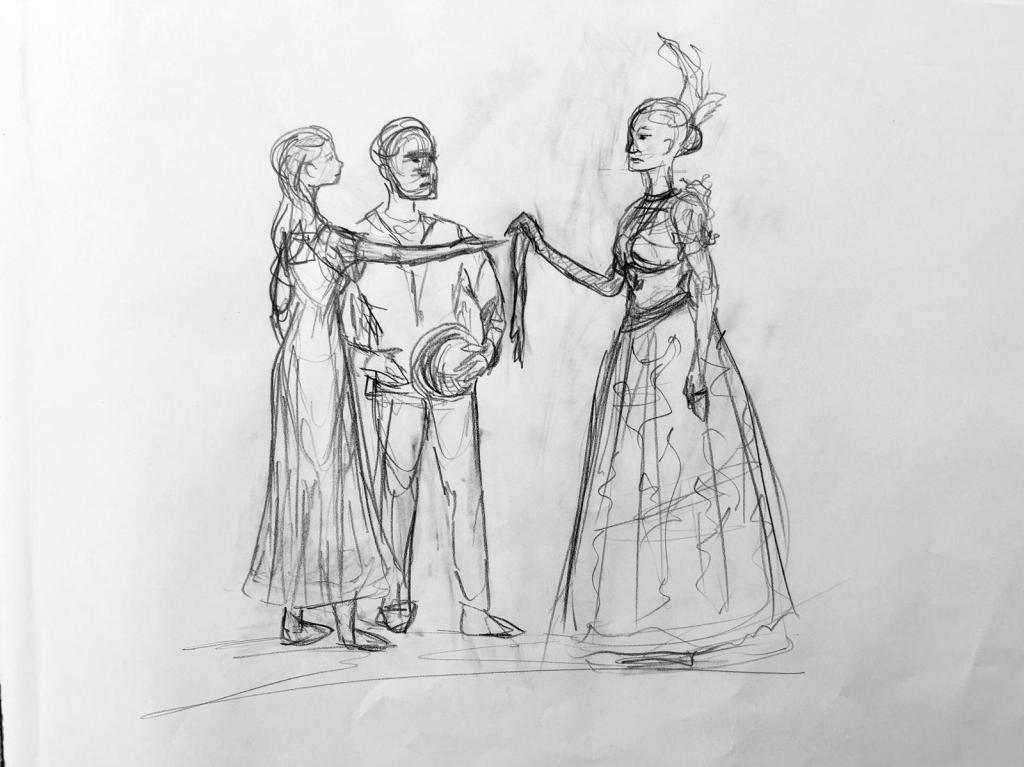
Once seen and surely never forgotten is the Glove Scene.  Bathilde, Albrecht’s fiancée, removes one of her gloves with deliberation and drops it on the floor for Giselle to pick up.  Her cruel power game plays out in stillness: Giselle holds her rival’s gaze with confidence and defiance as she calmly returns the glove.  But it is not Giselle who has retrieved the glove.  No.  The other character in this triangle is Hilarion.  It is he who has stooped down to pick the glove up from the ground and has attempted in vain to make Giselle bow her head before Bathilde.  He has managed to force the other Outcasts to bow down before the Landlords, but Giselle he cannot control.
Victoria Trentacoste

As Albrecht and Hilarion fight—a fight so palpable in its aggression, even though physical contact is limited—the chief Landlord circles slowly around them until his gaze reaches Hilarion’s eyes, a gaze of such force that it brings the confrontation to an abrupt end.  Squeezing Albrecht’s jaw in the vice of his grip, the Landlord seals Albrecht’s fate with an angry kiss.

The fates of Giselle herself and Hilarion are sealed at the moment when triangular relationships collide into a deadlock. Giselle has dared to insert herself and her unborn baby into the “neat” triangle of the Landlord, Bathilde and Albrecht, that is, the triangle that will keep power in the hands of the powerful and keep it removed from the powerless.  Giselle pulls Albrecht’s hand to her belly, holding it there so he can feel their bond.  But feeling instead the glare of the Landlord and Bathilde’s penetrating eyes upon him, Albrecht wrenches his hand away, throwing Giselle to the ground.  Then he literally turns his back on Giselle to walk off stage with Bathilde.

Erina Takahashi as Giselle & James Streeter Albrecht © Camilla Greenwell

For us the words of First Soloist Katja Khaniukova, who has been involved in the ballet since its premiere, shine a light on this climax:

I believe that she’s dead from the moment when Albrecht left her, when he decided … when he just turned away … That’s the moment when she died inside.  

Erina Takahashi as Giselle © Camilla Greenwell

The ensuing mad scene is the final straw for the Landlords, as it were.  Giselle must be got rid of.  And it is Hilarion who is tasked with the dirty work.

Our impressions of Act I lead us to conclude that the narrative of Khan’s Giselle can be traced through this series of triangular relationships, based on love, desire, power and control, that escalate to the crisis point of Giselle’s destiny.
Victoria Trentacoste

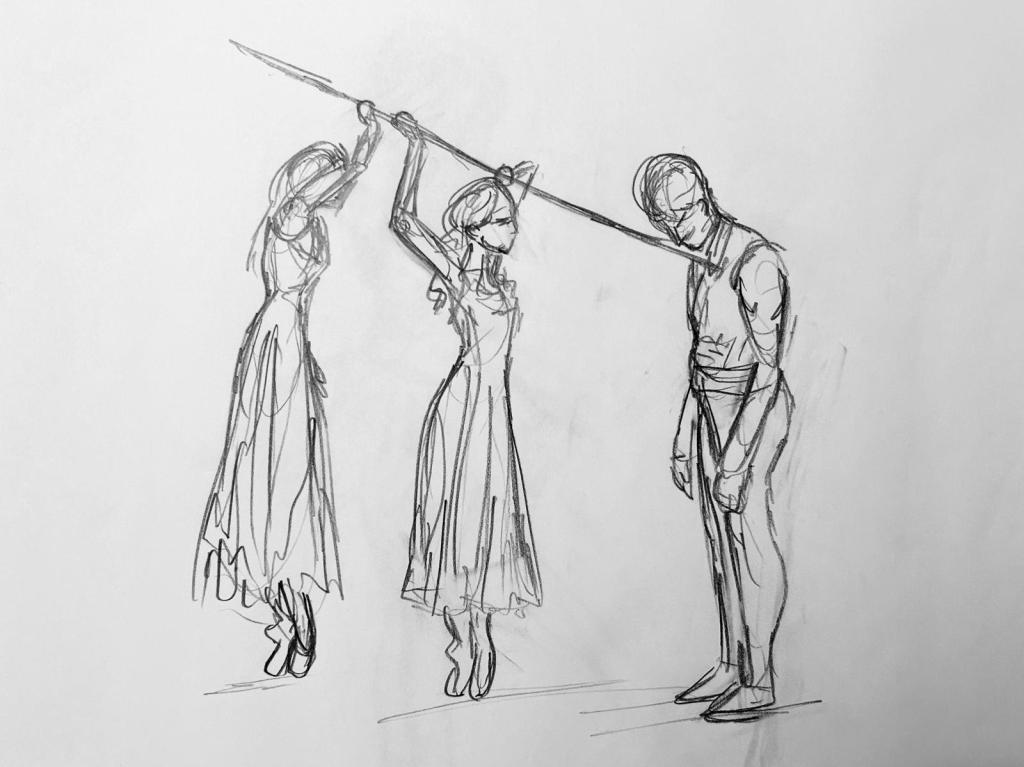
In the final triangle of the ballet Giselle seems to regain some of her agency.  It is she who cannot or will not pierce Albrecht through the heart with the cane, despite Myrtha’s urgent exhortations to do so.  It is she who demands some grace time to relive moments of love with Albrecht.  And it is she who pulls the cane from Myrtha’s grasp, thrusts it into herself and then Myrtha to connect them as they disappear back into the gloom.  Giselle then holds Albrecht’s gaze for as long as she is able.  Erina Takahashi, who has been dancing Giselle since 2016, gives us a sense of Giselle’s state of mind.

So one of the scenes that has a strong impact on me … is at the end of the ballet … the last pas de deux with Albrecht.  At the end we are feeling each another and Myrtha takes us separate, but I decide to say to Myrtha “It’s ok, I’m coming with you”. … You have a last look to Albrecht to say goodbye to him, and then go away with Myrtha.  That’s a very strong impact for me.

Emma Hawes as Myrtha © Camilla Greenwell

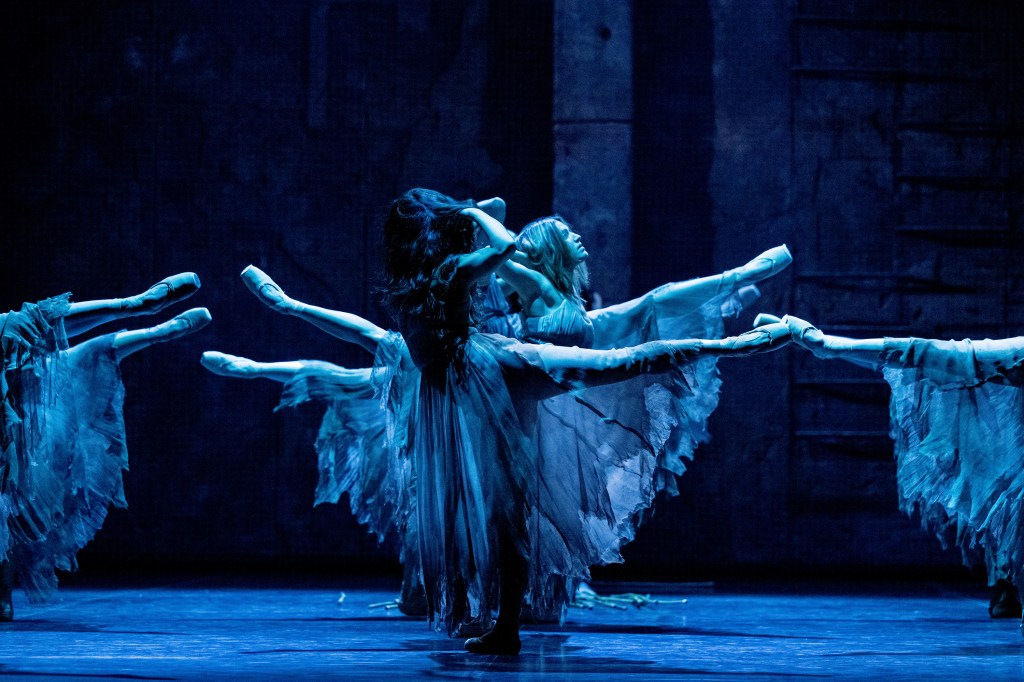
Days after the performance the magnificent score by Vincenzo Lamangna still haunts us.  Lamagna’s reworking of the familiar love themes from Adolphe Adam’s original 1841 music have now taken on a life or their own: like a phantom they hover and linger, circle and circle without resolution.  At a climactic moment the melody spirals into a dark wailing abyss as the Wilis perform their famous arabesques voyagés.  With another woman dead at the hands of the Landlords, the vicious cycle of oppression continues without respite.  
English National Ballet dancers © Camilla Greenwell

Ironically, in order to create such “bewitching” (Mackrell) performances of Outcasts, outliers and misfits, of divisive abuse of power, the Company must work together to produce cohesion in their dancing and storytelling.  And in truth, we have never experienced a performance of this ballet where the effort and energy of such cohesion was not pouring from the stage. 

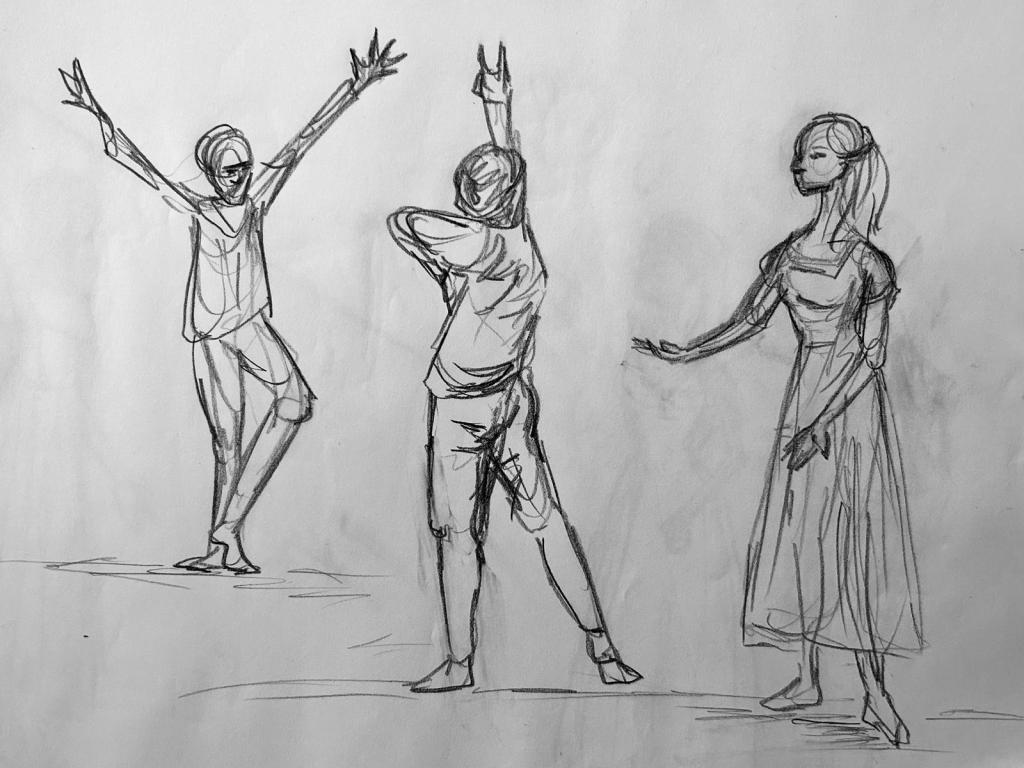
We would like to thank our lovely friend Victoria Trentacoste for the beautiful hand-drawn illustrations 🙏
thinkcreatewrite.com

Victoria Trentacoste

https://www.instagram.com/thinkcreatewrite/

© British Ballet Now & Then

References

Khaniukova, Katja. “Akram Khan’s Giselle: Katja Khaniukova’s favourite moments | English National Ballet”. YouTube, uploaded by English National Ballet, 23 Oct. 2016, https://www.youtube.com/watch?v=5cM8nK0WYxs

Mackrell, Judith. “Giselle review – Akram Khan’s bewitching ballet is magnificently danced”. The Guardian, 28 Sept. 2016, https://www.theguardian.com/stage/2016/sep/28/giselle-review-akram-khan-english-national-ballet

Takahashi, Erina. “Erina Takahashi on the ending of Akram Khan’s Giselle”.  X, uploaded by English National Ballet, 18 Sept. 2024, https://x.com/ENBallet/status/1836358770542190633

Watching with British Ballet Now and Then: Akram Khan’s Creature

It’s been a long time coming.  After being cancelled in both the spring and the autumn of 2020, Akram Khan’s Creature for English National Ballet has finally arrived on the stage. 

In preparation for watching Creature we have familiarised ourselves with Mary Shelley’s Frankenstein (1818) and wracked our brains for memories of studying Georg Bűchner’s 1837 Woyzeck at university.  To our consternation we have discovered that our image of Frankenstein’s Creature was totally askew, being associated in our minds with the horror genre of literature and film, and consequently with gratuitous savagery and cruelty.  Of course, both of these literary works deal with savagery and cruelty, but the vulnerability and pathos of Frankenstein’s “Monster” is something that had passed us by until now …Having watched the miniseries (Connor, 2004) and the National Theatre’s streaming of Danny Boyle’s 2011 production last year, and subsequently read the novel, our eyes have been opened …

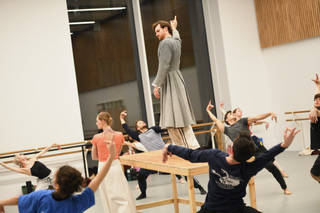
English National Ballet dancers in rehearsal for Creature by Akram Khan © Laurent Liotardo

As usual, English National Ballet have produced teasers, and videos discussing aspects of the work and preparations for the premiere.   

The extract with Jeffrey Cirio in the Arctic station dancing to Richard Nixon’s voice sends chills down our spine:

Because of what you have done

Because of what you have done

Because of what you have done

Nixon’s words, delivered to the Apollo 11 Astronauts in 1969, were intended as a message of pride and peace: “I just can’t tell you how proud we all are of what you have done … it inspires us to redouble our efforts to bring peace and tranquillity to earth”.  

But in front of us the movements of Khan’s Creature are spasmodic, fragmented, jittery, oscillating constantly between childlike curiosity and pride, fear and pain.  This Creature is a combination of Frankenstein’s Creature, and Woyeck, the impoverished and degraded military barber who submits himself to medical experiments, such as the indignity and pain of consuming a diet of peas alone, in order to earn some much-needed extra cash.  Juxtaposed to the Creature’s movements Nixon’s triumphant words take on a sinister meaning: “Because of what you have done the heavens have become a part of man’s world”.  We hear echoes of the repugnant arrogance of Victor Frankenstein and the Doctor in Woyzeck, arrogance that results in such cruel behaviour as to drive the victims of their cruelty to brutal, murderous acts.   

From the 19th century classics to Khan’s own works for English National Ballet, we know the power of group movement: the menace of Jean Coralli’s Wilis in Giselle (1842); the sheer transcendental beauty of “The Kingdom of the Shades” from Petipa’s 1877 La Bayadére; Khan’s human waves of mourning in Dust (2014).  Now we catch glimpses of such power again in the snippets of Creature that we’ve seen: a brigade of soldiers travelling swiftly through the space, consuming it through frequent changes of direction, attacking it through repeated thrusting and pulling movements as if they’re digging, mining the earth, hauling great weights.  Machine-like in their precision and strength.  We discover later the weakness hidden beneath such strength, the extent to which unison can be used to convey conformity—conformity, and fear of being different, of not belonging.

English National Ballet in Creature by Akram Khan © Laurent Liotardo
 

The opening scene of the ballet is dominated by Creature’s solo to Nixon’s words, and over the evening it transpires that this is the key to the whole work. The Soldier Astronauts enter the stage with huge slow-motion steps, pressing their way through the atmosphere to invade the space.  Neil Armstrong’s “giant leap for mankind” passes through our minds.

Like labourers in a penal colony, they continue with their relentless thrusting and hauling.  At other times they slither, slide and wriggle like animals, or pay obeisance to the Major, the symbol of ultimate control and power in the work.  Like automatons, their movements are frequently fragmented, stiff, constricted.  Fear ensures they seldom step out of line.  Creature suffers torture as the guinea pig of scientific experimentation.  Fear ensures that the soldiers fail to show him the empathy that would make them truly human: they seem to have been robbed of every human emotion save the fear of non-compliance.  We feel the looming presence of Solzhenitsyn, Orwell, Kafka …  

English National Ballet in Creature by Akram Khan © Ambra Vernuccio

Bűchner’s Doctor, so full of his own importance, has become a liminal figure in Creature.  In her behaviour the Doctor shows how failure to show empathy is a process of erosion.  Her behaviour towards Marie, Creature’s keeper, and occasionally even towards Creature himself, demonstrates her potential for empathy; but her responses to the Major show that her status is too precarious for her to be able to indulge in such humane sentiments. 

The work is quite desolate where human kindness, feeling or responsibility are concerned. Although there are exceptions.  

English National Ballet’s Victor Prigent and Jeffrey Cirio in Creature by Akram Khan © Laurent Liotardo

Creature performs tender and playful duets with his friend Anders and with Marie—here unison suggesting friendship, mutual understanding and affection, while free flow in the movement and music conveys a rare feeling of joyfulness.  

English National Ballet’s Jeffrey Cirio in Creature by Akram Khan © Laurent Liotardo

Like Frankenstein’s Creature, he is eager to learn from Anders and Marie; like Frankenstein’s Creature, he is longing to give as well as to receive affection.

But the abuse of power seeps through the very pores of the work, and the performance moves to a close literally on a different note to those we’ve heard before, as we hear the tones of sacred music accompanying the sight of Creature holding the lifeless body of Marie in his arms.  But he has not killed Marie: unlike his literary predecessors he has killed no one.  He has in fact attempted to protect her from the Major’s sexual assault.  Creature and Marie pay the price for not complying, for being different: she for resisting the advances of the Major, and for daring to show some empathy towards Creature; he for never quite mastering the steps, never quite understanding the patterns to which he is required to adhere.  

As the Soldiers depart from the collapsing research station in search of a new project, new places to conquer, Creature repeats some of his dance from the start of the ballet, only this time in the presence of Marie’s dead body.  He mimics walking forward with a rifle in his hand, as if he is a “forgotten man” from Al Dubin’s “Remember My Forgotten Man”, the extraordinary culmination of Busby Berkely’s Gold Diggers of 1933:

Remember my forgotten man,

You put a rifle in his hand,

You sent him far away,

You shouted “hip-hooray!”,

But look at him today.

Just as this musical number depicts how World War I soldiers were abandoned by the state after they had served their purpose, the climax of Creature depicts the two protagonists abandoned in the disintegrating research hut.  They have served their purpose.   

As Creature dances with Marie’s limp body, we realise that we have already seen this image.  In the first few moments of the work.  We realise that Marie’s rape and murder have both taken place downstage left, where the story began in darkness, save the glow emanating from Marie’s cleaning bucket, a prop that clearly symbolises life and rebirth through its connections with light and water.  The terrifying realisation dawns on us that the cycle of events that have played out over the last two hours are all too likely to repeat themselves …

Over the course of the evening we have heard Nixon’s words repeated, disintegrate into a coughing fit, and become increasingly distorted, until their final incomplete, but telling, iteration uttered by the voice of Andy Serkis, as if he is gasping his final breath … “Because of what I …”.  The prominence of Nixon’s proclamation, combined with the corps de ballet’s conquering of the stage space, and the persistent pointing upwards towards the sky, makes it clear to us that the makers of Creature are concerned not only with “man’s inhumanity to man”.  If space has become part of “man’s world”, the implication is that planet Earth is already “man’s world” and consequently subject to the whims and desires of human beings, no matter what the cost to the future of the world and its population.  The volume and raw insistence of Vincenzo Lamagna’s sound score, matched with synchronised movement, means there is no escape from a visceral response to the stage action.  We are reminded in no uncertain terms that we are all a part of this tale: “We’re all part of climate change. We all contribute to CO2 – we all drive cars, we fly, we all waste food, so we’re all part of it.” (Khan, “Akram Khan: Dancing Creature”).  

English National Ballet’s Jeffrey Cirio and Erina Takahashi in Creature by Akram Khan © Ambra Vernuccio

And then there’s the cleaning.  Of course there’s cleaning—we’re in a scientific lab—but the relentless mopping, wiping and scrubbing performed by Marie, Andres and Creature gives us the feeling that we are trying to subjugate our environment, tame it, erase its essence, so that we can exploit it to our heart’s desire.  It reminds us of Norbert Elias’ The Civilising Process (1939).  

The walls are cleaned, the floor is cleaned, but most importantly, the table is cleaned.  The Major mounts the table, shimmering with Olympian ease.  From here he is panoptic master of all he surveys.  But the table is also a world for Creature and Marie to explore together, as they move around it, over and under it, and dance together on its surface.

English National Ballet’s Jeffrey Cirio in Creature by Akram Khan © Laurent Liotardo

Through the course of this tale layers of meaning have carved meandering paths through our minds.  In the final moments the political and personal converge in a potent climax.  Like the words of Nixon, the research hut itself is disintegrating—a message for us all to take more care of our environment—while we witness the unbearable pain of Creature as he holds the corpse of Marie in his arms, his aloneness palpable.  

English National Ballet’s Jeffrey Cirio and Erina Takahashi in Creature by Akram Khan © Laurent Liotardo

We remember Frankenstein’s promise to make a female companion for his creation to assuage the Creature’s devastating loneliness, the promise that he breaks in the most heinous way by tearing her to pieces before even having finished constructing her.  We remember Mary Shelley’s Last Man (1826), a startling prediction of our times.  We realise that our hands have been clenching throughout the evening.

As we leave the theatre our minds are replete to bursting with images.  So many images, it’s impossible to imagine there won’t be plenty for each member of the audience, no matter what their background, experience in ballet or expectations.

The following morning our minds are still jangling.  Akram Khan wants his audience to “… feel a sense of the work; I don’t want you to see sense in the work” (“Free Thinking” 9:38-9:42). 

We have gained a sense of Creature.  We look out of the window at the garden and wonder where exactly we ourselves fit into Creature’s tale.

English National Ballet’s Jeffrey Cirio and Stina Quagebeur in Creature by Akram Khan © Ambra Vernuccio

We would like to thank our friends Philippa Burrows, Susie Campbell and Paul Doyle for stimulating conversations about Creature, which have undoubtedly found their way into this post.

© British Ballet Now and Then

References 

Creature: The Army (extract)”. English National Ballet, 2021, www.ballet.org.uk/production/creature/.

Creature: Because of What You Have Done (extract)”. English National Ballet, 2021, www.ballet.org.uk/production/creature/.

Khan, Akram. “Akram Khan: Dancing Creature”. Interview by Maggie Foyer. Dance ICONS, Sept. 2021, www.danceicons.org/pages/index.php?p=210826140840

—. “Free Thinking: Belonging”. Produced by Tim Bano, BBC Sounds, 16 Sept. 2021, www.bbc.co.uk/programmes/m000zl33.