KENNETH MACMILLAN’S MANON: LESCAUT’S MISTRESS

Why does Lescaut’s Mistress not have a name?
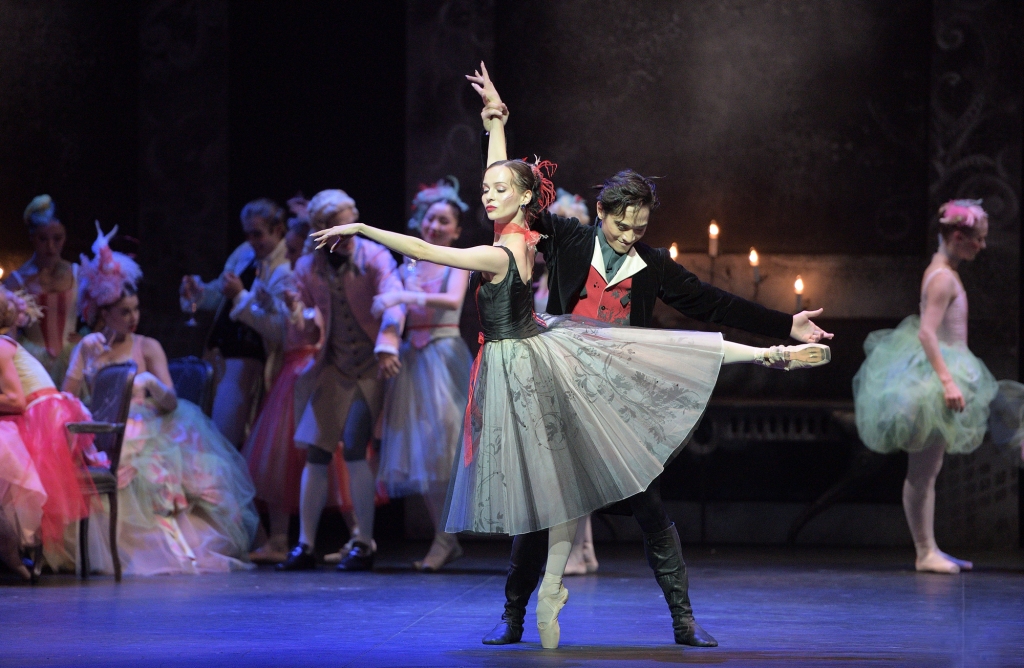
Since we first started watching Kenneth MacMillan’s 1974 Manon in the late ’70s we have found the role of Lescaut’s Mistress to be an increasingly engaging and fascinating character.    

As you will likely know, the Mistress is one of four protagonists, the other three being Manon herself, her Lover Des Grieux, and her Brother Lescaut.  Famously, to aid her preparation for creating the role of the Mistress, Monica Mason read the whole of Abbé Prévost’s novel The Story of the Chevalier des Grieux and Manon Lescaut, upon which the ballet was based.  However, to her disappointment, instead of discovering more about the Mistress, all she discovered was that no such character exists in the 1731 novel.  

Not only did MacMillan invent the character of the Mistress, but he gave her two delicious solos and a pas de deux.  The importance of the role is highlighted by the fact that it was created for Mason, a principal ballerina, who would moreover be dancing with an equally high-profile principal dancer, David Wall, as Lescaut.  (You can read more about Wall in our “Male Dancers in British Ballet Now & Then” post.)

Sometimes dancing the Mistress can be a stepping stone to dancing Manon herself.  Yasmine Naghdi, whose exquisite Manon we enjoyed this season, danced the Mistress in the Royal Ballet’s last revival of the work, in 2018.  Similarly, her coach, Laura Morera (now in charge of overseeing the MacMillan repertoire for the MacMillan Estate) danced the Mistress for several seasons before her debut as Manon.  And we are hoping that Mayara Magri, who is dancing the Mistress this season, will follow suit …

But for us, the importance of this character is not connected to career progression: rather, the importance of Lescaut’s Mistress lies in her feistiness and the sheer ebullience of her dancing.  In their reviews critics highlight the different facets of her character as portrayed by individual dancers, showing the richness of her personality.  Morera’s Mistress is “teasing” (Levene), while Yanela Piñera of Queensland Ballet is “spicy” and “sassy” in the role (Lois), and Katja Khaniukova of English National Ballet (ENB) dances “with creamy sensuality” (Mead, “The Full Depth”).  Of all the Mistresses we have seen, the dancer who lives most vividly in our memory is Crystal Costa, former First Soloist with ENB.  David Mead captures the essence of her performance: “Crystal Costa was spirited and vibrant. Bubbly and effervescent. She stole almost every scene she was in” (“Jurgita Dronina”). 

In our opinion all of these characteristics are integral to the Mistress’ solos.  Her expansive use of the kinesphere in movements such as développés and relevés lents à la seconde, and grandes sissonne ouvertes, along with her command of the general space, as she slices her way across the stage and travels around its circumference, clearly indicates her bold spirit, while the contrasting tricky pirouettes, intricate beats and piqués suggest her sharpness and wit.  At the same time the Mistress indulges in flirtatious, coquettish gestures and head tilts, lifts her skirts with tantalising glee, and uses central pathways in her kinesphere to unfurl her arms with sensuous aplomb.    

While the two solos and the duet with Lescaut are the highlights of the Mistress’ role, other, less central, moments reveal more about her personality.  Just a few minutes into Act I Lescaut slaps her on account of her unsolicited flirtatious behaviour, and yanks her mercilessly towards a passing cart of convicted prostitutes to remind her of her potential fate (the fate that in fact befalls Manon).  Given this treatment of her by her Lover, the ebullience of her solos strikes us as all the more remarkable, as does her humour and “haughty disdain” (Lois) in the duet.  In Act II, although tipsy, she is sufficiently alert to be aware of and disapproving of Des Grieux’s cheating at cards.  It seems to us that in a world where women have limited choices the Mistress is a survivor.  And we are in no doubt that she will survive Lescaut’s death.

Throughout this post we have been acutely aware that we been repeatedly referring to the subject of our writing as “Lescaut’s Mistress” or “the Mistress”.  This is because, despite having created such as smart, sexy, sassy character, MacMillan never dignified her with a name; and her title is dependent on her relationship with a man.  In Antony Tudor’s one-act Jardin aux lilas (1936) only one character is given a name: Caroline.  The other characters are identified in accordance with their relationship to Caroline: Her Lover, The Man She Must Marry, An Episode in His Past.  In this instance the reasoning is clear: Caroline is at the heart of the drama, which is presented through her eyes.  In contrast, even though Manon’s story is indisputably the focus of the stage action, apart from Lescaut’s Mistress, each of the protagonists has their own name, independent of their relationship with one another.

Every dancer who performs the Mistress emphasises different facets of her personality: even from the available recordings this evident, never mind the wealth of live performances we have witnessed.  And there is undoubtedly more for dancers  to mine in the choreographic riches of the role …

So, to conclude, there seems to be no good reason why Lescaut’s Mistress does not have a name.  Is it not time that she did?

© British Ballet Now & Then

Dedicated to the “spirited, vibrant, bubbly and effervescent” Crystal Costa

References

Levene, Louise. “Manon, Royal Opera House, London”. Financial Times, 1 Oct. 2014, https://www.ft.com/content/381eb35e-494a-11e4-8d68-00144feab7de.

Lois, Leila. “Dance review: Kenneth MacMillan’s Manon”. ArtsHub, 3 Oct. 2022, https://www.artshub.com.au/news/reviews/dance-review-kenneth-macmillans-manon-2583405/.

Mead, David. “The full depth of love and loss: English National Ballet in Manon”. SeeingDance, 21 Jan. 2019, https://www.seeingdance.com/english-national-ballet-manon-21012019/.

—. “Jurgita Dronina spellbinding in English National Ballet’s Manon”. SeeingDance, 24 Oct. 2018, https://www.seeingdance.com/enb-manon-26102018/.

Cathy & Jane: A Review of Northern Ballet’s Jane Eyre

When Shanghai Ballet visited London in 2013, they brought with them an adaptation of Charlotte Brontë’s Jane Eyre.  In this production, the figure of Berthe Mason, Mr Rochester’s wife, is foregrounded, making the notion of a dualistic vision of womanhood central to the work.  However, three years later British choreographer Cathy Marston created a Jane Eyre for Northern Ballet offering a completely different perspective.  We went to see the ballet in Leeds, but from April to June it will continue to be performed in a number of UK locations: Belfast, Sheffield, Cardiff, London and Manchester.

Binary representations of women abound in 19th century ballet, for example the good, chaste, virginal and beautiful pitted against the evil, seductive, sexual and ugly: think of Effie and the Sylph, Giselle and Myrthe, Aurora and Carabosse, Odette and Odile.  However, Marston refreshingly eschews such tropes and places Jane herself right at the heart of the work, from start to finish.

The way in which the structure of the ballet hangs on Jane’s development is ingenious, opening as it does at that point in the narrative where she is at her most emotionally and physically vulnerable, alone and in a state of collapse on the moor, having fled Thornfield after discovering the existence of Rochester’s wife. From there the first act depicts scenes from her life as they pass through her memory – the death of her parents, her childhood and early adulthood at Lowood, the events at Thornfield – until the action reaches the starting point and the scene on the moor is repeated. This repetition is daring on Marston’s part, and it leaves the audience in no doubt as to the focus of this adaptation.

Jane’s physical weakness and emotional exhaustion in this crucial scene on the moors are clearly demonstrated through her drooping body and her reliance on her partner St. John Rivers to support her.  This dependency however is not characteristic of her duets with Rochester, each of them imaginatively and eloquently depicting the stages of their growing relationship.  From Jane’s awkward juddering movements suggesting her conflicting feelings for Rochester and humorous gestures, such as the sharp kick she gives him in the shin, the movement becomes more sensuous.  Support work, so integral to ballet pas de deux, is tellingly not restricted to Rochester, but shared, for example, when the couple tenderly lean against one another.   The duets are also unusual and revealing in being punctuated by Jane defiantly staring back at Rochester. In contrast, the duet between Blanche Ingram and Rochester is much more conventional, as Rochester supports Blanche in lifts and turns depicting traditional ballet gender relations, thereby suggesting a relationship that would be condoned by society but would be of little interest to Rochester.

Marston has created an extraordinarily rich and expressive gestural language that is based on neither everyday body language nor on traditional mime and is fully integrated into the choreography. These gestures convey character, emotion and circumstance to the audience. The mechanistic repetitive movements for the pupils of Lowood School suggesting the drudgery of their daily chores are reminiscent of Anna de Keersmaeker’s Rosas danst Rosas.  The adult Jane shifts between reaching out as if grasping for freedom, and folding her arms over her torso, as if straitjacketed, bound to an existence that she is desperate to escape.  Rochester repeatedly holds one hand up to his face dividing it in two, left from right, implying something duplicitous in his nature, while Adele’s movements are all skittish with constantly varying gestures of excitement and glee. This gestural language is at its most eloquent in a circular wrapping movement of the arms for Rochester and Jane, symbolic of marriage, firstly initiated by Rochester, but then on Jane’s return to Thornfield initiated by her.

Patrick Kinmonth’s uncluttered designs and evocative costumes allow for seamless narration, and perhaps one of the reasons why he is so successful in this is that he was involved with Marston in writing the scenario. Moving wings represent the grimness of Lowood, the barrenness of the moors, and in contrast the fireplace and all-important entrance to the attic at Thornfield. The most striking costume is Berthe’s wildly flowing crimson red dress, which highlights her dangerous feral nature and connects her with the image of fire so crucial to the narrative.

But even more striking is the final mesmerising image of Jane on her own calmly walking towards the audience as the curtain falls. She has been reunited with Rochester in a soul-stirring duet of mutual love, passion and respect, but it is ultimately the trajectory of Jane’s life and personal journey that we are following, and the contrast between our first encounter with Jane as vulnerable, weak and lost to this final image of strength, independence and self-belief is a potent one indeed, and one befitting our times.

© Rosemarie Gerhard 2018

The Rise & Rise of ENB: Style Matched by Substance

Thoughts on English National Ballet in 2018 from an Audience Member

When I saw ENB last month at the London Coliseum, it suddenly struck me that nowadays when I see this company perform, I feel like I’m having the best kind of history lesson.  In La Sylphide (1836) the dancers’ ballon and line, and the accent and phrasing of their mime conveyed very well to me what I understand to be Bournonville style, and I found it extremely satisfying.  Because although La Sylphide is a Romantic ballet, it is more specifically a Bournonville ballet, and Frank Andersen, who staged the production, and Artistic Director Tamara Rojo were both intent on replicating the style as accurately and authentically as was possible.

The other Romantic ballet in the repertoire, Mary Skeaping’s production of the 1841 Giselle has its own stylistic characteristics: here very specific postures and port de bras are combined with linear stage patterns no less precise than in the works of Marius Petipa, such as The Sleeping Beauty (1890) and Le Corsaire (1899) (and indeed Petipa did rework Giselle extensively).  However, the dynamics and energy are very different, and Petipa’s ballets show evidence of a crisper attack than either act of Giselle.  And in the hands of ENB this is just what we see on stage.  In William Forsythe’s In the Middle Somewhat Elevated from 1987 attack is still more visible, as well as a stronger sense of weight, particularly noticeable in the women’s dancing.  For Akram Khan’s choreography, such as his 2014 Dust, yet a different use of weight is apparent, as well as a more extensive use of the back.

Ballet companies tend to pride themselves on their distinctive style (think of the rivalry between the Mariinsky and Bolshoi, for example).  However, from an audience perspective, the disadvantage of this is that works tend to look less individual than they could.  However, I am now finding ENB to be refreshingly and intriguingly different in this regard.  It’s not that other companies are not versatile (all ballet companies need to be versatile nowadays), but the dancers of ENB seem to perform the different styles in a far more noticeably embodied way, demonstrating their cognitive and corporeal understanding of the various works, which they verbalise intelligently on the ENB website.  This is something I have noticed developing over Tamara Rojo’s tenure as artistic director since 2012.


It might seem that this emphasis on embodying different historical and choreographic styles would detract from the individuality of the dancers.  But the contrary seems to be true.  In the January 2018 run of Kenneth MacMillan’s Song of the Earth (1965) in London, for example, Fernando Carratalá Coloma’s boyishness and youthful ease of movement lent an unusual poignancy to the role of the Messenger of Death, whereas Aaron Robison’s interpretation was brought to life by his clean incisive lines and his attack, accompanied by such subtleties as an eerie tilt of the head.  Precious Adams stands out for the luscious quality of her dancing, Francesca Velicu for the harmony of her movements, and Sarah Kundi for her marvellous versatility – from her attack, verve and style in William Forsythe’s In the Middle Somewhat Elevated to her vibrant account of Madge in Bournonville’s La Sylphide.

This accomplished articulation of historical, choreographic and personal styles is underpinned by the substance of a repertoire of stability and tradition on the one hand and intelligence and imagination on the other.  In addition to the repertoire discussed above, the last four years have seen Lest We Forget, the mixed bill of works inspired by the centenary of the First World War, and She Said, a triple bill of creations by female choreographers (a format to be replicated by Birmingham Royal Ballet next season); and this year will see the premiere of a new work from Forsythe.  And then there’s the jewel in the crown that is Akram Khan’s Giselle, created in 2016.  This magnificent work of art has given the dancers rich opportunities to create characters through spellbindingly inventive movement and a new lens through which to reimagine their traditional production of Giselle, clearly visible for example in the extraordinary interpretations of James Streeter as a jovial, then angry Prince of Courland, and Madison Keesler as a sympathetic and then distressed Bathilde.  This repertoire has ensured my own increasing attendance at performances since 2013.

And now Rojo has secured brand new purpose-built state-of-the-art premises to ensure the best possible working, practice, rehearsal and rehabilitation spaces for her company.  I look forward to the continuing rise of ENB …

© Rosemarie Gerhard 2018