KENNETH MACMILLAN’S MANON: LESCAUT’S MISTRESS

Why does Lescaut’s Mistress not have a name?
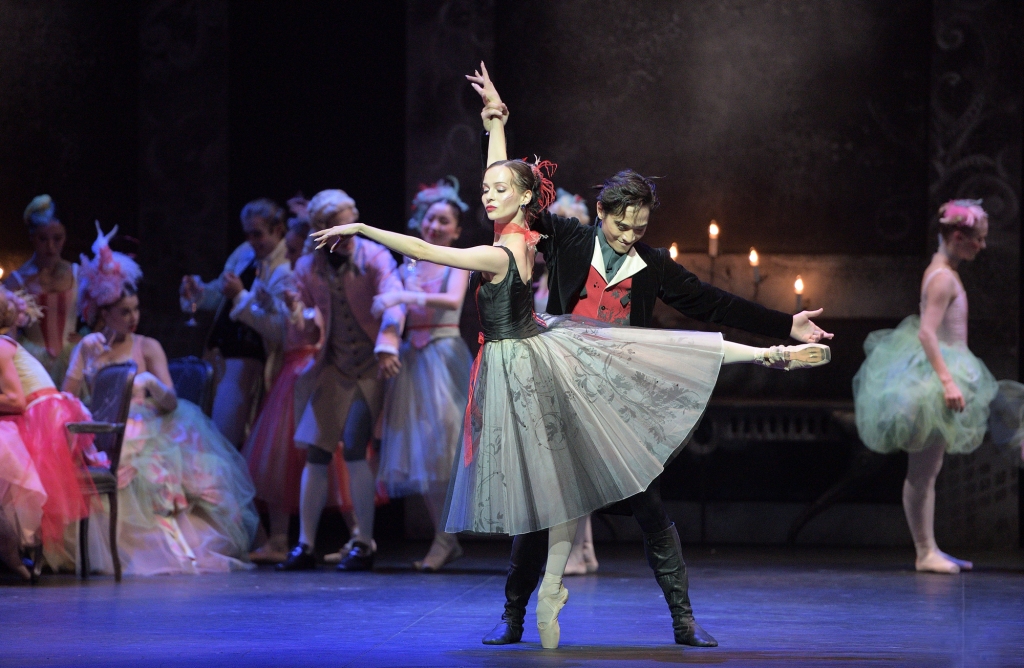
Since we first started watching Kenneth MacMillan’s 1974 Manon in the late ’70s we have found the role of Lescaut’s Mistress to be an increasingly engaging and fascinating character.    

As you will likely know, the Mistress is one of four protagonists, the other three being Manon herself, her Lover Des Grieux, and her Brother Lescaut.  Famously, to aid her preparation for creating the role of the Mistress, Monica Mason read the whole of Abbé Prévost’s novel The Story of the Chevalier des Grieux and Manon Lescaut, upon which the ballet was based.  However, to her disappointment, instead of discovering more about the Mistress, all she discovered was that no such character exists in the 1731 novel.  

Not only did MacMillan invent the character of the Mistress, but he gave her two delicious solos and a pas de deux.  The importance of the role is highlighted by the fact that it was created for Mason, a principal ballerina, who would moreover be dancing with an equally high-profile principal dancer, David Wall, as Lescaut.  (You can read more about Wall in our “Male Dancers in British Ballet Now & Then” post.)

Sometimes dancing the Mistress can be a stepping stone to dancing Manon herself.  Yasmine Naghdi, whose exquisite Manon we enjoyed this season, danced the Mistress in the Royal Ballet’s last revival of the work, in 2018.  Similarly, her coach, Laura Morera (now in charge of overseeing the MacMillan repertoire for the MacMillan Estate) danced the Mistress for several seasons before her debut as Manon.  And we are hoping that Mayara Magri, who is dancing the Mistress this season, will follow suit …

But for us, the importance of this character is not connected to career progression: rather, the importance of Lescaut’s Mistress lies in her feistiness and the sheer ebullience of her dancing.  In their reviews critics highlight the different facets of her character as portrayed by individual dancers, showing the richness of her personality.  Morera’s Mistress is “teasing” (Levene), while Yanela Piñera of Queensland Ballet is “spicy” and “sassy” in the role (Lois), and Katja Khaniukova of English National Ballet (ENB) dances “with creamy sensuality” (Mead, “The Full Depth”).  Of all the Mistresses we have seen, the dancer who lives most vividly in our memory is Crystal Costa, former First Soloist with ENB.  David Mead captures the essence of her performance: “Crystal Costa was spirited and vibrant. Bubbly and effervescent. She stole almost every scene she was in” (“Jurgita Dronina”). 

In our opinion all of these characteristics are integral to the Mistress’ solos.  Her expansive use of the kinesphere in movements such as développés and relevés lents à la seconde, and grandes sissonne ouvertes, along with her command of the general space, as she slices her way across the stage and travels around its circumference, clearly indicates her bold spirit, while the contrasting tricky pirouettes, intricate beats and piqués suggest her sharpness and wit.  At the same time the Mistress indulges in flirtatious, coquettish gestures and head tilts, lifts her skirts with tantalising glee, and uses central pathways in her kinesphere to unfurl her arms with sensuous aplomb.    

While the two solos and the duet with Lescaut are the highlights of the Mistress’ role, other, less central, moments reveal more about her personality.  Just a few minutes into Act I Lescaut slaps her on account of her unsolicited flirtatious behaviour, and yanks her mercilessly towards a passing cart of convicted prostitutes to remind her of her potential fate (the fate that in fact befalls Manon).  Given this treatment of her by her Lover, the ebullience of her solos strikes us as all the more remarkable, as does her humour and “haughty disdain” (Lois) in the duet.  In Act II, although tipsy, she is sufficiently alert to be aware of and disapproving of Des Grieux’s cheating at cards.  It seems to us that in a world where women have limited choices the Mistress is a survivor.  And we are in no doubt that she will survive Lescaut’s death.

Throughout this post we have been acutely aware that we been repeatedly referring to the subject of our writing as “Lescaut’s Mistress” or “the Mistress”.  This is because, despite having created such as smart, sexy, sassy character, MacMillan never dignified her with a name; and her title is dependent on her relationship with a man.  In Antony Tudor’s one-act Jardin aux lilas (1936) only one character is given a name: Caroline.  The other characters are identified in accordance with their relationship to Caroline: Her Lover, The Man She Must Marry, An Episode in His Past.  In this instance the reasoning is clear: Caroline is at the heart of the drama, which is presented through her eyes.  In contrast, even though Manon’s story is indisputably the focus of the stage action, apart from Lescaut’s Mistress, each of the protagonists has their own name, independent of their relationship with one another.

Every dancer who performs the Mistress emphasises different facets of her personality: even from the available recordings this evident, never mind the wealth of live performances we have witnessed.  And there is undoubtedly more for dancers  to mine in the choreographic riches of the role …

So, to conclude, there seems to be no good reason why Lescaut’s Mistress does not have a name.  Is it not time that she did?

© British Ballet Now & Then

Dedicated to the “spirited, vibrant, bubbly and effervescent” Crystal Costa

References

Levene, Louise. “Manon, Royal Opera House, London”. Financial Times, 1 Oct. 2014, https://www.ft.com/content/381eb35e-494a-11e4-8d68-00144feab7de.

Lois, Leila. “Dance review: Kenneth MacMillan’s Manon”. ArtsHub, 3 Oct. 2022, https://www.artshub.com.au/news/reviews/dance-review-kenneth-macmillans-manon-2583405/.

Mead, David. “The full depth of love and loss: English National Ballet in Manon”. SeeingDance, 21 Jan. 2019, https://www.seeingdance.com/english-national-ballet-manon-21012019/.

—. “Jurgita Dronina spellbinding in English National Ballet’s Manon”. SeeingDance, 24 Oct. 2018, https://www.seeingdance.com/enb-manon-26102018/.

ENB Emerging Dancer 2019

Last week Julia and Rosie went to watch English National Ballet’s tenth Emerging Dancer Competition.  Later in the week we talked about the role and impact of the competition, as well as discussing the actual performances. Here’s how our conversation went …

Rosie: This is the third year running that I’ve seen the competition, and what I’ve started noticing is how much the dancers develop through the process of investing in the preparations for the competition and the performance itself.  You see them blossoming almost in front of you.

Julia: Yes, I’ve noticed this especially with Julia Conway, so I was really excited for her when she won.  When we’ve seen her in class she’s always worked in such a focussed way and seemed so eager to take on feedback.  She seems to shine on the stage, but nothing quite prepared me for her bravura attack in the Flames of Paris pas de deux.

Rosie: You could sense the confidence from both her and her partner Rentaro Nakaaki the moment they took to the stage.  They blazed their way through the duet, and although their virtuosity was plain to see, it wasn’t in any way brash, as virtuosity can sometimes be.  In this way Julia reminded me a bit of Katja Khaniukova.  I saw Katja a few weeks ago at the Against the Stream gala tossing off scores of fouettés apparently with the greatest of ease, and with lovely elegant phrasing.

Julia: Julia’s coach Pedro Lapetra talks about how responsive and bright she is in their coaching sessions (“Coaching our Emerging Dancers”).  I think it’s great that the dancers are coached by their peers.

Rosie: It does show what a significant role the competition plays in the development of the company: as well as nurturing young dancers, it helps to secure coaches for the future; and as we know, teaching brings greater understanding to the teacher as well as to the student.

Julia: And I noticed Fabian Reimair also choreographed and wrote the music for Emilia Cadorin’s solo.  It’s a whole company enterprise.

Rosie: It’s a win-win!

Julia: Talking of winning, I was so impressed by the video of Daniel McCormick who was last year’s winner.  He was talking about how he felt a sense of responsibility after winning the competition – he wanted to be sure that people would understand why he had been selected and would agree that he had deserved to win.

Rosie: Yes, I found that quite poignant.  His partner Francesca Velicu was also quite spectacular in their Corsaire pas de deux last year.  It’s fantastic that we get to see the previous year’s winner perform a pas de deux.  For instance, this year Daniel and Francesca danced Don Quixote, and not only did he look marvellously self-assured in his dancing and his (sometimes daring!) partnering, but his épaulement was gorgeous, and he radiated character. 

Julia: We saw Daniel as Lescaut in Manon, remember.  The dancer has to have a lot of stage presence for that role, as well as really articulate technique and acting ability, because he starts off the whole ballet alone on the stage.  He really held my attention from the start.  The critics Maggie Foyer and Margaret Willis both noted these features of his performance.

Rosie: One of the dancers who played Lescaut’s Mistress was Rina Kanahera who won Emerging Dancer two years ago.  I wouldn’t have thought that she would be such fun to watch in this role, although I wasn’t surprised at how musical she was, how she played around with the phrasing.  I had already noticed a difference between the technical brilliance of her Esmeralda in 2017 when she was competing, and her regal but warm presence and lush, elegant port de bras in the Aurora Grand pas de deux that closed the evening in 2018.

Julia: The name Esmeralda makes be think about how the dancers often get the opportunity to perform pieces beyond ENB’s regular repertoire.  Of course this is great for the dancers to challenge their technique and for the audience, because we get to see things that we don’t often get the chance to see, but it also brings out different qualities in the dancers.  Alice Bellini and Shale Wagman opened the evening this year with Victor Gsovksy’s Grand pas Classique.  We’re already familiar with Shale’s accomplished technique from performances, class, and the recording of his winning variation at last year’s Prix de Lausanne International Ballet Competition, but Grand pas classique includes that ferociously demanding variation for the ballerina with the diagonal of slow ballonnés and pirouettes sur pointe all on one leg.  Alice had to be majestic and poised for this, but then her contemporary solo Clan B by Sebastian Klobborg was a quirky take on La Sylphide using music from the Løvenskiold score.

Rosie: She really showed versatility – the combination of gestures from La Sylphide like the fluttering hands and the signature Sylphide pose with angular, grounded and much more corporeal movement was very funny, and I thought Alice brought it off a treat.

Julia: The costume contributed to the humour as well, with her long socks, checked shorts and a sylph headdress.  I loved the way Vera Liber described the performance: “Full of vigour and fighting fit, she seems to have taken over James’ human body”.

Rosie: “Full of vigour and fighting fit” is hardly what you have in mind when you picture a sylph!  Graham Watts noticed this about Emilia Cadorin too – that she looked completely different in BAM!, the solo created for her; it seemed to suit her really well. And in fact I think it can be said of all the solos that there is a great contrast between them and the classical pas de deux.

Julia: Yes, although perhaps the choices that showed the least contrast were Coppélia and William Forsythe’s In the Middle Somewhat Elevated.  Even though that sounds a bit crazy because musically and visually they’re so different, Rhys Antoni Yeomans got to perform bravura leaps and spins in both of them, whereas the other contemporary pieces were based more on characterisation and mood, and if they were virtuosic, the use of the body was quite different.

Rosie: When I was watching Rentaro performing Own by Nuno Campos, I couldn’t help admiring the fluency and articulation of his torso and thinking of Hilarion in Akram Khan’s Giselle.

Julia: We could cast it with recent Emerging Dancer finalists and winners: maybe Francesca as Giselle and Aitor Arrieta as Albrecht (Aitor was joint winner with Rina two years ago) …

Rosie: … and Isabelle Brouwers has already performed Myrthe – I’m hoping we’ll get to see her this autumn.  She was fabulous as the Queen in Jerome Robbins’ The Cage – chilling and imperious.

Julia: But going back to In the Middle, I’d like to see more of the contemporary solos for the competition taken from established choreographers like Forsythe.

Rosie: I’m torn, because it’s an opportunity to see work specifically capitalising on the dancers’ talents, but Graham Watts suggests that time and resources may be limited, so that the new pieces don’t always serve the dancers as well as they might.

Julia: I think the main thing for me this year was that the dancer we were rooting for gave such wonderful performances and was the winner.  She was so characterful in Untiled Code (by Miguel Altunaga), as well as obviously giving a joyous rendition of Jeanne in Flames of Paris.  I’m looking forward to seeing how she develops and which major roles she’ll take on in the coming years – maybe Aurora or Giselle…

Rosie: As you know, I’ve been interested in Julia (Conway) since she joined ENB, because she studied with one of my ballet teachers, Olga Semenova, who herself studied at the Vaganova Ballet Academy in Saint Petersburg.  Taking class with Olga has had a huge impact on what I appreciate in dancers.  For example, Olga herself, Zhanna Ayupova (current Artistic Director of Vaganova) and Tamara Rojo all have exquisite necklines – it’s not all about the legs and feet!!!

Julia: You know that next year the competition will be in its second decade?

Rosie: In that case we should do a Now & Then post instead of an In Conversation.

Julia: We could do a Spotlight on one of the previous finalists during the run-up to increase the anticipation.

Rosie: Let’s do it!

References

“Coaching our Emerging Dancers”. YouTube, uploaded by English National   Ballet, 7 May 2019, http://www.youtube.com/watch?v=Ygnp_QmH8uY. Accessed 16 May 2019.

Foyer, Maggie. “English National Ballet: Emerging Dancer Award”. Critical Dance, 7 May 2019, http://www.criticaldance.org/english-national-ballet-emerging-dancer-award/. Accessed 16 May 2019.

Liber, Vera. “ENB Emerging Dancer 2019”. British Theatre Guide, 7May 2019, http://www.britishtheatreguide.info/reviews/enb-emerging-da-sadler-s-wells-17540. Accessed 16 May 2019.

Watts, Graham. “English National Ballet – Emerging Dancer Competition 2019 – London”. Dance Tabs, 9 May 2019, www. dancetabs.com/2019/05/       english- national-ballet-emerging-dancer-competition-2019-london/. Accessed 16 May 2019.

Willis, Margaret. “A Fine Company Achievement: English National Ballet’s Manon”. Bachtrack, 18 Jan. 2019, http://www.bachtrack.com/review-manon-dronina- hernandez-macmillan-english-national-ballet-london-january-2019. Accessed  16 May 2019.