ENGLISH NATIONAL BALLET’S R:EVOLUTION
Opening of 2025-26 Season
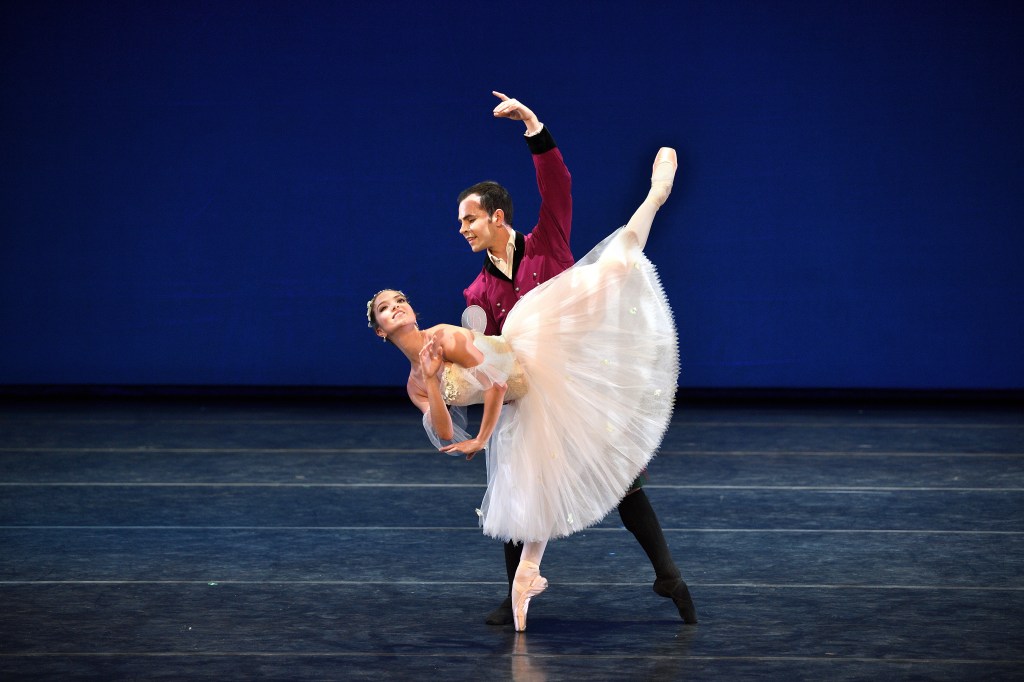
In October last year Jodie and Rosie went to see English National Ballet’s quadruple bill R:Evolution at Sadler’s Wells, which opened their 2025-26 season. The programme brought together George Balanchine’s Theme and Variations and Martha Graham’s Errand into the Maze, both from the year 1947, followed by William Forsythe’s Herman Schmerman (Quintet) (1992), and David Dawson’s 2023 Four Last Songs.
Looking back at 2025, this programme unexpectedly ended up being a highlight of the year, as we found so much to discuss …
Rosie: To be honest, I was quite sceptical about this bill. The last time I saw Errand into the Maze was when the Martha Graham Dance Company visited the Barbican in 1999. Even back then I thought it looked quite dated, and the reaction of some audience members corroborated this feeling. And I wasn’t sure how it would “fit” with the other works. But it’s quite clear from the reviews that the variety of dance styles was seen as a highlight, a really strong point of the billing (Murphy; Weiss, “ENB: R:Evolution”; Winship).
Jodie: I know what you mean, but I felt I went in almost completely ignorant—apart from the joyful Herman Schmerman Quintet, I’d never seen any of the other works before.
Rosie: But you’re familiar with choreographic styles of Balanchine and Graham, right?
Jodie: Ha yes, and well enough to know that the combination seemed like a buffet-style spread; choreographic prowess aside, I wondered if this eclectic concoction might turn out to be immiscible.
Rosie: As it was, to me Errand, which was the work I was most hesitant about, looked really fresh. I thought maybe because it was new to the Company, or perhaps precisely because it was in the context of contrasting works. As far as I know, ENB’s never performed any Graham before, but I always think that one of the strengths of the Company is the dancers’ willingness to go for different styles—I’m thinking Akram Khan, Pina Bausch, for example. When it came to it, I relished watching the dancers rise to the challenge of such varied styles, but I did feel a distinct jolt moving straight on to Herman Schmerman after Errand, with only a few minutes’ pause—I was still deep in Ariadne’s world when Herman Schmerman was starting.
Jodie: I agree that the shift from Errand to Herman felt abrupt, almost like a bit of a whiplash. Because everything about them felt different—the form, the structure, the atmosphere, even the colour palette. And being my two favourite works of the quadruple bill, I would have liked to see these bookend the night— I imagine that Errand would have had the audience entranced from the outset.
Rosie: So Herman Schmerman at the end? I’d also love to see the Herman Schmerman Pas de deux with the Pas de cinq. It’s so cool when the five dancers jump over the barrier at the back, look at each other and collapse to the floor, like they’re kids playing a game, and then the duet starts with the couple stepping over the same barrier.
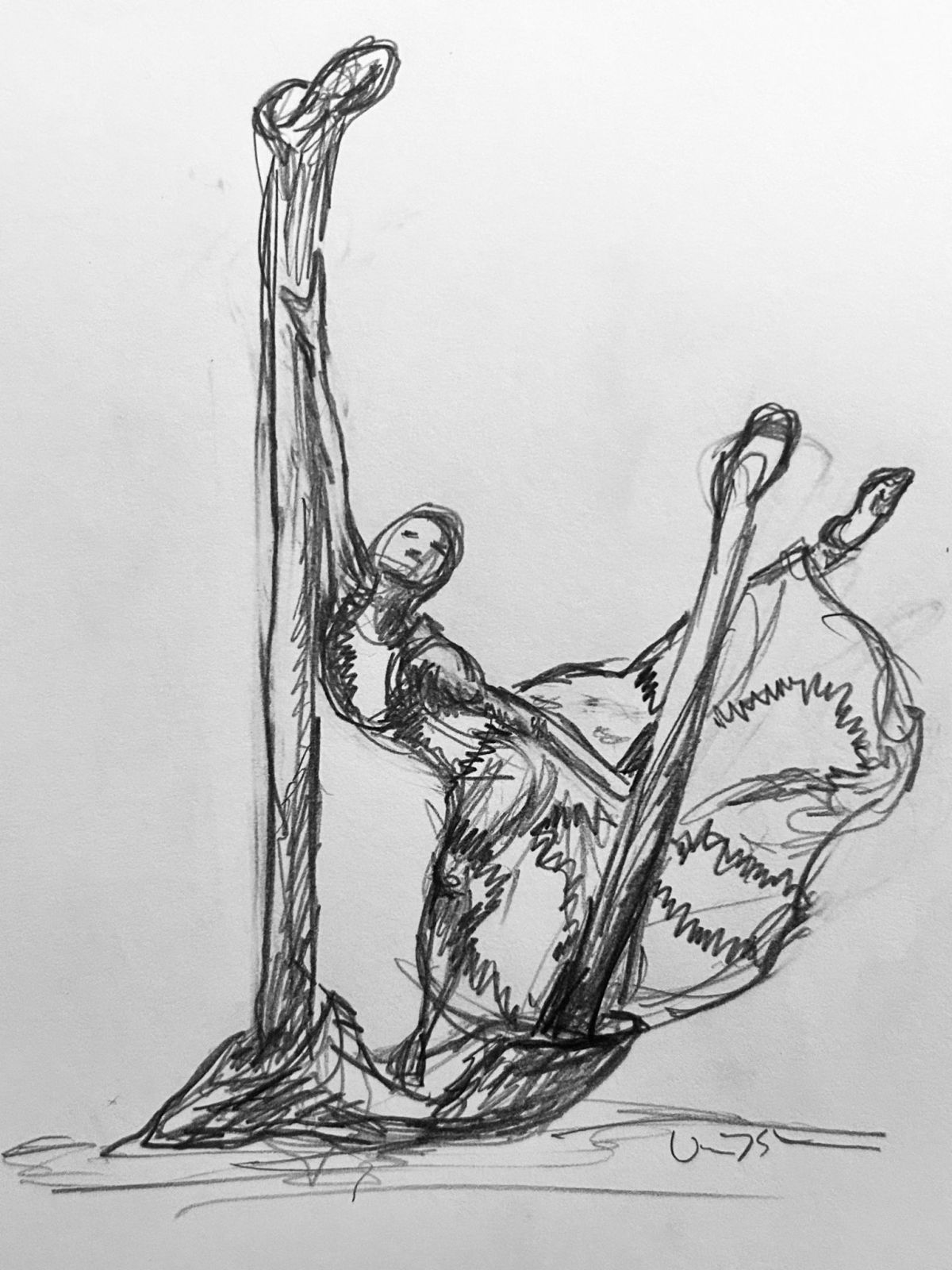
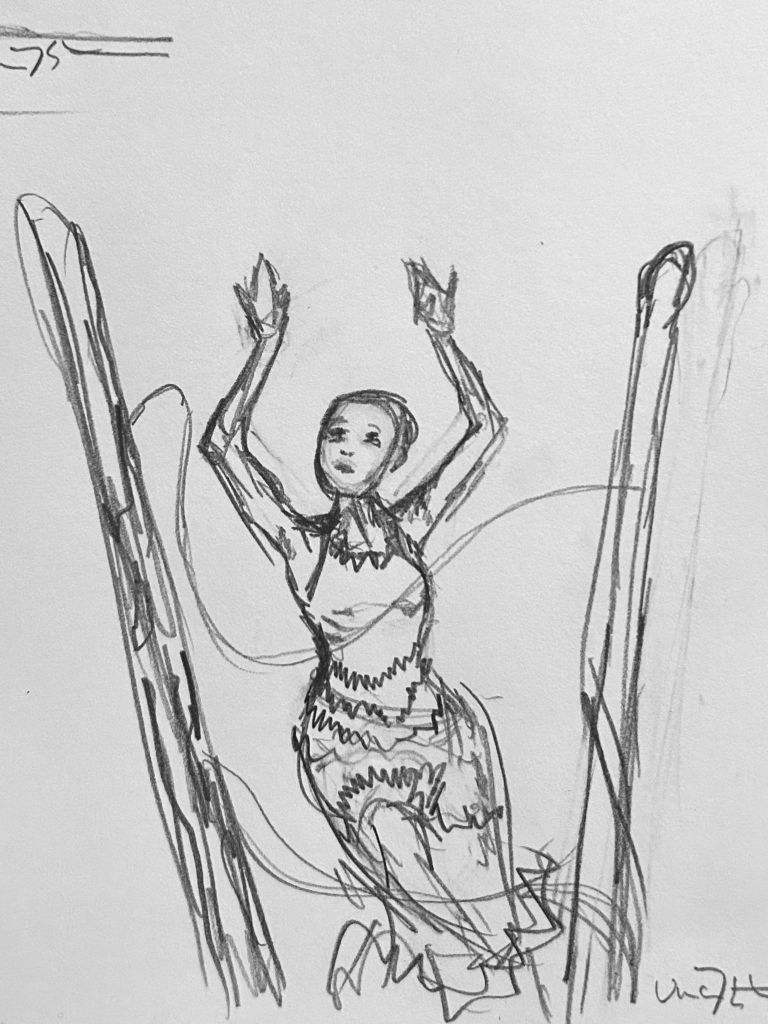
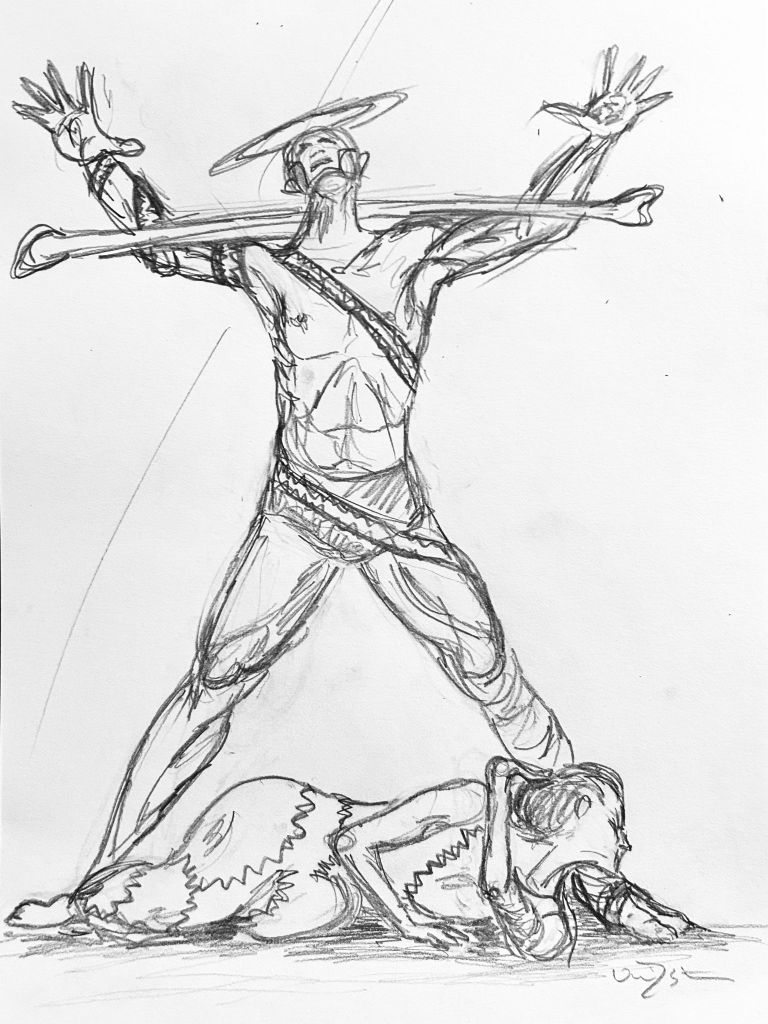
Jodie: The first time I saw the dancers drop behind the riser, I found it a little too tongue-in-cheek—you know, like physical punctuation to the end of the performance, in tandem with a classic blackout. It felt a bit self-conscious. But now I have come to love and appreciate Forsythe’s crisp and unserious customs. It is funny how that happens. But can we go back to Errand? One of the things I loved was that Theseus does not feature in the work, so the woman conquers the Creature of Fear (her fear) by herself, on her own. Who knew?
Rosie: I feel sure that my perception of the work was influenced by “The Truth about the Minotaur”, an episode of the podcast Betwixt the Sheets. By all accounts Theseus was not at all worthy of Ariadne. The programme quotes Graham as conceiving the Woman as a female remaking of Theseus, presumably because it is she who overthrows the Creature of Fear, rather than being the one who helps Theseus to do this.
Jodie: I want to quote Lindsey Winship and her alliteration:“Stark, striking, and stylised”. I also sensed an independent strength. For me, much of that came from Emily (Suzuki)’s performance, the Woman appearing stalwart despite her sinuous voyage into the self. Rhythmically Emily is so precise—punchy and committed.
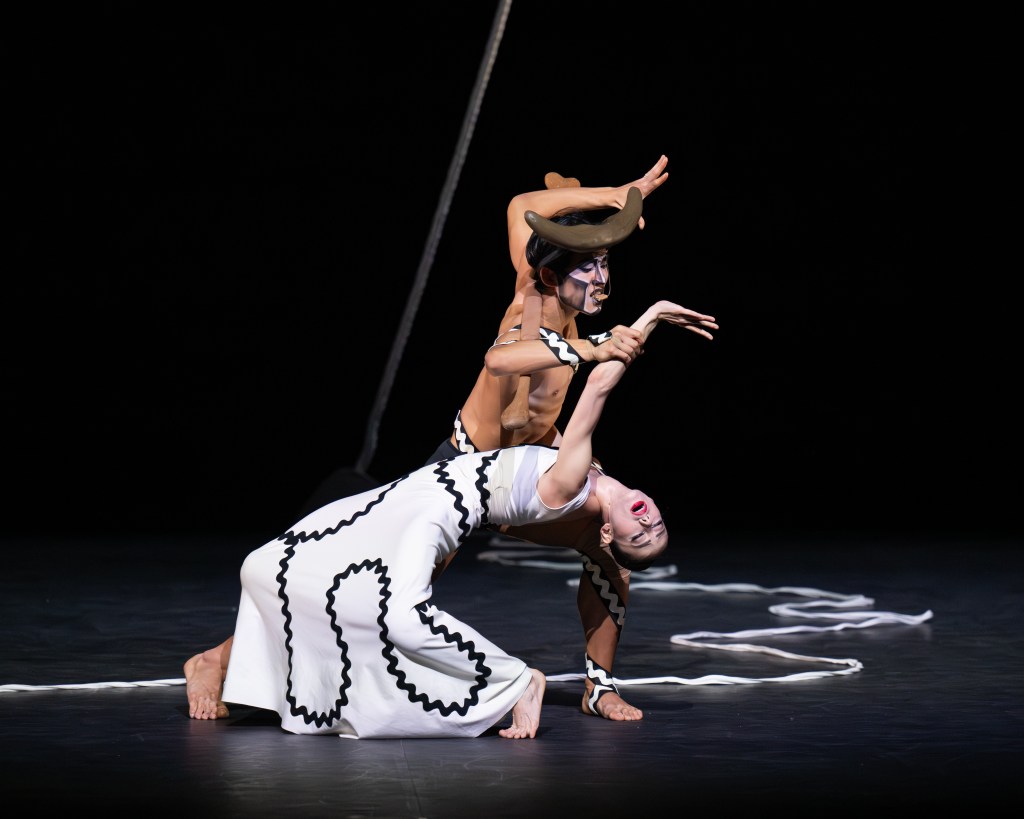
Rosie: Of course I was thrilled that Emily was the first cast for Errand. She is such a superbly versatile dancer with such impressive dramatic gifts. I first noticed her in Pina Bausch’s Rite of Spring, but she is equally suited to classical roles, such as the Satanella pas de deux that she performed in the Emerging Dancer Competition in 2020 (we wrote about her at the time). She was chosen for the first cast when William Forsythe brought his Blake Works I to ENB, and Mats Ek created the role of the Daughter on her in his adaptation of the Rite of Spring (2022). But probably my favourite was her rendition of the Ratchuli, the Georgian character dance from Tamara Rojo’s adaptation of Raymonda. She just blazed with fun and energy. I’m really happy that she’s the poster girl for the 10th anniversary of Akram Khan’s Giselle, and performing with James (Streeter) on first night.
Jodie: I just want to say one more thing about Errand, about Ariadne’s dress —it’s understated, yet so audacious against the minimalist set. It all feels very Modern…
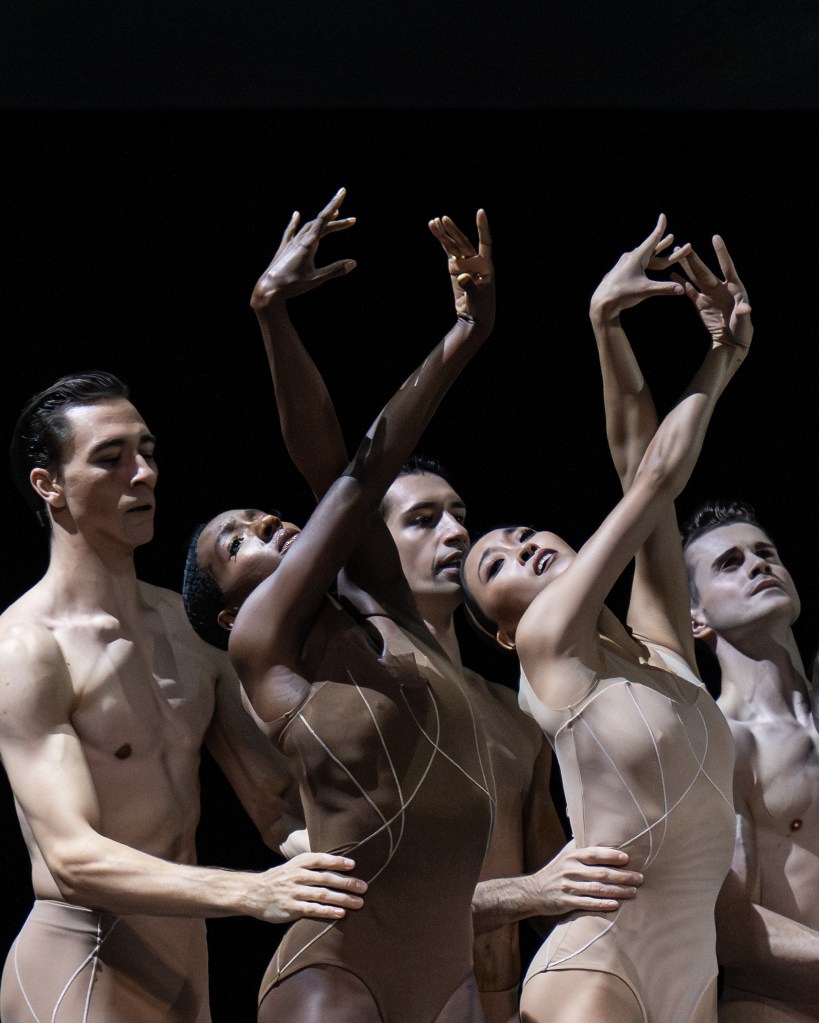
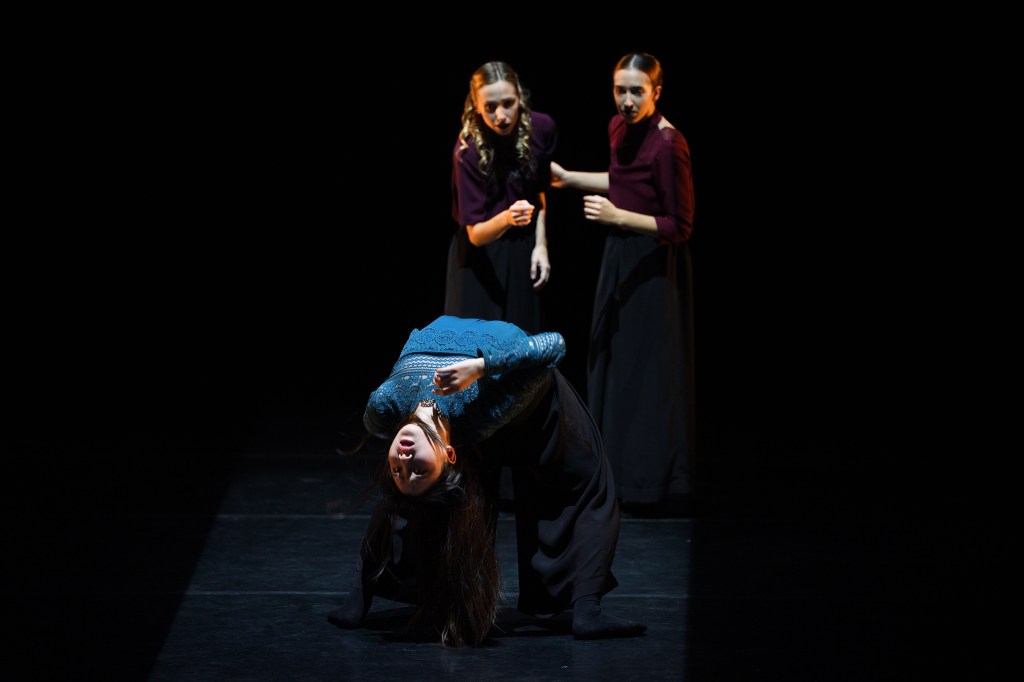
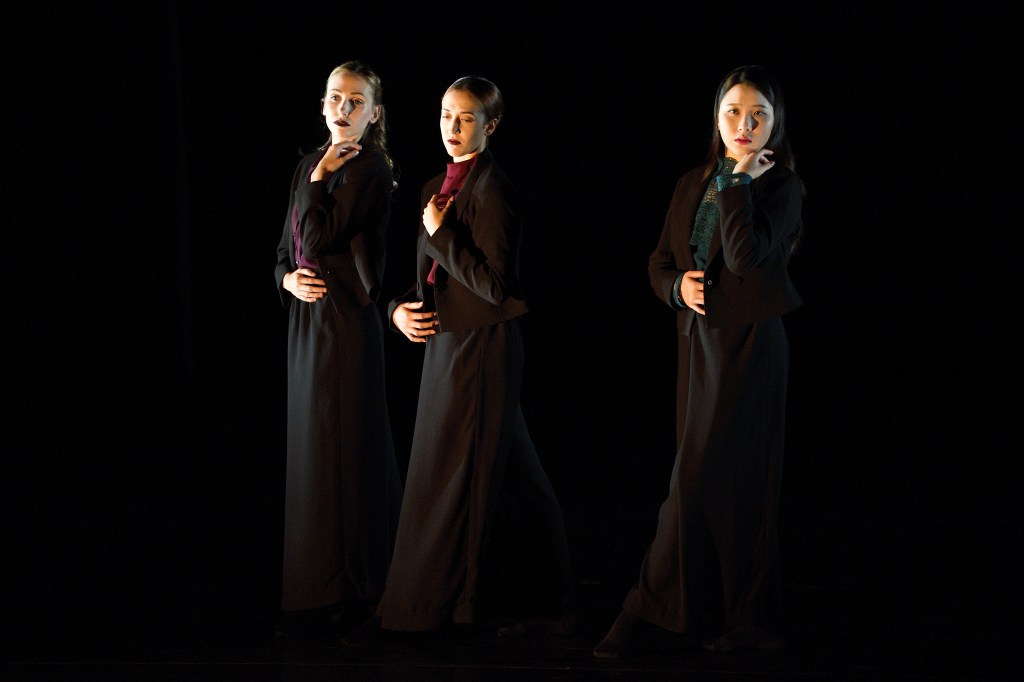
Rosie: Very different to the nude tones of the Four Last Songs costumes. Some of my friends absolutely loved Four Last Songs. I do understand in a sense. The dancers perform it so well, with such conviction, and there is an appealing melancholy about it and a sense of spirituality that comes from the poignant music, written by Richard Strauss when he was nearing the end of his life. I think the atmosphere arises too from the seamless choreography that shows the dancers merging into configurations which then unravel and move calmly into new patterns. There are many beautiful moments, notably when dancers rest for a moment of unison into a gentle gestural pose. Like the one where their right hand makes a soft curve by their cheekbone, while their elbow is resting lightly on the wrist of the other arm. To me it’s a really pensive pose, and it reminds me a lot of Macmillan’s wonderful Requiem, which he made in 1976 to the music of Gabriel Fauré.
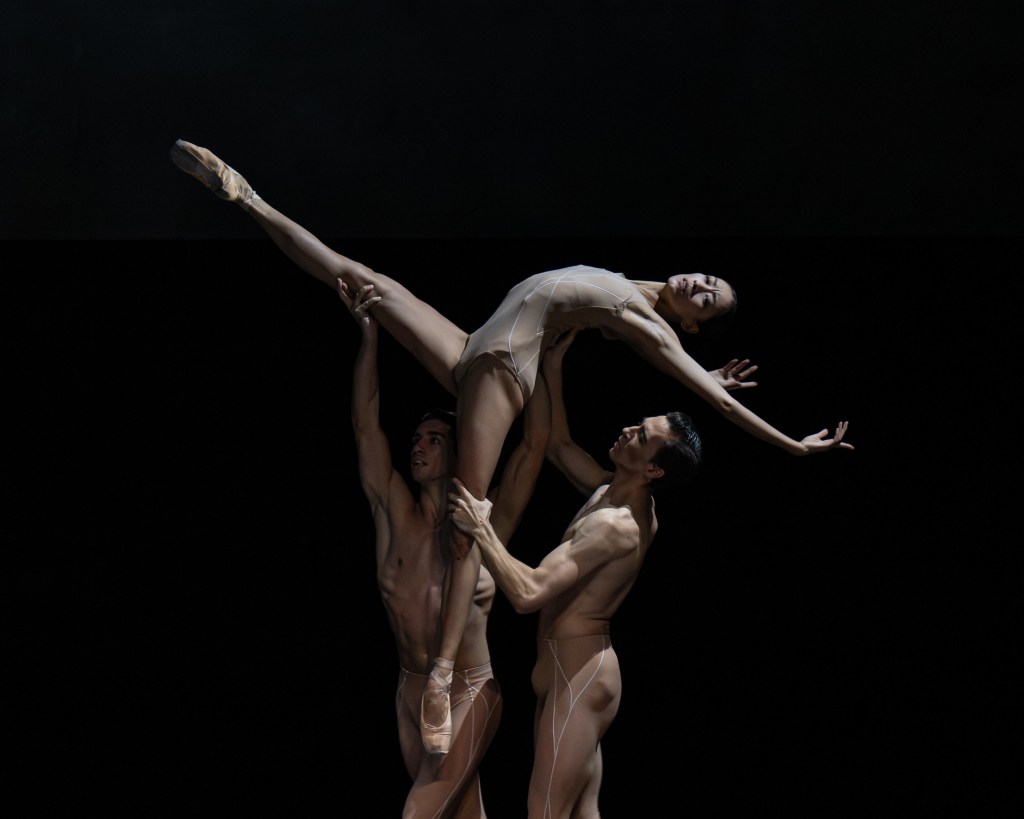
Jodie: Yes, I found some of the movement phrases poignant, and I was quite captivated by stolen moments of gentle gesturing and fleeting instances where the women moved their arms freely, invoking statuesque figures in an overgrown Garden of Eden.
Rosie: You like to capture the movement through imagery, don’t you?
Jodie: Indeed I do!
Rosie: But I find it disappointing that this work, which was made only a couple of years ago, is so dominated by male dancers lifting and tossing female dancers. In fact, I found a review that put my thoughts into words better than I could. Lucía Piquero of Gramilano wrote “I doubt there were 30 straight seconds in which a female dancer moved without being lifted or manipulated by a man, other than when walking or running”.
Jodie: Oh yes, I furiously agree with that. The throwing of women was incessant to my eyes: by the third throw it had lost its impact. I enjoy a refined and minimalist choreographic palette, but I feel there were just too many lifts. Especially as when they weren’t in the air, the women were being held, dragged, and manipulated on the ground. I was yearning for more between the running and the lifting. On my way home I tried running along the streets like a Four Last Songs dancer—arms outstretched, wrists flexed, searching for hope skyward, wondering how I might have developed the choreography …
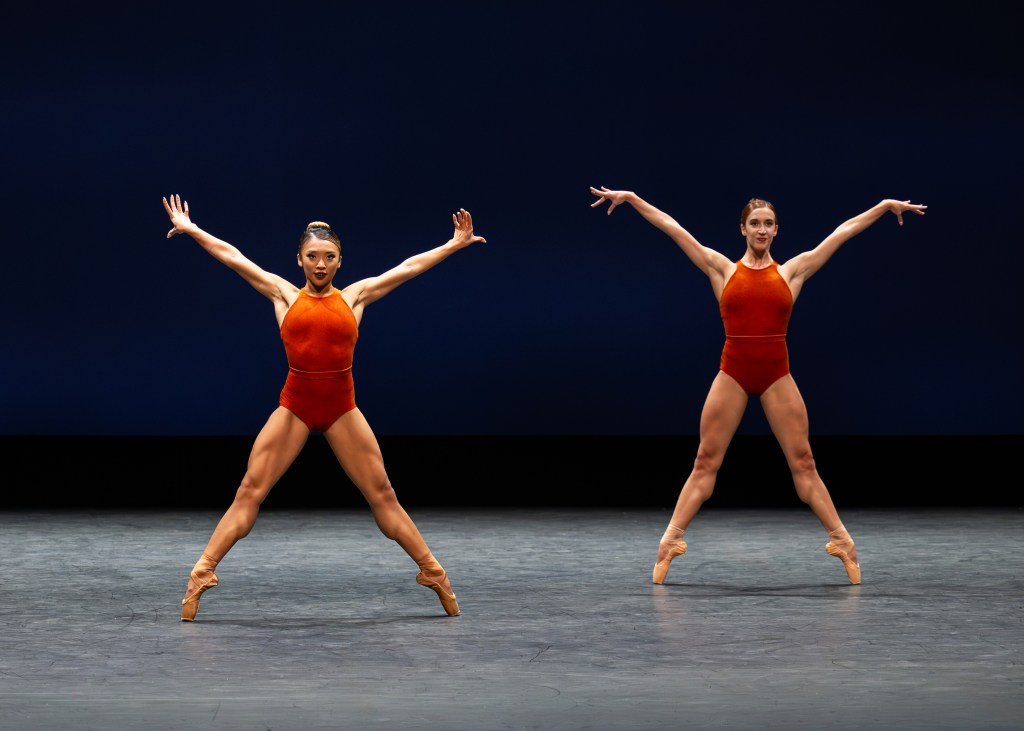
Rosie: Of course the women in the Herman Schmerman Pas de cinq are a completely different species. My knowledge of the ballet comes from a YouTube recording of the Bolshoi Ballet. All the dancers are in black (the original Versace designs, I believe), and the women all look like Amazons, but I like watching it with ENB partly because there are Amazonian dancers in the Company like Alice (Bellini), but they’re juxtaposed with pocket rockets like Carolyn (Galvao). And then there’s Swanice Luong, who dances as if to the manner born. She’s one of the dancers who followed Aaron Watkin to ENB from Semperoper Ballet in Dresden, and so has had experience of dancing Forsythe’s works. There’s a lovely Instagram reel of her talking about Forsythe’s influence on her (English National Ballet).
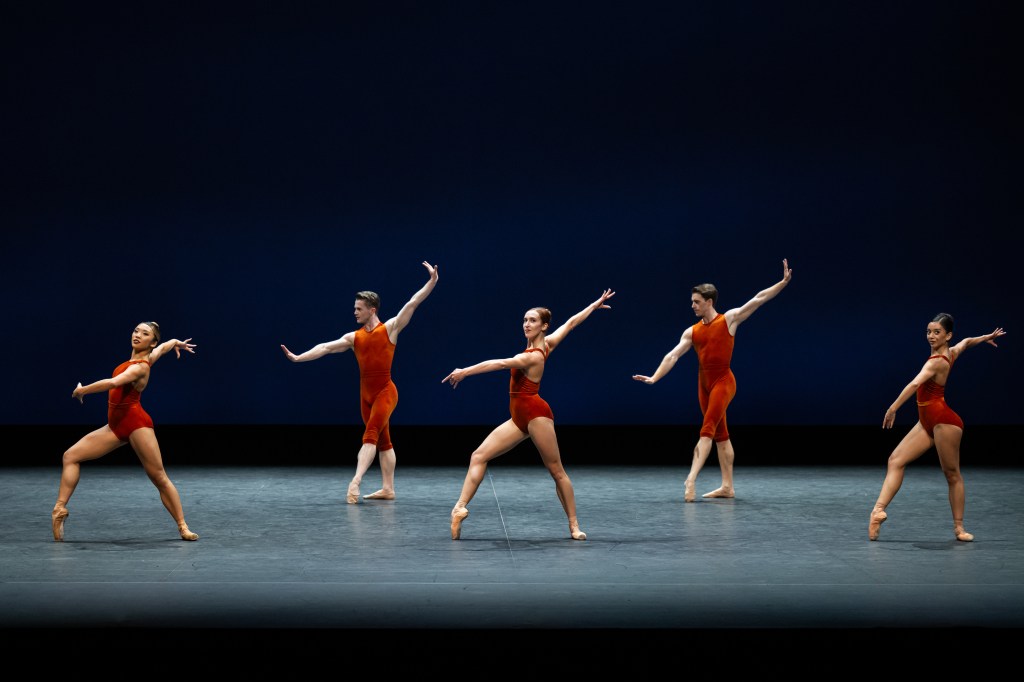
Jodie: I only ever see lines when I watch Forsythe’s works, lines and their point of initiation. The architecture of the body and the vacant spaces between sing with such style, swagger, and slick. It’s truly a task not to move in your seat. Herman Schmerman reminds me so much of Blake Works I, or rather Blake Works I reminds me of Herman Schmerman–same font, different colours.
Rosie: Again, I like that image! Talking of colours … The orange-red velvet costumes worn in this production do give the work a different visual impact and even a different mood, I think. Forsythe said he was “curious to see if it altered the perception of the work” (qtd. in Sulcas 17), and I thought the dancers were channelling more cool and fun than the recording I’m familiar with.
Jodie: Yes, even though I’ve just said it’s the lines in the choreography that hit me when I’m watching, I get that mood that you’re talking about. But also I thought that Dani (McCormick) and Noam (Durand) really seemed to have the measure of the choreography with great ripples through the body, fearless off-balance movements, to say nothing of the exciting syncopations.
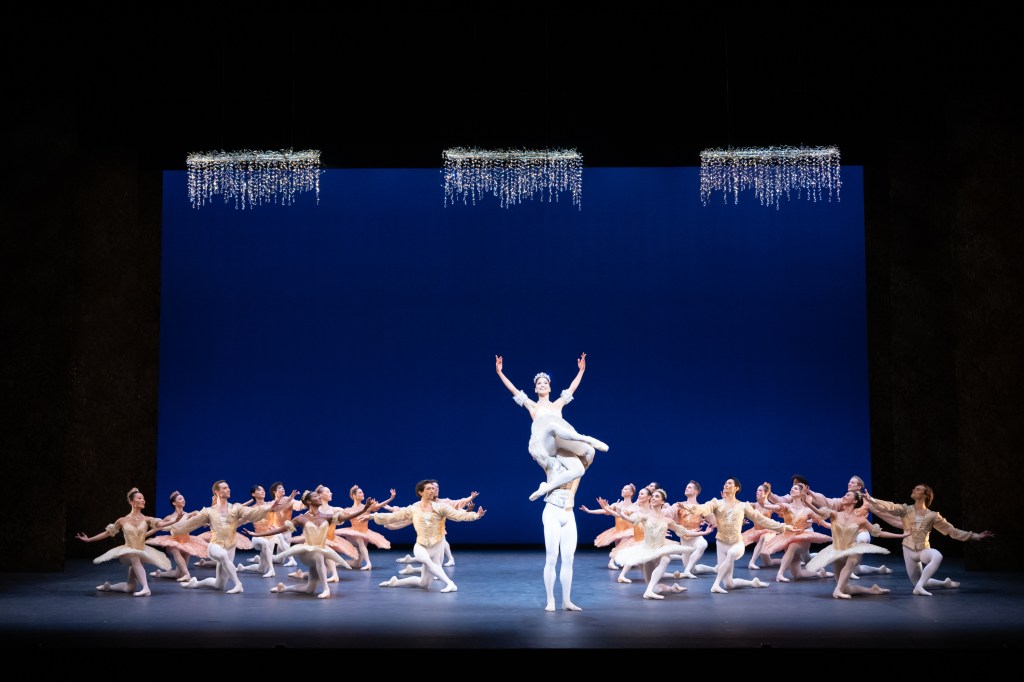
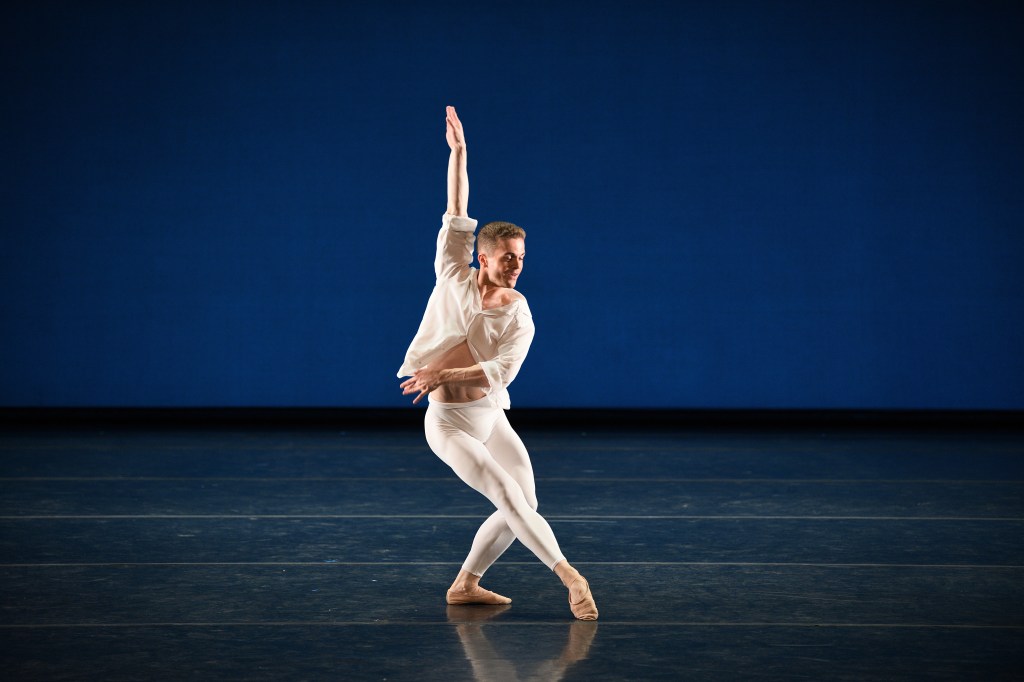
Rosie: One of my friends said that Herman Schmerman was her favourite of the four pieces because of its fast-paced choreography and its technical challenges. But I feel that Theme and Variations is more exacting and exposing—there’s just nowhere to hide. Like that series of tours en l’air into pirouettes from 5th position for the male principal, and the sequence of pas de chat into soutenu, then pirouette from 5th for the ballerina. When Aaron introduced the work into ENB’s rep, he wanted to make sure that the tempo was appropriate for Balanchine, so it was coached by Cynthia Harvey who used to dance it at “Gelsey Kirkland tempo” (qtd. in Weiss “George Balanchine” 8). I have to say that for me tempo is crucial to Balanchine works. Earlier this year the Royal Ballet performed a triple bill of Balanchine works, and a really important contribution to my enjoyment was that the music was conducted by Fayçal Karoui, who was music director of New York City Ballet for over five years.
Jodie: I so enjoy hearing your many stories of the ballet—particularly when you so meticulously debrief on the multiple casts, noting the subtle but never insignificant nuances between their performances, always calling into question personal, and perhaps in this case even national style (though discussing the orchestral conducting it may be).
Rosie: Of the casts I saw, my favourite principals were Dani and Julia (Conway), both “home-grown” dancers, so to speak: they were both winners of Emerging Dancer (Dani in 2018, Julia in 2019). Dani was a gracious partner, supporting Julia and mirroring and complementing her lines, and he nailed those ferociously challenging tours en l’air with pirouettes from 5th position. Wonderful rhythm too. As soon as Julia came on stage I noticed a beautiful “spring” in her steps, making all her movements appear light and breezy. As well as beautiful lines and ports de bras, she did those wonderful turns that I love—really speedy with those sloooow endings that make the dancing look both exciting and easeful. To me she seems to be developing a true ballerina aura too, which makes be very happy.
© British Ballet Now & Then
References
English National Ballet [@englishnationalballet]. Interview with Swanice Luong. Instagram, 3 Oct. 2025, https://www.instagram.com/reel/DPWszkkDFJC/.
Murphy, Siobhan. “English National Ballet: R:Evolution review”. The Stage, 2 Oct. 2025, https://www.thestage.co.uk/reviews/english-national-ballet-revolution-review-sadlers-wells-london.
Piquero, Lucía. “Review: English National Ballet’s R:Evolution – a beautiful dance down memory lane”. Gramilano, 5 Oct. 2025, https://www.gramilano.com/2025/10/english-national-ballet-revolution/.
Sulcas, Roslyn. “William Forsythe’s Herman Schmerman (Quintet)”. Programme for R:Evolution at Sadler’s Wells, London, 2025, pp. 16-17.
“The Truth About The Minotaur”. Betwixt the Sheets, hosted by Kate Lister, BBC Sounds, 30 May 2025, https://www.bbc.co.uk/sounds/play/p0lf466w.
Weiss, Deborah. “ENB: R:Evolution at Sadler’s Wells showcases tenacity, legacy and talent”. Bachtrack, 2 Oct. 2025 https://bachtrack.com/review-revolution-balanchine-graham-forsythe-dawson-english-national-ballet-sadlers-wells-london-october-2025.
—. “George Balanchine’s Theme and Variations”. Programme for R:Evolution at Sadler’s Wells, London, 2025, pp. 8-9.
Winship, Lindsey. “English National Ballet’s R:Evolution review – a triple whammy of Balanchine, Forsythe and Graham”. The Guardian, 3 Oct. 2025, https://www.theguardian.com/stage/2025/oct/03/english-national-ballet-revolution-review.




 British Ballet Now & Then