In Conversation: English National Ballet’s New Nutcracker (2024)

November 2024 saw the world premiere of a brand-new Nutcracker for English National Ballet (ENB), choreographed by Aaron Watkin (Artistic Director) and Arielle Smith, and with designs by Dick Bird.

The Nutcracker was the subject of our very first British Ballet Now & Then blog post in 2017, when we wrote about ENB establishing the tradition of performing the ballet annually in this country.
In December 2024 and January 2025 Rosie and Rebecca went to see the new production, and here are their thoughts …

Rosie: Shall we start by talking about the designs? I was following the posts on ENB’s social media before I first saw the production, and I really enjoyed watching the interview with Dick Bird where he discusses the sets and costumes.  I loved the idea that we experience the Edwardian setting inside an Edwardian theatre—the London Coliseum. 

Rebecca: Yes, I really enjoyed the setting in Edwardian London with the nods at Mary Poppins—the Chimney Sweeps and Suffragettes.  It made the setting seem very familiar.
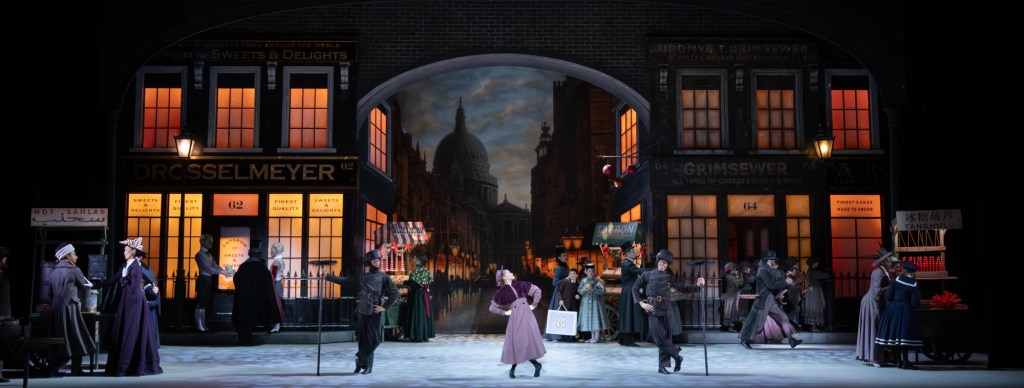
English National Ballet dancers © Photography by ASH

Rosie: On the other hand, I don’t think there’s any getting away from the fact that Cheesemonger Uromys Grimsewer with his gang of Street Children look like they come straight out of the pages of Oliver Twist, which was published in the 1830s, but I don’t think there’s any point in being picky about historical accuracy in this case.

Rebecca: Ha, I think that’s ok, though—no one is claiming realism, and they’re all connected to London history, or familiar literature set in London and made into musicals.  And Grimsewer is a fantastic name!

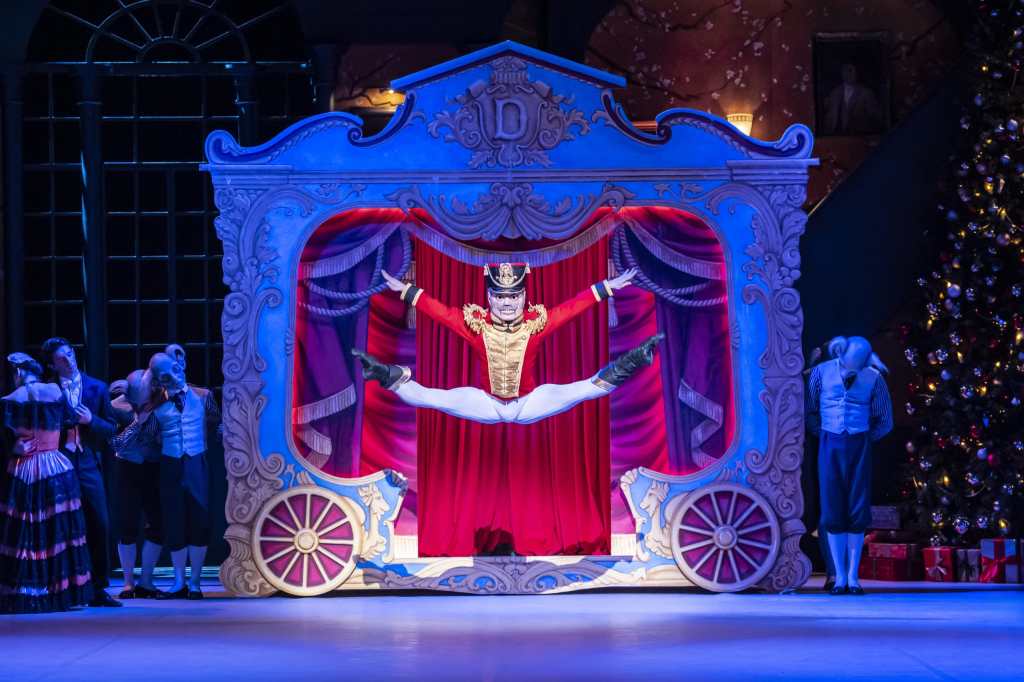
Rosie: I think Dickens would approve … Even before the performance started I was entranced by the frontispiece: I loved the way the tree baubles glistened and was fascinated by the Nutcracker’s mouth opening from time to time.

Rebecca: That’s exactly the kind of detail in design that I loved—I don’t think I’ve ever seen a Nutcracker costume with a lever at the back.  And then there was the Knight in Shining Armour—you could see the joints really clearly.  That attention to detail is something I really appreciated.

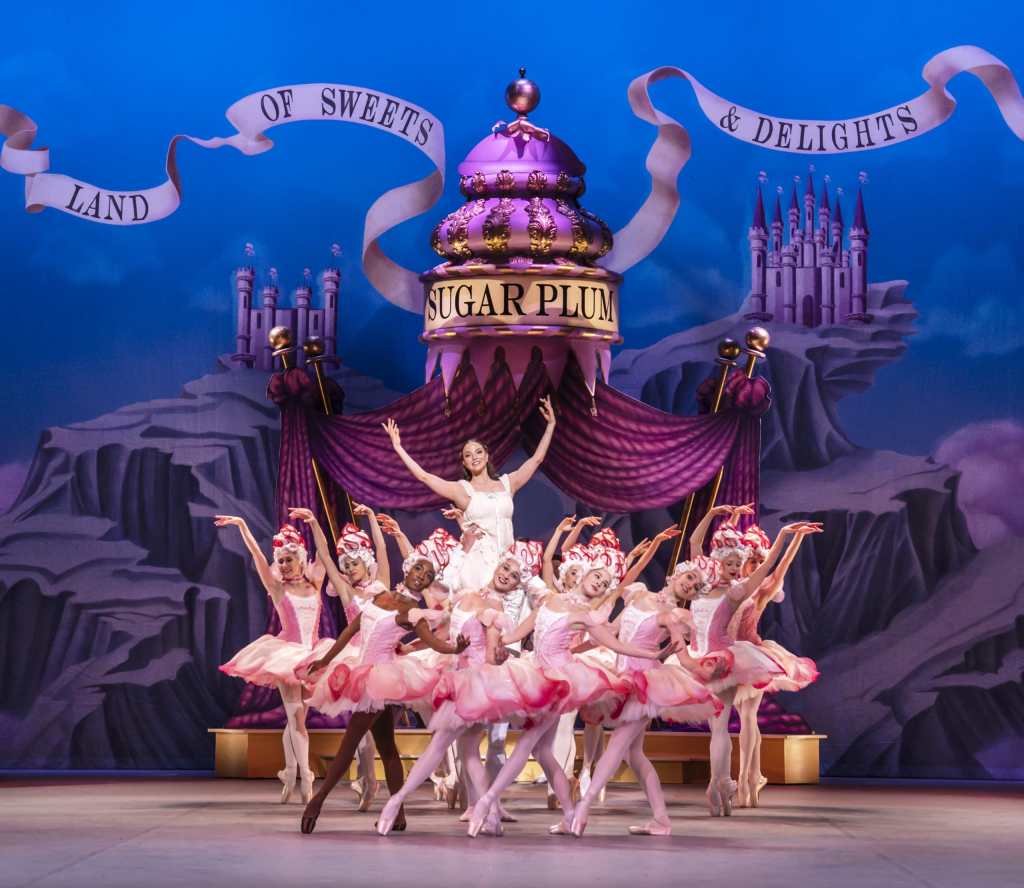
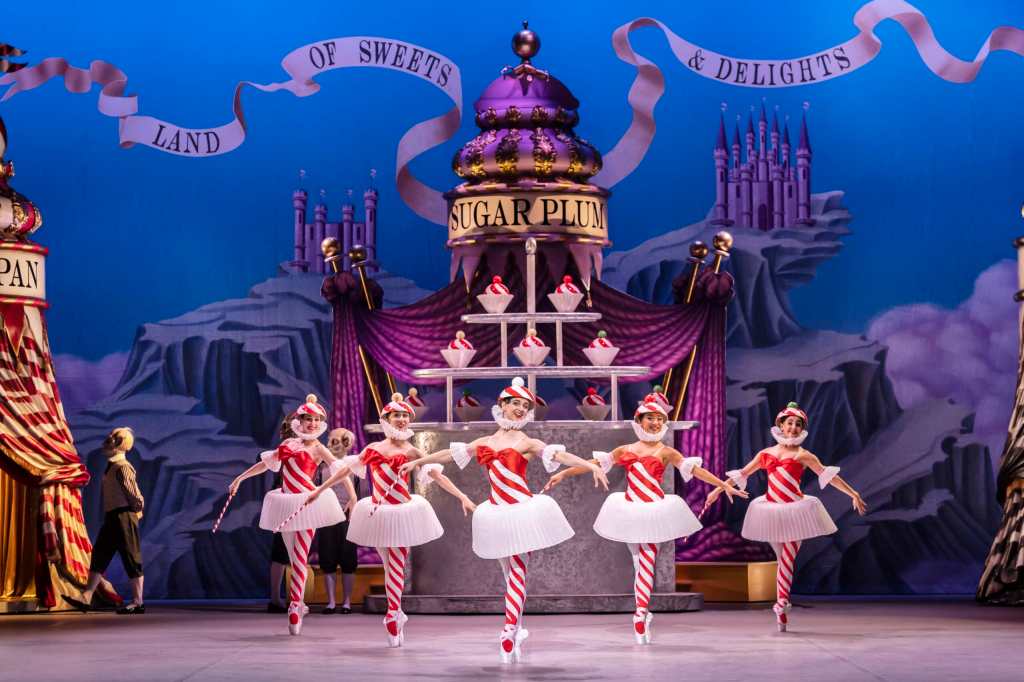
Rosie: I noticed it in particular in some of the headgear in Act II, set in the Land of Sweets, like the cinnamon stick hats and headdresses for the Buttercream Roses.
Rebecca: And the Liquorice top hat.

Rosie: Do you know, I think everyone I’ve spoken to loved that dance, maybe because of the combination of design and choreography, and perhaps because of the children too. 

Rebecca: I’m interested, because I’m not familiar with the music for that dance.

Rosie: It’s not actually in all productions I’ve seen, but it was originally for Mère Gigogne.  In Balanchine’s Nutcracker she’s called Mother Ginger, but she also appeared in London Festival Ballet’s 1957 production by David Lichine with the name of “Madame Regnier”.  She’s similar to the Old Woman who Lived in a Shoe.   She comes on stage in a huge frock, then her children run out from under the frock, and after they dance they return underneath her petticoats again.

Rebecca: Oh I see.  So there’s a direct link—now the children come out of the Liquorice Allsorts box.

Rosie: Yes, and the Grandmother from Act I is on top of the box.  

Rebecca: I thought the children looked great in their Liquorice Allsorts outfits and their movements complemented the soloist’s choreography well.  He had lots of quirky bendy, bouncy, curvy movements …

Rosie: Haha! Quirky and bendy—just like Liquorice Allsorts!  Yes, I see circles all over the place—on the costumes for the children and the soloist round the arms, legs and bodices, in the soloist’s port de bras and the funny little circles of his head.  I think the choreography reminds me of Bassett’s Catherine wheels and bootlaces, and the round coconut flavoured ones in pink and yellow.

Rebecca: Memories of childhood … Again, you could see the different Allsorts in the children’s tutus and headdresses.  I read in the programme that a phenomenal number of balls were sewn into their costumes to represent the aniseed-flavoured ones in blue and pink.  And it really did pay off.

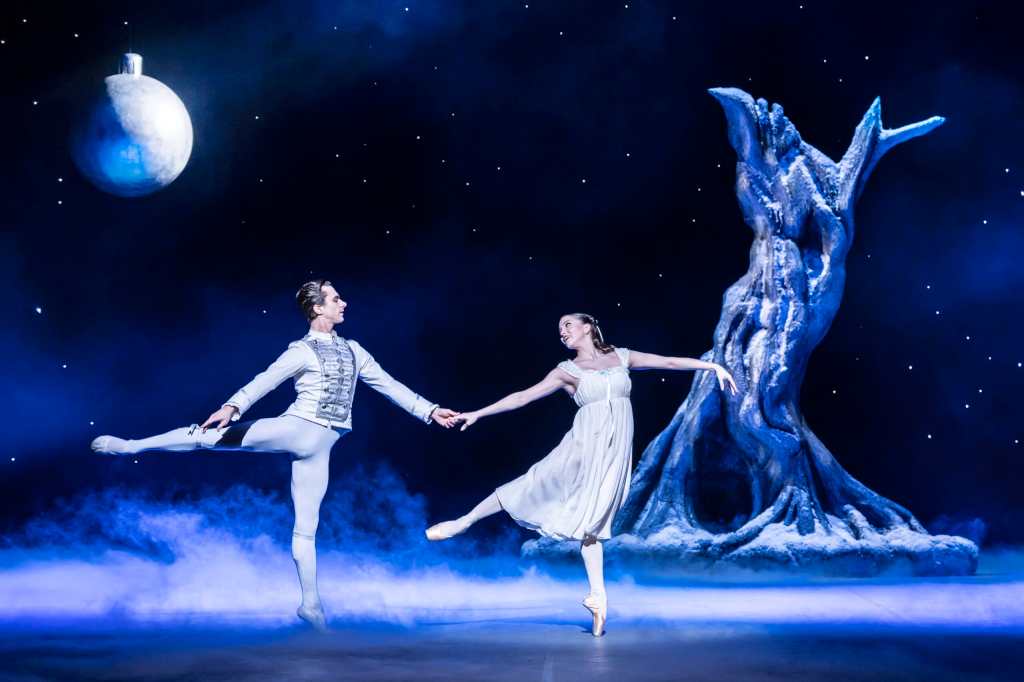
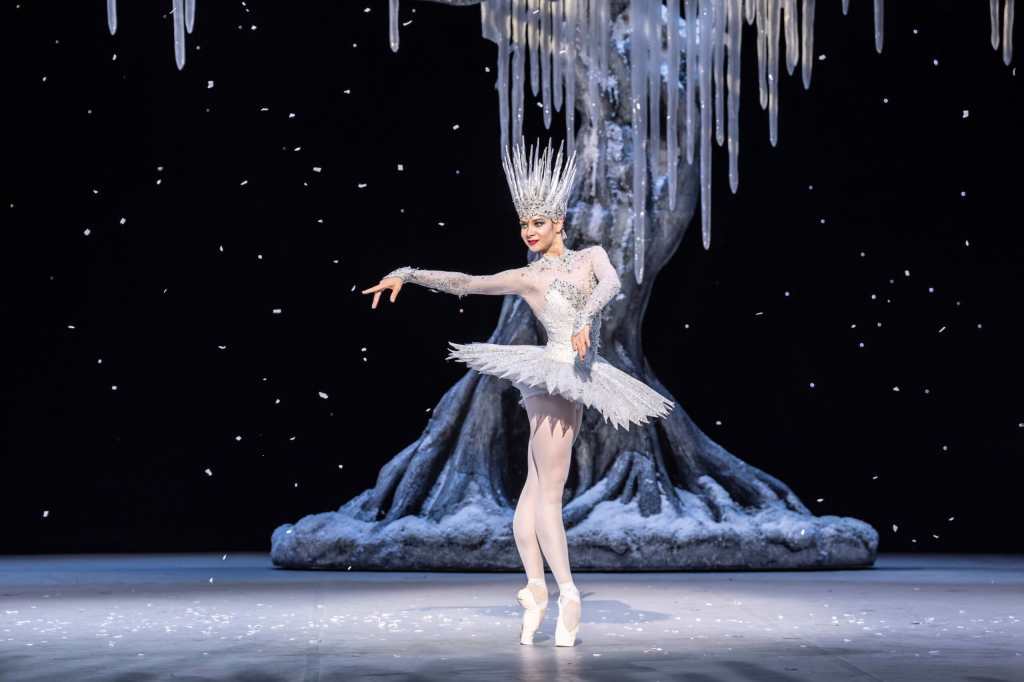
Rosie: I think design is probably more important for you than me, but I couldn’t help gasping when the curtain opened on the Ice Realm.
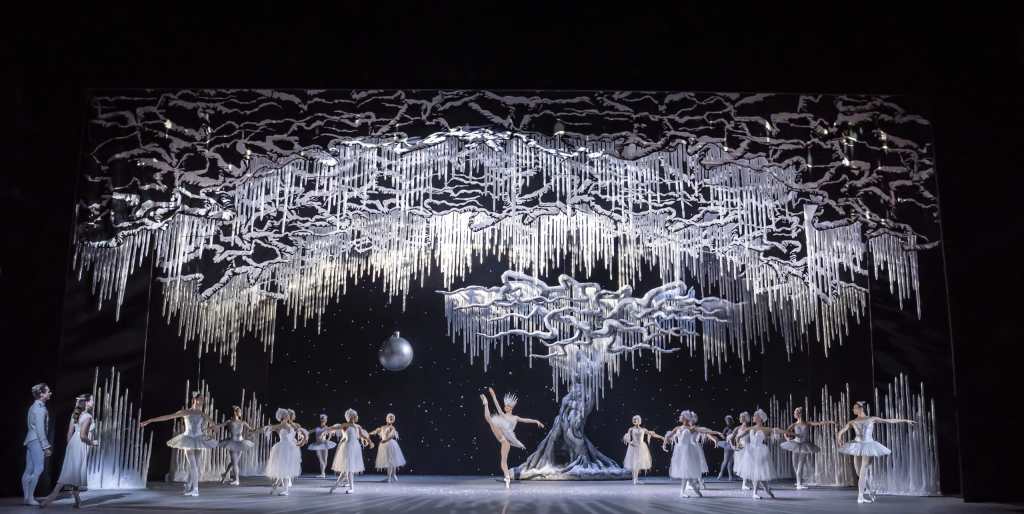
Anna Nevzorova as Ice Queen (c) Johan Persson

Rebecca: Yes, all the glittering ice stalagmites, and stalactites cascading down from that fantastical tree.  Magical.  But what did you think of the choreography? I know you love the Royal Ballet “Dance of the Snowflakes”.

Rosie: Yes, I do.  It’s not just that it’s based on the original choreography by Lev Ivanov (there’s a notation score for it), but the imagery of the snow is really clear—the dancers are constantly moving, weaving in and out, making snowflake patterns, fluttering their hands, then blocking together like a snowdrift.  It all looks very easy and organic. 

Rebecca: Yes, this new choreography didn’t quite have that fluidity, though I guess the dancers are icicles and snowflakes, so it’s not quite the same.

Rosie: Ah, I didn’t really twig that.  What I did enjoy was the Ice Queen’s Italian fouettés.  I just love them—they’re so expansive and regal—but they don’t seem to be included in many ballets: I can only think of Gamzatti in La Bayadère, the Queen of the Dryads in Don Quixote, and the Lilac Fairy in some productions of Sleeping Beauty.  So, ideal for the Ice Queen.
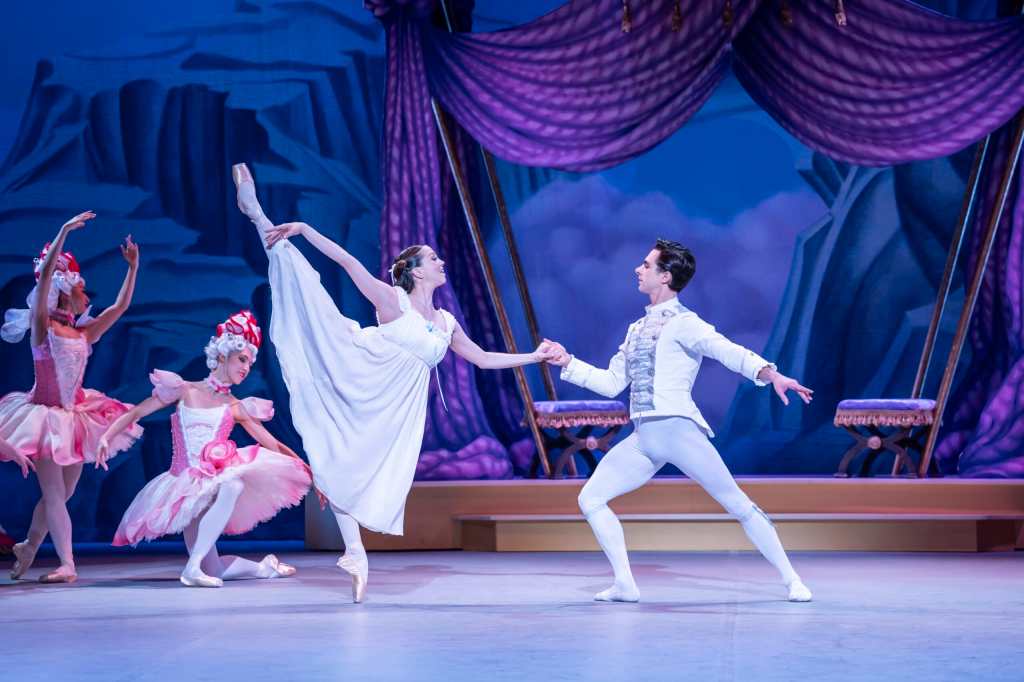
Rebecca: Something in the choreography that felt fresh to me was the way people were paired up in the Party Scene.  I found it so refreshing to see women dancing with women as well as men, and girls dancing with one another, as often happens in real-life social gatherings.  The social dancing in Nutcracker is so often too cleanly segregated according to gender.

Rosie: Exactly.  And I love that it wasn’t only the boys who were being boisterous, noisy and disruptive.  Let’s not pretend that girls can’t be boisterous too.

Rebecca: So lots to enjoy, and it looks really revitalised as a production.

Rosie: Yes, it does, and it’s a big cast, so plenty of opportunity to see lots of our favourite dancers. 
With thanks to our good friend Rebecca for her contribution to this post  

English National Ballet perform The Nutcracker at the London Coliseum 11 December 2025 to 11 January 2026.
© British Ballet Now & Then
The Nutcracker Now & Then

The Nutcracker Now

It strikes us that despite its ever-growing popularity, The Nutcracker presents something of a conundrum.  As last year, all the major ballet companies in the UK are performing runs of The Nutcracker, which stretch from the end of November into the new year. Of the three Tchaikovsky ballets Swan Lake (Petipa/Ivanov, 1895), The Sleeping Beauty (Petipa, 1890), and The Nutcracker (Ivanov, 1892), with their magnificent scores, the Christmas ballet is the work with the least dramatic coherence and the most varied choreography from production to production.  The result of this is that the identity of the work relies predominantly on the musical score, made famous by the suite of numbers performed in the concert hall, used for Disney’s 1940 Fantasia and numerous television adverts, and perhaps on a few key figures and events, such as Drosselmeyer, the Sugar Plum Fairy, the battle between the Toy Soldiers and Mice, and the growing Christmas Tree.

One problem for lovers of narrative ballet is that we are accustomed to works that offer the ballerina a central role combining complexity and variety in choreography, and development and contrast in characterisation.  Just think of Giselle (Coralli/Perrot, 1841), Swan Lake, Onegin (Cranko, 1965), and Manon (MacMillan, 1974), to name but a few examples. In fact, the original production of The Nutcracker was criticised for including “only one classical pastor the ballerina, and this near the end of the second act” (Wiley 199).  Yes, it’s a long time to wait, if you have booked a ticket specifically to see a beloved ballerina dancing the Sugar Plum Fairy …

In the eyes of some audience members this situation is undoubtedly exacerbated by the fact that the main character, Clara, is a child, and Act I is populated by children.  Dick Godfrey highlighted this issue in his review of Scottish Ballet’s performance last year, a revival of Peter Darrell’s 1973 production after over forty years: “Darrell’s bold – and in many ways admirable – decision to cast children in the roles of the children instead of the more commonly found young professionals limits the amount of dance he offers”.  The Royal Ballet production addresses this dilemma by casting a young-looking company member as Clara.  This can be seen in recordings on DVD, for example with Miyako Yoshida as the Sugar Plum Fairy and Alina Cojocaru as Clara in 2001, and Lauren Cuthbertson and Francesca Hayward in the same roles in 2016.  And in truth the opportunity to see a budding star of the calibre of Cojocaru or Hayward can imbue the performance with a wonderful sense of excitement.

In English National Ballet’s current production staged by Wayne Eagling in 2010 the child Clara dreams of growing up and falling in love, and consequently dances the grand pas de deux that concludes the ballet.  In this case we can gain an enormous amount of pleasure from seeing a ballerina capable of expressing both Clara’s teenage youthfulness and the grandeur required of the grand pas de deux.  Describing Tamara Rojo’s performance at the end of Act I Graham Watts writes: “it is astonishing how Rojo peels away the years to become an excited, wide-eyed teenager on stage”.  In contrast, by the end of Act II, “her experience shows in the way that she deploys contrast, from the soft-backed swoop of her promenades with Berlanga in their opening duet to the steely verticality of her triple fouettés in the coda” (Jennings).

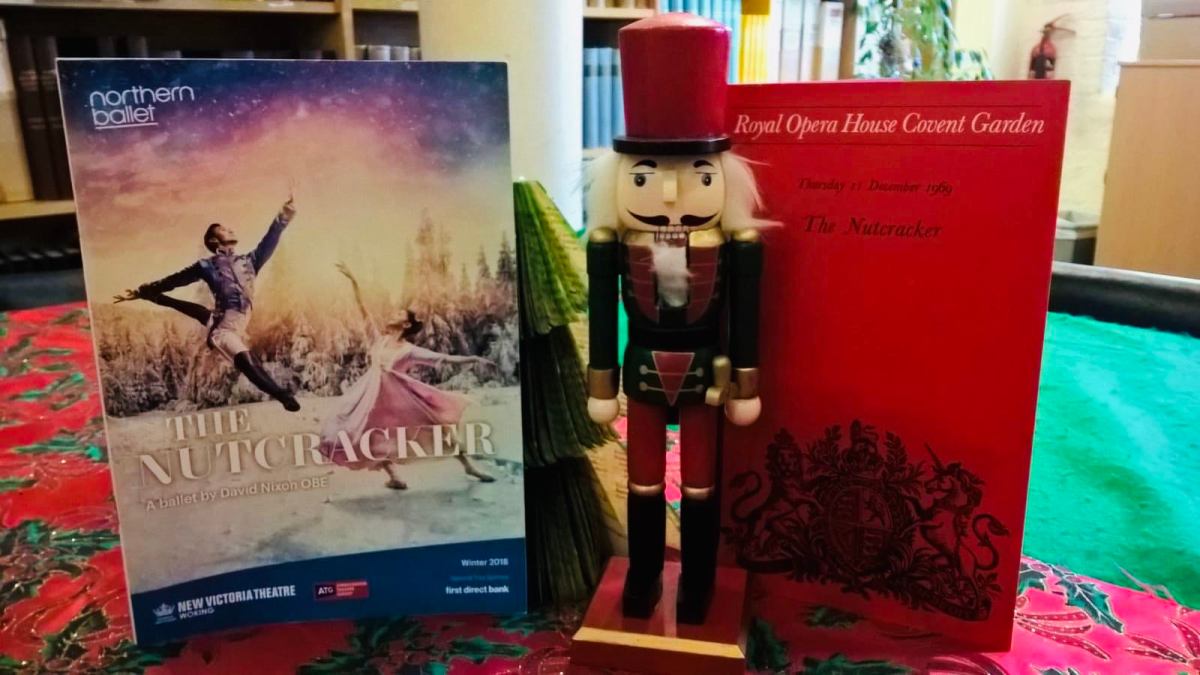
At the start of December we saw Northern Ballet perform their production in Woking.  One of the delightful features of the performance was the fact that the children were notably of different heights, creating a vivid sense of a family gathering in the first act.  The production is similar to the Royal Ballet’s in that Clara and the Sugar Plum Fairy are danced by two different performers, but the two acts are securely connected not only through the figure of Clara, but through the resemblance between the characters of her life in Act I and her dream in Act II, for example between her elder sister and the Sugar Plum Fairy, both performed by the same dancer. However, this in no way makes the libretto complex, and David Nixon, Artistic Director and creator of this production, is keen to emphasise his desire “not to change the story drastically or to bring a psychological overtone.  I wanted it to be festive and joyous … It is based on a dark story, but … I kept my version simple and childlike” (qtd. in Monahan 12).

The Nutcracker Then

If you think of The Nutcracker more as family entertainment than as high art, you might think it odd to question the practice of including child dancers as principal characters in the ballet, and you might be puzzled or even perplexed by the decision to bring greater depth to the work with a “psychological overtone”.  Yet there have been two British productions that have notably aimed to give the ballet more gravitas, both in part by aligning the narrative more closely to E.T.A Hoffmann’s 1816 Nussknacker und Mausekönig, the story that inspired the ballet’s original libretto.  These were Rudolf Nureyev’s version, performed by the Royal Ballet from 1968 into the early 1980s, and the version created by Peter Schaufuss for London Festival Ballet in 1986, which remained in the repertoire until 1992.

Nureyev is known for his eagerness to expand male roles, having choreographed additional solos for the male protagonist in The Sleeping Beauty, and Swan Lake, for example, and changing the end of Swan Lake to highlight the fate of Siegfried in preference for either Odette or the love between Odette and Siegfried.  Therefore, Nureyev’s decision to combine the role of Clara’s Godfather Herr Drosselmeyer and the Nutcracker Prince could simply be considered as a way of creating a role equal in substance to that of the ballerina. But the fact that Drosselmeyer, with his eccentric mannerisms, is so very different from the Nutcracker Prince offers an arguably greater challenge to the male protagonist than to the ballerina, who portrays Clara maturing into a young woman. For the dancer it affords the opportunity to bring out different facets of the old magician and his relationship with his Goddaughter; for the audience it adds an interesting dramatic layering and the rare chance to see male dancer in a dual role   Apart from Nureyev himself, notable exponents of the role were Anthony Dowell and David Wall, both of whom we discussed in our Male Dancers Now & Then post.  On the other hand, historian and critic Jack Anderson has criticised Nureyev’s production quite bluntly for its sombre atmosphere, its Freudian overtones and its pervasive “images of cruelty” (149).

With its Gingerbread Men and Lemonade Sea, Peter Schaufuss’ 1986 production was not pervaded by the same dark atmosphere, but through both including added detail from Hoffmann’s story and introducing Tchaikovsky and his family into the libretto, the narrative became quite complicated and perhaps even burdened with additional elements.  This included a toy theatre where the Tale of the Nut “Krakatuk” was played out, the illness of Tanya, (the character usually known as Clara, and in this version also Tchaikovsky’s niece), and a prologue with Tchaikovsky working on the Nutcracker score, learning of the death of his beloved sister Sasha, and reminiscing about a past Christmas spent at her family home.  The premise for the production was Schaufuss’ idea that “Tchaikovsky may have seen himself as the central figure, Drosselmeyer” (Clarke 400), and indeed one of the joys of these performances was watching Christopher Bruce as the Tchaikovsky/Drosselmeyer figure.  The programme notes included a Tchaikovsky family tree to clarify the various familial relationships.  We could argue that, as with Nureyev’s version, this approach helped to bring more substance to the ballet, giving it more gravitas as an art work, and perhaps making it seem more historically and artistically significant.


Share your thoughts!

In a brilliant review of the Royal Ballet’s Nutcracker this year Observer critic Luke Jennings noted that the only thing lacking in the “dreamlike perfection” of the production is the sense of melancholy so integral to Tchaikovsky’s score.  Similarly, film critic Ryan Gilbey criticises Disney’s The Nutcracker and the Four Realms for “failing to acknowledge the darker side of Christmas”.

So how do you prefer your Nutcracker? How important is the ballerina role to you? Are you interested in producers incorporating the “darker side of Christmas”? Is dramatic cogency important to you? Are you keen to see a romantic plot? Are you more in favour of a Nutcracker with lots of children and a simple clear storyline?

We’d love to know what you think!

© British Ballet Now and Then

References

Anderson, Jack. The Nutcracker Ballet. Bison Books, 1979.

Clarke, Mary. “The Nutcracker Season”. Dancing Times, vol. 77, no. 917, pp. 400-01.

Gilbey, Ryan. “No wonder Disney’s Nutcracker is a flop – festive films thrive on despair”. The Guardian, 8 Dec. 2018, http://www.theguardian.com/film/2018/dec/08/nutcracker-christmas-films-need-darkness-as-well-light. Accessed 20 Dec. 2018.

Godfrey, Dick. “Scottish Ballet’s revival of Peter Darrell’s Nutcracker restores the famous sparkle”. ChronicleLive, 2 Feb. 2018, http://www.chroniclelive.co.uk/whats-on/theatre-news/scottish-ballets-revival-peter-darrells-14232709. Accessed 20 Dec. 2018.

Jennings Luke. “The Nutcracker – review”. The Guardian, 23 Dec. 2012, http://www.theguardian.com/stage/2012/dec/23/nutcracker-english-national-tamara-rojo. Accessed 20 Dec. 2018.

—. “The Nutcracker review – in every sense a delight”. The Guardian, 9 Dec. 2018, http://www.theguardian.com/stage/2018/dec/09/the-nutcracker-royal-ballet-review-nunez-muntagirov-osullivan-sambe. Accessed 20 Dec. 2018.

Monahan, Mark. “An Awfully Big Adventure”. The Nutcracker, Winter 2018, New Victoria Theatre, pp. 12-13.

The Nutcracker. Choreographed by Peter Wright after Lev Ivanov, performance by Alina Cojocaru, Miyako Yoshida and Royal Ballet. 2001, Opus Arte, 2001.

The Nutcracker. Choreographed by Peter Wright after Lev Ivanov, performance by Francesca Hayward, Lauren Cuthbertson, and Royal Ballet. 2016, Opus Arte, 2017.

Watts, Graham. “Review: English National Ballet – The Nutcracker- London Coliseum”. londondance.com, 15 Dec. 2014, http://londondance.com/articles/reviews/english-national-ballet-the-nutcracker-2014/.. Accessed 20 Dec. 2018.

Wiley, Roland John. Tchaikovsky’s Ballets. Clarendon Press, 1985.